
14-Day Money-Back Guarantee
0
The short answer
In 1998, Marvel brought its four Spider-Man titles together around a single ritual, the Rites of the Five. Five volunteers, five pieces, five gifts drawn at random: power, knowledge, immortality, madness and death. Norman Osborn wanted power; he received madness without ever realising it. Mattie Franklin, for her part, walks away with power.
Contents
Why Marvel set up this crossover in the summer of 1998The nine issues, in reading orderThe Rites of the Five: four stones and a spindleFive gifts drawn at random, three blessings, two cursesNorman Osborn: he wanted power, he received madnessThe four others around the tableThe Final Chapter: Aunt May, the bombs and the burnt costumeHow to read the arc today
Why Marvel set up this crossover in the summer of 1998
By the late 1990s, four monthly Spider-Man titles were running side by side at Marvel: Amazing, Spider-Man, Spectacular and Sensational. In the summer of 1998, the publisher made them converge on a single story for nine weeks. Ralph Macchio supervised, with Bob Harras as editor-in-chief. The result goes by two names, 'The Gathering of Five' and then 'The Final Chapter', and it holds a place of its own among the web-slinger's great story arcs.
The intention was not only a narrative one. The crossover served to tidy up the line. Sensational Spider-Man ended with #33 and Spectacular Spider-Man with #263: both titles were cancelled. Amazing Spider-Man stopped at #441 and Spider-Man at #98, but those two started again from a new issue 1 in January 1999. That renumbering was imposed by the editor-in-chief. The end of the story and the end of an era fell in the same month.
At the same time, Marvel launched Spider-Man: Chapter One, by John Byrne, with a #1 cover-dated December 1998. The series rewrote the character's origins in the manner of the Man of Steel Byrne had delivered at DC. The reception was poor and the project was quickly set aside. The publisher was looking for a way out and tried several at once. The covers from that period are still around, as comic posters as well as in reprints.

Spider-Man Comic Battle Poster
The poster reproduces the cover of Amazing Spider-Man #200: the web-slinger leaps towards the burglar, with the DOUBLE THE SIZE banner, the Marvel Comics Group logo and the period price of 75 cents in the top left corner. One for anyone who loves landmark issues.
View the product — from €19.90The real sticking point lies elsewhere. The crossover brought back Aunt May, who had died three years earlier at the height of the Clone Saga, in Amazing Spider-Man #400. For some readers, that return wiped out one of the few deaths the series had actually stood by. The Clone Saga had already tested everyone's patience with Ben Reilly, Peter Parker's clone; undoing May's death on top of that was a lot to take.
The nine issues, in reading order
The reading order is not a fan reconstruction: it is printed on the pages themselves. Every episode carries its rank in its title, from 'Part One' to 'Part Five' for the first arc, then from 'Part 1 of 4' to 'Part 4 of 4' for the second. No room for error, then. The rhythm is weekly, from 5 August to 30 September 1998.
Cover dates run ahead of the on-sale dates, as was the custom. In practice, an issue that went on sale in August 1998 carries October 1998 on its cover. The first four parts of 'The Gathering of Five' are dated October 1998; everything else carries November 1998. On the very last issue the databases disagree, with November remaining the soundest date.
| Part | Series and issue | On sale | Cover date |
|---|---|---|---|
| 1/5 | Sensational Spider-Man #32 | 5 August 1998 | October 1998 |
| 2/5 | Amazing Spider-Man #440 | 12 August 1998 | October 1998 |
| 3/5 | Spider-Man #96 | 19 August 1998 | October 1998 |
| 4/5 | Spectacular Spider-Man #262 | 26 August 1998 | October 1998 |
| 5/5 | Sensational Spider-Man #33 | 2 September 1998 | November 1998 |
| 1/4 | Amazing Spider-Man #441 | 9 September 1998 | November 1998 |
| 2/4 | Spider-Man #97 | 16 September 1998 | November 1998 |
| 3/4 | Spectacular Spider-Man #263 | 23 September 1998 | November 1998 |
| 4/4 | Spider-Man #98 | 30 September 1998 | November 1998 |
The creative teams change from one title to the next. Todd DeZago writes both Sensational instalments. Howard Mackie writes Spider-Man #96, #97 and #98 as well as Spectacular #263. For Amazing #440 and #441, the credits databases name John Byrne, while a widely repeated source attributes the series to Mackie: the point is not settled. On art, Joe Bennett, Rafael Kayanan, Norman Felchle, Luke Ross and John Romita Jr. all cross paths: five styles for a single story, hence the visual jolts from one issue to the next.
One last marker before we get into the story, and it saves a lot of pointless searching: the third series, launched in 1990 under the title Spider-Man, shows Peter Parker: Spider-Man on the cover from #75 onwards, while the indicia still reads 'Spider-Man' until #98. That is why you will find issues #96 to #98 listed under two different names depending on the catalogue or the shop.
The Rites of the Five: four stones and a spindle
The ritual has a name in the story: the Rites of the Five. It is Hamilton Cromwell, a fifth-degree Maegis of the Technomancer Agency, who explains it to Norman Osborn in Sensational Spider-Man #32. Cromwell is anything but enthusiastic: he warns him that attempting the Rites of the Five is sheer madness. The warning lands in the opening pages of the arc, and Osborn pays it no attention at all.
The object of the ritual is often badly summarised. Most write-ups talk about five identical fragments. The first instalment is more precise: four stones and a spindle. Gathering the four stones is not enough; the spindle is what captures the mystical energy. Five pieces in all, one per participant, but the fifth does not serve the same purpose. The spindle had vanished in Istanbul in the 12th century, and Osborn announces that he has found it again.
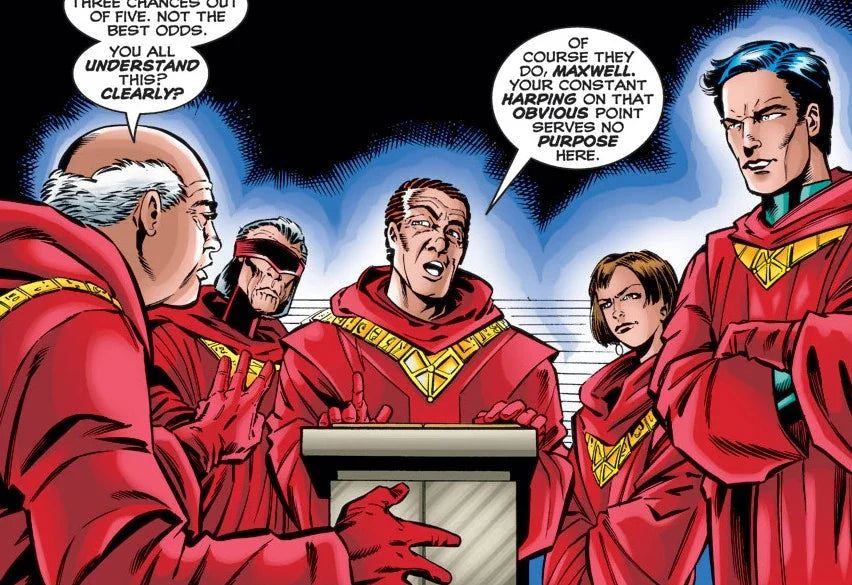
Second rule, and it matters: every participant has to come willingly. Morris Maxwell spells this out in Amazing Spider-Man #440. Nobody is dragged to the table by force, which rules out the idea of a ritual imposed on victims. Maxwell also warns Osborn that he risks madness or death. The billionaire is therefore warned twice, by two different people, before he puts his piece down. Nothing was hidden from him.
What the arc never tells you
The comics give neither the origin of the five pieces, nor their age, nor the name of the entity handing out the gifts, nor the reason why they are misread at first. The incantations themselves stay off the page. The ritual works as a mechanism, never as an explained mythology.
This mystical machinery stands out in a series that runs on shaky science. The Green Goblin was born of a chemical formula, not an incantation: the scientist Mendel Stromm lurks behind that origin, and the Green Goblin as a character was built on a laboratory. Here, we tip over into the mystical forces of the Spider-Man universe. That taste for relics and symbols turns up again in the Spider-Man decorations you hang up at home.
Five gifts drawn at random, three blessings, two curses
The five gifts are announced plainly: power, knowledge, immortality, madness and death. Three blessings, two curses. Morris Maxwell runs through the split just before the ceremony, in Amazing Spider-Man #441: three participants will be given power, immortality or knowledge, the other two will receive madness or death. Nobody chooses. The draw is random, and that is exactly what makes the scene tense.
The trap lies elsewhere, and it is nicely built. The gifts do not look like what they are at the moment they land. What looks like madness is knowledge. What looks like power is madness. And death wears the face of immortality. Maxwell warns the participants: these powers will not be the ones they are hoping for. Each of them walks away with a false reading of what they received.
THE DRAW
No participant chooses their gift. The five gifts are handed out at random among the five piece-bearers.
THREE AND TWO
Three blessings: power, immortality and knowledge. Two curses: madness and death. Maxwell sets out the split before the ceremony.
THE MISREADING
Everyone misjudges what they are given. Knowledge passes for madness, madness for power, death for immortality.
The idea is not new, but it is rarely handled this head-on. An obsession with immortality had already carried an entire villain: Silvermane, the Maggia's cybernetic godfather, who made it the engine of his whole career. Conversely, when Peter inherits a power from elsewhere in the cosmic Uni-Power episode, he ends up giving it back. The participants in the Rites, by contrast, are stuck with their gift, understood or not.
One useful point: not all the real gifts are revealed inside the arc. Only Osborn's case is settled there. For the other four, you have to wait for the first issues of the 1999 relaunch. Readers at the time spent months with a hazy allocation, which explains part of the confusion still going around. All the more reason to read the arc and its sequel back to back, with a Spider-Man blanket over your knees.
Norman Osborn: he wanted power, he received madness
What Osborn is after has never been ambiguous: he wants power. The crossover starts upstream, in Peter Parker: Spider-Man #95. Having survived an assassination attempt by Nitro, he makes a call: it is time to proceed with the gathering of the five. His information about the ritual and about the main artefact comes from his time in the Cabal of Scrier, far from the laboratories of Oscorp Industries, where his villainy is usually written.
On the page, in Amazing Spider-Man #441, he closes the ritual. Just before the ceremony, he catches Mattie Franklin reading a magazine devoted to Spider-Man and loses his temper: the detail says everything about his obsession. When his turn comes, he lays down his piece and believes he has been given power. The wording matters, because a false version is doing the rounds: no, he does not think he is holding knowledge. He has just received madness.

Spider-Man Toy Figure - Green Goblin
An articulated Green Goblin figure: purple suit, green skin, shoulder bag and an orange pumpkin bomb in the raised hand. Three views show the stand and the GREEN GOBLIN box marked 6+. Just the thing for putting the arc's villain on a shelf.
View the product — €29.90What follows shows it plainly. Osborn threatens the world with genetic bombs, triggered by a device implanted in Aunt May's skull. Then he hallucinates his victory: he believes he has unmasked and killed Peter Parker at the Daily Bugle, when in fact Peter beats him without difficulty. Readers in 1998 never saw that confrontation, which was only shown in 2000, in Revenge of the Green Goblin #1.
This ritual sets up the version of Osborn that the following decade would exploit. His madness is revealed in one of the last two instalments. Sprung from police custody by his henchmen, he then tries to make Peter his heir, in 2000. Arcs such as Dark Reign and Go Down Swinging carry that version of the character forward. His place among the web-slinger's most iconic villains is decided here, and his symbiote drift points to the Venom and Carnage figures.
The four others around the table
Cassandra Webb, whom readers know as Madame Web, comes to the ritual in a critical state. Blind from birth and suffering from myasthenia gravis, she lives on a respirator. Her motive: without immortality, she will soon die. To obtain her piece, she asks Spider-Man to retrieve an artefact without telling him what it is. He does so without knowing that he is feeding Osborn's ritual.
She lays down her fragment first and collapses: the whole table believes she has received death. It was immortality, and the effect shows first on her body — she grows younger. The ritual therefore gives her what she came for, without anyone suspecting it. What comes next is less clear-cut: the sources themselves stay cautious about what is left of her immortality years later.
Mattie Franklin, for her part, should never have been there at all. Fifteen years old, the daughter of businessman Jerry Franklin, she overhears the phone call between her father and Osborn. She decides her father is too timid, takes the artefact and goes in his place. Osborn waits for the father at LaGuardia and sees a teenage girl turn up, the stone in a briefcase. Maxwell is uneasy about her taking part; she insists. When she lays down her piece, all she feels is a tingle.
That tingle was power: strength estimated at around ten tons, speed, reflexes, limited durability and, above all, flight. While Peter is away, she passes herself off as Spider-Man in a costume cut to her size, and it is because she flies rather than leaps that it jars. She wears the same symbol he does, like readers who prefer a Spider-Man T-shirt to the costume. The bearers of the mask are not all equal, but she counts.
| Participant | What the scene suggests | Actual gift | Where the gift is named |
|---|---|---|---|
| Cassandra Webb | She collapses; everyone assumes death | Immortality | Amazing Spider-Man vol. 2 #6 |
| Mattie Franklin | Just a tingle | Power | Amazing Spider-Man vol. 2 #1 |
| Gregory Herd | A surge of power running through him | Death | Amazing Spider-Man vol. 2 #3 |
| Morris Maxwell | He screams and convulses; everyone assumes madness | Knowledge | Amazing Spider-Man vol. 2 #3 |
| Norman Osborn | He believes he holds power | Madness | Spider-Man #97 or #98 |
That leaves two men who are often forgotten. Gregory Herd, alias Override, feels a surge of power run through him as he lays down his piece: he is wrong, it is death he receives. Morris Maxwell screams, his mind overwhelmed, and collapses in convulsions. Everyone assumes madness; it was knowledge. Those two close the demonstration: nobody knows what they are holding. The web-slinger's universe is full of these decisive supporting players.
The Final Chapter: Aunt May, the bombs and the burnt costume
The turn comes once the ritual is complete. Osborn goes on the attack, and the arc drops its heaviest revelation: the Aunt May who died in Amazing Spider-Man #400 was not Aunt May. She was an actress, coached by Osborn and altered with May's DNA. The real May was being held at the Osborn hunting lodge. Three years of mourning, undone in a few pages. Marvel never did this with the death of Gwen Stacy, which has stayed permanent.
The information reaches Mary Jane another way. Alison Mongrain, fatally wounded by the Molten Man, has time to tell her that May is alive. While we are here, one stubborn confusion: the Molten Man is not the fifth participant. He is a tool of Osborn's, fitted with a brain implant to hunt Mongrain down. He carries no fragment and never enters the ceremony. Deaths and fake deaths are a speciality of the series.
The ending has a calm brutality to it. Peter tells Mary Jane that he is giving up being Spider-Man and burns his costume. On the device lodged in May's skull the sources diverge: according to one, Reed Richards repairs it and leaves it in place so as not to set off the bombs; according to the other, the trigger is removed. Treat it as unconfirmed. Peter and Mary Jane as a couple come out of the arc unmasked, for a few months only.
The false claims doing the rounds about this arc
- The Molten Man as the fifth participant He carries none of the ritual's pieces. Osborn uses him as a puppet, through a brain implant, to hunt Mongrain down.
- Osborn was hoping for knowledge The sources describing the scene say the opposite: he believes he holds power. What he walks away with is madness.
- Madame Web received death She collapses first and the whole table believes it. The real gift, immortality, is revealed much later.
- Five identical stones The first instalment describes four stones and a spindle that captures the energy. Five pieces, but not five identical objects.
- Osborn kills Peter Parker Osborn hallucinates his victory at the Daily Bugle. Peter beats him, and the real scene is only shown two years later.
This finale very nearly took a different shape. Tom DeFalco, who had left shortly before, had planned for Kaine to give the Parkers back their daughter, May, a thread that became the starting point of the MC2 universe. It was Mackie and Byrne who imposed the return of the elderly Aunt May. The burning of the costume ranks among the harshest moments in the series, and what that period mainly left behind is the Green Goblin, turning up on everything from Spider-Man mugs to framed prints.
How to read the arc today
The arc exists as a collected edition, under the title Spider-Man: The Gathering of Five. If you go through the original issues, stick to the printed order: Sensational #32, Amazing #440, Spider-Man #96, Spectacular #262, Sensational #33, then Amazing #441, Spider-Man #97, Spectacular #263 and Spider-Man #98. Reading 'The Final Chapter' on its own is pointless: the conclusion only holds up thanks to the ritual before it.
Second piece of advice: go straight on to the January 1999 relaunch. Amazing Spider-Man volume 2 #1 is written by Howard Mackie, pencilled by John Byrne and inked by Scott Hanna; Peter Parker: Spider-Man volume 2 #1 pairs Mackie with John Romita Jr. That is where Mattie Franklin passes herself off as Spider-Man, and where the real gifts are named. Without that sequel, the riddle stays whole.
Third point, and the more honest one: this arc is not a masterpiece. The ritual is well set up and the idea of the misread gift is excellent, but the execution is still argued over, mainly because of Aunt May's resurrection. It is a pivotal arc, not a high point. Readers who enjoy divisive stories will find the same debate around Sins Past, which British fans have never got over either.

Spider-Man Retro Comics Print
In the photo, the print is framed in black on a white brick wall: Spider-Man leaps towards the reader, legs tucked up, against a background of yellowed comic panels with speech bubbles and sound effects. The frame is part of the styling.
View the product — from €22.90One good reason to read it remains: it explains the Osborn of the years that followed and it brings Mattie Franklin into the mythology. If you are building a library, this arc belongs with the turning points, not with the curiosities. And if you are wondering what to give a reader who already owns the collected editions, the merchandise guide and the Spider-Man gift ideas will help you avoid a duplicate.
What to take away
'The Gathering of Five' and 'The Final Chapter' form a single block of nine issues, published from 5 August to 30 September 1998 across the four monthly Spider-Man titles. Five volunteers, five pieces, five gifts handed out at random: power, knowledge, immortality, madness and death. Three blessings, two curses, and one rule that gives the arc all its flavour: nobody understands what they are given.
In the end, Mattie Franklin walks away with power, Morris Maxwell with knowledge, Cassandra Webb with immortality, Gregory Herd with death and Norman Osborn with madness. Osborn wanted power and spent the following years behaving as though he had got it. The genetic bombs and the Daily Bugle hallucination both follow from that misreading. The web-slinger's most powerful enemies are not always the best equipped.
Two caveats to finish, because they come up in every discussion. The Molten Man is not the fifth participant, and the allocation of the gifts can only be read properly after the fact, once the relaunch is under way. If you come across a summary that gives knowledge to Osborn or death to Madame Web, you now know that it has swapped the ceremony's two misreadings.
Remember three things. The arc is read in the order printed on the covers, from Sensational Spider-Man #32 to Spider-Man #98, one issue a week in the summer of 1998. The gifts are drawn at random and misread by those who receive them: Osborn believes he holds power, he holds madness. And the full answer sits in the January 1999 relaunch, where each gift is finally named.

