
14-Day Money-Back Guarantee
0
The short answer
This conglomerate run by Norman Osborn is the matrix behind a good share of the hero's enemies: in the recent adaptations, the modified arachnid that bites Peter Parker comes out of it, and so does the Green Goblin, born of the serum its boss tested on himself. Its founding, its excesses and the family legacy are set out below.
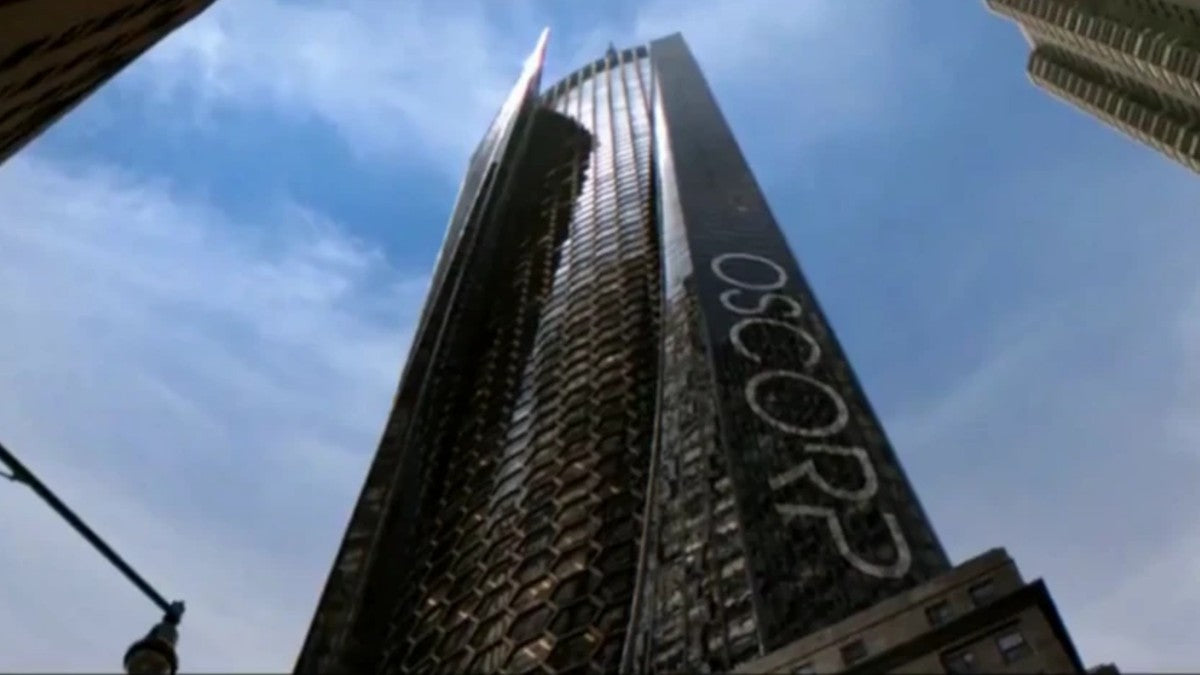
At the heart of Spider-Man's universe, one company keeps coming back in the biggest storylines: Oscorp Industries. Founded by Norman Osborn in the 1960s, this New York giant embodies the paradox of modern scientific progress better than anyone — an explosive mix of brilliant innovation and moral corruption. Behind its glass façades in Manhattan and its polished speeches about the common good, Oscorp is a nest of genetic manipulation, experimental weaponry and experiments whose consequences have run through the whole Marvel mythology for four decades.
This article retraces the full history of Oscorp — its founding, its role in Spider-Man's origin, the gallery of monsters created by its laboratories, its impact on the comics and film mythology. To place the company inside the wider narrative web, a detour through the Green Goblin, Peter Parker's worst nightmare is essential — without Norman Osborn there is no Oscorp, and without Oscorp half of Spider-Man's enemies simply would not exist.
Oscorp and Spider-Man's origin: a criminal responsibility
In the classic versions of the myth, the famous radioactive spider that bites Peter Parker in Amazing Fantasy #15 (1962) comes from a generic science exhibition. But in the modern versions, notably Marc Webb's films (The Amazing Spider-Man, 2012-2014) and the video game Marvel's Spider-Man (2018), it is Oscorp that produces the genetically modified spider. That narrative update changes everything: Spider-Man is no longer a victim of chance, he is a victim of corporate negligence.
This dimension gives Oscorp an enormous narrative responsibility. The company is not a simple backdrop — it is the original cause of the hero. To dig into that reversal of perspective, a detour through Norman Osborn's return in the recent comics is illuminating — Bruce Wayne is born of a family crime, Peter Parker of an industrial one. That difference shapes both mythologies at a deep level.
The other crucial dimension is that Norman Osborn probably knew what his spiders were being used for. Oscorp's safety protocols were lax enough for a teenage pupil to be bitten during a school visit. That negligence is not an accident — it is a corporate choice, driven by the race for scientific output. Spider-Man is therefore, quite literally, an industrial side effect.
Norman Osborn: the genius who became a monster
You cannot talk about Oscorp without going deep into its founder. Norman Osborn is one of the most complex antagonists in the whole Marvel mythology. Ruthless boss, ambitious politician, visionary scientist and failing father: he holds every role, every contradiction, every grey area at once. That is probably what makes him such a durable character.
Norman has everything he needs to succeed in civilian life. A fortune inherited from an industrial family, a doctorate in chemistry, a marriage to Emily Lyman, the birth of a son, Harry Osborn. But Norman is eaten away by a pathological ambition. He wants to be more than Oscorp's CEO — he wants to be the most powerful, the most feared, the most respected. That thirst for the absolute pushes him to experiment on himself with a serum developed in secret in his own laboratories. The result: he gains superhuman strength and agility, but loses his mind for good.
Out of that chemical transformation the Green Goblin is born, the criminal persona that has haunted Spider-Man ever since. To dig into the character's psychology, a detour through Norman Osborn, the man behind the mask is useful — Norman shares with other mythical antagonists that dimension of a split personality. The respected CEO by day, the masked criminal by night. That duality echoes Spider-Man's own, but inverted.
The Osborn family pays a terrible price for Norman's madness. Emily dies young. Harry, the son, becomes a drug addict and then a Green Goblin himself in certain continuities. That generational transmission of madness is one of the most heartbreaking arcs in the whole Marvel mythology. To grasp the son's complexity, a detour through Hobgoblin, the Green Goblin's diabolical heir is essential.

Oscorp's master, in collectible form
Spider-Man No Way Home Green Goblin Collector Figure
This Green Goblin collector figure captures Oscorp's CEO at his tipping point on screen — Norman Osborn's iconic appearance in No Way Home. A premium piece for collectors who want the brain behind the laboratory on their shelf.
299,90 €
View the figure →The Oscorp laboratories: a monster factory
Beyond Norman himself, Oscorp is responsible for the direct or indirect creation of an enormous share of Spider-Man's rogues gallery. That industrial dimension of evil deserves to be catalogued. The company is not a simple gadget maker — it is a super-villain factory.
The most emblematic case is Scorpion, a forgotten but formidable enemy. Mac Gargan, a private detective hired by J. Jonah Jameson to investigate Spider-Man, agrees to undergo genetic experiments in laboratories affiliated to Oscorp. He comes out transformed into a human-scorpion monster, fitted with a mechanical tail of devastating power. His transformation is irreversible. His life is ruined. And it is entirely Oscorp's fault.
Then comes the Lizard and his wife Martha, a collateral victim, another case altogether. A brilliant scientist who lost an arm in a military accident, Connors works in the Oscorp laboratories on a regenerative serum inspired by reptiles. The result: his arm grows back, but he turns into an uncontrollable, monstrous creature. That scientist/monster double identity is one of the most tragic in the rogues gallery.
Other figures emerge in a similar way. Hammerhead, Electro in certain continuities, Vulture (who salvages recycled Oscorp tech), and even, indirectly, Carnage through certain symbiote experiments. To understand the sheer size of that gallery, a detour through the Sinister Six, a look back at the cult group is illuminating — several members of the collective owe their existence directly or indirectly to Oscorp.
The Oscorp experiments: between progress and atrocity
Oscorp's scientific reach is sprawling. The company invests in pharmaceutical research, robotics, military technology, computing and aerospace. That strategic diversification makes it one of the biggest companies in the Marvel universe, comparable only to Stark Industries — Tony Stark's company. That head-on rivalry between Oscorp and Stark in fact shapes several arcs.
Where Stark Industries eventually gives up weapons to become a civilian company, Oscorp embraces the most opaque military contracts instead. Strength serums, exoskeletons, combat drones, genetic weaponry: Oscorp R&D knows no ethical limit. That difference in moral direction between the two companies is what separates Tony Stark from Norman Osborn. One has a code, the other has a profit margin. To dig into that technological comparison, a detour through Peter Parker and Tony Stark, between fatherhood and toxic collaboration is illuminating.
Oscorp's most dangerous projects are often classified top secret. The biographies of researchers who were sacked or eliminated pile up in the confidential archives. That opaque-company dimension, where professional deaths are hushed up and failed experiments are dressed up as accidents, is one of the most chilling in the mythology. Oscorp sometimes looks less like a company than a scientific cartel.

Stark tech against Oscorp tech
Spider-Man Iron Spider Resin Bust Figure
The Iron Spider suit, designed by Tony Stark, embodies the ethical alternative to Oscorp R&D. This quality resin bust reproduces Spider-Man's most iconic tech aesthetic — for collectors who want to give that industrial side of the mythology a physical form.
229,90 €249,90 €
View this Iron Spider bust →Oscorp in the comics: an all-powerful presence
In the comics, Oscorp appears from the very first years of Spider-Man's adventures. Norman Osborn is introduced in 1964 in Amazing #14, under the Green Goblin identity, before his Oscorp origins are gradually developed. That narrative progression is typical of the Stan Lee/Steve Ditko style of writing — revealing the great antagonist step by step, over several years.
Several major arcs have put Oscorp at the centre. The Night Gwen Stacy Died (1973), probably the most famous arc of all, sees Norman Osborn murder Gwen Stacy, Spider-Man's first great love. That tragedy marks the mythology deeply. Dark Reign (2008-2009) sees Norman Osborn take control of the American defence agency after the events of Secret Invasion. That institutional rise of Oscorp's CEO is one of the most striking transgressions in the genre.
The other great modern Oscorp arc is Sins Past (2004-2005), where we learn that Norman and Gwen Stacy had two secret children — a revelation that proved extremely controversial among fans. Whatever the current canonical status of that arc, it shows how omnipresent Norman is in Spider-Man's life. No other villain haunts Peter that much over the long run. To dig into that obsessive dimension, a detour through Gwen Stacy vs Mary Jane, Spider-Man's true partner is essential.
Oscorp on screen: the adaptations that mattered
On screen, Oscorp has had several notable adaptations. In Sam Raimi's trilogy, Norman Osborn is played by Willem Dafoe (Spider-Man, 2002), in a performance many still consider the definitive one. The company is presented there as a military arms manufacturer losing ground, which pushes Norman towards dangerous experiments.
In Marc Webb's The Amazing Spider-Man duology, Oscorp takes centre stage. The company headquarters becomes a recurring set, the origin of the mutant spider is explicitly attributed to its laboratories, and several villains (Lizard, Electro, Green Goblin) are produced directly by its research. That narrative integration of Oscorp is probably one of the underrated strengths of that franchise.
In the MCU, Oscorp does not appear explicitly for a long time. It is No Way Home that finally brings Norman Osborn on screen — still played by Willem Dafoe, in a multiverse continuity with Raimi. That legendary appearance confirms that the Oscorp mythology is intact in the Marvel film multiverse, ready to be folded fully into the MCU in the phases to come. To dig into that multiverse dimension, a detour through Far From Home and the post-Endgame context is interesting — Far From Home introduces recycled tech of Stark origin, a parallel to Oscorp tech.
Oscorp in the video games: the most accomplished version
It is probably in the video games that the Oscorp mythology is at its most accomplished. The 2018 game and the PS5 game released in 2023 put Oscorp at the heart of their plots. The Oscorp tower dominates the Manhattan skyline in the game. Norman Osborn is mayor of New York. The Osborn family carries political, economic and military weight.
That video game adaptation succeeded particularly well in giving the villain's corporate dimension a physical form. You see Oscorp employees, underground laboratories, confidential projects under way. That thickness of world-building gives Norman an industrial credibility no other adaptation had reached. The evil CEO exists because you can see his empire. And his empire really does look like a modern multinational — which is precisely what makes the character's social critique so relevant.
The other adaptation worth mentioning is Edge of Time (2011) and Web of Shadows. These games explore alternative dimensions where Oscorp takes absolute power. That corporate dystopia is one of the most disturbing extrapolations in the mythology: what if Norman ended up running the entire world?

The press against Oscorp
Spider-Man Daily Bugle Article Poster
The Daily Bugle is the other force covering the Oscorp scandals in the mythology. This official poster reproduces the newspaper aesthetic of Jonah Jameson's paper — for fans who want to put the media counter-power facing Manhattan's corporate empires on their wall.
22,90 €
View this poster →The Oscorp legacy: what the company stands for
Three structural reasons explain Oscorp's cultural longevity. First reason: its ethical modernity. At a time when questions of corporate responsibility, Big Pharma and unregulated tech dominate public debate, Oscorp has become a perfect metaphor. Norman Osborn is no longer just a comic-book villain — he is the archetype of the dangerous CEO that real regulators are still trying to catch.
Second reason: its narrative coherence. The company lets writers unify dozens of enemies under a single banner. Instead of a scattered gallery of villains, Oscorp gives them all a common origin — irresponsible industry. That narrative unity is precious for long arcs and crossovers.
Third reason: its potential for expansion. Oscorp can still generate new enemies for decades. Every new scientist hired can become a future monster. Every new R&D project can produce a catastrophe. That narrative fertility explains why Marvel has never wanted to destroy the company for good — keeping it in business means keeping an infinite reserve of villains open. To dig into how that mechanism works, a detour through the history of the symbiotes, from Venom to Carnage is illuminating — the symbiote lineage runs on the same logic of a common origin.
Conclusion: Oscorp, Spider-Man's corporate mirror
Oscorp Industries is probably the greatest institutional creation in the Marvel mythology after the Avengers. Not a character with a face, but an institution with a logo. That corporate dimension makes it a unique antagonist in the superhero landscape: you can fight Norman Osborn, but you cannot fight Oscorp. The company outlives its founder, recruits new executives and carries on producing its catalogue of dangers.
To take the exploration further, there are several essential leads. First, read The Night Gwen Stacy Died — the founding arc of the modern Green Goblin. Then play, or watch playthroughs of, Marvel's Spider-Man 2 — the best modern adaptation of Oscorp. Finally, follow the fourth Spider-Man film (announced for 2026), which could finally fold Oscorp fully into the MCU. To turn that passion into a collection, the Spider-Man figures collection, the posters collection and the T-shirts collection all offer visual hooks towards every player in the Oscorp dilemma.
One thing is certain: as long as Marvel keeps producing comics and films, Oscorp will exist. Not as one company among others — as Spider-Man's corporate flip side. Where Peter Parker is a precarious photographer paying his rent late, Norman Osborn reigns over Manhattan from a glass tower. That economic opposition shapes the whole social critique of the Marvel mythology. And it is probably the deepest reason why Oscorp remains, even today, one of the finest creations popular fiction has ever produced.

