
14-Day Money-Back Guarantee
0
The essentials before you choose
The ranking depends entirely on the yardstick you use: box-office takings, merchandising volumes, or the affection people declare by age bracket. Peter Parker, Miles Morales and Spider-Gwen don’t top the same indicators, and each one has a case to make. We break it down version by version below.
The question comes back with every generation of fans, every film release, every major new arc in the comics: which Spider-Man is really the most popular? The one who left the deepest mark, the one children recognise first in the street, the one whose name triggers an instant smile in adults born in the 1980s just as much as in teenagers in 2026. The answer isn’t as simple as it looks, because Spider-Man’s popularity can’t be measured in a single unit. It is measured in box-office figures, comic sales, video game downloads, figures sold, Instagram hashtags, and above all in personal attachment. Every generation has its Spider-Man, and every Spider-Man has its generation.
This article takes stock of the versions of the character currently dominating the pop culture conversation, cross-referencing market data, fan feedback and cultural indicators. Does Peter Parker still hold his crown after more than sixty years on the throne? Has Miles Morales really overtaken his mentor in the hearts of younger fans? Is Spider-Gwen a lasting phenomenon or an aesthetic flash in the pan? And do all those alternative versions — Spider-Man 2099, Spider-Man Noir, Spider-Punk, Spider-Man UK — genuinely have an audience of their own? We untangle all of it below, with pointers to the pages dedicated to the Spider-Verse and the articles that dig into each incarnation in detail.
Peter Parker: the icon who never ages
Let’s be blunt: despite the wave of new versions of the character since the 2010s, Peter Parker remains, in absolute terms, the most popular Spider-Man in the world. Every brand-awareness study confirms it: say ‘Spider-Man’ to someone in the street and it is still Peter Parker’s image that forms in their mind. That dominance is no accident — it is the fruit of six decades of continuous presence in the comics, ever since Amazing Fantasy #15 in 1962, nine major live-action films between 2002 and 2024, and countless animated series that have run through children’s daily lives ever since the very first television series in 1970.
What makes Peter Parker impossible to unseat is less his seniority than the depth of his story arcs. No other version of the character has a mythology this dense: the death of Uncle Ben, Gwen Stacy’s fall from the Brooklyn bridge, the marriage to Mary Jane, the Green Goblin’s returns and disappearances, the Clone Sagas, the ‘Back in Black’ and ‘One More Day’ arcs… Every generation of readers finds a thread in that narrative web that speaks to them. To grasp just how thick this construction really is, the Peter Parker encyclopaedia on the site goes through, layer by layer, everything that turned this character into the very archetype of the modern superhero.
On the numbers side, Peter Parker is also still the economic engine of the licence. The game Marvel’s Spider-Man from 2018 on PS4 is still one of the best-sellers in the PlayStation catalogue, and Peter Parker figures still lead the market in sales. The classic Spider-Man costumes in red and blue still outsell the multiverse variants, even if the gap is narrowing. Peter Parker’s dominance is slowly eroding, but it remains overwhelming.
PETER PARKER — The Original Icon

Spider-Man Figurine
69,90 €
The Spider-Man everyone knows, in his most recognisable form. A collector’s piece that pays tribute to the Peter Parker of the founding comics and the Sam Raimi films.
Discover →Miles Morales: the version that redefined generational identification
Since his introduction in 2011 in the Ultimate Marvel line, Miles Morales has followed a trajectory few spin-off characters ever manage. Born out of a desire to represent a more diverse readership, the Afro-Latino Spider-Man from Brooklyn established himself not as an alternative but as a fully-fledged figure, with his own story arc, his own villains, his own writing logic. For a lot of young fans born after 2005, Miles is the default Spider-Man — Peter Parker remains a respected classic, but Miles is the one who looks like them, the one who speaks their language. That generational shift, slow but deep, is probably the most striking phenomenon of the last fifteen years in the web-slinger’s history.
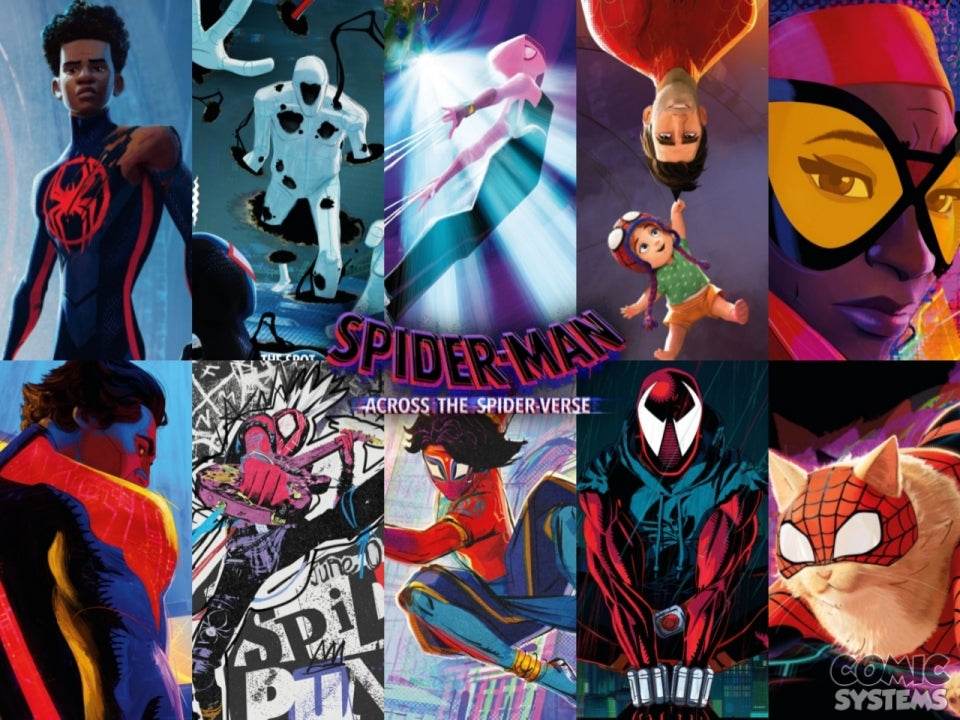
The cultural tipping point for Miles Morales came in 2018 with the release of Into the Spider-Verse, which pushed the character to a level of fame no spin-off hero had reached before. The film won the Oscar for Best Animated Feature and set off a massive wave of merchandising around Miles’s black and red suit. The sequel, Across the Spider-Verse in 2023, confirmed that the momentum was no flash in the pan: Miles Morales is now firmly settled in the global top three of the best-loved Spider-Man versions. On the gaming side, Spider-Man: Miles Morales, released on PS5 in 2020 sold several million copies and proved that the audience was ready to accept Miles as the lead of a blockbuster game.
Miles Morales’s story arc also draws on a very strong family dimension, with supporting characters who have become icons in their own right. His uncle Aaron Davis — otherwise known as the Prowler — is central to his story, and fans can find the details of that dynamic in the piece devoted to the Prowler, the key villain of the multiverse. That family depth, at once close to Peter Parker’s and radically distinct from it, is one of the reasons Miles manages to exist without being crushed by the shadow of the original web-slinger.
Spider-Gwen: the aesthetic phenomenon that lasted
Gwen Stacy in the Spider-Woman suit, better known as Spider-Gwen, is probably the version whose rise in popularity took the industry most by surprise. Introduced in 2014 in an Edge of Spider-Verse saga that could easily have stayed a footnote, the character exploded overnight, carried by a graphic design of rare visual force — the hood, the white, pink and black colour palette, the stylised outline of the mask. Where most alternative versions take years to find an audience, Gwen became within months one of the most replicated cosplay figures on the convention circuit, and the merchandising around her immediately outstripped what publishers had expected. To understand the emotional thread that ties Peter Parker to Gwen Stacy in the main universe, the article on Spider-Man’s love life, from Gwen Stacy to MJ and Zendaya, gives you the essential context.
What sets Spider-Gwen apart is that she turned a visual success into a narrative one. The Spider-Gwen arcs introduced a mythology of their own — an Earth-65 where Peter Parker never survived the radioactive bite, and where Gwen wears the suit in his place. That reversal of fate won over comic fans, but also a wider audience who had never warmed to the classic Spider-Man. The Spider-Gwen of the animated Spider-Verse, voiced on screen by Hailee Steinfeld, confirmed in 2018 and again in 2023 that the character belonged on the big screen, and that her complicated relationship with Miles Morales was a powerful narrative engine. A similar idea is explored in the article Spider-MJ: what if Mary Jane had been bitten instead of Peter, which extends the logic of ‘what if the other one had been chosen’.
Today, in popularity rankings broken down by segment, Spider-Gwen very clearly leads the female side of the fanbase, and she has become one of the three or four most recognisable figures of the extended Spider-Verse. Spider-Gwen figures sell particularly well to younger collectors, and Spider-Gwen costumes have become an extremely popular Halloween option — including for fans who had never cosplayed before.
SPIDER-MAN MCU — Brand New Day

Spider-Man Brand New Day Cosplay Costume
89,90 €
The most recent version of the web-slinger, as played by Tom Holland in the next chapter of the MCU. For fans who want to be today’s Spider-Man, in all his modernity.
Discover →Spider-Man 2099, Spider-Punk, Spider-Man Noir: the cult versions on the rise
Just below the podium held by Peter Parker, Miles Morales and Spider-Gwen, a second layer of alternative versions has exploded in visibility since the animated Spider-Verse. The most prominent is Spider-Man 2099, alias Miguel O’Hara, whose futuristic silhouette and inverted red-and-blue colour scheme won over a huge audience after his appearance in Across the Spider-Verse. Miguel O’Hara’s popularity rests on a rare combination: a memorable visual design, a story in dialogue with classic cyberpunk, and an ambiguous character who sits on the border between ally and antagonist to Miles Morales. That ethical ambiguity is precisely what makes him so compelling for modern fans — he embodies an adult, traumatised Spider-Man, willing to sacrifice the individual to preserve the multiverse.
Spider-Punk, alias Hobart Brown, occupies a powerful emotional niche of his own. He comes from an Earth where the United Kingdom lives under a corporate dictatorship, and this rebellious Spider-Man — mohawk, anarchist badges, anti-authoritarian attitude — won people over in only a handful of appearances. His introduction in Across the Spider-Verse made him one of the most memorable supporting characters in the film, and his popularity keeps climbing. The invisible rules of the Spider-Verse explore in detail why these plural versions can coexist without cancelling out the magic of the original character, and why Spider-Punk in particular manages to turn a political stance into a graphic signature without tipping into caricature.
Spider-Man Noir, the 1930s film-noir take popularised by the Spider-Verse, is another version that has found its audience, despite a narrower niche. The animated Spider-Verse film did a great deal to make him known, and a live-action series in development should widen his visibility further. Spider-Man UK, part of the Inheritors mythology, completes the gallery — his strategic role in the resistance inside the Spider-Verse is analysed in the article Spider-Man UK, the strategist of the Spider-Verse.
The impact of the three live-action actors on popularity
No popularity ranking can skip the three Spider-Men who have marked the live-action screen since 2002: Tobey Maguire, Andrew Garfield and Tom Holland. Each of the three embodies a different generation of fans, and each enjoys a different level of affection depending on the segment. For most fans born before 2000, Tobey Maguire is still the ‘real’ Spider-Man on screen — the one from Sam Raimi’s three films, which laid the foundations of the character’s cinema mythology. Andrew Garfield holds a more complicated place: long underrated after his two Amazing Spider-Man films, he was massively rehabilitated by his appearance in No Way Home in 2021, which brought him triumphantly back into the collective memory of fans.
Tom Holland is the Spider-Man of the MCU generation, the teenage Peter Parker folded into the Avengers universe. His popularity with young adults and teenagers is enormous, and his arc in No Way Home turned him into a tragic figure — the Spider-Man who loses everything and has to start again. The next chapter, titled Brand New Day, is expected to be one of the major Marvel films of the coming years, and its recent shoot has been followed closely by the community, particularly after the incident detailed in the article Tom Holland injured on the set of Spider-Man Brand New Day. The reunion of the three Spider-Men in the upcoming Avengers: Doomsday is widely anticipated, and the article Tobey, Andrew and Tom reunited in Doomsday sets out what we actually know about that project.
These three performers don’t cannibalise each other — on the contrary, together they build a cumulative popularity for the character of Peter Parker. Fans don’t pick between them, they stack them up in their affection. That is exactly why Peter Parker, as a narrative entity, remains the most popular version despite the rise of the alternative incarnations — each of the three actors brought his own fans, who were added to the existing base rather than replacing the ones before.
The concrete indicators: sales, searches, cultural presence
To quantify how popular a version of Spider-Man really is, several concrete indicators can be cross-referenced. Google Trends searches remain one of the best barometers: Peter Parker still leads in absolute volume, but Miles Morales hits peaks above Peter’s with every animated film or video game release. Spider-Gwen generates very high one-off spikes, particularly among searches by women. Figure sales, tracked by the main distributors, follow a similar logic — Peter Parker stays in front, Miles Morales closes the gap year after year, and Spider-Gwen leads the cosplay and lifestyle merchandising segment.
On video game sales, the verdict is clear-cut: Marvel’s Spider-Man (Peter Parker), Spider-Man: Miles Morales and Marvel’s Spider-Man 2 have all crossed the PlayStation best-seller thresholds, but it is Peter Parker who leads in absolute volume. The history goes back a long way — the article Spider-Man 1982, the story of the web-slinger’s very first video game on the Atari 2600 retraces the gaming genealogy that has kept Peter Parker part of players’ daily lives for four decades.
On social media, the ecosystem is more complicated. TikTok and Instagram strongly favour the visually striking versions — Spider-Gwen, Spider-Punk and Spider-Man 2099 get amplification there that is out of all proportion to their actual sales. Reddit, by contrast, remains Peter Parker territory, where the narrative depth of the comic arcs is celebrated more than the visual signature. YouTube, finally, swings between the two depending on the sub-community. For a fan who wants to explore the diversity of this universe, the shop’s complete Spider-Man universe brings the collections together by theme and gives a quick overview of every version available.
The niche versions worth knowing
Beyond the main podium and the cinema versions, the Spider-Man multiverse holds dozens of more confidential takes, some of them with fiercely devoted fanbases. Spider-Girl, Mayday Parker, the daughter of Peter and Mary Jane in the alternative MC2 reality, holds a special place in the hearts of comic fans nostalgic for the 90s. Her arc, which imagines a direct generational handover inside the Parker family, speaks to the themes of lineage that structure the whole mythology. A similar logic drives Martha Franklin, the Spider-Woman who inherited the web-slinger’s mantle, whose story bridges the main universe and its possible futures.
The clone narrative is another source of fascinating secondary versions. Spidercide, Peter Parker’s most unstable experimental clone, illustrates that darker side of the mythology, as does Ricochet, Hornet and Prodigy, Peter Parker’s alternative identities, which presents the temporary masks Peter has worn across the arcs. These niche versions carry no weight in the mainstream ranking, but they exist in the narrative grammar that hardcore fans know by heart. Their popularity is measured not in absolute figures but in intensity of attachment — a small group of deeply invested fans is often worth more, in community value, than a large but disengaged audience.
The horror versions — such as Shathra, the predatory spider goddess or the Inheritor variants that include Daemos — widen the spectrum further. And we shouldn’t forget the liminal figures such as Ezekiel Sims, keeper of the Spider Totem’s secrets or Karn, the Inheritor who defied his destiny. That whole gallery makes up the deep fabric of the Spider-Man universe, and those layers are precisely what set the web-slinger apart from other superheroes: no other franchise has a multiverse this structured and this densely inhabited.
Why ‘which one is the most popular’ is a slightly loaded question
With that panorama in place, it has to be said that the question ‘which Spider-Man is the most popular’ is slightly badly framed. It assumes fans choose between versions, when in practice they stack their attachments. A modern fan loves Peter Parker for his history and his films, Miles Morales for his generational energy, Spider-Gwen for her design and her singularity, Spider-Man 2099 for his cyberpunk atmosphere, Spider-Punk for his attitude. It isn’t an exclusive choice, it is a multiple identity card. The web-slinger’s real popularity is no longer measured in the number of fans of one given version, but in the density of the multiverse the universe as a whole now offers.
That stacking logic also explains why Spider-Man merchandising is diversifying so much — fans no longer want just a Peter Parker figure, they want their full Spider-Verse set, with their three or four favourite versions side by side on the shelf. It is exactly this collecting logic you find in the Spider-Man figures of 2026, the complete guide, and it also shapes the jewellery such as Spider-Man rings that can be matched to your favourite version — a classic logo band for Peter fans, a red web pattern for MCU fans, a black finish for symbiote fans, and so on.
The costume is probably the most symbolically loaded item in all of this. Whether it is for Halloween, a fancy-dress party or simply everyday play for a young fan, choosing a Spider-Man costume means choosing a version. The hidden details on the costume that only true fans spot are what separate a generic cosplay from a precise one, faithful to a specific incarnation. The same applies to Spider-Man outfits for kids, where the choice of version directly shapes the final look.
SPIDER-GWEN — Multiverse Identity

Spider-Man Spider-Gwen Mask
29,90 €
To become the version that redefined the visual multiverse: Spider-Gwen’s signature mask, perfect for a quick cosplay or for completing a multiverse collection.
Discover →The future: which versions are set to rise
Looking two or three years ahead, several versions are positioned to gain ground in the popularity ranking. Miguel O’Hara’s Spider-Man 2099 should continue his climb with the announced sequel to the animated Spider-Verse and his expected role in the wider MCU projects. Spider-Punk could see a boom in visibility if Marvel decides to give him a dedicated animated or live-action project — the character’s commercial potential remains largely untapped. And the Brand New Day Spider-Man played by Tom Holland will undeniably shape 2026 and 2027, with the usual knock-on effects in merchandising and cultural presence.
Among the existing incarnations, Miles Morales should keep climbing towards Peter Parker’s level, not necessarily overtaking him in absolute terms but drawing level with him. Spider-Gwen will remain a favourite of the newer generations, and her central role in the animated Spider-Verse trilogy guarantees her cultural longevity. Comic fans are also watching the evolution of the major arcs with interest — Spider-Man mythology is in permanent motion, and sagas like House of M, the perfect life Spider-Man never lived, show that Marvel is still able to reinvent the outlines of the character without betraying him.
The universe’s full ecosystem keeps getting denser. The major Spider-Man story arcs are regularly reread and reinterpreted, and every new saga adds its stone to the building. Avengers Doomsday, Spider-Man’s expected role against Doctor Doom, will be one of the key milestones in that evolution. Global pop culture around the character is still growing, and that is precisely why the question of the most popular version has no definitive answer — it keeps moving, because the web-slinger himself keeps moving.
Conclusion: a podium that shifts, a licence that never runs dry
To sum up: Peter Parker remains the most popular Spider-Man in absolute terms, carried by six decades of presence and by three major screen performers. Miles Morales is the version rising fastest, and the one who leads among fans born after 2005. Spider-Gwen holds a powerful niche built on her unique design and her role in the animated Spider-Verse. Spider-Man 2099 and Spider-Punk are settling in for the long term as pillars of the extended multiverse. All the other versions — the horror Spider-Men, the Inheritors, the clones, the temporary alternative takes — make up the deep fabric that gives this universe its richness, and that sets the web-slinger apart from every other superhero.
Whatever your favourite version is, the point is not which one wins on the numbers, but which one wins your personal attachment. The Spider-Man you carry with you — the one from your childhood, the one from your teenage years, the one who made you cry or laugh at a particular moment — is the right one. The Spider-Man guides section on the site gathers everything you need to dig into each of these versions, and the Spider-Man accessories collections, from rings to necklaces by way of bracelets, let every fan wear their favourite version day to day. That is probably the best answer to the original question: the most popular Spider-Man is the one you decided to love — and the one you keep carrying, in one form or another, long after you have closed the comic or left the cinema.

