

14-Day Money-Back Guarantee
0
The essentials before you choose
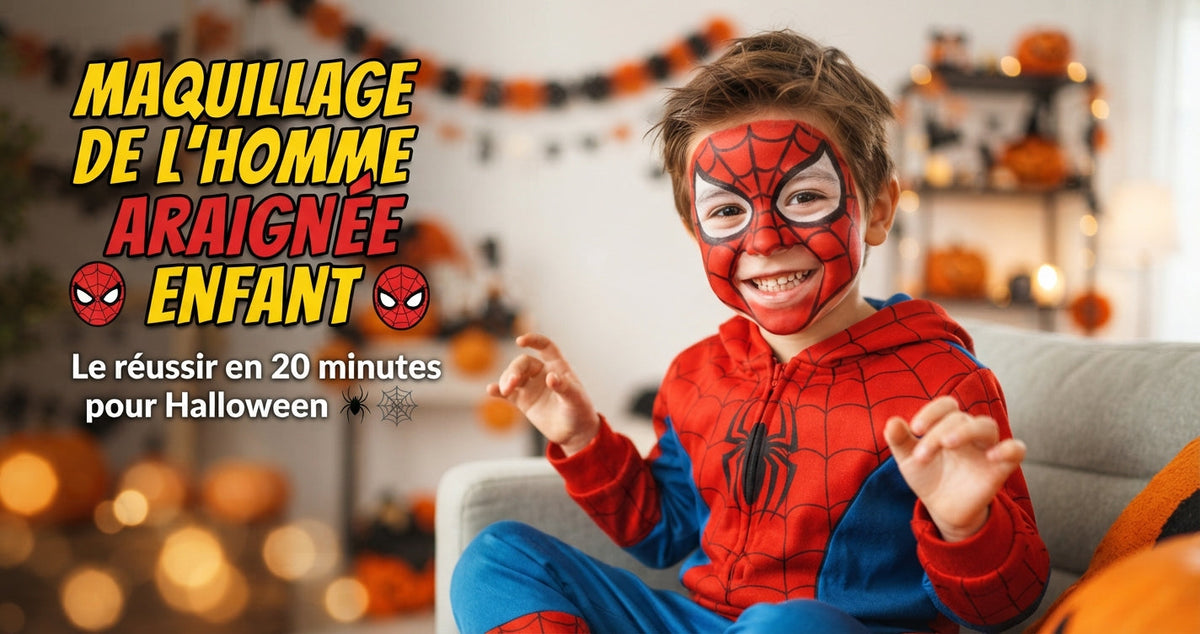
To make a child up as Spider-Man in 20 minutes: a water-based face paint sold as a cosmetic and labelled in French, patch-tested on the wrist 24 to 48 hours beforehand; a red base, 2 white eyes ringed in black, and a web spreading out from the nose. Remove it the same evening. If your child won't sit still, the hood of the classic pack at €54.90 takes over.
Contents
The kit: face paint made for skin, never felt-tipsLabelling, patch test and preparing the skinThe classic mask step by step in 20 minutesThe Miles Morales variation: black base, red webThe Spider-Gwen variation: white, pink and a hoodLasting all evening, then removing it the same nightFace paint or mask: an honest verdictThe mistakes that ruin a child's face paint
The kit: face paint made for skin, never felt-tips
A Spider-Man face comes down to very little: a red base, 2 large white eyes ringed in black and a web spreading out from the nose. None of it takes professional talent, as long as you start with the right kit. If the costume to go with it isn't bought yet, the guide to choosing your child's costume settles the question of size and comfort first.
The basic product is a face paint, water-based or cream. In Europe it is a cosmetic product within the meaning of Regulation (EC) No 1223/2009, which has applied since 11/07/2013: it must be safe under normal conditions of use, assessed by a qualified person and placed under the responsibility of a person established in the Union. For children, the French consumer organisations CLCV and 60 Millions de consommateurs both recommend water-based paint.
WATER-BASED PAINT
What the CLCV recommends for children: it goes on with a damp sponge, handy for the large red base.
CREAM PAINT
It spreads with a finger or a brush and works for touch-ups. The manufacturer's instructions say where to avoid it and how to remove it.
LEAVE WELL ALONE
Felt-tips, markers, poster paint, craft acrylics: these are not cosmetics and they don't belong on skin.
Felt-tips, markers, poster paint and craft acrylics stay in the school pencil case: for Health Canada as for the American FDA, these are not cosmetics and they are not designed for skin. An old paint that smells off may be contaminated, so throw it away. On products that keep for more than 30 months, the open-jar symbol tells you how many months the paint lasts once opened.
Children's face-painting kits can fall under both cosmetics rules and toy rules: on 09/09/2021, a children's make-up palette was recalled on France's RappelConso register for a heavy-metal content too high if swallowed by very young children. For tools: a sponge, 2 fine brushes, a cup of water and a headband. The Spider-Man for children guide by need adds other ideas sorted by need.
Labelling, patch test and preparing the skin
A face paint is chosen first on its label, written in French: the name and address of the responsible person in the European Union, the batch number, precautions for use, an expiry date or the open-jar symbol, and a list headed by the word 'ingredients'. Online, that list must be shown before purchase. The same reflex applies to children's clothes, as the article on the standards to check on Spider-Man pyjamas.
| Wording on the packaging | What it tells you |
|---|---|
| Ingredients | The composition, in descending order of weight; the colourants under a CI code. |
| Responsible person | A name and an address in the European Union. |
| Open jar or date | How many months the product keeps after opening, or an expiry date. |
| Precautions for use | The areas to avoid, such as around the eyes, and sometimes an age limit. |
| Batch number | The production run concerned in the event of a recall or a reaction. |
Some colourants are only permitted well away from the eyes or off the mucous membranes: a paint intended for the cheek is not necessarily cleared for the eye area or the lips. If the packaging says 'do not use near the eyes', respect it, even if the photo on the box shows a fully painted face. If there is a known allergy, read the list: fragrance allergens appear on it above 0.001% in a leave-on product.
This reading is anything but theoretical. In a DGCCRF survey of 101 make-up and face-painting products, reported on by the French government in 2014, only about half were compliant, mainly because of labelling. In 2016, 60 Millions de consommateurs found unwanted substances in 11 of the 12 children's make-up products it tested. And the word 'hypoallergenic' is no guarantee that there will be no reaction.
That leaves the patch test, recommended by the American FDA, the American Academy of Pediatrics and Health Canada. Dab a little of each colour on the inside of the wrist, never on the face, at least 24 to 48 hours before the party, so by the evening before at the latest. Watch for redness, a rash, swelling, itching, dryness or blisters: at the slightest sign, that paint does not go on the face.
On the day, allow 3 minutes of preparation: face washed in lukewarm water with a gentle cleanser suited to your child's age, patted dry, hair under a headband, child seated at your height and facing the light. An old towel over the shoulders protects the collar of the costume. On skin that is irritated, grazed or in an eczema flare-up, ask your doctor or your pharmacist first.
The classic mask step by step in 20 minutes
The classic Spider-Man face comes down to a red mask, 2 large white eyes ringed in black and a black web radiating from the centre of the face: lines and flat colour, within reach without any training. To have a model in front of you, the article on how Spider-Man's film costumes evolved traces the successive versions of the suit; prop a photo of the mask near the mirror.
A rough timing guide
Preparing the skin and hair3 min
Red base in 2 thin coats6 min
White eyes and black outline4 min
Web: spokes, then arcs5 min
Finishing touches and drying2 min
Total20 min
Step 1, the red base. With a damp, well-wrung sponge, dab from the centre of the face outwards, up to the hairline and under the jaw. Leave the lips bare, unless the packaging allows them to be painted, and 2 teardrop-shaped zones around the eyes, where the white eyes will go. 2 thin coats, each left to dry for a minute, beat one thick coat that tends to crack.
Step 2, the eyes. With a fine brush, fill the 2 teardrops in white; they start at the top of the nose and sweep up to a point towards the temples. If the paint isn't cleared for the eye area, keep the eyelid and the lash line free of product: the shape then sits on the brow bone and the top of the cheekbone, and still reads from a distance. Then ring each eye with a thick black line.
Step 3, the web. In black, first draw 6 to 8 spokes from the top of the nose towards the forehead, the temples, the cheeks and the chin, working around the white eyes. Then join them with arcs curving towards the nose, in 3 spaced rows. There's no need to aim for perfect symmetry: from a distance it's the regularity of the arcs that shows, not their precision.
Step 4, the finishing touches: go back over the eye outlines, correct any overspill with red, then allow 2 minutes without touching the face. The hands stay bare or take on the hero's colours with Spider-Man gloves. The face paint goes with the red and blue suit of the Spider-Man costumes for children, with the hood tucked in the bag for later.
The Miles Morales variation: black base, red web
Miles Morales is often the hero children ask for after the animated Spider-Verse films. The article who is Miles Morales gives you something to talk about during the session, and the page on the Spider-Verse multiverse places the other versions of the hero. On the brush side, good news: the method doesn't change, only the palette flips, from red to black.
The base goes on in black, in 2 thin coats, leaving the lips and the eye teardrops bare. Against a dark background the slightest white overspill shows: work in small areas and keep a clean cotton bud to hand for corrections. The eyes are filled in white then ringed in red, as on the hood of the shop's Miles costume, and the web is drawn in red, spokes then arcs.

Spider-Man Children's Costume - Miles Morales
A full black suit, a red spider on the chest, red shoulders, white eyes ringed in red, red hands and feet: this costume takes up the colours of the Miles face paint, for the child who has chosen the hero from Brooklyn.
See the product — €39.90For a child who doesn't take to an all-black face, limit the black to the upper face, from the forehead to the tip of the nose, like a masquerade mask, and let the red web run down over the cheeks. The same black base also works for a Venom, with wider white eyes and no web: the article on symbiote and Venom Spider-Man costumes helps you choose the version.
For the rest of the outfit, the guide to the Miles Morales costume runs through the pieces, and the Miles Morales collection brings together everything made in his image. Put the accessories on before the face paint, never after: a child who is already made up and pulls a hoodie over their head wipes out 20 minutes of work in one second.
The Spider-Gwen variation: white, pink and a hood
For the child who prefers Gwen Stacy to the original web-slinger, the face paint follows a different logic: you are no longer covering the face in a bright colour, you are lightening it. The page on the complete universe of Spider-Man characters introduces the other figures in the saga, and the guide to the Spider-Gwen costume for girls covers the rest of the outfit. For the face, 2 colours are enough: white and a deep pink.
The white base goes over the whole face or just its upper half, in very thin coats, because white quickly shows up any overloaded patches. The eyes are drawn as large teardrops ringed with a thick pink line, as on the hood of the costume, then a few pink web lines go on the temples and the top of the cheeks. It's the contrast of white and pink that makes the character.

Spider-Man Costume - Spidergwen for Children
Seen from the front and the back: a white hood, a white mask with eyes ringed in pink, a purple body marked with a light-blue spider, sleeves and sides webbed in pink. The costume that picks up the white and pink of the Gwen face paint.
See the product — €44.90Watch out for neon pink. In the United States, the FDA lists fluorescent colours among those not to be used near the eyes, and in Europe the official list of colourants likewise excludes certain shades from eye products. The packaging has the final word: if your pink carries the words 'do not use near the eyes', keep it for the cheeks and ring the eyes with a pink whose packaging allows it.
On the costume side, pulling the white hood up frames the painted face, hides the edge of the paint on the forehead and saves you styling the hair. The guide to the Ghost-Spider costume goes further into the accessories and the details of the character, and the Spider-Gwen collection brings together figures and objects in her image, enough to keep the fun going once the face is clean.
Lasting all evening, then removing it the same night
Face paint applied in thin coats lasts all the better for being left alone: what damages it is rubbing from hands, from the hood put back on for a photo, from a cup or a sleeve. Give 2 instructions before setting off: don't touch your face, and drink through a straw. Slip a touch-up kit into your pocket, with black and red paint, a fine brush and a sponge, and blot sweat by dabbing, never rubbing. For a party at home, the guide to organising a Spider-Man birthday party takes care of the rest.
Lasting an evening doesn't mean stretching it out. The dermatologist quoted by the CLCV advises keeping face paint on for as short a time as possible, and the FDA and the American Academy of Pediatrics are clear: a child does not go to bed in make-up. So take it off as soon as you get home, before pyjamas, however late. For water-based paint, follow the instructions for use; for cream paint, the manufacturer's leaflet says how to remove it.
1
Get everything ready Lukewarm water, a gentle cleanser suited to your child's age, 2 flannels and a dark towel.
2
Dab The black first, then the red, dabbing without rubbing or pulling at the skin.
3
The eyes last Eyes closed, with a clean corner of a flannel and clear water.
4
Rinse and moisturise Clear water, pat dry, then a cream suited to your child's age.
5
Check in the morning Redness that persists is worth a pharmacist's or a doctor's opinion.
If redness, itching or swelling appears, remove the product, keep the packaging for its batch number and its ingredient list, and ask a pharmacist or a doctor. Since 01/01/2024, cosmetovigilance, that is the monitoring of adverse effects from cosmetics, has been handled in France by Anses; members of the public can report an adverse effect through the French health ministry's reporting portal.
Face paint or mask: an honest verdict
Face paint isn't always the right answer: it asks a child to sit still for 20 minutes, which is a lot for many toddlers. No official French text consulted for this guide sets a minimum age, but some products carry the words 'do not use on children under 3'. For a little one who wriggles, Spider-Man tattoos give a nod to the hero with no sitting session, and the article which Spider-Man costume to choose by age and occasion helps you decide.
Glasses weigh in the balance too: a hood sits badly over a frame, whereas face paint leaves them in place, as long as you spare the bridge of the nose and draw the white eyes a little wider than the lenses. Heat argues for face paint as well, because a hood covers the whole face and, in a room full of running children, some end up taking it off.
For photos, face paint has a clear advantage: you can see the smile and the pulled faces. The mask offers something else: in front of the mirror, the child no longer sees their own face, they see the hero. For a reserved child that anonymity counts, as the article on how Spider-Man helps shy children build confidence explains. If you lean towards that option, the Spider-Man mask comparison helps you choose.
Nothing stops you combining the two: the hood for trick-or-treating, the face paint for the party indoors. That's the appeal of a pack that brings together suit, hood and web-shooter, like the shop's classic pack, available from 100 to 150 cm. Spider-Man masks sold on their own complete a costume that hasn't got one, and web-shooters give the hero's gesture, painted or masked. Either way, let your child choose: they are the one who will spend the evening in it.

Classic Spider-Man Costume Pack for Children with Web-Shooter
A full red and blue suit, a hood with white eyes ringed in black, a large black spider on the chest, and beside it a wrist launcher with 3 suction-cup darts and a red glove: everything you need to alternate mask and face paint.
See the product — €54.90The mistakes that ruin a child's face paint
Face-painting mishaps rarely come down to the brush: they come from a purchase made too quickly, a test that was skipped, or an evening that drags on with no clean-up. Buy the paint a week ahead, test it 2 days before, and get the removal kit ready before you leave. For choosing the model to suit the event, the article on Spider-Man costumes for carnival and Halloween sets things out.
5 mistakes to avoid
- Felt-tips or acrylics Not cosmetics: never on skin.
- Testing on the day Too late: at least 24 to 48 hours before, on the wrist.
- The eyes without checking If it says 'do not use near the eyes': eyelid left bare, whatever the box shows.
- An incomplete label With no ingredients in French and no address in the European Union, the product stays on the shelf.
- A night in make-up Clean it off on your return, however late, then moisturiser.
Be wary too of cheap kits ordered from sites outside the European Union: they are subject to less protective rules, and labelling only in a foreign language can be a sign of an illegal sale in France. A kit with no ingredient list, no address for a responsible person in the Union or no batch number has no place on your child's face, however low the price.
One last trap, sharing: on Halloween night, the same sponge travels quickly from face to face. The American Academy of Pediatrics advises not sharing make-up and washing your hands before using it, so plan on one sponge and one brush per child. The shop's guides and advice bring together the other practical articles for getting ready for the party.
What to remember
A successful Spider-Man face paint rests on 3 decisions taken before the day: a paint sold as a cosmetic, preferably water-based, with a complete label in French; a patch test on the wrist at least 24 to 48 hours beforehand; and removal planned for the same evening. The rest is method: a red base in thin coats, white eyes ringed in black, and a web radiating from the nose.
The variations follow the same logic in other colours: black and red for Miles Morales, white and pink for Spider-Gwen. If your child won't sit still, the hood of a costume or a temporary tattoo does the job without a brush; if they wear glasses, face paint stays more practical than a hood. To find the costume to go with it, the shop's Spider-Man costumes and outfits bring the models together, for children and adults alike.
If the costume is to be a gift, for a birthday or for Christmas, the page devoted to Spider-Man merchandise to collect and to give and the selection of Spider-Man gifts round out the costume. Keep the essentials in mind: a successful face paint is the one your child is happy to keep on until they get home, that you take off the same evening, and that leaves no redness in the morning.
Remember the order of operations: a face paint made for skin, the label read, a patch test on the wrist 24 to 48 hours before, 20 minutes of painting, a touch-up kit in your pocket and a clean-up when you get home. Felt-tips, acrylics and a night in make-up have no place on a child's face.

