
14-Day Money-Back Guarantee
0
The short answer
Mendel Stromm is the co-founder of Osborn Industries whose work, hijacked by his business partner, produced the Goblin Formula. Created by Stan Lee and Steve Ditko in The Amazing Spider-Man #37 (1966), this chemist was aiming at muscle regeneration, not warfare. We trace his path and his legacy below.
Norman Osborn did not invent the Goblin Formula. It is perhaps the most uncomfortable truth in the whole Spider-Man universe, and Marvel has spent fifty years burying it under reboots, contradictory flashbacks and convenient narrative fog. The real technological father of the Green Goblin, the man whose Oscorp lab notebooks gave Norman his superhuman muscles, his green blood and his unquenchable madness, is called Mendel Stromm. He never got a film. He never got an animated series. He never even got an iconic figure. And yet, without him, there would be no tormented Harry Osborn, no Dark Reign, and none of that visceral shift that dragged Peter Parker into the modern era through the murder of Gwen Stacy on the bridge. This article restores a shadow lineage that the comics deliberately erased.
For a few months now, as Marvel reactivates its old narrative relics to set up Brand New Day and its great editorial reset, the name Mendel Stromm has been quietly resurfacing in recent runs. He is mentioned in half-whispers in the back matter of Oscorp Industries, and you catch a glimpse of his face in a photograph in Shadow of the Green Goblin. The window is narrow: in two years, Marvel will probably have buried the character again under yet another rewritten origin. Understanding Mendel Stromm now means grasping the internal machinery that allows Norman Osborn to stay terrifying after fifty years of comics.
Who Mendel Stromm really is, the ghost scientist of the Osborn laboratories
Mendel Stromm first appears in The Amazing Spider-Man #37, published in June 1966. At the time, Stan Lee and Steve Ditko were looking to thicken the backstory of Norman Osborn, who had only just been revealed as the Green Goblin. So they invented a forgotten business partner, a scientist with grey hair, square glasses and tired eyes: Mendel Stromm is the co-founder of Osborn Industries, from before the company became the bio-technological monster known as the Oscorp that all Manhattan fears today. It was he, not Norman, who developed the first muscular mutagen prototypes. It was he, not Norman, who wrote the neurochemical equations that would later become the famous 'Goblin Formula'.
His character was built on a classic pulp science-fiction archetype: the competent but naive scientist, the one who believes free research will save humanity, the one who refuses to see his partner's greed. Unlike other scientist-villains in the Spider-Man pantheon such as Doctor Otto Octavius or Curt Connors, who became the Lizard, Stromm is not chasing glory. He is not chasing power. He is not chasing revenge — not at first, at any rate. He wants to understand how the human body could be chemically enhanced to defeat degenerative diseases, a theme that echoes strangely with the parallel research that would give rise to Captain America's super-soldier serum. That medical ambition is what makes Mendel Stromm a tragic figure rather than a simple foil.
The contrast with Norman Osborn is brutal. Where Stromm is a pure researcher, obsessed with the reproducibility of his experiments, Norman is an industrialist obsessed with the patent, the funding round, the press coverage. That difference is not incidental: it is the narrative engine of everything that follows. It explains why Norman could not let Stromm live once the formula was ready. It also explains why Mendel Stromm remains, fifty years later, an irreplaceable archetype in the complete gallery of characters orbiting Peter Parker: the accomplice who is removed, the inconvenient witness, the scientist whose name is wiped off the patents.
The secret collaboration with Norman Osborn inside the Oscorp laboratories
To grasp how important Mendel Stromm is, you need to understand exactly when in Oscorp's history he steps in. We are at the end of the 1960s in Marvel's fictional continuity — even if successive retcons have shifted the date. Norman Osborn is already a prosperous businessman, but Osborn Industries is still only a small industrial chemistry firm, a long way from the giant that Peter Parker would learn to fear much later. It is Mendel Stromm, older, more experienced and better qualified, who brings Norman the scientific credibility the company needs to land military contracts.
In the back-up stories published over the decades, we learn that Stromm spends whole nights in Oscorp's underground laboratory. He works on what he initially calls 'Project Athena', a compound meant to stimulate muscle regeneration in patients with dystrophy. Stromm's lab notebooks — which Marvel would show much later in a few carefully placed flashbacks — describe trials on laboratory rats that gain physical strength, aggression and resistance to pain. The rats also become paranoid, they bark, they tear each other apart. Stromm treats these side effects as a problem to be solved. Norman Osborn sees a military opportunity.
This is the precise moment when the partnership starts to fracture. Norman wants to accelerate the human trials. Stromm flatly refuses. Norman starts consulting the lab notebooks in secret. He photocopies pages, he asks apparently innocent questions of the project lead, he quietly pays a junior assistant to report back on progress. This phase of silent intellectual theft is essential to understanding Norman Osborn's psychology in contemporary runs. It explains why, in Dark Reign, Norman applies exactly the same method — stealing other characters' credibility, claiming their public victories as his own, erasing their contributions from the official archives. This is not a writing tic: it is the behavioural DNA that Stan Lee implanted in the character through the Stromm-Osborn triangle.
One detail often goes unnoticed, but it is worth underlining for any reader who wants to read the contemporary Spider-Man runs properly: the Oscorp files that the Daily Bugle regularly publishes to smear Norman Osborn sometimes refer to a 'Doctor S.' in the internal leaks. That Doctor S. is Mendel Stromm. Marvel uses him as a narrative ghost, a name that prowls in the margins without ever being clearly restored.
The Goblin Formula: two versions, a stolen secret and a chemical betrayal
The Goblin Formula — sometimes written 'Goblin Serum' in the original comics — is not a finished product that Stromm willingly handed to Norman. It is a work in progress, an experimental prototype that Stromm considered far too unstable to be tested on a human being. Stromm's notebooks explicitly mention two distinct versions of the compound: 'Formula A', more stable but less potent, and 'Formula B', which grants far greater physical abilities but triggers an irreversible, progressive psychosis. This point is essential to understanding why Norman Osborn swings permanently between ice-cold lucidity and murderous madness, a duality that reaches its peak in the man behind the Green Goblin mask.
Norman chose Formula B. He tested it on himself, in secret, in Oscorp's underground laboratory, on a stormy night — or so the canonical flashbacks have reconstructed it since the 1970s. The immediate result: Norman gains triple strength, reflexes close to those of an Olympic athlete, a resistance to pain that would later unsettle even a hard case like Wilson Fisk. The medium-term result: a splitting psychosis, the birth of the 'Green Goblin' alter ego, the invention of the leering mask, the development of the glider, the pumpkin bombs, the string of crimes that would culminate in the death of Gwen Stacy and change the tone of comics for ever.
For any reader who wants to dive into the great arcs that redefined the Spider-Man canon, the Goblin Formula is the silent pivot. It is what makes Norman as dangerous as a god; it is also what makes him incapable of not betraying himself. That pivot would not exist without Mendel Stromm. And yet almost no film adaptation dares to mention him. Not Sam Raimi's 2002 film, not the multiversal carnival of No Way Home, not the new Spider-Man 4 in the works. The camera always prefers the image of the lone chief executive in his laboratory, lit by green lightning. It does not want to clutter the story with a partner.
The betrayal that created the Green Goblin: a murder disguised as a heart attack
What Norman Osborn does to Mendel Stromm in The Amazing Spider-Man #37 is the prototype of every later betrayal by the character. Norman, who has now understood that Stromm will never approve the use of Formula B on humans, simply decides to make his partner disappear. The method is surgical: he fabricates an embezzlement file from scratch to have Stromm arrested by the company police, then arranges for the researcher's body, while he is in custody, to receive a lethal injection disguised as 'medical care'. The official report speaks of a natural cardiac arrest. Nobody but Norman knows that Stromm died poisoned.
This sequence is crucial to reading Norman Osborn correctly. It installs in the character a behavioural pattern that Peter Parker will take decades to understand: Norman does not kill in public, he does not kill in anger, he does not kill on impulse. He kills by administrative removal, by signed order, by corporate procedure. It is the same Norman we meet again in Dark Reign, when he legally runs America while illegally persecuting Spider-Man. It is the same Norman who, in certain modern runs, orders from a distance the psychological destruction of his own son Harry Osborn, sometimes an ally, sometimes an enemy, always used as a tool.
Understanding Stromm's murder also makes it easier to see why Peter Parker, later on, struggles so much to think of Norman as a 'supervillain' in the classic sense. Norman Osborn is not Kraven, he is not Venom, he is not a symbiote possessing a host. Norman is a boss. A boss who erased his founding partner with a signature. This corporate reading of the Green Goblin also sheds light on why Eddie Brock and Peter Parker, two tragic men, can never truly defeat him without simultaneously dismantling the whole of Oscorp Industries, patents, subsidiaries and governance included.
PREMIUM COSTUME — THE GREEN GOBLIN

Premium Spider-Man Costume - The Green Goblin
149,90 €
The true face of the formula stolen from Mendel Stromm — slip on the leering mask that has defined fifty years of comics and become the most dangerous boss in the Marvel universe, in a hand-stitched piece.
Discover →Robot Master: the mechanical resurrection of a man erased from the records
What Norman Osborn did not know is that Mendel Stromm had anticipated his own removal. Two months before his death, sensing the betrayal coming, Stromm spent long nights programming a series of back-up automatons in a Long Island warehouse, without Oscorp's knowledge. These machines hold a partial neural copy of Stromm's consciousness, transferred by a cortical scanning process cobbled together from stolen medical equipment. It is these automatons that, a few years after Stromm's official death, wake up and rebuild a cybernetic form of the researcher. This resurrected version takes the name 'Robot Master' — loosely rendered in French editions as 'Maitre des Robots', although the term never really caught on among French-speaking comics readers.
Robot Master is a strange character, almost experimental within Marvel's 1970s output. He appears sporadically, he attacks laboratories, he steals electronic components, he vanishes. He is not an iconic supervillain and has never appeared in the cult group that is the Sinister Six or in any other major villain team. That relative invisibility is in fact an editorial choice: Marvel uses Robot Master to keep Stromm in a narrative state of 'clandestine survival'. The character works as a thread writers can pull whenever they need to explain why certain Oscorp technologies seem to have an origin that predates Norman himself.
For any collector hoping to track down these rare appearances, the trail runs through the back issues of 1975 to 1985. It is archaeology, and that is precisely why these comics have gained value in recent years — something that will interest any reader starting to build a serious Marvel collection. Robot Master never had a solo series, but his appearances in the forgotten ASM runs are continuity landmarks that deep-lore fans treasure, much as others treasure the old Spider-Man games of the Atari 2600 era.
Gaunt and the Clone Saga: Stromm's return in the shadows of the 1990s
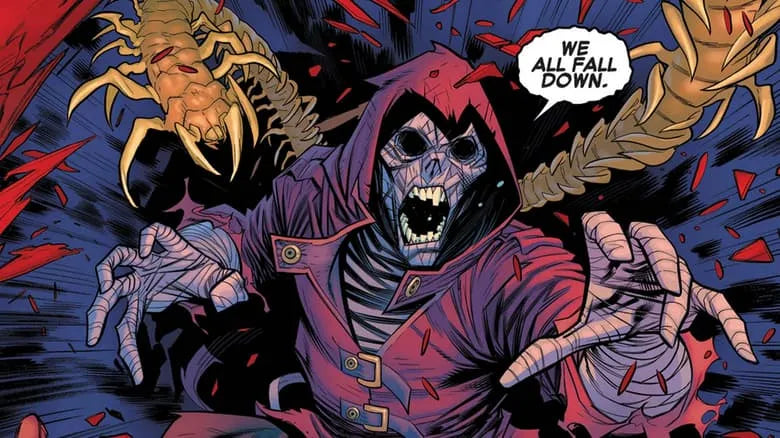
The Clone Saga was, for many fans, the editorial low point of Spider-Man, the period when Marvel multiplied supporting characters until continuity became unreadable. But the Clone Saga was also the quiet return of several forgotten characters, Mendel Stromm among them. Under a new identity this time — a skeletal, hooded man breathing through a medical tube, going by the name 'Gaunt'. Gaunt means hollowed out, wasted away, and the choice of name is not gratuitous: it evokes a body that has nothing left in common with the warm-hearted scientist of the 1960s.
Gaunt is the secret architect of a complex operation aimed at eliminating Ben Reilly, the clone of Spider-Man, while manipulating Peter Parker in parallel. That pincer manoeuvre bears the mark of the same twisted mind that devised the back-up automatons twenty years earlier. Gaunt works behind the scenes, never dirties his own hands, sends mercenaries and hunters in his place. It is the same corporate method as Norman Osborn's — as though Stromm, resurrected and embittered, had ended up adopting the techniques of the man who murdered him. That convergence of methods is one of the finest ironies of the Clone Saga era, and it almost always goes unnoticed.
This Stromm-Gaunt version also has a murky relationship with the broken clone who would later become Chasm. Some ambiguous dialogue in the 1996-1997 runs suggests that Gaunt tried to use Reilly's genetic matrices to build a brand-new human body, into which he could have transferred his own consciousness. That thread was never followed through by the writers of the day, which is a real shame, because it probably contains one of the most interesting untold tragedies in the whole corpus of Spider-Man's enemies.
FIGURE — DR OCTOPUS

Spider-Man Toy Figure - Dr Octopus
29,90 €
The Green Goblin's scientific cousin in the Marvel pantheon — Octavius embodies that other path of the scientist who tips into excess, proudly displayed next to your rare comics.
Discover →Stromm's contemporary echo in Brand New Day and the modern runs
In the Spider-Man runs published after 2015, Marvel has discreetly reintegrated Mendel Stromm into several subplots, without ever giving him a central role again. He is mentioned in the flashbacks of Shadow of the Green Goblin, a mini-series that revisits the genesis of the Green Goblin with a darker focus than the 1960s comics. You see his face in a framed photograph in Norman's office in certain issues of The Green Goblin Reborn. You hear him, again, in Norman's monologues, which betray a belated guilt.
This discreet return is consistent with Marvel's editorial strategy around Brand New Day, the great reset that changed Peter Parker's life. Since that reset, Marvel has favoured rewritten origins that are more complex than the simple origins of the 1960s. Stromm is reactivated as a ghost, never as a protagonist. He is what writers call, internally, a 'seed character': a character you can plant, leave dormant, and let bloom the day a specific run needs him.
That strategy also explains why Stromm's name keeps coming up in fan theories about what Marvel is preparing for Norman Osborn's big return in contemporary comics. Some fans imagine that Stromm could come back as a digital consciousness embedded in the Oscorp servers, a ghost in the machine quietly sabotaging every one of Norman's plans from the very foundations of his empire. That hypothesis is elegant and narratively coherent — it would also be the perfect revenge of a betrayed man. Marvel will no doubt end up using it.
Why Marvel has deliberately kept Mendel Stromm in the shadows for fifty years
The question deserves to be asked head-on: why has Marvel never made Mendel Stromm a central character, despite his obvious narrative importance? Three editorial reasons combine, and they say a great deal about how the mainstream comics industry works.
The first reason is commercial. An isolated, charismatic villain sells better than an origin shared between two characters. The Green Goblin, pure marketing, works better on his own in the books, in the toys, in the films. Introducing Mendel Stromm into Sam Raimi's 2002 canon would have diluted Norman's myth. Marvel's marketing department prefers a simple, iconic villain, reusable across the top figures that keep the Marvel shops busy. The second reason is narrative. Norman Osborn is more terrifying if he is the sole architect of his own monstrosity. Making him the heir to a betrayal paradoxically weakens his status as an absolute villain, turning him into a thief rather than a creator.
The third reason is subtler, and concerns the death of Gwen Stacy and the moral weight it carries in the canon. That murder, seen as the tipping point from the Silver Age into the Bronze Age of Marvel comics, draws its force from the fact that Norman is personally responsible, with no intermediary, no chemical excuse dictated by a formula he had not understood. Introducing Mendel Stromm too clearly would risk handing Norman a narrative escape route: 'it was not me, it was the formula I stole'. Marvel has always preferred to preserve the tragic integrity of that murder. This editorial decision may be the greatest injustice done to Mendel Stromm, but it is also what makes the Spider-Man universe so emotionally powerful, comparable to the power of Back in Black, when Peter Parker abandons morality after Aunt May's death.
For any reader who wants to explore deeper into the guts of the Spider-Man universe, from the Green Goblin to his accomplices in the shadows, the best way in remains the complete file devoted to Peter Parker and his journey as well as the complete gallery of the characters who structure his universe. These two resources, updated regularly, are the equivalent of a continuity manual in plain English for any serious fan of the web-slinger.
COMICS POSTER — SPIDER-MAN IN BATTLE

Spider-Man in Battle Comics Poster
19,90 €
The visual mood of the Stromm era and the 1960-70 runs in a single poster — the raw material for any fan wall that wants to show the real mythology rather than the generic blockbuster.
Discover →What Mendel Stromm teaches us about the inner machinery of Marvel supervillains
Deep down, the real lesson of Mendel Stromm goes far beyond Spider-Man. It tells us about the way the great Marvel villains are built — never alone, never out of nothing, but always at someone's expense. Behind Norman Osborn, there is Mendel Stromm. Behind Doctor Octopus, there is a laboratory accident that cost a brilliant researcher his career. Behind Venom, there is the symbiote that cost Eddie Brock his dignity. Every great villain carries, in his shadow, a broken man he used as the springboard for his own megalomania.
This systemic reading is useful for contemporary readers coming to the 2020s Spider-Man runs, saturated with multiverses, clones and variants. Understanding Stromm means understanding the logic behind the construction of the Marvel villain. It also means doing justice to a character who was literally erased from the adaptations and who remains, within the wider Spider-Man universe you can explore collection by collection, a missing but essential piece of the puzzle. Fans who want to dig further will find plenty to document and to make tangible in the Spider-Man guides hub and in the complete 2026 Spider-Man figures guide.
It remains to be hoped that Marvel will one day fully rehabilitate Mendel Stromm — perhaps on the occasion of a major event extending Brand New Day on the big screen, or through a mini-series devoted to Oscorp's true origins. In the meantime, the article you have just read is your best landmark for recognising this scientific ghost the next time he turns up in a panel, a back-up strip, a conversation between Norman and his son. You will never look at him as a mere extra again. You will know that without him, the modern mythology of the Green Goblin would not exist, and that Peter Parker would probably never have had to carry the weight that has defined him since 1966.

