
14-Day Money-Back Guarantee
0
The short answer
Neither quite one nor quite the other: the criticisms hold up — overcrowded plotting, an unstable tone, Venom rushed through, Uncle Ben's death rewritten — yet the film also carries thematic ambitions it is rarely credited for. We weigh up both sides below.
Spider-Man 3: the most hated film... and the most cult
In 2007, Spider-Man 3 hit cinemas carrying colossal expectations. The first two films in Sam Raimi's Spider-Man trilogy had revolutionised the superhero genre, established Tobey Maguire as the perfect embodiment of Peter Parker, and generated unprecedented enthusiasm worldwide.
The result? A commercial triumph (890 million dollars at the box office), but a critical failure that still divides opinion today. Spider-Man 3 became the paradoxical symbol of a film both hated by the critics and adored by part of the fanbase.
Nearly twenty years after its release, the question is still wide open: Spider-Man 3 — was it really a failure, or simply a misunderstood film, the victim of expectations no film could have met?
The answer is neither simple nor clear-cut. Spider-Man 3 suffers from undeniable, objective flaws, but it also hides narrative and thematic qualities that often go unnoticed. It is an imperfect film that attempts bold things, sometimes successfully, sometimes not.
A film caught between two creative visions
To understand Spider-Man 3, you first have to understand the context of its production. Sam Raimi wanted a film centred on Sandman and redemption. Sony wanted Venom to win over a younger audience used to modern comics.
The result: a film that tries to satisfy both visions, at the risk of diluting every narrative arc. That creative tension explains many of the perceived inconsistencies in the finished film.
The complex legacy of the Raimi trilogy
Sam Raimi's Spider-Man trilogy remains an essential benchmark for the superhero genre. The Spider-Man films that followed have all been measured against the gold standard set between 2002 and 2007.
Spider-Man 3 had to bring that story to a close while introducing new elements. An immense narrative challenge that explains some of its most contested choices.
In this article, we look objectively at the strengths and weaknesses of Spider-Man 3, work out why it divides people so sharply, and explore how its reputation has shifted over time.
The objective flaws that hurt the film
Let's be honest: Spider-Man 3 has real narrative and creative problems that justify part of the criticism it received. Acknowledging those flaws does not mean hating the film, it means looking at it clearly.
Too many villains, too many story arcs
The main criticism levelled at Spider-Man 3 concerns its narrative overload. The film tries to develop, all at once:
- The arc of the black symbiote and Peter's transformation
- The story of Sandman and his fatherly motivation
- The revenge of Harry Osborn/New Goblin
- The introduction of Venom and Eddie Brock
- The Peter/Mary Jane relationship in crisis
- The arrival of Gwen Stacy
This proliferation of plotlines dilutes the emotional impact of each one. No arc gets the time it needs to breathe and develop fully. Venom in particular arrives too late and disappears too quickly to feel genuinely threatening, unlike the most powerful enemies of Spider-Man who generally benefit from far deeper development.
Compared with the narrative focus of the first two films, Spider-Man 3 feels scattered, almost chaotic in its structure.
An uneven tone and a few misjudged scenes
Spider-Man 3 swings between intense drama and offbeat comedy, sometimes within the same scene. That tonal instability makes for an unsettling experience.

Peter's dance sequence under the influence of the symbiote, meant to show his growing arrogance, was widely criticised for being grotesque and unintentionally funny. What was supposed to illustrate the character's corruption became an internet meme, much like some of the funniest scenes in the Spider-Man films.
Sam Raimi himself has admitted that some of those scenes did not work as intended, creating a gap between intention and reception.
Venom's rushed treatment
Venom is one of the most popular enemies of Spider-Man in the comics. His introduction in Spider-Man 3 was hotly anticipated by fans. The result? Limited screen time, minimal development and a hasty conclusion.
Eddie Brock lacks psychological depth. His transformation into Venom comes too late in the film to create a genuine threat. The character ends up a secondary antagonist where he deserved to be central.

That haste comes down to production constraints: Venom was imposed late in the day by Sony, forcing Raimi to reorganise his original script, which was centred on Sandman. For fans of the symbiote the impact was twofold: narrative disappointment, and an unsatisfied craving for Venom costumes and Venom figures that are more faithful to the comics.
The Uncle Ben retcon: a controversial decision
Revealing that Sandman was in fact involved in Uncle Ben's death retroactively changes a founding element of the mythology established in the first film. Many fans saw that narrative choice as a betrayal.
The decision needlessly complicates an origin that was already clear and emotionally powerful. It seems to exist only to create an artificial link between Peter and Sandman, at the expense of the overall coherence that makes Spider-Man's story so strong.

Uneven visual effects
While some sequences remain spectacular (Sandman's transformation, the aerial fights), others show digital effects that looked dated even at the time. Venom's CGI in particular lacks weight and physical presence.

That visual unevenness contrasts with the consistent quality of the first two films, where the effects always served the emotion rather than pure spectacle.
In the next part, we will see that despite these flaws, Spider-Man 3 has qualities that are often overlooked and deserve a fresh look.
The underrated qualities of Spider-Man 3
Beyond the legitimate criticism, Spider-Man 3 contains narrative, thematic and visual elements that are frequently underestimated. These strengths deserve an objective reappraisal.
A mature exploration of Peter Parker's dark side
Spider-Man 3 is the only film in the trilogy that truly dares to explore Peter Parker's psychological flaws. Under the influence of the symbiote, Peter becomes arrogant, vengeful, at times cruel. It is a bold deconstruction of the perfect hero.
This exploration of inner darkness chimes with the arc of Peter Parker torn between responsibility and personal desire. The film shows that great power can corrupt as well as create responsibility, questioning head-on the line that defines Spider-Man.
That psychological nuance was ahead of its time. Today, flawed and tortured superheroes are the norm. In 2007 it was riskier. Peter's black suit has in fact become one of the most popular Spider-Man costumes with fans, proof of the lasting impact of this darker take on the hero.
Thomas Haden Church plays a tragic, moving Sandman
Despite the narrative overload, Sandman remains the most emotionally complete character. Thomas Haden Church delivers a nuanced performance as a desperate man, not fundamentally evil, just trapped by his own choices.

The sequence of his transformation into Sandman, almost silent and carried entirely by the music and the images, is one of the most poignant moments in the whole trilogy. It shows Sam Raimi's visual power perfectly.
The final forgiveness between Peter and Sandman delivers a powerful emotional conclusion on the theme of forgiveness and redemption, central to the Spider-Man universe. That scene is one of the most memorable moments in Spider-Man's history on screen.
Harry Osborn's arc finds its conclusion
The evolution of Harry Osborn from best friend to sworn enemy runs through the entire trilogy. Spider-Man 3 brings that arc to a satisfying close, with Harry's final sacrifice redeeming his mistakes.

The Peter/Harry relationship is the emotional heart of the film. Their reconciliation and the final fight side by side against Venom and Sandman deliver the catharsis we have been waiting for since the first film. The legacy of the Green Goblin finally finds its tragic but dignified resolution.

James Franco delivers a solid performance, moving between hatred, confusion and finally redemption. His death alongside Peter closes his arc tragically but with dignity, a reminder that the Green Goblin is still Peter Parker's worst nightmare, even through his son.
An exceptional score
Danny Elfman and Christopher Young deliver a remarkable soundtrack, among the best in the superhero genre. The musical themes carry the emotion of the key scenes, sometimes making up for the weaknesses of the script.
The music for Sandman's transformation in particular turns a visual effects scene into a genuine moment of cinematic grace.
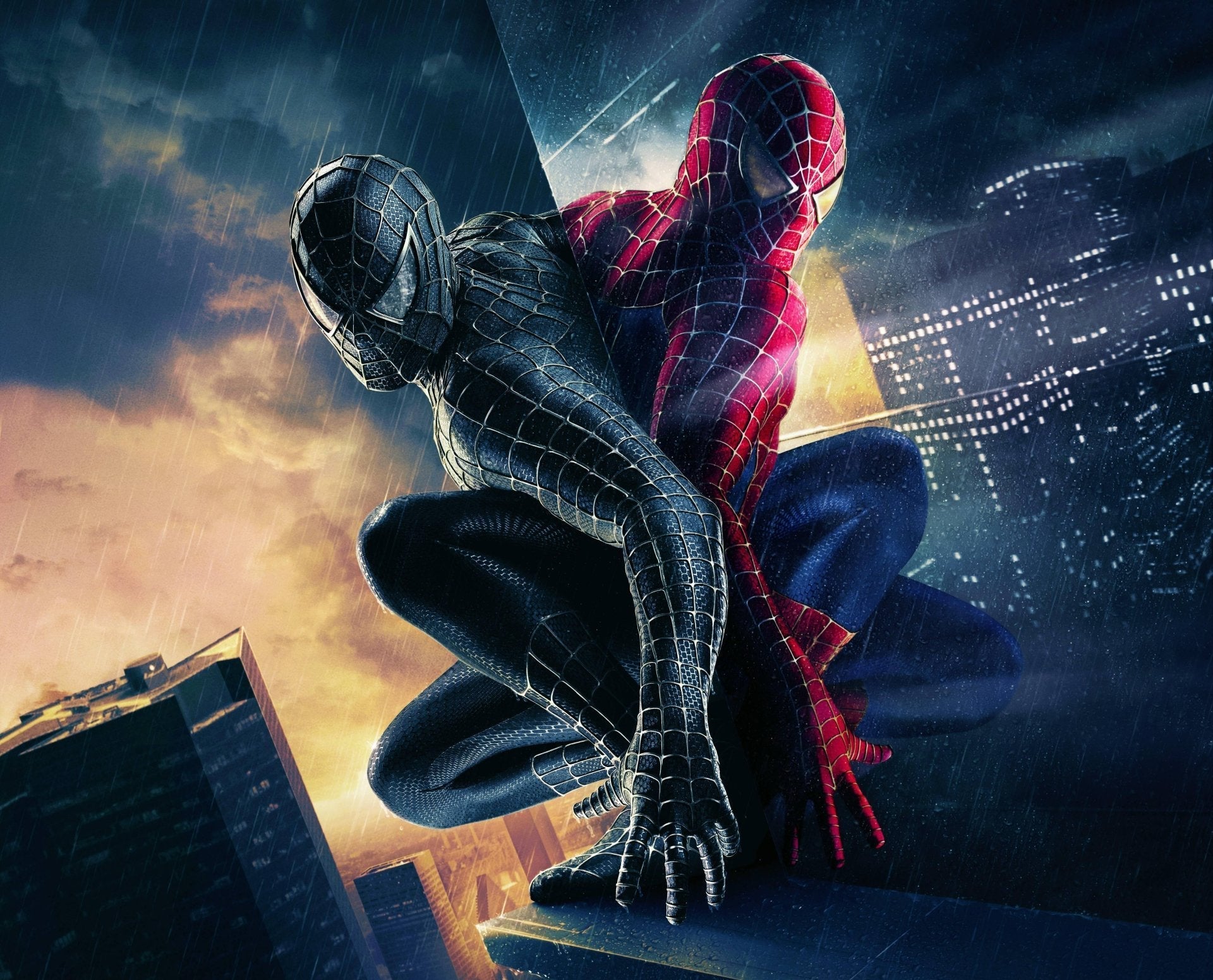
The black suit: a visual icon
Despite Venom's rushed narrative treatment, Spider-Man's black suit has become iconic. Its sleek, menacing design marked a whole generation of fans and still influences the evolution of Spider-Man's costumes on screen.
This suit has inspired countless Spider-Man costumes, posters, figures, Spider-Man jumpers and T-shirts. It remains one of the most popular versions of the hero in geek culture, to the point of ranking among the most sought-after Spider-Man products.
Spectacular action scenes
Beyond the narrative debates, Spider-Man 3 delivers several memorable action sequences: the fight against Harry in the skies over New York, the underground clash with Sandman, the final battle against Venom.

Those moments of pure action remain visually impressive and choreographed with Sam Raimi's usual mastery. They are a reminder of why the trilogy revolutionised superhero films and why it is still a benchmark for the web-slinger adored around the world.
In the final part, we look at how perceptions of Spider-Man 3 have changed with time and distance.
How Spider-Man 3 became a cult film in spite of itself
Nearly twenty years after its release, something fascinating has happened: Spider-Man 3 has gradually gained cult status with a new generation of fans. That cultural reappraisal deserves a closer look.
Meme culture and irony
The most criticised scenes in Spider-Man 3 (Peter's dance, his arrogant poses) have become unavoidable internet memes. What was seen as a tonal failure is now celebrated ironically, joining the TikTok and cosplay culture that wins over Gen Z.
That cultural reappropriation gave the film a second life. Younger generations discover Spider-Man 3 through these memes and develop a genuine affection for its excesses and its unabashed clumsiness.
The film has become an object of nostalgia, sometimes ironic, sometimes sincere. That duality is part of its charm today, and it explains why Spider-Man T-shirts featuring the film's iconic images (notably Peter's arrogant pose) are enjoying unexpected success.
The post-MCU context changes the perspective
After fifteen years of a standardised Marvel Cinematic Universe, the Raimi trilogy looks in hindsight like a singular authorial vision. Sam Raimi stamped his personal mark on these films in a way that feels rare today.
Spider-Man 3, for all its flaws, carries that distinctive visual and narrative signature. It dares to take creative risks, even if they do not all come off. That boldness is valued differently today, especially compared with Spider-Man: Homecoming or Spider-Man: Far From Home which follow stricter MCU codes.
The current uniformity of superhero blockbusters makes the experiments in Spider-Man 3 almost refreshing by comparison. The film is now an integral part of the Spider-Man cinematic universe with its own unique personality.
Nostalgia for the Raimi trilogy as a whole
Spider-Man 3 benefits from the wider nostalgia for the Raimi trilogy. Fans who grew up with these films develop an affection for the whole set, third instalment included.
That nostalgia grew stronger after the successive reboots (The Amazing Spider-Man, MCU). Each new version of Spider-Man paradoxically strengthens the attachment to the previous one. The question 'which Spider-Man is the most popular' comes back every time, and Tobey Maguire keeps a special place in fans' hearts.
The different actors who have played Spider-Man create comparisons that retrospectively flatter Tobey Maguire and his trilogy. That nostalgia translates into renewed interest in figures from the Raimi trilogy, vintage posters and even Spider-Man clothing based on the design of the 2002-2007 films.
Spider-Man: No Way Home and the official rehabilitation
Tobey Maguire's return in Spider-Man: No Way Home officially rehabilitated the Raimi trilogy in the eyes of many viewers. Seeing Maguire take the role back with tenderness and nostalgia reminded everyone why this version is still so dear to fans.
That appearance created a huge surge of interest in the complete trilogy, Spider-Man 3 included. New generations are discovering or rediscovering these films with fresh eyes, feeding the phenomenon analysed in how No Way Home changed everything for the Spider-Man universe.
The concept of the Spider-Man multiverse has also made it possible to place Spider-Man 3 in a wider context where every version of the hero has its own legitimacy and its own fans.
An imperfect but sincere film
With hindsight, what stands out in Spider-Man 3 is its emotional sincerity. Despite studio interference and narrative compromises, the film genuinely tries to explore mature themes: forgiveness, revenge, the corruption of power.
Sam Raimi wanted to say something, not just make a calibrated blockbuster. That artistic ambition, however imperfectly realised, deserves respect and reappraisal. The film sits in the tradition of the Spider-Man comics which have never shied away from the grey areas of morality.
The lasting influence on later Spider-Man films
Spider-Man 3 influenced every Spider-Man film that followed, often as a reaction against its excesses. The Amazing Spider-Man avoided multiple villains. Homecoming went for narrative simplicity.

Paradoxically, the lessons learned from the mistakes of Spider-Man 3 helped improve the later incarnations of the character. Its legacy is more complex than its critical reputation alone. You can even feel its impact in Spider-Man: Into the Spider-Verse which, by fully embracing its multiple narrative ambitions, succeeds where Spider-Man 3 failed.
The merchandising and cultural legacy
Beyond the film itself, Spider-Man 3 left a lasting legacy in popular culture. The black suit is still one of the most reproduced designs across costumes, masks, figures and Spider-Man clothing.
Fans keep buying posters of the film, soft toys and even toys inspired by the characters. That commercial longevity shows a real attachment that goes well beyond the initial reviews.
Final verdict: neither a flop nor a masterpiece, but important
Spider-Man 3 is neither the absolute disaster described by its detractors nor the misunderstood masterpiece defended by its most fervent fans. It is an imperfect, ambitious, sometimes clumsy film, but always a sincere one.
Its flaws are real: narrative overload, uneven tone, the rushed handling of Venom. But its qualities are just as real: the psychological exploration of Peter, Thomas Haden Church's moving performance, the satisfying conclusion to the arc of Harry Osborn.
Twenty years on, Spider-Man 3 remains a fascinating cultural object: over-criticised at the time, perhaps overrated in its current nostalgic reappraisal. The truth sits somewhere between those extremes.
What is certain is that Spider-Man 3 marked a whole generation of fans. It is an integral part of the cultural DNA of Spider-Man on screen. For many, it was their first contact with the black suit, with Venom, with the idea that a hero can fail.
So, a flop or misunderstood? Perhaps a little of both. But above all a film that refuses to leave anyone indifferent, which in itself is a kind of success. It keeps fuelling the debate about which is the best Spider-Man film of all time, proof of its lasting impact.
To explore the Spider-Man cinematic universe further and compare the different adaptations, see our complete guide to the Spider-Man films. To understand how Spider-Man travels across the generations, read our analysis of why Spider-Man is still one of the most loved heroes in the world.
And to discover how the Spider-Man universe keeps evolving, explore our guides & advice section which covers every aspect of the web-slinger's world, from Spider-Man gift ideas to the most in-depth analysis.
Because in the end, Spider-Man 3 reminds us of an essential truth: even imperfect heroes deserve our attention. And sometimes it is precisely their imperfections that make them human, endearing and worth reassessing. Exactly like Peter Parker himself.

