
14-Day Money-Back Guarantee
0
The short answer
Sandman, real name William Baker, first appears in September 1963 in The Amazing Spider-Man #4, by Stan Lee and Steve Ditko. 'Flint Marko' is only a criminal alias. His powers come from a radiation accident, not from a gene. What makes him singular has less to do with his raw strength than with his repeated redemptions: pardoned by the president, an Avengers reservist, a substitute father, and back down again every time.
Unlike other iconic enemies such as the Green Goblin or Doctor Octopus, Sandman does not fall into crime out of a thirst for power or a need for revenge. He slides into it out of necessity, out of misplaced anger, through a run of wrong doors taken at the wrong moment. Sixty years of publishing have made him one of the rare Marvel villains whose path looks less like a descent than a moral yo-yo. This full portrait works through the verified facts, issue by issue, and carefully separates what the comics tell from what the films invented.
Who is Sandman really?
The character first appears in The Amazing Spider-Man #4, dated September 1963, in a story titled 'Nothing Can Stop... the Sandman!'. He is created by writer Stan Lee and artist Steve Ditko, right at the start of the series, at a time when the web-slinger's gallery of opponents is being built issue by issue. So he belongs to the very first group of enemies, alongside the Chameleon and the Vulture, and the page devoted to Spider-Man's villains ranks him among the founding figures of this universe.
First point that plenty of character profiles copy out wrongly: his real name is William Baker. 'Flint Marko' is a criminal pseudonym he adopts later, precisely to stop his mother finding out about his life of crime. That split in names is not a piece of trivia for completists: it structures the whole character, and it will resurface much later, in explicit form, when he asks people to stop calling him Marko.
The origin of his powers is an accident. Having escaped from prison, he takes shelter on a beach next to a nuclear testing site near Savannah, Georgia, and comes into contact with sand irradiated by an experimental reactor. His molecules fuse with those of the sand and he survives, transformed into a conscious creature. Marvel classifies him as a human mutate, meaning a human altered by an accident: he is not a mutant, his abilities have nothing genetic about them, whatever a quick read of his recent appearances might suggest.
His very first defeat has stayed famous for its total lack of glamour. Hunted by the police, he takes refuge in Peter Parker's school, Midtown High School, bursts in on the principal and demands a diploma. Spider-Man ends the fight with an industrial vacuum cleaner found on the spot, then hands him over to the authorities. That slightly absurd scene already says the essential thing: this villain has never had a long-term plan. Anyone fond of that period will find the same energy in the comic-inspired Spider-Man posters, which often take their cue from the artwork of those early years.
A childhood that explains everything
It is Friendly Neighborhood Spider-Man Annual #1 (2007), written by Peter David, that finally fills in his past in detail — and that issue changes the way you can read the character. William Baker is born in Queens. His father, Floyd Baker, walks out on the family when he is three. His mother raises a child she neglects on her own. The only bright memory of that childhood comes from days spent at Coney Island, where the little boy grows fascinated with sandcastles. The coincidence is almost too neat, and the writers have never denied themselves the use of it.
At school, he plays American football. To help his friend Vic, in debt to a mobster, he fixes a match. He is thrown off the team, hits his coach, and gets expelled from the school. That is the tipping point: no spectacular trauma, no revelation, just a teenager doing a mate a favour and losing everything he had. The contrast with Peter Parker, another modest schoolboy from Queens, is head-on — and that is exactly why the confrontation in issue 4 takes place in a classroom.
The alias itself is built from two memories of that period. Flint comes from Miss Flint, a teacher he was in love with. Marko comes from a jibe by his old coach, who told him he would never leave his mark on the world. So he built himself a criminal name out of a first love and a humiliation. Taking another name so that his mother would not recognise him is already wearing a mask — the same gesture as Peter Parker's, in reverse, and Spider-Man masks remain the object that best condenses that idea of a covered identity. Few Marvel villains carry a psychology this readable in their name alone, and the page listing the characters of the Spider-Man universe holds few equivalents at that level of biographical detail.
COLLECTOR FIGURES

Classic Sam Raimi Spider-Man Figure
Sam Raimi's trilogy is still how most fans first meet Flint Marko. This piece of the Spider-Man from that era holds the pose and the level of detail you expect on a collector's shelf, with the exact silhouette of the suit worn in the film where Sandman makes his big-screen debut.
89.90 €
Discover →A power that tells the story of his instability
On paper, his ability fits in one sentence: his body is bound to sand at molecular level, he shifts from flesh to sand at will, changes his shape, his density and his size, scatters and reforms without ever losing consciousness. In practice, the mechanism is more interesting than that. His mass, his strength and his shape-shifting capacity are proportional to the number of grains that make him up: the more sand or aggregate he takes in around him, the more powerful he becomes. That is a rare rule at Marvel, where powers are generally fixed.
In a fight, he shapes his arms into blunt weapons — mace, sledgehammer — and most projectiles pass straight through him without doing any damage. He can also turn himself into a sandstorm, which lets him cover long distances and suffocate an opponent. Brute force is useless against him, and that is what sets him apart from a Rhino or an Electro, whose fighting patterns are far more direct.
His four real weaknesses
Water is the main one. It saturates his grains, he loses cohesion and control over his mass, and has to wait until he dries out. It is the Achilles heel the films picked up, and rightly so. Airtight confinement is a second: in The Amazing Spider-Man Annual #1, he loses a fight staged inside a sealed metal box, quite simply because Spider-Man has the better lungs. Cement is the third: mixed into his mass, the compound hardens and leaves him motionless, alive but in a comatose state, until he returns to normal.
The fourth is the most elegant, and the latest to arrive. Whatever quantity of sand he absorbs or loses, his body has to keep one single key grain that holds his consciousness. Isolating that grain neutralises him. This weakness is exploited in The Amazing Spider-Man #684 (2012), 'Ends of the Earth, Part Three: Sand Trap': Spider-Man, Black Widow and Silver Sable take him on in the Sahara, provoke his rage to bring the grain to the surface, and trap him in a lead-lined web. The story takes care to point out that the manoeuvre is too complex to be replayed in every fight.
He has also taken spectacular damage. Venom once tore a clean chunk out of his mass with a single bite of the jaws; the sudden loss deformed him so badly that he could no longer hold his human shape and crumbled away in the sewers, where he was believed dead. Doctor Octopus once vitrified him in reprisal for a betrayal, and it was Spider-Man who saved him. Anyone fond of those clashes will find the main players in the Venom, Carnage and symbiote figures and in the classic Spider-Man figures range.
The team villain, never the mastermind
He is a founding member of the Sinister Six, brought together in The Amazing Spider-Man Annual #1 (October 1964) by Doctor Octopus, alongside the Vulture, Electro, Mysterio and Kraven the Hunter. He is also a founding member of the Frightful Four, who appeared in Fantastic Four #36 (March 1965) with the Wizard, Paste-Pot Pete — the future Trapster — and Madame Medusa. So he is as much an enemy of the Fantastic Four as of the web-slinger, something the adaptations systematically forget. To go further on this, see also The French names of Spider-Man characters: the complete glossary.
That double founding status says something important: he gets recruited, he does not get followed. He has never led a single team. He is the firepower that other people organise, from the first Sinister Six through to Sinister War, by way of Return of the Sinister Six. The Wizard even designed him an armoured green costume with a diamond pattern, fitted with a three-button belt that injected chemicals into his mass to change its consistency — a piece of kit he drops once the group breaks up, and one that remains a classic among Spider-Man costumes and fancy dress for anyone who wants to move past the obvious choices.
The article on the seven most powerful Spider-Man villains places him correctly in that hierarchy: formidable in a fight, but rarely decisive in a plot, because he lacks what Harry Osborn or Cletus Kasady have — a personal obsession with Peter Parker. In 2009, IGN ranked him the 72nd greatest comic book villain of all time, which sums up his position rather well: indisputably established, never at the top.
PRINTS AND POSTERS

Spider-Man Comic Battle Poster
The drawn showdowns of the great years remain the best way into this rogues' gallery. This poster takes the linework and flat colours of the fight pages, in a format that sits on an office wall without crushing the rest of the decor.
19.90 €
Discover →The successive redemptions, and what Marvel did with them
Few Marvel supervillains can claim to have tried, several times over, to change course. The first shift dates back to Marvel Team-Up #1 (March 1972), written by Roy Thomas, which gives him his first morally ambiguous reading. Thomas himself has said he may well have planted the seeds of the character's redemption there. Nine years later, in Amazing Spider-Man #217-218 (1981, script by Denny O'Neil, art by John Romita Jr.), he teams up with Hydro-Man; an accident fuses them into a creature named Mud-Thing. The episode is traumatic, and it triggers his change of heart.
The real tipping point is Marvel Two-in-One #86 (April 1982), written by Tom DeFalco and drawn by Ron Wilson. The scene deserves to be better known: The Thing does not fight him. Ben Grimm and he talk over a beer, and Grimm urges him to start again from scratch and put his abilities to good use. A character switches sides because another one took the time to talk to him — that is rare, and it is what makes the page memorable.
What follows is a long heroic phase that often gets overlooked. Silver Sable, impressed by his intervention against the Sinister Syndicate, hires him as a freelance agent, and he then becomes a full-time mercenary within the Wild Pack, alongside Paladin and Battlestar. He joins the Outlaws, that group of reformed former enemies of the web-slinger, with the Prowler, Rocket Racer, Puma and Will o' the Wisp. And in Avengers #329 (February 1991), he receives a presidential pardon and joins the Avengers — as a reserve member, not an active one — with Captain America vouching for him. The same issue makes Rage a probationary Avenger.
Then Marvel backtracked. In The Amazing Spider-Man vol. 2 #4 (1999), written by Howard Mackie, he renounces his redemption, declares his allegiance to evil and goes back to work for the Wizard. The reversal provoked an outcry from readers, who saw him as having become a hero. The publisher rushed out a corrective story in Peter Parker: Spider-Man vol. 2 #12 (December 1999): the Wizard had kidnapped him and put him through his mind-control device, the Id Machine. Rarely has a readership so clearly forced a villain to be kept on the road to redemption.
Keemia, or the father he wanted to be
The 'Sandblasted' arc, in Friendly Neighborhood Spider-Man #17-19 (April-June 2007), has him ask Spider-Man for help clearing his father, Floyd Baker, accused of murdering a homeless man. The real culprit turns out to be Chameleon 2211. So the son abandoned at three fights for the honour of the father who left him — the biographical loop is closed by the story itself.
Three years later, 'Keemia's Castle' (The Amazing Spider-Man #615-616, 2010, by Fred Van Lente and Javier Pulido, as part of 'The Gauntlet') pushes the character to his limits. He kidnaps young Keemia Alvarado and builds her a giant sandcastle on Governors Island. Above all, the arc redefines his powers: he now creates duplicates of himself with personalities of their own — and, to his horror, those doubles claim murders he did not consciously commit, including that of Keemia's mother. Spider-Man destroys them with a fan, and the child is placed in foster care.
What comes next is logical and cruel. In Dan Slott's 'Big Time' arc, he joins a new Sinister Six hoping to collect two billion dollars, the only way of winning custody of Keemia. Sent to guard a facility in the Sahara — the largest body of sand in the world, and therefore his ideal ground — he is beaten there by the isolation of his key grain. A man who goes back to crime to get a child back, and who loses on the one terrain where he was invincible: the summary fits on a single line, and it is more tragic than most villain deaths.
What the films invented, and what they got right
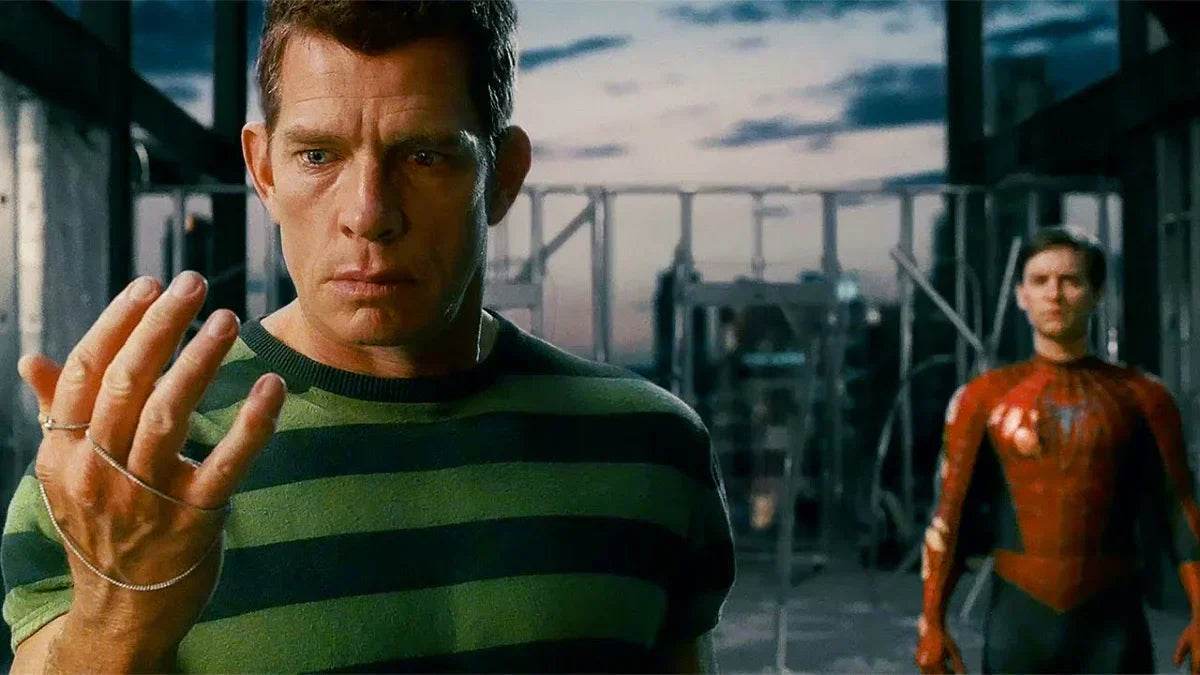
Thomas Haden Church plays Flint Marko in Spider-Man 3 (2007) by Sam Raimi, then returns to the role in Spider-Man: No Way Home (2021). On screen the character gains a popularity the comics had never given him — and a backstory that has very little left in common with his own. It is worth telling the two apart, especially if you discover him through the films, which is set out on the page covering every Spider-Man film.
The film's three inventions
The origin, first: in the film, on the run from the police after escaping, he falls into a particle physics testing site that fuses his body with sand. No irradiated sand, no nuclear testing site, no childhood link with sand. The family, next: the film invents him an ex-wife called Emma and a seriously ill daughter called Penny, whose medical bills justify his robberies. Penny does not exist in the comics — the only child in his story is Keemia, and he did not father her.
The third invention carries the heaviest consequences: the film makes Marko the real killer of Uncle Ben. During the car theft, he was holding Ben at gunpoint, his accomplice Dennis Carradine startled him, and the shot went off by accident. None of that exists in the comics: there, Ben Parker is killed by an anonymous burglar, the very one Peter had let get away, and who later dies of a heart attack on discovering that Spider-Man and Peter Parker are the same person. Sandman never had the slightest role in that death, and the article detailing how Uncle Ben died puts the record straight.
The film does get two things right, though. It illustrates the water weakness correctly: Spider-Man bursts a pipe in a subway station, which reduces Marko to mud and washes him away — without killing him, since he reforms. And it keeps his ambiguity right to the end: in the finale, Marko explains that Ben's death was an accident, Peter forgives him and lets him go. He does not die, he is not arrested. The debate around Spider-Man 3, a failure or misunderstood often misses this writing choice, which is nonetheless one of the most faithful to the spirit of the character in the whole of Sam Raimi's trilogy, whose imagery still feeds a good share of the Spider-Man T-shirts sold today.
In No Way Home, Marko is pulled into another universe, held at the Sanctum, deteriorates, at first refuses the cure under the Green Goblin's influence, then is cured of his powers by Peter-One and Peter-Two at the Statue of Liberty before being sent back home. A production detail that rarely gets mentioned: Thomas Haden Church never filmed on set. He recorded his dialogue remotely, another performer handled the motion capture, and reworked footage from Spider-Man 3 was reused. One last piece of confusion to clear up: in Spider-Man: Far From Home (2019), the creature of earth and rock is not Sandman, it is an illusion manufactured by Mysterio.
MUGS AND EVERYDAY OBJECTS

Spider-Man Battle Mug
Rereading the old issues calls for coffee. This mug takes a fight scene in the bold colours of period artwork, goes in the dishwasher and holds a normal amount — it lasts for years without the design fading.
24.90 €
Discover →Sandman beyond the comics: series, games and a return to his original name
He is one of the recurring antagonists of The Spectacular Spider-Man, voiced by John DiMaggio, in a small-time crook version paired with Alex O'Hirn — the future Rhino — working for Tombstone. It is probably the animated adaptation that best conveys his social situation, and it explains part of the nostalgia still attached to this series cancelled far too soon, which you can place in context thanks to the chronological order of the animated series.
On the video game side, he opens Marvel's Spider-Man 2 (2023, Insomniac) as the very first boss, voiced by Leandro Cano. That version had gone straight in order to raise his daughter Keemia; his mind is fractured into sand crystals scattered across New York, which the two Spider-Men have to recover. So the studio chose to keep the redemption rather than the crime, which says a great deal about how the character is seen today — the page devoted to the Spider-Man video games traces that overall evolution, and Spider-Man toys as well as Spider-Man phone cases happily borrow the look of those games.
A radically different version arrived in 2026: in the live-action series Spider-Noir, Jack Huston plays Flint Marko. It started airing on 25 May 2026 on MGM+ in the United States, then worldwide on 27 May 2026 on Prime Video, with Nicolas Cage in the lead role. This Marko is a former First World War soldier, the victim of German experiments, whose body turns to sand a decade later. Everything is rewritten except the sand — and the article on the Spider-Man Noir series goes into that choice in detail, while the choice between black and white and colour shapes the way that material is rendered on screen.
In the comics, finally, a recent development closes the loop. After the 'Gang War' arc, committed to Ravencroft, he asks Peter Parker to call him William Baker and states that 'Flint Marko' is his bad half. The duality that was only a choice of pseudonym in 1963 has become, sixty years later, the explicit subject of the character.
Why this villain stays unforgettable
What makes Sandman fascinating is his hybrid nature: victim, substitute father, thief, survivor, failed hero. He never chose to become a supervillain, and that is precisely what makes him credible. Where most of the web-slinger's opponents have an obsession, he has a trajectory — with climbs back up, relapses, and intermittent clear-sightedness about what he has become. His shifting matter is not just a power: it is the most direct metaphor a comic has ever produced for the instability of a man.
Readers are not fooled. They defended him in 1999 to the point of forcing an editorial correction, and writers keep coming back to him because he offers what few villains allow: a scene where a hero talks to him, and where something changes. That particular place also shows in the way he crosses eras and media, traced in the complete saga of the major story arcs as well as in the Spider-Verse overview, where the alternative versions of the web-slinger almost always run into a version of him.
Flint Marko is proof that a villain can be far more than an obstacle for the hero. He is a mirror, a warning, and a reminder that behind every wrong there is a story. To carry on exploring this gallery, the page on Spider-Man merchandise lists the pieces that put them centre stage, from Spider-Man mugs to Spider-Man slippers for late-night rereading sessions.

