
14-Day Money-Back Guarantee
0
The short answer
Ben Parker is shot dead at his Forest Hills home by a burglar: the very same man that Peter, drunk on his new powers, had let slip away a few days earlier backstage at a television studio. Amazing Fantasy #15, published in 1962, seals the hero's creed in the process. The details of the scene follow below.
Some deaths in comics are not simply plot twists. They redefine a character for eternity. The death of Uncle Ben Parker is exactly that: the event that turns an ordinary teenager into one of the most iconic heroes in the Marvel universe. Without that tragedy there is no devouring guilt, no obsessive sense of duty, none of that line carved into our collective memory: "with great power comes great responsibility". Uncle Ben dies so that Spider-Man can truly be born, and that death echoes through every version of the character, from the Spider-Man films to the comics. But how exactly did that death happen? Why, more than sixty years on, does it still haunt Peter Parker and fascinate millions of readers? Let's dive into a full analysis of this pivotal moment.
Uncle Ben in the original comics: Amazing Fantasy #15 in 1962
It all begins in August 1962, in the pages of Amazing Fantasy #15, an issue that was meant to be the last of the series before its cancellation. Stan Lee and Steve Ditko introduce a revolutionary character: Peter Parker, a shy, bookish high-school student living in Forest Hills, Queens, with his Uncle Ben and his Aunt May. Benjamin Parker is not a supporting character in the classic sense of the term. In just a handful of panels, Lee and Ditko establish a warm, loving man who raised Peter as his own son after the loss of his parents Richard and Mary Parker. Uncle Ben embodies the ideal father figure: caring without being smothering, wise without being preachy, present without being intrusive. He represents everything Peter holds most precious in his life before the powers arrive.
In that founding issue, Peter is bitten by a radioactive spider and discovers superhuman powers: prodigious strength, extraordinary agility, spider-sense. But instead of becoming a hero, Peter tries to cash in on his gifts. He makes himself a costume, calls himself Spider-Man and launches a television career. The success goes to his head, and so does the ego. Peter starts to believe that his powers place him above ordinary problems. It is that arrogance that will cost the life of the man who raised him, and that lesson will become the very foundation of the Spider-Man universe.
Peter Parker's fatal choice: not stepping in
The scene that changes everything unfolds backstage at a television studio. After one of his TV appearances, Peter Parker, still in his Spider-Man costume, sees a thief run past him, chased by a policeman shouting for help. Peter, leaning comfortably against a wall, lets the criminal escape without lifting a finger. When the officer takes him to task for doing nothing, Peter answers with chilling nonchalance: "That's not my problem. I'm not the police." That line, harmless on the surface, is in fact the hinge of the whole story. Peter Parker has just made a choice with irreversible consequences.
Peter is not a villain, he is simply a teenager intoxicated by his new powers, who reckons the world owes him nothing. Stan Lee is not creating a tragic hero whose fate is written in the stars. He is creating a boy who makes a deeply human mistake, a mistake any one of us could make. It is that ordinariness that makes Uncle Ben's death an event that ranks among the saddest moments in Spider-Man's history.
Discovering the killer: the moment everything turns
A few days later, or perhaps a few hours depending on the retelling, Peter comes home to find the police outside his house. An officer gives him the news that will shatter his life: his Uncle Ben has been shot dead by a burglar who broke into their Forest Hills home. Wild with grief and rage, Peter pulls on his Spider-Man costume and hunts the murderer down. The chase leads him to an abandoned warehouse on the docks, a dark, oppressive setting that clashes violently with the television studios where he was parading a few days earlier.
Peter takes the criminal down with unsettling ease. But it is when he lights up the killer's face that he takes the real fatal blow. He recognises that face immediately: it is the same man he let slip away backstage at the studio. The thief he refused to stop is the very one who killed his Uncle Ben. The final panel shows Peter crumpled, mask lifted, while the caption reads: "And a sadder but wiser Peter Parker realises that with great power there must also come great responsibility." That panel has become one of the most famous images in the history of comics, a moment that has inspired countless retellings on screen.
"With great power comes great responsibility": the birth of a creed
The line has become so iconic that it transcends the character himself. "With great power comes great responsibility" is a cultural proverb quoted in political speeches and everyday conversation. Yet in Amazing Fantasy #15 nobody actually says it: it appears as external narration from the omniscient narrator. Only in the films is the line given directly to Uncle Ben, becoming his last words or his final piece of advice to Peter.
By giving the line to Ben Parker, the screenwriters turn a narrative caption into a personal legacy. Responsibility becomes a father's testament to his son. Every time Peter wants to give up the suit, it is Ben's voice that rings out. That line is both his shield and his chain: it protects him from despair but binds him to perpetual guilt. Peter can never forgive himself for letting his uncle die, and it is that wound that makes him a hero so unlike the all-powerful figures who populate the Marvel universe.
Ben Parker's philosophy has influenced far more than Spider-Man alone. It redefined what it means to be a hero in popular culture. Before Spider-Man, superheroes acted out of innate vocation or patriotic duty. After Spider-Man, being a hero becomes a daily moral choice, an inner battle as much as an outer one. Uncle Ben, by dying, gave birth to a new conception of heroism, and that is why his death remains, for many fans, the founding event of the entire modern Marvel universe, something you will find explored in the great Spider-Man story arcs.
Ben's death in the films: Tobey, Andrew and Tom Holland's meaningful absence
The Sam Raimi trilogy with Tobey Maguire (2002-2007)
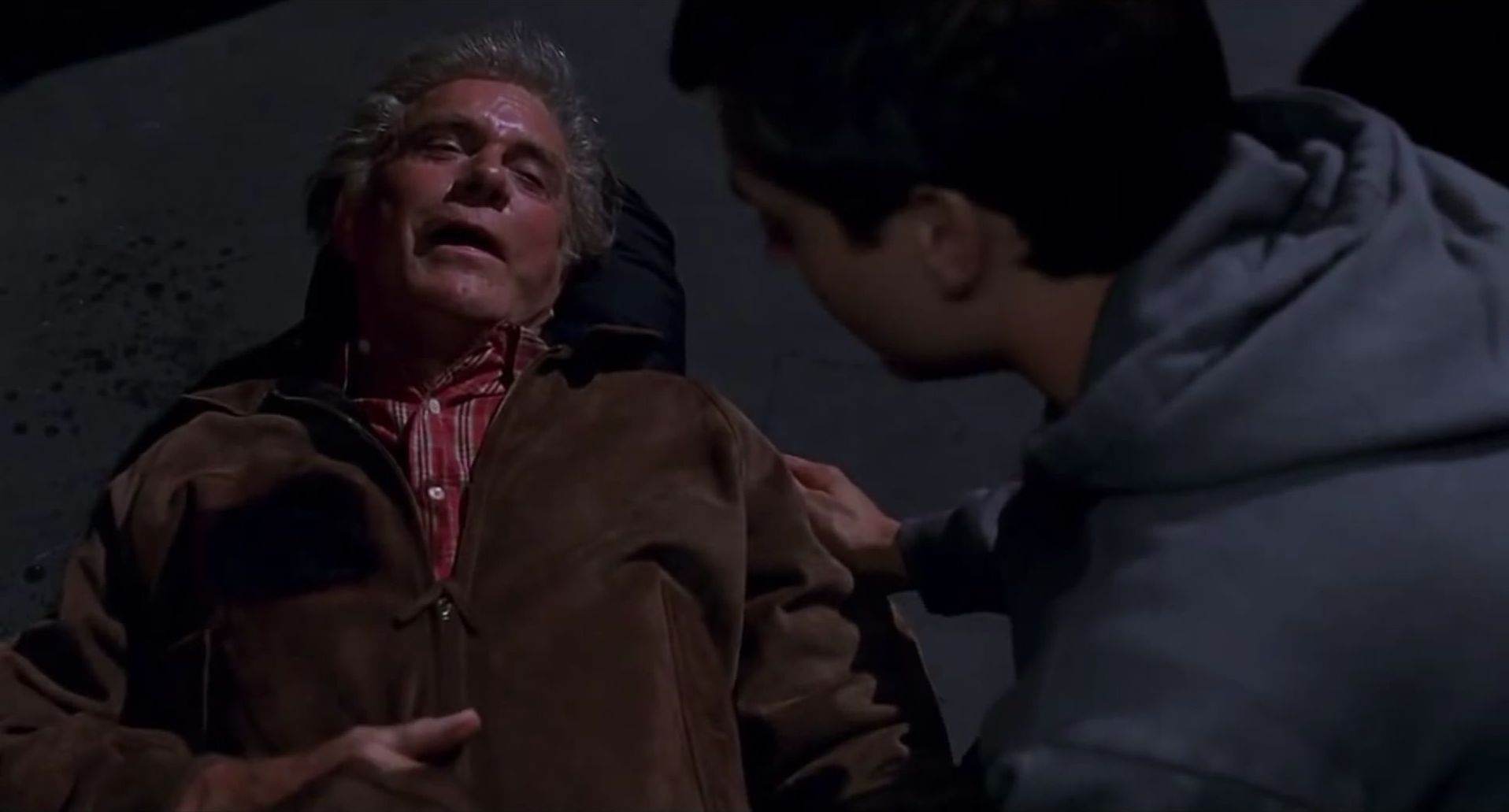
The first major screen adaptation of Uncle Ben's death arrives in Sam Raimi's Spider-Man in 2002, with Cliff Robertson as Ben Parker. The film follows the original storyline faithfully while enriching it considerably. Raimi devotes a long sequence to establishing the relationship between Peter and Ben, showing their closeness, their conversations, their mutual love. The scene in the car, where Ben delivers the fateful words "with great power comes great responsibility", has become one of the most memorable scenes in superhero cinema. Tobey Maguire brings a devastating vulnerability to it, snapping irritably at an uncle who is simply trying to guide his nephew through the turbulence of adolescence.
Ben's death is caused by a carjacker whom Peter lets run off after being cheated by a wrestling promoter. The discovery of the body in the street and the pursuit of the killer faithfully reproduce the structure of the comics, with an emotional intensity that moved millions of viewers. That scene is part of the reasons this version remains so popular with fans.
The Amazing Spider-Man with Andrew Garfield (2012-2014)
Martin Sheen plays a more combative Ben Parker, who steps in to stop a thief in a corner shop and is shot dead in the confrontation. The film leans into Peter's quest for revenge, as he spends weeks hunting the murderer through the streets of New York, an obsession that leads him towards his Spider-Man identity. This interpretation stresses Peter's raw anger rather than the introspective guilt of the Raimi version, a nuance that recalls the Back in Black arc from the comics.
The MCU with Tom Holland: absence as a narrative choice
The MCU makes a brilliant decision: never to show Uncle Ben's death. In Homecoming, Ben is never mentioned by name. That choice avoids repeating a scene already seen twice in fifteen years and turns Ben's absence into a ghostly presence. The suitcase bearing the initials "B.F.P." in Far From Home is one of the few visual clues confirming that he existed. Only in No Way Home is the line "with great power comes great responsibility" finally spoken, by May Parker this time, creating an emotional bridge between every version in an extraordinary multiverse moment. The subject is covered in more detail in All of Spider-Man's Deaths in the Comics: When Did Peter Parker Really Die?.
The alternative versions: Ultimate, Spider-Verse and What If
The Ultimate universe: an even more brutal death
In the Ultimate Marvel universe, launched in 2000, Brian Michael Bendis and Mark Bagley rewrite Uncle Ben's death with amplified intensity. Ultimate Spider-Man #1 to #7 spread the story across seven issues instead of a single one, giving the reader time to grow deeply attached to Ben Parker before he is torn away. In this version, Ben is shot by a carjacker named Dennis Carradine as he leaves the family home. The death is more explicit, more violent, and Peter's reaction is heartbreaking. Bendis pushes Peter's guilt even further by showing that he had a furious row with his uncle just before the tragedy, adding a layer of regret to an already unbearable pain. Many readers consider this version the most emotionally devastating of all the iterations of Ben Parker's death.
Spider-Verse: Ben Parker as Spider-Man
The Spider-Verse event explores the infinite possibilities of the multiverse, and among them realities in which Ben Parker himself becomes Spider-Man. On Earth-3145, an elderly Uncle Ben wears the spider suit in a post-apocalyptic world, offering a poignant vision of what the character might have become had he survived and received the powers instead of Peter. These variations are not mere curiosities, they demonstrate the archetypal strength of Ben Parker as a character, his ability to embody heroism whatever the reality he exists in. The Spider-Verse thus offers a touching tribute to a character whose death defined an entire narrative universe.
What If: the realities where Ben survives
Marvel's What If series has explored several times what would have happened if Uncle Ben had survived. In those alternative realities, Peter Parker often becomes a less tormented but also less determined hero, paradoxically confirming that Ben's death was necessary to the birth of Spider-Man as we know him. Some versions show a Peter who abandons the costume out of boredom, others a Ben who discovers his nephew's secret and helps him in his mission. These narrative explorations reinforce the idea that tragedy is constitutive of Spider-Man's identity, that without the pain the hero cannot fully exist. That reflection on fate and sacrifice sits at the heart of the greatest ordeals Spider-Man has faced.
The lasting psychological impact on Peter Parker
Uncle Ben's death is not a one-off trauma that Peter Parker gets over with time. It is a permanent wound, an emotional black hole that bends the trajectory of his entire life. In the comics, Peter regularly returns to his uncle's grave, sometimes in his Spider-Man costume, sometimes in civilian clothes, to talk to him, to ask his advice or simply to cry. Those moments of vulnerability are among the most powerful in the series, because they remind us that beneath the superhero mask hides a broken young man who has never stopped punishing himself for a mistake made in his teens.
Peter's guilt shows in his inability to keep stable relationships, his tendency to push away the people he loves, his obsession with personal sacrifice. That dynamic is explored in arcs such as "The Night Gwen Stacy Died", where the death of Gwen Stacy reactivates the trauma of losing Ben. The women in his life, from Betty Brant to Carly Cooper by way of Anna Maria Marconi, all suffer the consequences of a grief that was never resolved.
Successive writers have used that wound as an inexhaustible narrative engine. In "Spider-Man: No More", Peter throws his costume in the bin, convinced that Spider-Man causes more harm than good. It is the memory of Ben that brings him back to the fight. In "Kraven's Last Hunt", Peter is buried alive and it is the thought of Ben that gives him the strength to claw his way out of the grave. In every great ordeal, in every crushing defeat, it is Uncle Ben's legacy that serves as the moral compass for a hero permanently on a knife-edge. Journalists such as Ben Urich of the Daily Bugle never understood that intimate dimension, seeing in Spider-Man only a masked vigilante rather than the grieving nephew he has never stopped being.

Spider-Man Figurine Money Box
Uncle Ben taught Peter the value of everything: protecting what matters, putting a little aside for the hard days, never wasting what life gives you. This Spider-Man money box captures exactly that spirit. Sitting on a desk or a shelf, it is a daily reminder that real wealth lies in the values we pass on. A simple object, full of meaning, like the lessons Ben murmured to Peter on their walks through Queens.
29,90 €
Keep hold of what matters
Is Ben really dead? Resurrections and clones in the comics
In a universe where death is rarely final, Uncle Ben stands out as a remarkable exception. While characters such as Jean Grey, Bucky Barnes or even Norman Osborn have come back from the dead more than once, Ben Parker has stayed dead in Marvel's main continuity for more than six decades. That permanence is deliberate. Marvel's editors and writers have long considered Ben's death one of the untouchable pillars of the Spider-Man universe, alongside the death of Gwen Stacy. Resurrecting Ben would mean cancelling out Peter Parker's founding lesson, hollowing out the very engine of the character.
That has not stopped Marvel playing with the boundary several times. In the Clone Saga, one of the most controversial arcs of the 1990s, a clone of Peter Parker named Ben Reilly appears, carrying the dead uncle's first name as a tribute. Ben Reilly wears the Spider-Man costume for a while, blurring the lines between the original and the copy, between the living and the dead. More recently, Ben Reilly has become Chasm, a tragic antagonist whose very existence is a painful reminder of Uncle Ben and everything his death represents. The Beyond arc pushed that exploration further still, asking what it means to carry the Spider-Man legacy when the lines between original identity and copy grow blurred.
Cosmic entities have tried to bring Ben back to life, offering Peter the ultimate temptation. Peter has always refused, understanding that resurrecting his uncle would be to deny responsibility itself. It is a magnificent paradox: Uncle Ben can only remain the symbol of responsibility if he stays dead. That narrative tension remains one of the most powerful springs of the Spider-Man saga. The Brand New Day arc showed how far Peter was willing to go by making a pact with Mephisto, not to resurrect Ben but to save May, proving that Ben's lesson transcends even the offers of demons.
Uncle Ben's legacy: more than a character, a symbol
Uncle Ben is a unique case in the history of comics. He is one of the most influential characters in the Marvel universe even though he appears in only a few pages of the original comics. His impact comes not from what he does, but from what his death sets off. He is the catalyst, the detonator, the flame that lights the fire. Without him, no Spider-Man. Without his death, no hero. It is a remarkable piece of narrative economy: Stan Lee and Steve Ditko created a character whose narrative function is to die, and that death is so perfectly built that it still resonates more than sixty years later.
Ben Parker dies in a simple burglary gone wrong, an ordinary, realistic death. It is that ordinariness that makes it devastating. By anchoring the tragedy in everyday life, Lee and Ditko opened the door to a more mature kind of storytelling that would transform the comics industry. Ben has also become a cultural archetype: the mentor who has to die so the hero can be born, like Obi-Wan or Dumbledore. But where those characters die fighting evil, Ben dies because of his protege's inaction. Uncle Ben dies in the moral vacuum Peter leaves behind when he refuses to act, and it is that vacuum Spider-Man will spend his life filling. For fans who want to explore other little-known figures around Peter, the article on Peter Parker's parents reveals another side of this family marked by loss.
Ben's influence is felt in every piece of Spider-Man merchandise. The most moving Spider-Man figures are the ones showing Peter unmasked, vulnerable, a reminder of the grieving boy behind the hero. The best-selling Spider-Man posters are not the ones showing spectacular action, but those that capture the web-slinger's solitude, perched on a skyscraper, gazing over the city he protects in memory of his uncle. Even the most popular Spider-Man T-shirts often carry that now universal quotation, proof that Ben Parker's message has moved beyond the pages of the comics and into popular culture worldwide.
Whether it is a Spider-Man plush toy to pass the story on to the youngest fans, a Spider-Man mug to start the day with the hero's philosophy, a Spider-Man costume to embody the values of responsibility, or Spider-Man toys so that children grasp the lesson instinctively, every piece of merchandise carries part of Ben's legacy. Spider-Man pyjamas accompany the dreams of those who believe one individual can make a difference. The collection of best-sellers reflects that deep emotional connection between fans and the character, and when it comes to the perfect Spider-Man gift, nothing beats an object that embodies that philosophy.

Gothic Spider-Man Oversized T-shirt
Behind every mask hides a pain. This oversized T-shirt and its gothic design capture the darker side of Spider-Man, the one only true fans understand. Wearing this design means acknowledging that heroism is born of suffering, that Peter Parker's strength comes from losing his Uncle Ben. A piece for those who know that the deepest courage is the kind forged in grief.
29,90 €
Wear the hero's shadow
Conclusion: why Uncle Ben's death remains the most important in Marvel
Uncle Ben Parker's death is not simply a tragic event. It is the founding moment of a modern myth, the cornerstone of the whole Spider-Man edifice. In eleven pages of Amazing Fantasy #15, Lee and Ditko touched something profoundly universal: guilt, responsibility and the way a single mistake can define the rest of a life.
That death is not the work of a cosmic supervillain. It is the result of a human choice, ordinary and selfish: not helping when you could. Every reader can recognise themselves in that moment, because we have all looked away when someone needed help. Ben's death reminds us that our inaction has consequences, and it is that duality that makes Peter the most human hero in the Marvel universe.
Whether you discover Spider-Man through the films, the animated series or the comics, Uncle Ben's death is always there, silent and ever-present. Spider-Man's true power lies not in his strength but in the lesson an old man passed on to him as he died on a quiet street in Queens. From Secret Wars to his adventures against his most formidable enemies, every fight Spider-Man takes on is an echo of that night when Peter Parker was born a second time, as a man who refuses to let inaction destroy what he loves. To dive deeper into the world of the Spider-Man characters, to discover the most moving moments of his saga, the story of Electro or the hidden details in the films, Uncle Ben's story is only the beginning of a journey that never stops surprising you.

