
14-Day Money-Back Guarantee
0
The short answer
Directed by Bob Persichetti, Peter Ramsey and Rodney Rothman for Sony Pictures Animation, the feature won the Oscar for Best Animated Feature. Its gamble: follow a Brooklyn teenager backed by five spiders from parallel dimensions, in a visual style that imitates a printed comic book. Production, story and graphic choices are detailed below.
In December 2018, an animated film landed out of nowhere and redefined what a superhero film could be. Spider-Man: Into the Spider-Verse does not simply tell another Spider-Man story: it blows the very concept of Spider-Man into a thousand colourful shards, introduces the wider public to a hero comic book fans already adored — Miles Morales — and puts an idea on the table that is as simple as it is revolutionary: anyone can wear the mask. Here is a look back at the animated stroke of genius that changed everything, from its plot to its visual style, without forgetting the trilogy it launched.
Into the Spider-Verse: the film that reinvented the animated superhero
Produced by Sony Pictures Animation and driven by the creative duo Phil Lord and Christopher Miller, Into the Spider-Verse is directed by Bob Persichetti, Peter Ramsey and Rodney Rothman. On paper, the ambition looked mad: adapting one of the most filmed characters in history as animation, at the very moment when Tom Holland's live action versions were smashing the box office. Why would audiences go and see yet another Spider-Man?
The answer lies in a single gamble: do not retell Peter Parker's story, tell the story of the boy who takes over. And do it with a visual style nobody had ever dared put on screen. The result swept up the Oscar for Best Animated Feature, buried the critics under praise and proved there were still endless ways to tell the story of the web-slinger. To place this film within the vast mosaic of the multiverse, our feature on every Earth in the Spider-Man multiverse puts each character back in their dimension of origin.
The story: how Miles Morales becomes Spider-Man
A Brooklyn teenager like no other
Miles Morales is a mixed-race teenager of African-American and Puerto Rican descent, torn between the Brooklyn neighbourhood he loves and the posh boarding school his parents have enrolled him in. His father, a police officer straight as a die, dreams of a well-behaved son; his uncle Aaron, cooler and more shady, takes him tagging in the subway tunnels. And it is in one of those tunnels that everything changes. To get to know the character in depth, our profile of who Miles Morales really is goes into his comic book origins and his rise.
The bite, the grief, and the burden of the mask
A radioactive spider bites him. Shortly afterwards, Miles watches helplessly as the Peter Parker of his own dimension is killed by Kingpin. He inherits a role he never chose, with powers he cannot control — his hands stick to everything, his camouflage kicks in whenever he panics. That is where the whole strength of the film lies: Into the Spider-Verse is not the story of a fully formed hero, but that of a terrified kid learning, fall after fall, to take that famous leap of faith that defines Spider-Man.

The multiverse assembled: six Spiders in a single film
The real feat of the screenplay is the way the film introduces the multiverse without ever losing its audience. While trying to destroy Kingpin's collider, Miles sees five other spiders from parallel universes crash into his dimension. Each one brings its own tone, its own graphic style and its own story.
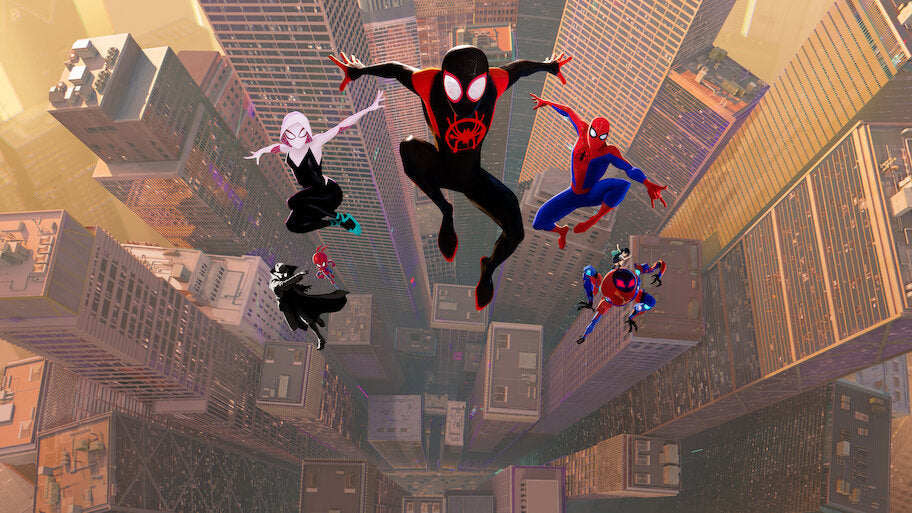
First there is Peter B. Parker, a forty-something Spider-Man, divorced, paunchy and jaded, who becomes Miles's mentor in spite of himself. Then there is Gwen Stacy, aka Spider-Woman, the teenager from Earth-65 who Miles instantly falls for. There is Spider-Man Noir, straight out of a black-and-white 1930s crime story, Peni Parker and her SP//dr mecha from a manga-flavoured future, and finally Spider-Ham, the cartoon spider-pig straight out of a Looney Tunes short. Making five radically different animation styles coexist in the same shot without the whole thing turning into visual mush: that is the technical miracle of the film.

Miles's coming-of-age journey: mentor, friendship and first love
What gives the film its soul is the relationship between Miles and Peter B. Parker. The tired old Spider-Man wants nothing to do with training a kid at first; yet he ends up recognising himself in this rookie hero, and that gruff handing-over becomes the emotional thread of the story. Where other films would have sunk into pathos, Into the Spider-Verse keeps defusing the mood with humour — the USB stick scene, the chase through Aunt May's bunker, the running 'bagel' gag.
And then there is the scene. The one that stays with everyone: the 'leap of faith'. Miles, finally ready to accept his role, throws himself off a Manhattan skyscraper, the camera flipped, while 'What's Up Danger' plays. The image turns over, the city rolls above him, and in that same instant you understand that the frightened boy has become a hero. It is one of the most iconic shots in modern animated cinema, regularly cited as the visual and emotional peak of the film.
A visual knockout: the animation that changed everything
If a single word had to sum up Into the Spider-Verse, it would be 'texture'. The film is not chasing the smooth photorealism of Pixar productions: it wants to look like a comic book in motion, an open page right in front of your eyes. The studios developed brand-new techniques to get there — Ben-Day dots printed onto the image itself, deliberate chromatic aberrations that shift outlines into red and blue, sound effects and thought bubbles overlaid on screen.
A brilliant detail, often invisible on a first viewing: Miles's animation initially runs at a choppier rate than the other characters, as if he were not yet 'in sync' with his role as a hero. As he grows in confidence, his animation becomes smoother. The style literally tells the story. It is this comic-book aesthetic that has inspired a whole wave of animated films since, and that makes every shot a potential poster for your wall.

A cult soundtrack and a moving tribute to Stan Lee
It is impossible to talk about Into the Spider-Verse without mentioning its music. Where most superhero films lean on a classic orchestral score, this one fully embraces Miles's world: hip-hop. The soundtrack, produced with extreme care, fits its Brooklyn hero like a second skin. 'Sunflower' by Post Malone and Swae Lee became a global phenomenon, while 'What's Up Danger' carries the cult leap scene. The music is never mere decoration: it tells you who Miles is, where he comes from, and what he becomes.
The film also hides a moment of huge emotion for fans. Stan Lee, who died a few weeks before release, has a cameo as a costume seller. He says to Miles, about a Spider-Man costume that looks too small: 'It always fits… eventually.' A throwaway line that became heartbreaking, followed by a tribute card to Stan Lee and Steve Ditko, the creators of the character, at the end of the credits. A quiet, perfect farewell to the father of Spider-Man.

Immersive décor
Into the Spider-Verse Tapestry
Bring the comic-book look of the film into your home. A large-format wall piece in electric colours, perfect for turning a bedroom into a portal to the multiverse.
Kingpin, the Prowler and the emotional drama of the film
Behind the visual fireworks, Into the Spider-Verse hides a surprisingly dark heart. The main villain, Wilson Fisk aka Kingpin, is not a simple megalomaniac: he builds his dimensional collider to try to get back the wife and son he lost, killed as they fled from him. An antagonist driven by genuine grief, which makes him all the more chilling.
But the real gut punch of the film is the Prowler. Beneath the mask of the fearsome killer working for Fisk hides Aaron Davis — the beloved uncle of Miles. The scene where Aaron recognises his nephew's voice under the Spider-Man mask, refuses to shoot, and pays for it with his life, remains one of the emotional peaks of the film. Our feature on who the Prowler really is looks back at this key multiverse character and his tragic bond with Miles.

Cult object
Into the Spider-Verse Poster
Every shot of the film is already a frameable work of art. Put up the style that swept the Oscar: pop colours, printed dots and Miles mid leap of faith.
Why Into the Spider-Verse made cinema history
Beyond the 2019 Oscar and its huge commercial success, Into the Spider-Verse left a lasting cultural mark for one precise reason: its message. 'Anyone can wear the mask.' The film universalises Spider-Man, detaches him from a single face, a single skin colour, a single gender. It tells every child who sees themselves in Miles: this hero could be you.
That idea, radical in its simplicity, gave the character back a depth that the endless live action films were starting to dilute. It also opened the door to a wider reflection on the place of the web-slinger in pop culture — a debate we explore in our piece on the Spider-Verse arc that redefined the world of the web-slinger in the comics, which the film draws on directly.
A film that changed the whole animation industry
The influence of Into the Spider-Verse goes far beyond Spider-Man. By proving that a mainstream animated feature could break free from the smooth 3D look imposed for twenty years, it set a whole generation of creators free. You can find its visual DNA in films like Teenage Mutant Ninja Turtles: Mutant Mayhem, Puss in Boots: The Last Wish or The Mitchells vs. the Machines, all driven by that same desire to commit to a strong, textured graphic style, imperfect in the best sense of the word. The studios understood that an audience hungry for something new wanted more than technical perfection.
The film also sped up recognition for characters who had been niche until then. Without Into the Spider-Verse, Miles Morales would probably not be the star of hit video games today, nor a serious candidate for a live action adaptation. The feature acted as an accelerator, turning niche heroes into global icons, and proving that the spider multiverse was a creative gold mine that is far from exhausted.

Cosy multiverse
Into the Spider-Verse Blanket
The perfect companion for trilogy nights. A soft blanket covered in artwork from the film, so you can watch Miles pull on the mask again, snug under the multiverse.
From Into to Across and Beyond: the animated trilogy
Into the Spider-Verse was such a success that a sequel was inevitable — and Sony thought big, turning the film into a trilogy. In 2023, Across the Spider-Verse pushed the concept even further, with hundreds of spiders on screen, the arrival of Miguel O'Hara, the Spider-Man 2099, and a cliffhanger that drove fans wild with impatience.
That leaves the grand finale: Beyond the Spider-Verse, meant to close out the adventure of Miles. Long delayed, the film now has an official release date that we detail in a dedicated feature. If you loved the emotional power of Into the Spider-Verse, know that this third instalment is awaited as one of the biggest events in the whole spider saga.
FAQ — Into the Spider-Verse
Do you need to know the comics to understand the film?
Absolutely not. Into the Spider-Verse is built as a way in: the film explains the concept of the multiverse itself, with humour and clarity, through the repeated 'origin stories' of each character. That is precisely one of its strengths — a complete newcomer follows everything, while the long-time fan savours the nods.
Does Miles Morales really exist in the comics?
Yes, and he has for a long time. Miles appeared in 2011 in Marvel's Ultimate universe, created by Brian Michael Bendis and Sara Pichelli. He was already a much-loved character among readers before the film, which mainly served to make him known to the wider public. Today he is one of the most popular Spider-Men, video games included.
What is the link with the Tom Holland films?
No direct link. The Spider-Verse saga is an animated franchise completely independent from the MCU. The two universes coexist without crossing over — even if the multiverse concept, explored here first, later rubbed off on the live action films.
Why did the film win the Oscar?
For its unprecedented visual daring and its ability to marry technical innovation with genuine emotion. In 2019 it beat Pixar and Disney productions, which was far from a foregone conclusion. It is now considered one of the greatest animated films of all time.
In what order should you watch the trilogy?
In release order: Into the Spider-Verse (2018), Across the Spider-Verse (2023), then Beyond the Spider-Verse. The story of Miles runs continuously across the three films — starting with Into is essential if you want to grasp the full scope of what follows.
Is there a post-credits scene?
Yes, and it made an impression. Right at the end of the credits, Miguel O'Hara, the Spider-Man 2099, appears, perfecting a device for travelling between dimensions. The scene, funny and intriguing at the same time, directly sets up the central role of Miguel in Across the Spider-Verse — and gave birth to one of the most famous memes on the internet, the one with the two Spider-Men pointing at each other.
Is the film suitable for children?
Broadly yes, from around 7-8 years old. The humour, the colours and the pace speak to younger viewers, but a few violent scenes (the death of Peter Parker, the sacrifice of uncle Aaron) and the sheer visual density may call for a parent alongside. It is a film that parents and children often enjoy together, each for different reasons — a real family film in the best sense of the term.
3 reads to stay in the multiverse
From the animated film to live action, from the head-to-head to the sequels ahead — here is the logical next step in your exploration.

