

14-Day Money-Back Guarantee
0
The short answer
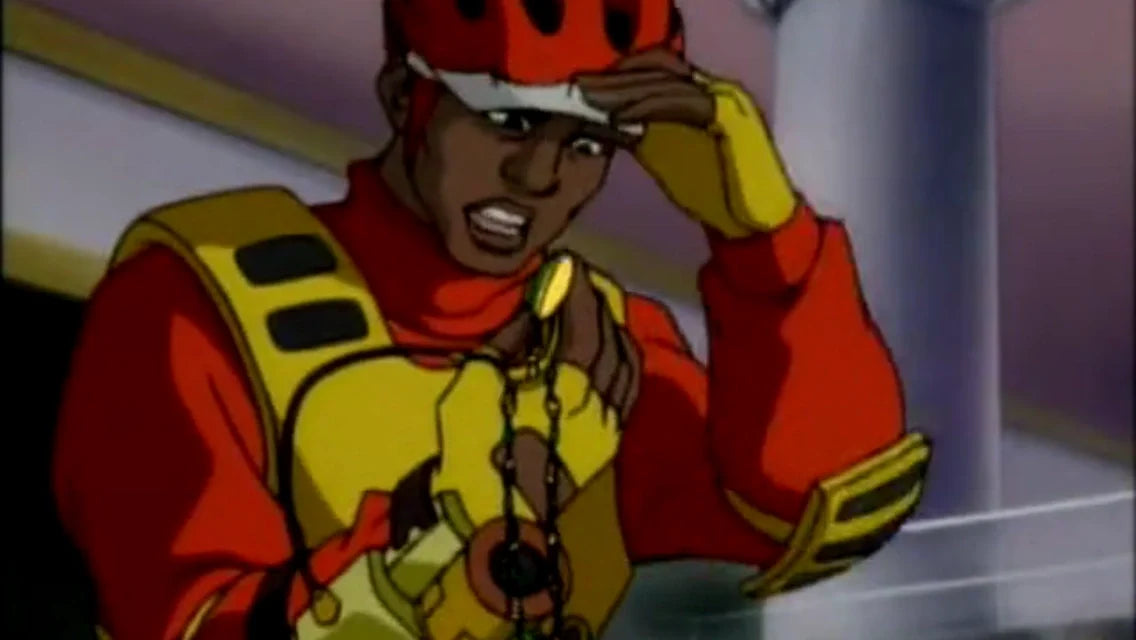
Robert Farrell, alias Rocket Racer, is a self-taught engineer raised in Harlem who turns to crime to pay for his mother's care and feed his brothers. Created by writer Len Wein and artist Ross Andru in Amazing Spider-Man #172 (September 1977), he takes on the web-slinger with a rocket-powered board and magnetised projectiles, before earning his respect. We break down his story below.
In July 2026, as Marvel Studios prepares a new wave of supporting-character appearances in the wake of Beyond the Spider-Verse, a name few fans know is quietly resurfacing on forums and in video essays: Rocket Racer. This young Black man from Harlem, riding a skateboard fitted with micro-rockets and electromagnetic discs, has never had his own film, his own animated series, or even his own one-shot. And yet, ever since his explosive debut in Amazing Spider-Man #172 in September 1977, Robert Farrell has embodied something rare in the web-slinger's world: an antagonist whose moral failing is inseparable from social hardship, a thief who never wanted to hurt anyone, an antihero Peter Parker himself came to respect. This article traces the full story of Rocket Racer, his kit, his enemies, his unlikely alliances, and why, almost fifty years after his creation, he remains one of the most endearing and most overlooked characters in the Spider-Man saga.
1970s Harlem as the birthplace of a street-level antihero
To understand Robert Farrell, you first have to understand the context in which Len Wein and Ross Andru created him. In the mid-1970s, Marvel was going through a phase of social introspection: writers such as Roger Stern, Chris Claremont and Steve Englehart were pulling their characters into murkier, more urban territory, closer to their readers' economic reality. Harlem became a recurring backdrop, Luke Cage's stamping ground and the birthplace of several new figures. It is in this climate that Robert Farrell appears, an African-American teenager raised by a single mother in an overcrowded flat in the south of the neighbourhood, the eldest of a family he has to feed alone after his father's death.
Farrell is what people at the time called a 'mechanical prodigy', a self-taught young engineer trained at the local technical school, able to patch up motorbike engines with scooter parts and to programme microprocessors on boards salvaged from Bronx scrapyards. This portrait is no throwaway detail: it places Rocket Racer straight away in a very specific lineage, that of the Spider-Man villains whose arcs would deserve a solo film, those characters whose crime is almost the logical consequence of a system that let them down. Where Vulture embodies the resentment of the cheated technician, Farrell embodies raw talent with nowhere to go, intelligence that never found a legal way out.
So it is not out of cynicism that Robert puts on his gear for the first time. It is out of necessity. His mother is ill, his younger brothers are hungry, his rent is three months overdue, and when a stranger offers him a sum that would cover a year of debt to steal a shipment, he says yes. That reasoning, perfectly human and perfectly ordinary, would go on to be the raw material of every later appearance. Rocket Racer is never a villain out of ideology. He is a young man caught in a moral dilemma that Peter Parker, a middle-class orphan from Queens, understands better than most of his opponents.
Amazing Spider-Man #172: the first appearance and the visual jolt
The first encounter takes place in Amazing Spider-Man #172, cover-dated September 1977. Peter Parker is patrolling the rooftops of Manhattan when he spots a strange figure tearing along the avenues at full speed, propelled by a skateboard fitted with two miniature thrusters. The image sticks: in a decade when skate culture was exploding in Venice Beach and New York, Ross Andru captures exactly the street fashion of the moment and lays it over the superhero imagination. Rocket Racer is the first serious opponent of the web-slinger to use a tool that has since become a global symbol of counterculture.
The fight that follows is short but memorable. Farrell surprises Peter with his manoeuvrability, forces him to improvise counter-intuitive leaps, and gets away by hurling one of his electromagnetic discs at his pursuer (more on those shortly). What matters in this opening scene is that Peter does not look down on him. He treats him not as a ridiculous enemy, despite appearances, but as an opponent to be taken seriously. That same tone comes back later with other offbeat antagonists such as Big Wheel, a villain so absurd he becomes touching, or Shocker, whose shockwave gauntlets look grotesque right up until they work.
What stands out most in this founding issue is the way the story looks at Farrell. Peter, in his role as a Daily Bugle journalist, traces the incident back and finds Robert's flat, his bedridden mother, his little brothers in tears. The web-slinger then chooses not to turn the thief in to the police straight away and offers a kind of unspoken understanding. That empathy does not make Farrell an ally, not yet, but it plants the seed of a relationship that will develop over the next twenty years, punctuated by quiet returns in back issues and crossovers.
URBAN STREETWEAR - GRAFFITI-EFFECT TRAINERS

Spider-Man High-Top Trainers - Graffiti Effect
129,90 EUR
The graffiti and street spirit of Harlem on your feet. A pair that turns heads on a night out as much as on a board.
Discover itAnatomy of an unlikely kit: the rocket-powered board and the electromagnetic discs
Plenty of Marvel supporting characters end up forgotten because their gimmick fits on a single line. Rocket Racer, by contrast, benefited from remarkable design work by Ross Andru, and later Ron Frenz. His kit is worth dwelling on, because it shapes all of his action scenes and explains why Peter Parker never managed to neutralise him as easily as a run-of-the-mill opponent.
The centrepiece is of course the skateboard. Unlike a standard board, Farrell's is a reinforced composite, mounted on four trucks angled slightly backwards to optimise lift when the micro-rockets fire. Those thrusters, set beneath the tail of the deck, burn an experimental liquid fuel Robert synthesised himself, delivering enough thrust to push the whole thing to a top speed of around 150 km/h. Control comes from weight transfer and from a miniature joystick built into the right heel of the costume, which lets Farrell stay upright, hands free, while he manoeuvres.

The second key element is the steel-rimmed electromagnetic discs he carries on his belt and throws like frisbees. The discs cling to metal surfaces through polarisation, which lets him both pin opponents down (by planting a disc on a wall behind them and magnetising their weapons) and create improvised ramps to bounce off into the air. The comparison with the gadgets of Hobgoblin, the diabolical heir to the Green Goblin, is striking: where Roderick Kingsley develops his pyroclastic pumpkin bombs in a lavishly funded laboratory, Farrell cobbles his discs together in a Harlem basement with a second-hand lathe. The talent is equal; the means are not.
Finally, the costume itself. A synthetic-fabric suit in yellow and orange, an aerodynamic full-face helmet with an infrared visor, reinforced gloves to absorb the impact of high speed: nothing flashy, everything functional. It is an engineer's design, not a supervillain's. Anyone who enjoys diving into the mechanical lore of the Spider-Man universe will want to read our look at all the records and standout gadgets of the franchise, where Rocket Racer's kit is cited as one of the most energy-efficient inventions in the arachnid rogues' gallery. To take this thinking about costume craft and the way Marvel translates it to the screen further, the collection devoted to Spider-Man web-shooters and the Spider-Man cosplay collection offer several replicas that echo, in a wholly different register, that same obsession with the functional gadget.
The real face of Robert Farrell: family, morals and a double life
What makes Rocket Racer interesting in the long run is not his kit, ingenious as it is. It is his everyday life. Robert Farrell is one of the few of the web-slinger's antagonists whose address, mother's name and brothers' first names we know precisely. That biographical closeness puts him among the most human figures in the Marvel rogues' gallery, the ones whose writers take the time to sketch out the family life off-panel. Think of Harry Osborn, whose relationship with Peter swings constantly between friendship and hatred, or even of Peter Parker himself, whom an excellent article takes apart in our feature on his real face.
Robert's mother suffers from a chronic illness that keeps her from working. His two younger brothers, Bobby and Aaron, are still at primary school. Robert himself broke off his engineering studies when his father died, unable to afford to carry on, and lives off the little he can pick up as a day-rate mechanic. The move into organised theft is not an ideological conversion: it is a pragmatic shift. He would steal less if he earned more. That clear-sightedness means that, in several of his later appearances, Robert openly expresses his shame, turns down jobs he judges too violent, and negotiates his targets to avoid anyone getting hurt.
This in-between morality, neither heroic nor criminal, places Rocket Racer in a very particular category of the Spider-Man rogues' gallery: the figures whose relationship with the web-slinger cannot be reduced to a simple fight. You find it too in Spot, that low-key but fascinating enemy of the Spider-Verse, and in Electro, a supervillain who never quite got over his humble beginnings as an electrical labourer. These nuanced characters form what you might call the web-slinger's 'second ring' of opponents: not the Sinister Six, not extras either, but a middle layer essential to the depth of the universe.
CULT STREETWEAR - BASEBALL JACKET

Spider-Man Baseball Jacket
129,90 EUR
Seventies streetwear aesthetics, revisited. The iconic varsity jacket cut, with the web-slinger's energy.
Discover itBig Wheel, the Terrible Tinkerer and the underground scene of criminal inventors
An often-forgotten aspect of Rocket Racer's story is how he fits into a wider network of fringe inventors orbiting the New York underworld. That network, run in large part by the famous Terrible Tinkerer (Phineas Mason), acts as a genuine underground marketplace: it is there that Scorpion first kits himself out with his mechanical tail, there that Boomerang orders his returning blades, and there that Robert Farrell ends up crossing paths with another unusual customer: Jackson Weele, alias Big Wheel.
The meeting between the two characters is one of the strangest, and most moving, moments of the late seventies. Weele, a ruined businessman, had the Tinkerer build him a gigantic cylindrical machine: an armoured wheel three metres across, motorised, capable of rolling through Manhattan like a bulldozer. Big Wheel appears in Amazing Spider-Man #182 with the aim of crushing Farrell, whom he blames for stealing a shipment that was meant to save him from bankruptcy. Cornered, Rocket Racer finds himself fighting for his life against an opponent barely less desperate than he is. The scene builds to a confrontation in the streets of New York, where Peter Parker eventually steps in to separate the two men and stop one from killing the other.
The Rocket Racer / Big Wheel pairing is remembered as one of the great moments of tragic strangeness in the Marv Wolfman era. Both figures are mentioned in our analysis of the way Spider-Man draws explosive team-ups of enemies towards him, not because they belong to the Sinister Six, but because they illustrate the idea that in New York two of the web-slinger's opponents can also become allies in misfortune. This rivalry between small-time criminals, a long way from the glamour of Norman Osborn as the Green Goblin or of Kraven the Hunter stalking his prey like an avenging god, is what gives the late-70s comics their distinctive, almost documentary texture.
From thief to antihero: the slow conversion written by Roger Stern
The character's decisive turning point comes in the early 1980s, from the pen of Roger Stern. Having become the lead writer on The Amazing Spider-Man from 1982, Stern inherited an overcrowded rogues' gallery and decided to bring several forgotten figures back to the surface, Rocket Racer among them. He gives him a three-part arc in which Farrell tries in turn to find honest work, has his applications rejected by several companies because of his record, then finally accepts, not without hesitation, a technical assistant post in a municipal laboratory thanks to a letter of recommendation written by Peter Parker.
That small scene, almost invisible to casual readers, says a great deal about the philosophy Stern wanted to stamp on the series. The web-slinger is not just a vigilante who puts criminals in prison; he is also a brotherly figure who, when the chance arises, holds out a hand to those who might be saved. It is exactly the logic Stern would later apply to Sandman, whom he would make a fully fledged member of the Avengers. Rocket Racer thus becomes one of the very first cases of redemption accepted by modern Spider-Man lore, long before the Punisher's moral hesitations or the on-again, off-again relationship Peter has with Frank Castle.
In the years that follow, Farrell returns from time to time as an occasional ally, lending the web-slinger a hand on several street-level investigations, notably in the back issues of Web of Spider-Man. For a time he also joins the Nightwatch programme, a team of Black vigilantes operating in Harlem and Brooklyn, where he is seen working alongside figures such as Prowler and Cardiac. It is in this context that he repeatedly crosses paths with Hobie Brown, alias Prowler, the uncle of Miles Morales, and a quiet but real bond is woven between the two characters, both from Harlem, both having moved from crime to redemption.
Rocket Racer in the wider context of the web-slinger's street-level enemies
To place Robert Farrell precisely in the galaxy of the wall-crawler's antagonists, you have to compare him with his closest contemporaries. In the late 1970s, several 'second ring' characters emerge, all driven by economic rather than ideological motives. You could name Hydro-Man, a docker maimed by an industrial accident, Swarm, a Nazi scientist turned into a swarm of bees, or indeed Vermin, the human guinea pig turned sewer monster. Each of them tells, in his own way, how the web-slinger's world is populated by figures society produced rather than fought.
Rocket Racer has neither Vermin's savagery nor Hydro-Man's elemental power. Nor does he have the metaphysical dimension of Kindred, the intimate, tortured enemy recently introduced by Nick Spencer. But he has a quality few of his peers can claim: legibility. You understand what he does, why he does it, what he would rather be doing instead. That is why he still fascinates readers rediscovering the seventies runs today: he brings a human scale to a universe that, over time, has tended to give in to cosmic one-upmanship. Purists can extend this overview with our guide to all the major Spider-Man story arcs since 1962, where issue #172 is counted among the quiet but foundational milestones of the second half of the seventies.
Readers curious about this 'second ring' of antagonists will find further complementary portraits in our pieces on Cletus Kasady and the birth of Carnage, the Jackal, the web-slinger's most tragic scientific enemy, and Chameleon, the series' very first opponent back in 1963. Each profile adds a shade to this New York criminal fresco that Peter Parker has been moving through for six decades.
COMICS DEEP DIVE - THE DAILY BUGLE

Spider-Man Building Block Set - The Daily Bugle
239,90 EUR
The legendary headquarters where Peter Parker writes his articles and runs into J. Jonah Jameson every week. An exceptional piece for fans of the seventies.
Discover itRocket Racer in 2026: where to find Robert Farrell in contemporary lore
The character has never entirely disappeared, but he was long relegated to the margins. He does resurface regularly, though, particularly in multiverse-related stories. In recent Spider-Verse runs, Farrell appears in cameos on several alternate Earths, sometimes as an ally of Spider-Punk and the anarcho-punk scene of Earth-138, sometimes as the opponent of an older, disillusioned Peter Parker. That dimensional flexibility makes him an ideal candidate for future appearances in the Marvel Cinematic Universe, especially if the studios want to broaden African-American representation within the Spider-Man galaxy, still too often limited to Miles Morales, Prowler and a handful of others.
On the editorial side, it is worth noting that a Rocket Racer mini-series was pitched to Marvel in 2019 by an independent writer, without the project going anywhere. The cyclical reboot rumours circulating since Beyond the Spider-Verse, analysed in detail in our features on the Spider-Man multiverse and every version of the web-slinger and on the Web of Life and Destiny and the Spider-Totems, suggest that a return, even through a variant cover or an appearance in an annual, could well revive interest in this quiet character. For the most completist fans, our index of every Spider-Man guide in the shop offers several chronological reading routes in which Rocket Racer holds a minor but genuine place.
Some readers will prefer to explore this lore through its most iconic figures first. For them, the place to start is our overview of the seven most powerful opponents of the web-slinger, then to dig into the psychological figures such as the piece explaining why the Green Goblin remains Peter Parker's worst nightmare, or the monstrous ones such as Juggernaut, the all but unstoppable opponent. Rocket Racer then follows naturally, as a human counterpoint to these giants.
Why Rocket Racer deserves your attention today
There are several reasons to rediscover Robert Farrell in 2026, and they go well beyond simple seventies nostalgia. First, because in a genre saturated with excessive figures he embodies a realistic scale: a talented young man, constrained by hardship, capable of the worst as well as the best. Second, because he opens up a sociological reading of Peter Parker: the web-slinger, at his best, does not merely stop wrongdoers, he tries to understand why they became what they are. And finally because skate culture, so central to contemporary fashion and urban music, finds in Rocket Racer an unexpected forerunner, fifteen years before Tony Hawk and twenty before the X-Games exploded.
This kind of supporting figure, patiently enriched over the decades, is also what makes the arachnid rogues' gallery so rich compared with more recent universes. You do not find them in blockbusters; you meet them by digging into back issues, reading forgotten runs and exploring the very detailed profiles devoted to characters such as Mendel Stromm, the ghost scientist behind Norman Osborn, Silvermane, the cybernetic godfather of the Maggia, Molten Man, the incandescent and tragic enemy, and Puma, the mystical warrior who wanted to redeem the web-slinger's honour. Rocket Racer fits naturally into this gallery of 'second stringers' essential to the narrative depth of the saga.
To round out this overview and carry on reading, two further resources are worth flagging. The first is our analysis of all the web-slinger's great defeats at the hands of his craftiest opponents, which puts in context the rare episodes where Rocket Racer genuinely gave Peter trouble. The second is our feature on the complete chronology of the Marvel films in MCU order, where we discuss possible future appearances of Harlem supporting characters across the coming phases.
Rocket Racer, an antihero for patient readers
Robert Farrell may never headline a blockbuster. He probably will not get his own animated series, and his name will not be on the lips of the children pushing open the doors of Spider-Man fancy dress shops at Halloween. But for readers who take the time to dig through back issues, who comb the forgotten crossovers and who care about figures whose human arc goes beyond simple superhero mechanics, he remains one of the richest and most moving characters in the web-slinger's long history. A young engineer from Harlem, riding a rocket-powered board, who stole to feed his family before realising, thanks to a clumsy Daily Bugle journalist, that he could do something else with his life. It is a small thing and an enormous one at once. It is, exactly, the promise Peter Parker makes every week to those he meets: the promise of a second chance.
To carry on exploring this rich narrative universe, the pillar page devoted to the Spider-Man universe and all our official collections remains the most complete way in. Anyone curious about supporting figures will also find food for thought in our pieces on Morbius, an enemy apart ever since his scientific origin, and Mr. Negative, the antagonist caught between light and darkness. Finally, to dress the part, the Spider-Man clothing collection and the essential LEGO Spider-Man range offer plenty to keep your daily connection with the web-slinger's world alive, whether read, watched or worn.

