

14-Day Money-Back Guarantee
0
The key points before you choose
Three threads are enough to make sense of this warrior: a bloodline prepared over centuries to face a prophesied threat, an animal metamorphosis that risks drowning the man beneath the instinct, and a life debt owed to the web-slinger. Each strand is unpacked below.
In the vast gallery of characters orbiting Spider-Man, a handful of figures escape the usual categories. Neither truly enemies nor truly allies, they follow their own code, foreign to the ordinary morality of heroes as much as to the greed of criminals. Thomas Fireheart — the mystic mercenary known as Puma — is arguably the most fascinating of them all. A Native American warrior shaped by generations of ritual selection, chief executive of a multinational company, a predator able to transform into a superhuman feline creature, bound to Spider-Man by a debt of honour that would torment him for years: Fireheart is a character of rare richness, and yet one the wider public barely knows. Here is his full story.
The origins: a warrior shaped by centuries of tradition
Puma first appears in The Amazing Spider-Man #256, published in September 1984, written by Tom DeFalco and drawn by Ron Frenz. From the moment he was conceived, the character stood apart from the classic supervillains of the era. Thomas Fireheart is not the product of a scientific accident or a chance mutation. He is the deliberate culmination of a project centuries in the making.
Fireheart belongs to a fictional Native American tribe from the south-west of the United States. According to the mythology developed in the comics, his ancestors had prophesied the coming of a great threat — an ancient demon named Gog — and set out, generations in advance, to create the warrior capable of facing it. Through a programme of carefully arranged marriages and mystic rituals handed down from generation to generation, the tribe shaped a bloodline destined to produce an ultimate champion. Thomas Fireheart is that champion: the living vessel of centuries of tribal magic and warrior selection.
This origin gives Puma a dimension that few of Spider-Man's adversaries possess. Where Kraven the Hunter embodies the personal obsession of a man trying to prove his own superiority, Fireheart carries a collective, sacred inheritance on his shoulders. He did not choose his nature: he was born to fulfil it. That tension between imposed destiny and individual freedom is one of the character's most powerful emotional engines.
The transformation: when the man becomes the cat
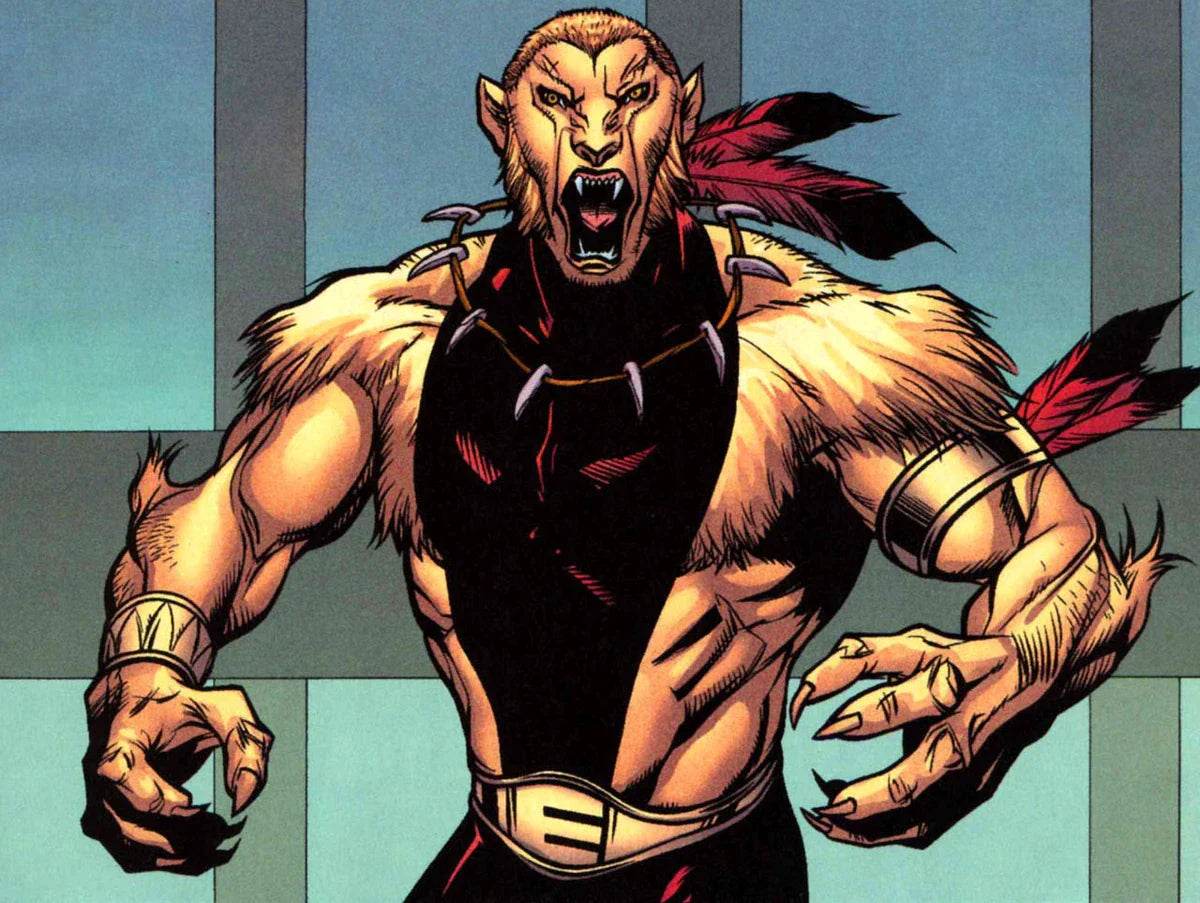
Puma's central power lies in his ability to turn into a humanoid feline creature — a being covered in golden fur, with retractable claws, razor-sharp fangs and superhuman musculature. In this form, Fireheart gains strength, speed and agility that rival Spider-Man's own. His senses are heightened to the point where he can follow a trail like a big cat, sense a presence at a distance, and anticipate an opponent's movements by smell and hearing.
But the most remarkable thing about this transformation is that it is not merely physical. When Fireheart becomes Puma, his psychology shifts too. The rational, self-possessed businessman gradually gives way to the instinct of the predator. The longer he stays in his feline form, the greater the risk of losing himself to savagery, of letting the beast take the upper hand over the man. This duality — the eternal struggle between civilisation and instinct, between control and impulse — places Puma close to the great literary tradition of the werewolf and the metamorphosis tale. The failed experiments of the Spider-Man universe have often explored this theme of humanity dissolving into the monster, but with Puma the transformation is a sacred gift as much as a burden.

The ultimate predator
Spider-Man Figurine — Kraven the Hunter
Like Puma, Kraven the Hunter embodies the archetype of the predator bound to Spider-Man by the instinct of the hunt. This collector's figurine captures the noble savagery of the greatest hunter in the Marvel universe.
69,90 € View the figurine
The mercenary of honour: a code stronger than money
Thomas Fireheart earns his living as a top-tier mercenary — one of the most expensive and most effective in the world. But what sets him radically apart from ordinary hired killers is his unbending code of honour. Fireheart never betrays a contract once he has accepted it, yet he also refuses to cross certain moral lines. His word is worth more than any sum of money, and he regards dishonour as a spiritual death worse than physical death.
This ethic places him in a very particular family of characters within the Spider-Man universe: the professional fighters bound by a code rather than by a cause. Silver Sable, the elite mercenary from Symkaria, shares Puma's moral ambiguity — neither heroine nor criminal, but a professional of violence guided by her own rules. The two characters have in fact worked together several times in the comics, forming a mercenary duo whose respective codes of honour echoed one another and sometimes clashed.
Fireheart's first mission involving Spider-Man is, ironically, a contract to eliminate him. Hired to hunt down and kill the web-slinger, Puma throws himself into the chase with the professionalism of a born predator. But that first confrontation sets off a chain of events that would change the relationship between the two men forever — and reveal the character's true nobility.
The debt of honour: the heart of the character
Puma's most striking story arc is unquestionably the debt of honour that binds him to Spider-Man. During their clashes, Spider-Man saves Fireheart's life — or acts in a way that, according to the mystic code of Puma's tribe, creates a sacred obligation. For a warrior of the Fireheart line, a life debt cannot be ignored. It must be repaid, or the honour of his entire bloodline is stained and the spiritual balance that makes him what he is falls apart.
That debt becomes an obsession for Fireheart. How do you repay a man whose identity you do not know, whose life is made of precariousness and daily struggle? The answer Puma comes up with is one of the most original plots ever devised around Spider-Man: to clear the web-slinger's reputation, tarnished for years by the smear campaign run by the Daily Bugle, Fireheart sets out to buy the newspaper itself.
The idea is fiendishly clever. Fireheart understands that the real wound inflicted on Spider-Man is not physical but reputational — it is the media war waged by J. Jonah Jameson that poisons the hero's existence. By taking control of the Daily Bugle, Puma could put an end to that campaign and restore Spider-Man's public image, repaying his debt of honour as completely as possible. This plot, which blends high finance with warrior mysticism, shows just how sophisticated the character is: Fireheart does not simply fight, he thinks, he plans, he wields capital with as much mastery as his claws.

The street-level side of New York
Detective Spider-Man Figurine
Puma moves through the New York of mercenaries, crime bosses and turf wars. This collector's figurine embodies the Spider-Man of the underworld, the one who crosses paths with the Silver Sables, the Kingpins and the hunters of honour.
79,90 € View the figurine
Fireheart Enterprises: a warrior in the boardroom
One of Puma's most modern facets is his double life as a captain of industry. Thomas Fireheart runs Fireheart Enterprises, a thriving multinational whose financial resources let him operate on a scale far beyond that of a mere mercenary. This entrepreneurial dimension gives the character a contemporary credibility and plants him firmly in the world of New York economic power.
In that world of finance and influence, Fireheart rubs shoulders with — and sometimes confronts — other figures of New York's hidden power. Kingpin, who rules the underworld from his glass towers, is the dark mirror of what Fireheart might have become: a man who converted violence into an economic empire, but without the code of honour that holds Puma back. This opposition between two visions of power — one utterly unscrupulous, the other disciplined by ancestral honour — greatly enriches Fireheart's place in the web-slinger's mythology.
The Daily Bugle takeover arc perfectly illustrates this fusion of warrior and businessman. Fireheart does not use his claws to repay his debt: he uses his chequebook, his lawyers, his financial analysts. He is a twenty-first-century warrior, aware that the most decisive battles are now fought in trading rooms as much as on the rooftops of Manhattan. That modernity makes Puma a strikingly current character, a world away from the exotic-savage cliché that less inspired eras might have made of him.
Neither enemy nor ally: Puma's grey zone
What makes Puma so valuable to writers is precisely his refusal of labels. Over the decades, Fireheart has been Spider-Man's adversary, his occasional ally, his reluctant protector, and even his partner in fights against shared threats. That narrative fluidity makes him a character authors can call on in a multitude of situations without betraying his deeper nature.
His relationship with Spider-Man swings constantly between mutual respect and mistrust. Both men share a sharp sense of responsibility, but their methods differ radically. Where Peter Parker refuses to kill and places the preservation of life above all else, Fireheart is a professional of lethal violence who treats death as one tool among others. That ethical gap fuels a permanent tension: Spider-Man can never entirely trust Puma, and Puma does not always understand the web-slinger's scruples. And yet, in the decisive moments, Fireheart's code of honour almost always puts him on the right side.
This ambiguity recalls other complex figures in the universe, such as Black Cat, whose relationship with Spider-Man also moves between alliance, seduction and conflict. But where Felicia Hardy plays on passion and transgression, Puma embodies an austere, almost monastic warrior ethic. He seeks neither love nor wealth for its own sake: he seeks to honour his destiny and to preserve the spiritual balance that defines his existence.
Gog and the ancient threat: Puma's reason for being
It is easy to forget, but Puma was not created to fight Spider-Man. His entire bloodline was shaped with a single purpose: to face Gog, the demonic entity whose coming had been prophesied by Fireheart's ancestors. That cosmic mission gives the character a mythological depth that his more down-to-earth appearances on the streets of New York sometimes leave in the shade.

The creature Gog has indeed crossed Spider-Man's path in certain arcs, notably in connection with the world of Kraven and his family, the Kravinoffs, who have maintained complex relations with the mystic and totemic forces of the Marvel universe. The fact that Puma fundamentally exists to face a supernatural threat ties him to a whole underground mythology of the Spider-Man universe — that of totems, prophecies and ancestral forces that reach far beyond a simple clash between a hero and his villains.
This dimension makes Fireheart far more than an exotic mercenary: he is the guardian of a cosmic balance, the last link in a chain of warriors stretched across the centuries towards a single decisive confrontation. Once you grasp that, Puma's appearances in more modest storylines take on a new resonance: here is a man destined to save the world from an ancient demon, and who ends up settling debts of honour on the streets of Manhattan.

A prestige piece for collectors
Spider-Man Resin Collector's Figurine
For lovers of noble characters and exceptional pieces. A premium resin figurine that pays tribute to the grandeur of the great warriors of the Spider-Man universe, in the tradition of the most sought-after collectibles.
299,90 € View the figurine
Puma in Spider-Man's criminal New York
Beyond his debt of honour and his cosmic mission, Puma belongs fully to the New York organised-crime ecosystem that forms the permanent backdrop to Spider-Man's adventures. In a world where figures such as Tombstone or The Rose fight over territory and influence, a mercenary of Fireheart's calibre is a coveted asset. The crime lords would love to secure his services; the heroes would rather neutralise him.
But Puma lets no one own him. His independence is total, guaranteed by his personal fortune and by a code of honour that forbids him from selling himself to an unworthy cause. That autonomy makes him an unpredictable agent, able to upset the balance of power simply by picking a side. Even the police, whose relationship with Spider-Man is explored in the story of the fragile alliance between the web-slinger and the New York police, regard Fireheart with a mixture of respect and caution: he is no ordinary criminal, but his power makes him dangerous to anyone who gets in his way.
This position of independent strength, neither allied nor hostile, makes Puma one of the hardest characters in the Spider-Man pantheon to classify — and that is exactly what makes him so interesting. He represents a third way between Peter Parker's sacrificial heroism and the destructive greed of the great criminals: the way of the warrior who serves nothing but his own honour.
Why Puma deserves to be rediscovered
At a time when the Spider-Man universe has never been more widely explored in film, in video games and in animated series, Puma remains strangely absent from the public eye. That is an injustice, because the character has exactly the qualities that make for great modern adaptations: a strong and respectfully handled cultural origin, a rich psychological duality, a complex ethic, and a relationship with the hero that escapes black-and-white thinking.
Thomas Fireheart is a character who asks deep questions: can you be bound by a destiny you did not choose? Does honour still mean anything in a world ruled by money and cynicism? Can you stay human when you carry the beast inside you? Those questions resonate with particular force today, and they make Puma an ideal candidate for rediscovery. The 1980s and 1990s arcs that feature him — notably the famous Daily Bugle takeover plot — are among the most original stories ever written around the web-slinger's supporting cast.
For readers who want to explore the lesser-known corners of the Spider-Man universe, Puma offers a doorway into a deeper mythology, made of prophecies, codes of honour and transformations. He is a character who proves that the best stories are not always found among the most famous villains, but sometimes among these ambiguous figures who refuse to pick a side and who, in doing so, tell us a great deal about human nature.
Conclusion: the warrior you do not forget
Thomas Fireheart, alias Puma, is the embodiment of a fascinating paradox: a modern man carrying a thousand-year-old tradition, a mercenary governed by honour, a predator who fights every day to preserve his humanity. His relationship with Spider-Man — made of respect, debt, mistrust and mutual admiration — ranks among the most subtle in the whole Marvel universe.
In a pantheon of villains often reduced to their obsessions or their madness, Puma stands out for his moral consistency and his mythological depth. He is not the most powerful, nor the most publicised, of Spider-Man's adversaries. But he is one of the noblest, one of the most complex, and one of the most unjustly forgotten. If you think you know every major character in the web-slinger's universe, the story of Thomas Fireheart will prove there are still treasures to be unearthed in the yellowed pages of 1980s comics.
To explore other mercenaries and hunters from the Spider-Man universe: discover Silver Sable, the elite mercenary who shares with Puma a professional code of honour, and dive into Kraven's Last Hunt, the absolute peak of hunt stories in the web-slinger's mythology.

