
14-Day Money-Back Guarantee
0
The short answer
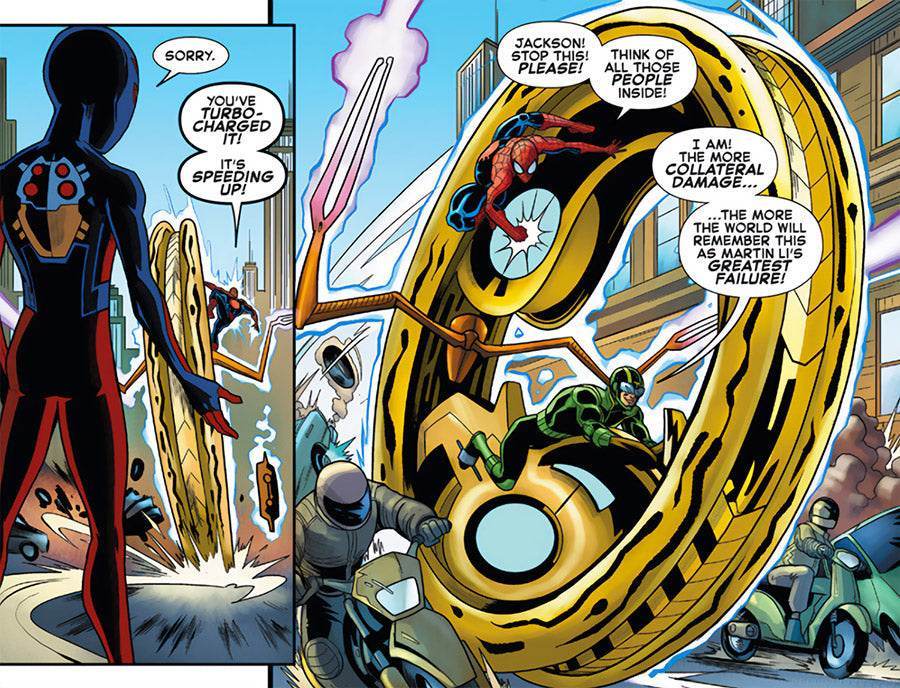
Jackson Weele, alias Big Wheel, is a businessman turned criminal who takes on the web-slinger perched atop a giant motorised wheel, first appearing in the comics in 1978. His contraption sums up Marvel's taste for the absurd in that period. We break the case down below.
Big Wheel: When the 70s and 80s Created Spider-Man's Most Ridiculous Villain
If you had asked Stan Lee and Steve Ditko, the creators of Spider-Man, to draw up a list of the most important villains in the Marvel universe, we are certain Jackson Weele would never have made the cut. And yet this eccentric character perfectly embodies a golden age when Marvel dared to be absurd, when the writers picked their pens back up after a little too much coffee in the morning. Big Wheel is not a villain who frightens anyone. He is not an existential threat like Mephisto or a fearsome brute force like the Vulture. No, Big Wheel stands for something more precious: a window onto the creative madness of a bygone era.
The Origins of a Ridiculous Marvel: Amazing Spider-Man #183
Jackson Weele made his debut in the pages of Amazing Spider-Man #183, published in September 1978. By that point, Spider-Man had already faced an impressive rogues' gallery: Doctor Octopus, the Green Goblin, the Scorpion, and countless others. But none of them carried a prop as visibly absurd as this: a gigantic mechanical wheel.
The concept was simple, almost naive. Weele, a wealthy businessman turned criminal, had decided that the best way to commit crimes was to use a giant motorised wheel. No sophisticated lasers. No armoured suit. Just a wheel. Enormous. Mechanical. And completely improbable. Somewhere in Marvel's writing rooms, a writer probably raised his coffee cup and said: 'What if the criminal simply rolled towards Spider-Man inside a huge metal circle?' And that is exactly what happened. Stan Lee and the editors approved it. Big Wheel was born.
The Giant Wheel: Crime Weapon or Masterpiece of Bad Faith
Understanding Big Wheel means, above all, understanding his wheel. This monumental machine, several metres across, made absolutely no tactical or practical sense. It was slow, predictable, and gave Spider-Man one of the easiest targets of his career. But that is exactly where its timeless charm lies. To discover more gear and gadgets from the Spider-Man universe, explore our Spider-Man gift collection and our Spider-Man toy collection.
Big Wheel's ride embodied a very 1970s mindset: the idea that technology, however stupid, was impressive by default. At the time, supernatural powers and genetic mutations had dominated pop culture, but tech-driven criminals were starting to gain ground. Weele stood for that awkward transition towards an era in which technological gadgets seemed to outdo simple creation or heredity. It was pretentious, it was ridiculous, and it was gloriously entertaining. That creative spirit of the 70s and 80s runs through our Spider-Man decor collections and our Spider-Man posters, which celebrate that vintage heritage.
In practice, the wheel made little sense as a crime vehicle. It could not turn quickly without losing control, it was hard to manoeuvre through the alleyways of New York, and it drew attention for miles around. But Big Wheel's genius lay in his absolute confidence in that absurd contraption. There was no irony, no wink to the reader. Weele sincerely believed his wheel was formidable. And it is that serenity in the face of absurdity that made him memorable for generations of Marvel readers.
Jackson Weele's Hidden Track Record: Comebacks and Reinventions
Although Big Wheel never became a regular antagonist for Spider-Man, he kept turning up sporadically across the decades. Those comebacks, few as they were, let Marvel explore how to present the character in a more modern era. The post-80s stories showed a certain narrative awkwardness with Big Wheel, as if contemporary writers were unsure whether to treat him seriously or handle him as an established joke.
Some later appearances reinvented him as a more pathetic figure, a second-string criminal hanging around with more serious thugs. Others simply dropped him into groups of minor villains where he could play his part without too many questions. These variations show how narrative sensibilities evolve. What was once presented as a legitimate villain was later understood, implicitly, as a glorious farce. And that shift in perspective says a great deal about how we, as readers, interpret heroes and villains over time.

His returns in modern comics have generally shown him as an opponent to be taken seriously at first glance, before the ridiculousness of his situation becomes obvious. It is a delicate balance, and it is precisely why Big Wheel has earned a cult following that appreciates his unintentional kitsch charm. To learn more about the strangest villains in the Spider-Verse, you can explore our analysis of the cleverest villains.
Big Wheel vs Stilt-Man and Paste Pot Pete: Marvel's Holy Trinity of Absurdity
To really appreciate Big Wheel, you have to place him among his ridiculous peers. If Big Wheel is the wheel of absurdity, then Stilt-Man is the legs, and Paste Pot Pete is the glue holding it all together.
Stilt-Man, whose real name is Wilbur Day, was an inventive mind who had decided that highly unstable motorised stilts made a solid foundation for a criminal career. Like Big Wheel, Stilt-Man embodied an era when Marvel took pleasure in absurd concepts. The difference is that Stilt-Man had a certain visual charm; he was simply a very tall bloke moving about on strange legs. It was daft, but it made visual sense.

Paste Pot Pete, next, was perhaps the most ridiculous of the three. A criminal whose main weapon was... a specialised adhesive paste. Yes, really. He threw pots of glue to fight super-heroes. For years, fans wondered how anyone could seriously believe that weapon was effective against a person with super-powers. And yet Paste Pot Pete endured, appearing regularly in Marvel comics, often alongside other second-tier villains.
What unites these three characters is a total absence of self-awareness. None of them seems to recognise how absurd their approach is. They press on with the unshakeable conviction that their method is legitimate and formidable. It is that candour in the face of stupidity that made them memorable well beyond their first appearances. Unlike genuine threats such as Spot or Mysterio, these three represent criminal naivety in its purest form.
Why Minor Villains Enrich the Spider-Man Universe
You might think the real narrative masterpieces would come from the big arcs involving Norman Osborn, the Jackal, or Mephisto. And it is true that these characters offer incomparable narrative depth. But minor villains like Big Wheel serve a function that matters just as much: they remind us that the Marvel universe is vast, unpredictable and often strangely funny. By comparison, the genuine crime titans such as Kingpin or Kraven offer structured threats, while Big Wheel embodies pure unpredictability.
Minor villains humanise Spider-Man's world. They show that New York is not populated solely by evil geniuses or superhuman creatures. It is a city where ordinary crooks with ridiculous ideas can cause trouble too. That criminal diversity makes Spider-Man's world feel more authentic, more alive and, frankly, more realistic within its own logic. If you enjoy exploring all these characters, our Spider-Man accessories collection and our Spider-Man T-shirts let you celebrate this rich universe.
What is more, minor villains offer a perfect contrast to the huge existential threats Spider-Man has to face. After battling symbiotic creatures from space or the cosmic Inheritors, a run-in with a ridiculous bloke on a giant wheel is a welcome breather. It is a moment when readers can catch their breath and enjoy the unintentional humour of the plot. Explore how these shifts in tone enrich the universe with our Spider-Man stickers and our Spider-Man film DVDs.
Villains like Big Wheel, Stilt-Man and Paste Pot Pete are also part of Marvel's creative heritage. They represent a time when the conventions of superhero comics had not yet set. Before editors decided precisely how villains 'should' act and look, there was a period when almost any idea was on the writing-room table. Big Wheel embodies that creative freedom, that willingness to try something different even when it made no sense at all. That era also produced more serious opponents such as Electro and Rhino, showing the creative reach of the period.


The Unintentional Cultural Impact: Big Wheel in Marvel's Collective Consciousness
What is fascinating about Big Wheel is that, despite his total absurdity, the character has gained a certain notoriety among long-time fans. Online discussions about Spider-Man's worst villains mention Big Wheel regularly, often with a mix of ironic affection and sincere fascination. Some fans even wear T-shirts with Big Wheel's ridiculous face on them, not out of love for the character, but precisely out of appreciation for his absurdity.
That belated recognition shows how pop culture works. Characters originally conceived as serious threats but who became unintentionally comic over time often develop a specialised cult following. Big Wheel is the perfect example. Thanks to the internet and the global circulation of niche content, Big Wheel has gained a cultural visibility he would never have achieved at the time of his original publication. Modern fans celebrate that cult status through our Spider-Man LEGO collections and our Spider-Man mugs, full of vintage nostalgia.
To discover other sides of this complex universe, have a look at our complete guide to all of Spider-Man's enemies and explore the more complex villains such as Carnage.
The Modern Transition: How Comics Handle Big Wheel's Legacy
In modern comics, writers have to navigate a delicate situation with characters like Big Wheel. How do you take seriously an opponent whose very existence is a joke? Some writers have chosen the route of unintentional redemption, placing Big Wheel in contexts where his ridiculousness becomes an advantage. Others have simply accepted his status as a cosmic joke and used him to provide comic relief within darker story arcs such as Kraven's Last Hunt or Dying Wish.
There is also a school of thought among contemporary writers that calls for dignity for characters like Big Wheel. Some have attempted reinterpretations that took Weele seriously, turning the wheel into a genuinely clever and terrifying weapon. Those attempts are generally less successful, precisely because they try to fix something that was never meant to be fixed. Big Wheel's charm lies in his unintentional refusal to conform to expectations.
The multiverse also offers interesting opportunities. In the Spider-Verse events, for instance, you can imagine alternate versions of Big Wheel that take full ownership of this daft concept and turn it into something genuinely formidable. So far, though, those explorations remain largely undeveloped.
Big Wheel and the Psychology of the Absurd in Comics
From a psychological point of view, Big Wheel embodies a fascinating concept: the unconscious absurd. The character does not exist to explore a complex philosophical idea. He exists because someone thought it was cool. And that simplicity is exactly what makes him interesting to analyse.
Comics psychologists have often pointed out that the most memorable characters are frequently those who embody one very specific, clearly defined trait. Spider-Man has guilt and responsibility. Green Goblin has instability and duality. Venom embodies parasitic revenge, while Big Wheel simply embodies absolute confidence in a terrible idea. It is a basic lesson in character psychology.
That theme of confidence in the face of adversity, even when that adversity is entirely unjustified, says something about the human mind. Big Wheel reminds us that sometimes the worst ideas are delivered with the greatest conviction. It is a metaphorical lesson in not mistaking confidence for competence.
Where to Watch and Read: Big Wheel in the Marvel Canon
For readers keen on the full Big Wheel experience, the starting point is unmissable: Amazing Spider-Man #183. But if you are after a fuller understanding of the Marvel universe of that era, we recommend our complete chronological guide to the Spider-Man films and comics. You will also find out where Big Wheel fits into the comics to read as a beginner and how he feeds into the major Spider-Man events.
Big Wheel has never had the honour of appearing in a Hollywood superhero film (and probably never will, unlike other villains who have had big-screen adaptations). That said, for anyone exploring television adaptations and animated series, he can turn up occasionally, usually very briefly. If you want to explore every adaptation, have a look at our article on all the Spider-Man animated series.
For a more modern experience, some Marvel video games have included Big Wheel as a side fight or a humorous reference. The game Marvel's Spider-Man on PS4 featured a modern take on the character, showing how the contemporary industry reads this ridiculous legacy. To explore the best adaptations of the web-slinger, have a look at our guides to the best Spider-Man film and every Spider-Man video game.

Jackson Weele's Legacy: A Testament to the Golden Age of Comics
In the end, Big Wheel is not memorable because he is a formidable opponent. He is a memorable character because he is a time capsule of an era when Marvel was more experimental, less self-consciously cool and more willing to take ridiculous risks. In a universe dominated by existential threats and deep personal drama, Big Wheel offers something refreshing: pure, simple absurdity. If you want a better understanding of Peter Parker and his complex adventures, Big Wheel stands for the small ironic moments that balance out the dramatic arcs. Also explore the complete character universe.
True Spider-Man fans recognise that the sheer variety of the web-slinger's opponents is exactly what makes the universe so rich. You can have epic story arcs with Kindred or The Thousand, but you also need moments where Spider-Man simply has to deal with a bloke on a giant wheel. It is that alternation between the serious and the absurd that creates a complete narrative experience. Discover every enemy in our complete guide to the iconic villains.
For a deeper understanding of the Spider-Man multiverse, have a look at our page dedicated to the Spider-Verse. And if you want to explore all the major story arcs, our complete guide to the Spider-Man arcs is an essential resource.
Big Wheel therefore remains an enigmatic and delightfully ridiculous figure in the pantheon of Marvel villains. He may be the weakest of Spider-Man's opponents, but he is also one of the most authentic witnesses to a time when creativity in comics was as unpredictable as a giant wheel rolling through the streets of New York.
Big Wheel's story shows you that every character, even the most ridiculous, has a place in the Spider-Man universe. Explore that passion by diving into the figures, costumes and accessories that capture the very essence of the web-slinger. Build your own gallery of heroes and villains with the best collections available and relive these classic moments in style.
Discover the Spider-Man Figures
