
14-Day Money-Back Guarantee
0
The short answer
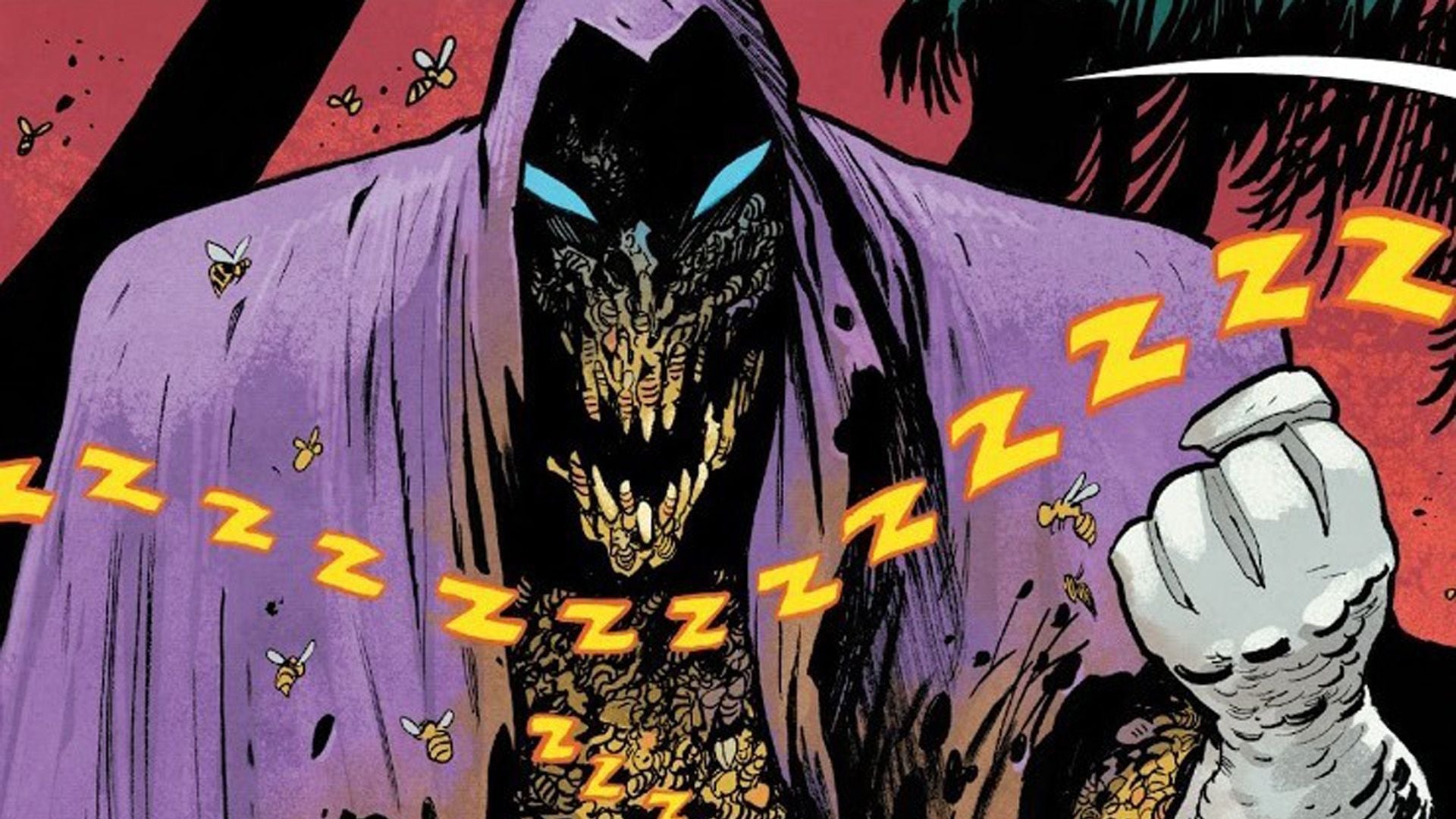
Behind the swarm hides the consciousness of Fritz von Meyer, a scientist on the run who was absorbed by a South American colony, revealed in Champions #14 (1977). He re-forms as soon as part of him is destroyed, which forces Peter Parker to outwit him rather than punch him. His abilities are detailed below.
In the rogues' gallery of Spider-Man, some stand out for their raw power, others for their madness, and a few for a concept that is simply the stuff of nightmares. Among the latter you will find Swarm, a terrifying creature made up of… bees. Born from the unbridled imagination of Marvel's writers, this villain embodies one of the darkest and strangest corners of the web-slinger's world.
Behind this deadly swarm hides a former Nazi scientist, Fritz von Meyer, whose soul and consciousness merged with a colony of mutant bees. The result: a half-human, half-insect entity able to control a living cloud. Unlike more conventional enemies such as the Vulture or the Scorpion, Swarm does not fight with gadgets, but with a swarm of insects capable of overwhelming his opponents.
The macabre origins of Swarm
First appearing in Champions #14 in 1977, Swarm is the embodiment of a biological nightmare. Fritz von Meyer, a former Nazi scientist on the run, discovers a colony of mutant bees in South America. Trying to control them, he is literally devoured and absorbed by them. But instead of dying, his mind survives through the swarm, giving birth to a monstrous entity in which thousands of bees act as a single body.
This blend of science, mysticism and horror makes Swarm a one-of-a-kind villain. Where Spider-Man usually has to face criminals with clear motives (money, power, revenge), here he comes up against an inhuman creature, with no real physical form, whose strength rests on sheer numbers and the terror it inspires.
What sets Swarm apart from other enemies is the psychological side: fighting a swarm means facing a faceless mass you cannot reason with or neutralise for good. That contrast with more 'human' villains also recalls cosmic threats such as Knull, the god of the symbiotes, who likewise goes far beyond human understanding.
To live out your own battle against the villains from the world of Peter Parker, explore our collection of Spider-Man figurines, where you'll find his most legendary confrontations, including those against supernatural enemies.
A collective power: the strength of the swarm
Unlike enemies such as the Green Goblin or Doctor Octopus, who rely on a physical, identifiable human body, Swarm has no real flesh-and-blood shell. His power rests on the collective intelligence of thousands of mutant bees which together form a single conscious entity. That quirk makes him extremely hard to defeat: even if Spider-Man destroys part of the swarm, Swarm can quickly re-form.
Swarm's formidable abilities
- Flight and extreme mobility: as a swarm, Swarm can move quickly through the air, clearing obstacles and surrounding his opponents.
- Multiple attacks: the bee stings he directs can paralyse, poison and weaken an enemy, making every confrontation gruelling.
- Extraordinary resilience: destroying a few hundred bees changes nothing, because the swarm re-forms. Only total destruction can really neutralise him.
- Psychological horror: facing a cloud of aggressive insects is already terrifying for an ordinary human being. Even for a hero like Spider-Man, panic and disorientation play a key part in Swarm's advantage.
What makes Swarm especially dangerous is that he is not only a physical threat, but a psychological one too. Peter Parker, who has already faced colossal beings such as the Rhino, or manipulative geniuses such as the Chameleon, here finds himself against an almost intangible entity he can neither intimidate nor really hit. Being unable to fight a 'classic' battle forces him to lean even harder on intelligence and strategy.

In several stories, Swarm is even compared to a living plague, echoing the biblical plagues. It is a way for Marvel to heighten the visceral horror he embodies. It also shows that Spider-Man's world is not limited to classic street-level fights, but explores science fiction and horror too. The same logic runs through darker arcs such as Spider-Island, where an epidemic turns the whole population into spider-creatures.
To carry on this journey through Spider-Man's scariest enemies, discover our collection of Spider-Man masks, a reminder of how much identity and anonymity matter in the web-slinger's battles.
The clashes between Spider-Man and Swarm
The fights between Spider-Man and Swarm are not just physical duels: they are tests of survival and strategy. Unlike an opponent such as Shocker, who relies on technological gadgets, or Mysterio, who plays on illusions, Swarm brings a visceral fear and a completely different combat dynamic. Spider-Man cannot afford to charge in head first: he has to analyse, find scientific solutions and rely on his intelligence as much as his reflexes.
An enemy who is hard to hit
The first difficulty Peter runs into is the absence of a real 'body' to strike. Each blow only scatters part of the bees, and they re-form straight away. That elusive nature forces Spider-Man to look for alternative ways to neutralise Swarm: using chemical repellents, exploiting fire or electromagnetic fields to break up the swarm.

Fights shaped by horror
In several arcs, the confrontations with Swarm take on the feel of a horror film. Picture a black cloud sweeping down an entire New York street, sending the crowd into a panic. These scenes show that Spider-Man's world can venture into darker territory, where psychological fear matters as much as pure action.
Swarm embodies a diffuse threat that can appear anywhere, at any moment, as long as his swarm is intact. That unpredictability makes him a memorable figure among the web-slinger's secondary enemies, and he is often mentioned in discussions of the most powerful Spider-Man villains.
A mirror of Spider-Man's limits
Every clash with Swarm highlights Spider-Man's weak points. He normally relies on his spider-sense to dodge blows, and here he faces an enemy that attacks him from every direction at once. His webs become less effective against a moving cloud, and even his physical strength is useless against thousands of tiny creatures.
These battles remind readers that Spider-Man, for all his gifts, is still vulnerable. It fuels the dramatic tension and makes his adventures feel real: even a hero this complete can be put in trouble by an unexpected threat. That contrast is what makes the web-slinger's world so rich and believable.
To go deeper into these darker stories, explore our collection of Spider-Man costumes, some of which showcase his fights against his worst enemies, from the Lizard to Venom.
The legacy and curiosities surrounding Swarm
Even though he lacks the fame of icons like the Green Goblin or Venom, Swarm holds a special place in the Marvel universe. His very concept — a human body replaced by a cloud of bees — makes him unique and deeply frightening. He is an enemy who relies not only on brute force, but on the idea of the inevitable: how do you stop an army of living insects?
A figure who is often underestimated
Swarm is rarely used in the big sagas, but he comes back regularly in arcs where horror and science mix. He embodies the danger of dehumanisation: Fritz von Meyer lost his identity to become, literally, a hive. In that, he illustrates a central theme of Spider-Man: what happens when science is used without moral conscience, a theme already explored with Doctor Octopus or the Lizard.
Swarm in other media
An interesting detail: Swarm has appeared in several animated series and video games, sometimes in lighter forms to suit a younger audience. In Spider-Man: The Animated Series, he is portrayed as an alien entity, while in the games he is often a tricky secondary boss. These adaptations keep his aura of menace alive while broadening his place in the collective imagination of fans.

An enemy built for modern stories
With the rise of darker, more realistic stories in comics, Swarm could enjoy a revival. Picture a modern arc where the hive he controls becomes uncontrollable on a global scale, echoing today's environmental crises. That narrative potential could raise him to the rank of a major threat, in the way characters such as Kraven the Hunter have been reinvented for new generations of readers.
Conclusion
Swarm is not just a 'weird' villain from Spider-Man's rogues' gallery. He is a chilling reminder of the dangers of science pushed to the extreme and of how impossible it is to control nature. His existence enriches the variety of Peter Parker's enemies, somewhere between science fiction, horror and human drama. And even if he is not the most popular, he embodies that part of the Marvel universe where imagination has no limits.
If the world of Spider-Man interests you, you can visit our complete guide to Spider-Man merchandise on our full page dedicated to the subject.

