

14-Day Money-Back Guarantee
0
The short answer
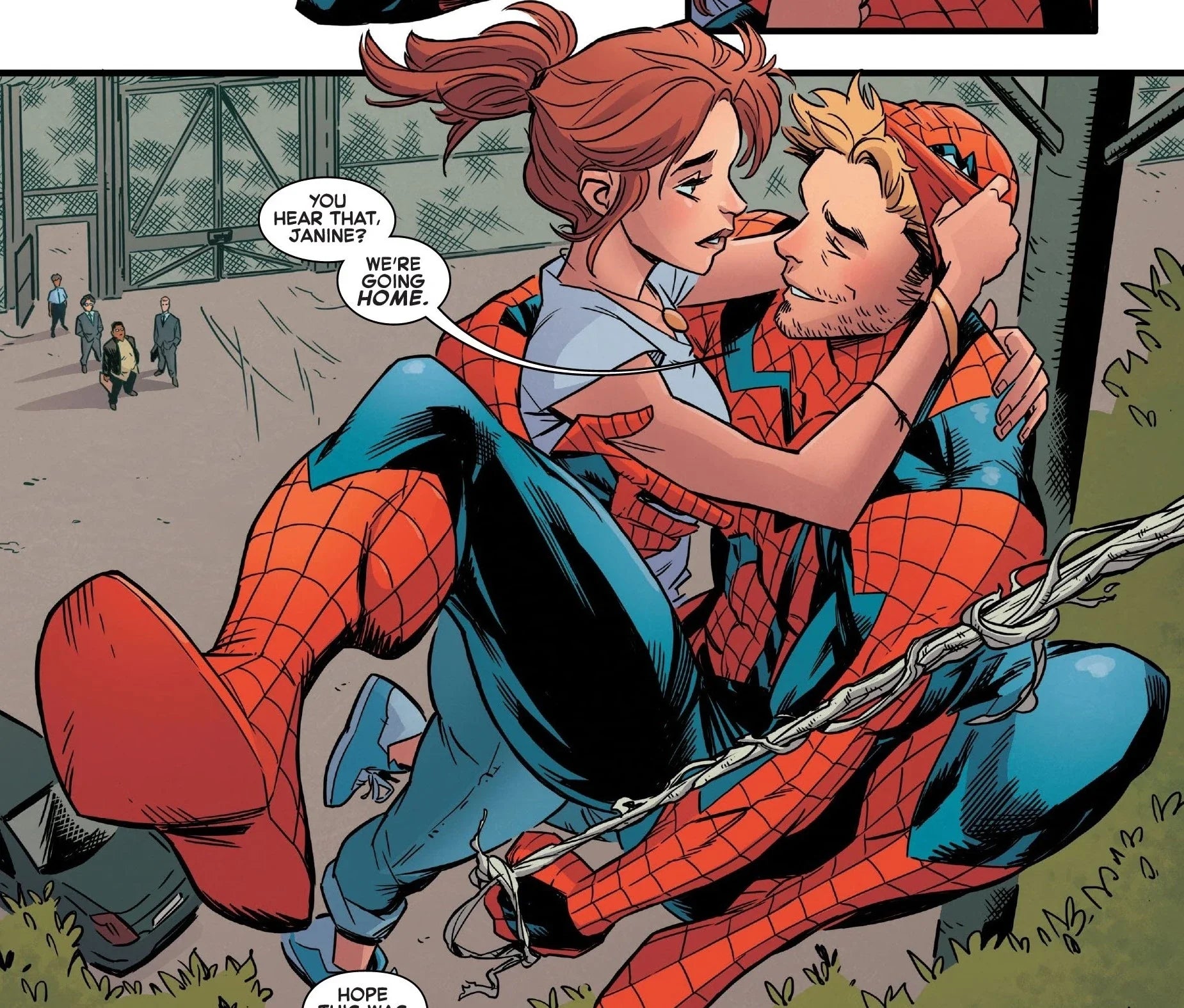
Janine Godbe is the partner Ben Reilly meets in Salt Lake City: a waitress living under a false identity after killing the father who had abused her, then staging her own disappearance. Created by J.M. DeMatteis, she serves as a human mirror to the clone. Her full story is set out below.
When people talk about the Clone Saga, the male figures who shaped it come to mind straight away: Ben Reilly, Kaine, Peter Parker, the Jackal. Almost everyone forgets the central figure of a fair-haired young woman, met in an anonymous Midwest diner, who gave the web-slinger's most famous clone his first real love story. Her name on the run was Elizabeth Tyne. Her real name is Janine Godbe. And her fate sums up on its own everything the web-slinger's clone mythology does that is most heartbreaking: the idea that no copy, however perfect, can build a future without the past coming to claim its due.
This article retraces the path of a character who never had a solo series, never had an action figure, almost never had an editorial spotlight, and who nevertheless is the secret wound of the entire clone epic. Janine Godbe is neither a heroine nor a villain. She is the rarest thing the Clone Saga ever produced: a human being in the middle of genetic doubles, twisted experiments and stolen identities. To measure her impact, you have to go back to the moment when Ben Reilly, drifting across America, crosses her path and allows himself, for the first and last time, to hope for a normal life.
A meeting in a strange town
To understand Janine Godbe's arrival, you have to place yourself in the chaotic chronology of the most famous clone in comics. After the events told in The Lost Years, the arc that recounts the lost years of the forgotten clone, Ben Reilly flees New York. He refuses to be Peter Parker. He refuses to be Spider-Man. He just wants to exist, in a town where nobody knows his face, where nobody knows he came out of one of the Jackal's test tubes. For Ben Reilly, whose complete journey as a clone remains one of the most fascinating in the Marvel universe, this journey is above all an inward escape.
It is in Salt Lake City that he first crosses paths with Janine. She works as a waitress in a charmless diner, under the name Elizabeth Tyne. She is discreet, almost self-effacing, but something in her eyes catches Ben's. He too lives under a false identity. He too hides what he is. That shared secrecy immediately creates a quiet intimacy between them, as if two fugitives recognised each other's fear without needing to explain it. The writer who introduced Janine, J.M. DeMatteis, was playing on exactly that idea: a love story between two people who lie about their name, but tell each other the truth about their soul.
The bond grows slowly. Ben tells Janine what he believes to be his story, leaving out the supernatural details. Janine tells Ben she lost her father in circumstances she cannot bring herself to put into words. Neither of them asks the other for the whole picture. That delicacy, that mutual respect for the shadowy areas, makes it one of the finest romantic relationships ever written for a character orbiting the web-slinger, worth comparing with Mary Jane Watson's influence on Peter Parker or with the eternal debate between Gwen Stacy and Mary Jane. Janine is not playing in the same league: she is not seducing a hero, she loves a man who has done everything to stop being one.
Elizabeth Tyne, a fugitive's stolen name
Janine's truth is as dark as Ben's, perhaps darker still. Janine Godbe grew up in a home where her own father abused her for years. One night, in an act of desperate self-defence, she killed him. To escape prison, she staged her own suicide by making it look as though she had thrown herself into a river, then fled, changed her name, changed her town, changed her life. Elizabeth Tyne did not exist before that act. It is an identity built to survive, almost like a costume, a replacement face.
That parallel between the two leads is what gives the whole story its power. Ben Reilly is a clone, a being manufactured to look like someone else. Janine is a criminal who manufactured a new identity in order to stop being herself. Both live in bodies that do not carry their real name. Both were produced by one man's violence: for Ben, it is the tormented creator of the Clone Saga who brought him into the world in a laboratory; for Janine, it is an abusive father she ended up killing. The narrative connection is never spelled out bluntly, but it runs through every scene they share.

This mechanism echoes the paths of other supporting figures in the Marvel universe who rebuild themselves out of false identities. Eddie Brock, in his tragic bond with Peter Parker, is another example. But Janine is not after power. She is not after revenge. All she wants is to sleep one full night without nightmares. That tragic modesty of purpose, that refusal of revenge or of heroic redemption, makes her a deeply singular character.
DECOR — Modern Art Canvas

Canvas Print — Modern Art
22,90 €
Just as Janine was looking for a setting where she could breathe, this canvas dresses a wall with a graphic beauty that invites contemplation. A calming object that never shouts.
Discover →The fragility of a love built on two secrets
Ben and Janine live as a couple for several months in a bubble made all the more precious by how fragile it is. Ben keeps his distance from any uniform. He refuses to put on the costume. He pretends his powers do not exist. He works seasonal jobs, paints a little, reads a lot. Janine puts in her hours at the diner, saves up, dreams up plans for getting her life back. For the first time since he was created, the clone lets himself entertain the idea that maybe, just maybe, he might be entitled to a future of his own.
That lull is essential to understanding the character's moral arc. Ben Reilly is not an anti-hero. Nor is he simply a variant of the hero. With Janine, he becomes something rarer: a man who has given up the heroic identity to become plainly human again. That stance brings him close to the period when Peter Parker hangs up the costume in Spider-Man No More, with the difference that Ben never even had the luck of a normal life to go back to.
The tragedy is that this interlude rests entirely on a lie. Neither Ben nor Janine tells the other the truth. And the more time passes, the more every possible revelation threatens to bring the whole thing down. The storytelling builds a slow tension, like a rope pulling tight beneath the apparent gentleness of the domestic scenes. Every shared breakfast is a time bomb. Every loving conversation rests on what neither dares to say. And the whole clone mythology, in this arc, condenses into a simple question: can a being shaped in a lie love in truth?
The betrayal that breaks Ben Reilly
The inevitable arrives. As the story unfolds, Ben discovers Janine's true identity, along with the past hidden behind the name Elizabeth Tyne. He learns of the abusive father's death. He learns of the staged suicide. He learns that she spent years on the run, building a clandestine life. The revelation shakes him, not because he judges her, but because he suddenly understands that the woman he loves carries exactly the same burden he does: that of a being who has no right to exist under their real name. It is precisely at that point that Ben chooses, in full contradiction with his own story, to push her to turn herself in.

That decision is one of the most controversial in the clone's whole journey. Ben sincerely believes that Janine will never be able to live a full life as long as she lives in hiding. He thinks she has to answer for what she did in order to truly exist afterwards. But he fails to see that this moral demand, laid over the life of an abused woman, amounts to condemning her twice. Janine refuses. She runs. She fakes her own death a second time, this time letting Ben believe she has drowned in a river, just as she did ten years earlier with her father.
The clone then believes himself responsible for the death of the only woman who ever loved him. He falls apart. That precise pain is one of the engines of all his later wanderings, right up to his return to New York where he takes on the Scarlet Spider costume. Rage, guilt, fear of attachment: from then on Ben Reilly carries these wounds like a tattoo, exactly as Kaine carries the scars of his own genetic instability on his body. Janine does not appear in the immediate aftermath of the Clone Saga. But her ghost haunts every decision that follows.
The devastating return in The Clone Conspiracy
You might have thought Janine Godbe forgotten. And yet, more than twenty years later, her name comes back in The Clone Conspiracy, the arc that put cloning back at the centre of Spider-Man's world in 2016. The original creator has cloned her in turn. A resurrected Janine knocks at Ben Reilly's door, and he himself has become a murky, ambiguous figure, wavering between redemption and the fall. Janine's return is not simple nostalgic recycling. It is a precise knife thrust into the clone's psyche: the woman he believed he had killed through his own mistake comes back to him, genetically reconstituted, but with the full memory of their happy days.
That resurrection puts Ben in front of an unbearable dilemma. To love a cloned Janine is to validate the science of the demiurge who created him in the first place. It is to accept that the dead can be brought back, and therefore to accept the whole project of New U Technologies, the pharmaceutical company industrialising resurrection. Conversely, to refuse Janine is to lose her a second time and to confirm that the pain of love cannot be undone. Ben chooses love. And it is that choice that will push him for good into the grey zone of which the portrait of Chasm, the broken clone turned enemy of the web-slinger is the contemporary culmination.
In this new era, Janine Godbe is the emotional lever through which the demiurge's entire strategy works. Without Janine, Ben might have resisted the temptation of resurrection. With her, he becomes one of the Jackal's most active heirs. That narrative takeover is all the more striking for happening without any grand gesture: Janine brandishes no gun, leads no army, hatches no plot. She simply exists. And her existence is enough to tip a hero into his own opposite.
Why Janine is the secret wound of the clone mythology
Line up the gallery of characters born out of the Clone Saga and the pattern jumps out: almost all of them have a pathological relationship with identity. Spidercide, the most unstable experimental clone of the web-slinger, cannot even hold his own body together. Carrion, the macabre clone of the demiurge himself, is in permanent decay. Kaine is a scarred face. Ben Reilly swings between Scarlet Spider and Chasm. All the others are men, all wear costumes, all are identified by how close they are to Peter Parker.
Janine escapes that pattern. She is neither a clone of Spider-Man nor a clone created to fight. She is a human being, with a history, with trauma, with a body she built herself through flight and concealment. And it is precisely that difference that makes her the most precious exception in the whole clone galaxy. Where the other characters embody the faulty copy, Janine embodies the wounded original. Her mythology does not speak of genetics: it speaks of memory. It speaks of that part of ourselves that survives the worst, provided it can change its name.
This dimension makes Janine resonate with other figures around the web-slinger who have survived deep trauma. Back in Black, the arc where Peter Parker abandons morality after Aunt May's death, stages a similar rage. The analysis of Aunt May's death and its shockwave also speaks to that theme. But Janine goes further than the loss of a loved one: she survived a loved one who was attacking her. That specificity brings her close to female characters such as Spider-Gwen, the Spider-Woman fans adore, who also carries the weight of a violent parallel reality, but with no superpowers to transfigure it.
COLLECTION — Limited Edition Bust

Collector's Bust — Limited Edition
699,90 €
For enthusiasts who want to keep within sight the silhouette that has accompanied every great era of the web-slinger, from the Raimi years to the Clone Saga. A piece with absolute presence.
Discover →A rare female figure in Spider-Man's ecosystem
The Marvel universe around Peter Parker has plenty of powerful female figures. Gwen Stacy, whose death remains the most striking moment in the comics, is the tragic archetype. Mary Jane Watson is the radiant one. The complete portrait of Peter Parker shows how far his psyche was built around these luminous figures. But Janine belongs to another family: the ordinary women fiction leaves in the background, and yet can no longer forget once it has brought them in.
What sets Janine apart is that she never tried to exist alongside the web-slinger. She was never rescued by a superhero. She never faced a supervillain. Her struggle is internal, her flight is administrative, her pain predates any costumed adventure. She is, in a way, the counter-model to classic superheroics: a person for whom no cape could ever have changed the past. That quality brings her close to another narrative tradition, one that has grown around certain supporting characters such as Anya Corazon, the Spider-Girl who weaves her own destiny, or such as Peter's hypothetical daughter in Spider-Girl, the arc devoted to Mayday Parker in an alternative future.
Janine also raises an implicit political question. How many female characters, in the web-slinger's long history, have been granted a path that does not depend on a male hero to exist? Very few. Janine, despite her status as merely Ben Reilly's lover, escapes that rule: her story begins before she meets Ben and continues, in the background, after they part. She has an inner life of her own. That singularity makes her a quietly precious character, in a genre where female agency remains rare. Cindy Moon, the future Silk of the Spider-Verse, illustrates the more recent trend of giving female characters a complete arc of their own.
A mirror reading of the clone mythology
Janine's contribution to the clone mythology can also be measured on a more structural level. Her mere presence makes visible what the main arc was hiding. The Clone Saga, in its canonical form, is a story of men. Scientist men, superhero men, villain men, men in red costumes. Janine brings back a voice that was missing: that of a person who, like Ben, lives with a manufactured identity, but who never dreamed of being a superhero for all that. She is a civilian witness to the clone mythology, and that is how she enriches it.
That mirror reading also lets us reassess the demiurge's role. The Clone Saga, which still divides fans today, is often described as an editorial misstep. Janine lets us look at it another way: if you read the saga through its quietest characters, you find a far more moving story, far more truthful, far more human than the war of copies on the covers of the monthly issues. The best reading of the Clone Saga may not be the heroic one. It is the intimate one. And Janine holds the thread.
To finish measuring Janine's wake, you also have to mention the popular culture she passes through in silence. The complete map of the Spider-Verse barely devotes anything to her. The encyclopaedia of every character does not either. Her presence is mostly archived in specialist forums and wikis. That is precisely why an article like this one is needed: so that Janine does not remain a footnote, so that she takes her place in the wider puzzle. This tradition of shining a light on forgotten characters joins other excavations such as the little-known story of Peter Parker's parents or the real detail of Uncle Ben's death.
Reading and collecting this forgotten part of the Clone Saga
To follow Janine's path, the curious reader can start with Spider-Man: The Lost Years by J.M. DeMatteis and John Romita Jr., where the couple is born, lives and falls apart. Then comes the Clone Saga proper, where Janine is mentioned but little used. The strong comeback sits in the Dan Slott trilogy devoted to the Clone Conspiracy in 2016-2017. For fans of parallel continuity, certain issues of Ben Reilly: Scarlet Spider and of The Spectacular Spider-Men carry the thread on in small touches. The Spider-Man Redemption arc devoted to Kaine's last hope speaks indirectly to these questions of redemption. To go further on this subject, see also Spider-Boy (Bailey Briggs): the erased clone nobody remembered knowing.
The look of Ben and Janine as a couple has inspired few pieces of merchandise. That is one of the paradoxes of quiet characters: we cherish them, but we do not turn them into figures. For anyone who wants to extend this world anyway, the web-slinger cosplay collections offer Ben Reilly's Scarlet Spider variants, and the LEGO sets devoted to the web-slinger let you rebuild the iconic places where the Clone Saga played out. For those who like everyday pieces to wear and use, the official mask collection and the web-shooters keep alive the memory of the days when Ben wore his own uniform.
As for the meta reading, two background pages give a useful frame. The complete saga of Spider-Man's story arcs helps you place the Clone Saga in the overall chronology, and the complete guide to the emblematic villains gives valuable context for understanding how the demiurge of the Clone Saga fits into the gallery of great enemies. Janine appears in neither. That is her whole paradox: she is central in emotional reach, and invisible in structural position.
The stubborn shadow of an ordinary lover
The history of the great superhero stories is made of heroes and villains, costumes and origins, powers and abilities. And then, sometimes, at the edge of that machinery, an ordinary person walks into the story and refuses to leave. Janine Godbe is one of those people. She does not save the world. Nor does she destroy it. She loves a man who should not exist, and that love alone is enough to unsettle, for three decades, one of the most tortuous sagas in Marvel mythology.
You can read the Clone Saga without her. But once you have discovered her, you can never reread it without looking for her. Her silhouette, her soft accent, her stolen name, her constant fear of being unmasked: all of it surfaces on every page devoted to Ben Reilly, like a bass line colouring the whole. She is the secret wound, the knot the writers deliberately leave open, the reminder that even Spider-Man's most accomplished clone is nothing without a woman willing to accept him in their shared secrecy. And as long as Ben Reilly keeps appearing somewhere in the Marvel ecosystem, Janine Godbe will prowl, in the background, close to his heart. To go further and take in the whole of the hero's filmography, you can look at the complete portrait of Spider-Man's films, costumes and versions, which sheds light on the cultural context in which the Clone Saga spread far beyond the comics.

