

14-Day Money-Back Guarantee
0
The short answer
Bailey Briggs is no ordinary genetic double: he is a composite chimera, assembled by Madame Monstrosity from DNA taken from several heroes, then wiped from every memory by a spell of forgetting. Created by writer Dan Slott, he then claims his right to exist. More on his powers below.
When Peter Parker first meets Bailey Briggs in the pages of Spider-Man (2022) #7, his world tilts in the space of a few panels. The teenager standing in front of him claims to have been his sidekick for years, to share entire memories of adventures they went on together, even to wear a red and blue suit modelled on his own. And yet nobody remembers him. Not Mary Jane, not Aunt May, not the Daily Bugle newsroom. Spider-Boy exists in no living memory. This anomaly is neither a multiverse side effect nor a cheap narrative trick: it is the starting point of one of the most ambitious recent revelations about the web-slinger's clone mythology. To understand why Bailey Briggs changes the way we read everything we thought we knew about Peter Parker's genetic copies, you have to go back to the antagonist who built him in the shadows.
Bailey Briggs, the revelation that tilted the web-slinger's timeline
Writer Dan Slott, at the helm of the Spider-Man series since late 2022, introduces Bailey Briggs like a time bomb. Issue #7 opens on a chase scene: a costumed teenager fleeing a monstrous creature through the basements of New York. When he takes shelter with the web-slinger, he calls him 'the boss', mentions specific fights they shared against particular villains, even describes the decor of Peter's flat with unsettling accuracy. Except Peter has never seen him before in his life. That dissonance, underlined by Mark Bagley's artwork, sets off an investigation that will run across several arcs and lead to the launch of a dedicated solo series in late 2023.
The pitch fits into a single question: who is this kid, and why does his existence seem to have been scraped out of the fabric of reality? The first leads point towards a forgetting magic close to the one used in The Clone Conspiracy, but the mechanics are different. Bailey is not a resurrected ghost: he is still alive, solid, conscious. What has vanished is the memory he left in other people. That nuance is crucial, because it shifts the classic clone mystique onto fresh ground — social erasure — that none of the major characters in the Spider-Man universe had explored until now.
The strength of the device lies in its narrative economy. Slott does not rewrite Marvel continuity: he simply opens a trapdoor in the floor of the 1990s and lets a character climb back up whom everyone, readers included, should have known. The feeling of discovering a missing piece of a puzzle you thought was complete becomes the emotional engine of the whole series, and gives Bailey unexpected weight within the web-slinger's complete saga.
Madame Monstrosity, the antagonist who erases memories like tearing out a page
At the heart of this plot, a figure until now confined to the margins of Marvel comics suddenly takes on real scale: Madame Monstrosity. A genetic architect and manipulator of memories, she has run a clandestine laboratory for decades, building 'composite beings' from DNA samples stolen from the greatest heroes. Bailey Briggs is one of her projects: a subject designed to serve as her enforcer, raised in isolation, then released into the real world under the identity of an imaginary Spider-Man sidekick. When Bailey breaks free and finds refuge with the real Peter Parker, Madame Monstrosity triggers her signature power: a memory spell that erases every trace of Bailey from human minds.
This mechanism of forgetting recalls, without copying it, Mephisto's magic in One More Day, or the identity manipulations explored in the web-slinger's multiverse. Except that Madame Monstrosity is no cosmic deity: she is a methodical, almost surgical scientist whose motivation is neither revenge nor power, but pure experimentation. That clinical stance brings her archetype close to that of the Jackal, Spider-Man's most tragic scientific enemy, and places Bailey in a line of test-tube victims whose humanity was denied from conception.
What makes the whole setup especially dizzying is the idea that other 'Baileys' could exist, created and forgotten, perhaps still languishing in Madame Monstrosity's basements. That grey area fuels the suspense of the series and echoes the web-slinger's great historic villains, whose harshest schemes so often rest on mass-producing disposable bodies. Bailey, though, refuses that role. He chooses to become Spider-Boy again, not to serve, but to claim his right to exist on his own terms.
TRAGIC CLONES — FIGURINE

Spider-Man Figurine – Kaine
119,90 €
Before Bailey Briggs, Kaine embodied the loneliness of the abandoned clone. Having his figurine on the shelf anchors at home this line of tragic doubles that Marvel is revisiting today through Spider-Boy.
Discover →A clone unlike the others: the hybrid genetics of Bailey Briggs
If Bailey holds a place apart in the gallery of Peter Parker's genetic doubles, it is because he is not a pure clone. The internal analyses Peter runs in the series reveal a composite DNA make-up, mixing traces of the web-slinger himself with fragments borrowed from other emblematic heroes. That chimera nature gives him a broader range of abilities: classic arachnid agility, a warning sense calibrated to danger, but also heightened reflexes and stamina that sometimes exceed those of the original model. This unique profile sets him radically apart from the other clones readers know.
Compared with Ben Reilly, Spider-Man's perfect clone, Bailey is no carbon copy: he is a mosaic. Compared with Kaine, whose cellular degeneration marked an era, Bailey shows no visible genetic instability. Compared with Spidercide, the experimental clone with abnormal powers, he is neither amorphous nor regressive. And compared with Carrion, the macabre clone tied to Miles Warren's virus, there is nothing putrid about him: his body is healthy, young, full of energy.
That unusual physical stability contrasts with the fragility of his psychological identity. Bailey lives with implanted memories of a life that never happened. Every interaction with Peter Parker is marked by that dissonance: he knows the in-jokes, the habits, the little tics, yet deep down he knows none of those moments ever really took place. This double identity — new body, artificial memory — makes him a deeply contemporary character, built to resonate with a generation of readers used to questions of authenticity and digital identity. The page devoted to Peter Parker shows just how far Bailey completes, rather than competes with, the myth of the original web-slinger.
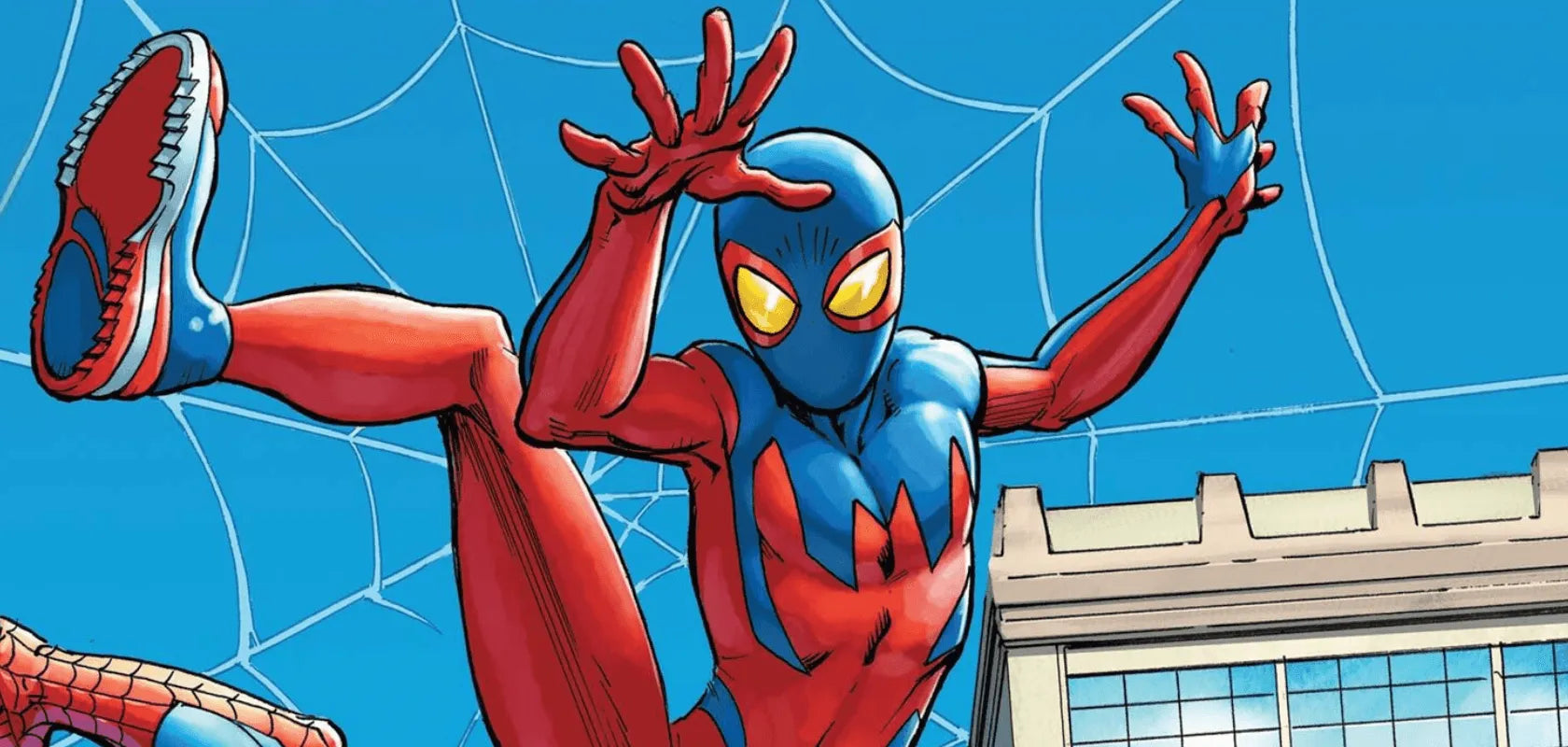
His costume, designed by Bagley, plays the same card of singularity. Where Ben Reilly had borrowed a very 1990s Scarlet Spider look, Bailey wears a cleaner red and blue suit, almost school-like, crossed with yellow flashes that recall the graphic signature of the Spider-Verse. A silhouette conceived for merchandising as much as for storytelling, one that can sit on fans' shelves alongside the existing web-slinger figurines or the posters devoted to the hero.
The Spider-Boy series (2023) by Dan Slott and Paco Medina: the birth of a solo title
The critical success of the introductory arc in the main series pushed Marvel to launch a monthly title dedicated to Bailey from late 2023. Spider-Boy, by Dan Slott and artist Paco Medina, picks up after the introductory run and moves the hero into his own narrative universe. On the programme: exploring his origins, facing new antagonists, a first clumsy romance, first existential doubts. The tone, more pop and younger than the parent series, hooks a teenage readership that finds in Bailey a figure who feels close, new, free of the historical weight that clings to the classic web-slinger.
That editorial strategy recalls the one used back in the days of Ben Reilly: The Lost Years, a spin-off series that made it possible to explore the perfect clone's psyche far from the web-slinger's main worksite. But where Ben Reilly drew his dramatic power from years spent wandering, Bailey starts out blank, with no acknowledged past, and has to invent a biography for himself in real time. That position opens up new narrative ground: who are you when your first true memory dates from yesterday? How do you forge an ethic with no precedent?
Slott uses that freedom to fold Bailey back into the publisher's wider continuity. The hero quickly crosses paths with Madame Web, Squirrel Girl, and even Spider-Gwen during incursions into the multiverse — so many chances to weave links back to the Spider-Gwen galaxy and the Brand New Day wave that defines the web-slinger's current period. Bailey becomes a bridge between several editorial lines, without ever being diluted.
CLONE COSPLAY — COSTUME

Spider-Man Chasm Ben Reilly Costume
129,90 €
Bailey might never have existed without the Ben Reilly precedent. Playing Chasm means taking on the clone's dark side, the very one Bailey is trying to avoid by choosing the light.
Discover →Bailey in the web-slinger's clone cosmogony: a missing piece long overlooked
To place Bailey in the family tree of Peter Parker's genetic doubles, you have to accept that Marvel has reopened a file many thought was closed. Ever since the original Clone Saga was set in motion in the 1990s, the publisher has never stopped revisiting this seam, sometimes brilliantly, sometimes clumsily. Bailey Briggs belongs to that lineage, but he redraws its outlines. He is not a pure avatar, like Ben Reilly. He is not a biological failure, like Spidercide. He is not a cursed reincarnation, like Carrion. He is a new category: the child who was manufactured, forgotten, and who comes knocking at the door when nobody expects him.
That singularity makes him more of an heir than a double. Bailey is not a copy of Peter: he is a synthetic son. The metaphor is openly embraced by Slott in several interviews, and it feeds the narrative dynamic between the two characters. Peter, marked by earlier experiences such as Chasm's slide into darkness, at first refuses to take on any kind of fatherly responsibility. But Bailey expects nothing from him: he simply wants to understand who he is, and he goes about it with surprising dignity.
That stance recalls, in several ways, the redemption arc sketched out in Spider-Man: Redemption, centred on Kaine. But Bailey takes a different road: where Kaine had to atone for crimes committed under degeneration, Bailey has to earn a place in a world that did not even know it existed. That nuance opens up fresh emotional ground, one that chimes with the themes of inheritance and identity that the Spider-Verse's Web of Life and Destiny has been exploring for several years now.
Why his existence changes how we read the Clone Saga and Brand New Day
Bailey's arrival casts new light back over the whole body of earlier clone stories. If Madame Monstrosity was able to manufacture an entire sidekick without anyone noticing, what is to stop other similar operations from having run in parallel? That question opens the door to interesting rereadings of The Clone Conspiracy and, more broadly, of the entire line of arcs centred on Miles Warren. Every scientifically minded enemy of past decades becomes a potential unwitting accomplice in a much larger operation, of which Bailey would be only the visible fragment.
This reinterpretation fits squarely into the editorial dynamic of Brand New Day, the web-slinger's current period, devoted to renewing the foundations. The Brand New Day line is looking to introduce supporting characters capable of carrying their own series, and Bailey ticks every box: a memorable look, a striking starting concept, strong emotional depth. Much like the Spider-Man cosplay gallery which today draws on every version of the web-slinger, merchandise around Bailey is beginning to appear among the sharpest fans.
For those who love editorial history, Bailey also illustrates a shift in the way Marvel reopens its old files. Where the 1990s tried to correct or cancel the Clone Saga through narrative brute force, the 2020s prefer to add pieces to the puzzle. The galaxy of the Spider-Man universe is no longer contracting: it is expanding, and Bailey is one of its new markers. This additive, more mature logic appeals to a new wave of adult readers who are discovering or rediscovering the comics through the web-slinger's films and the video games devoted to Peter Parker.
COMIC ARC — WALL POSTER

Alien Costume Saga Comics Poster
From 22,90 €
Bailey joins a long line of Marvel arcs that have redrawn the web-slinger's mythology. Putting the Alien Costume Saga poster up at home anchors, visually, the genealogy of stories that made Spider-Boy possible.
Discover →What future for Bailey Briggs in the Marvel universe?
In the short term, the Spider-Boy series keeps digging the furrow Slott opened: exploring his origins, ethical conflicts around artificial creation, first face-offs with other dark laboratories of the Marvel Universe. In the medium term, several threads suggest an expanded role for Bailey. His nature as a genetic chimera makes him compatible with almost any crossover: a fight alongside the X-Men looks plausible, an incursion into the Spider-Verse even more likely. The publisher has even hinted that other survivors from Madame Monstrosity's laboratory could emerge, paving the way for a genuine ensemble arc.
Further ahead, Bailey could establish himself as one of the web-slinger's declared heirs in the next editorial generation. With Miles Morales installed at the top of the young pyramid, and Gwen Stacy already consolidated as a multiverse figure, Bailey would offer a third leg: the clone-son, a literal link between Peter and the future. That configuration is already fuelling speculation about a possible animated or cinema adaptation, in line with the Sony and Marvel Studios projects constantly hunting for new faces to use. Bailey's visual closeness to the Across the Spider-Verse aesthetic and its variations reinforces that hypothesis, already debated in fan circles.
On the merchandise side, Bailey is slowly but surely entering the web-slinger's commercial ecosystem. The first exclusive figurines are appearing from independent makers, Spider-Man t-shirts are starting to feature his symbol, and web-slinger hoodies sometimes include nods to his clean red-and-blue suit. This gradual adoption follows the character's rise, and within a few years he could join the pillars of the catalogue alongside the classics.
The readers' verdict: a character in tune with his time
Beyond the editorial arguments, Bailey's reception by the readership comes down to a rare quality: generational resonance. At a time when questions of digital identity, archived memory and virtual doubles sit at the centre of youth culture, the idea of a character whose existence hangs on the persistence of an external memory strikes a nerve. Bailey is not just a clone: he is a metaphor. A living metaphor for everything we build today on ephemeral platforms, on deletable accounts, on databases whose durability rests on nothing at all.
That symbolic dimension, combined with efficient storytelling and careful design, makes him one of the most promising characters of the current editorial decade. For readers hesitating to dive into the series, issue #7 of Spider-Man (2022) remains the obvious entry point. For those nostalgic about the original Clone Saga, Bailey offers a respectful and inventive revival. For fans of pure mythology, he opens up perspectives that neither Ben Reilly's path, nor Kaine's, nor the Carrion nightmare, nor even the Spidercide experiment had truly dug into.
To go further into this rich universe, the reference article remains The Lost Years, the web-slinger's forgotten clone finally told, which lays the narrative foundations Slott builds on today. The complete saga of the narrative arcs is also an essential support for placing Bailey within the long editorial memory. And for collectors keen to bring that richness to life, the web-slinger costumes and outfits as well as the Spider-Man LEGO sets already make it possible to stage this genealogy of doubles at home. The dedicated poster collection and the figurines of every version of the web-slinger complete a fan display that now feels incomplete without Bailey Briggs.
It remains to be seen whether Marvel can keep its initial promise. For now, Spider-Boy stands out as one of the finest narrative finds of the decade: a clone who is not trying to replace his model, but to make a place for himself beside him, with dignity — a reminder that at the heart of every clone mythology lies one simple question: that of an existence acknowledged.

