
14-Day Money-Back Guarantee
0
The short answer
This 1967 story shows the web-slinger giving up his mask, then taking it back in the very same issue: when he witnesses a mugging, he cannot bear to stand by and watch. The episode plants the theme of heroic burnout, later brought to the screen by Sam Raimi. We break down the key scenes below.
Contents
Of all the landmark moments in Spider-Man's history, few stories have left as deep a mark as 'Spider-Man No More!'. First published in Amazing Spider-Man #50 in 1967, this arc written by Stan Lee and drawn by John Romita Sr. marks a break in Peter Parker's journey that is as powerful as it is symbolic.
Exhausted, misunderstood, weighed down by his responsibilities… Peter Parker makes a radical decision: he gives up his suit. One image has become iconic — the suit thrown into a dustbin — and on its own it carries the whole weight of Spider-Man's burden.
To understand Peter Parker's psychology better, explore our page on the story of Peter Parker or discover similar stories such as One More Day.
The origin of the myth: Amazing Spider-Man #50
In this cult issue, Peter Parker wrestles with an inner dilemma: his personal life is falling apart, his Aunt May is ill, he is failing at university, and the public sees Spider-Man as a criminal rather than a hero. Discouraged, he decides to drop his secret identity.
But as so often with Spider-Man, giving up is only a step towards a rebirth. Because before long crime comes roaring back, innocent people suffer, and Peter realises he cannot run from his destiny. A simple act of heroism by a passer-by reminds him that 'with great power comes great responsibility'.
👉 It is this duality between duty and personal life that makes the character so deeply human. A central theme you will find again on our page dedicated to the Spider-Man films.
The iconic scene of the abandoned suit
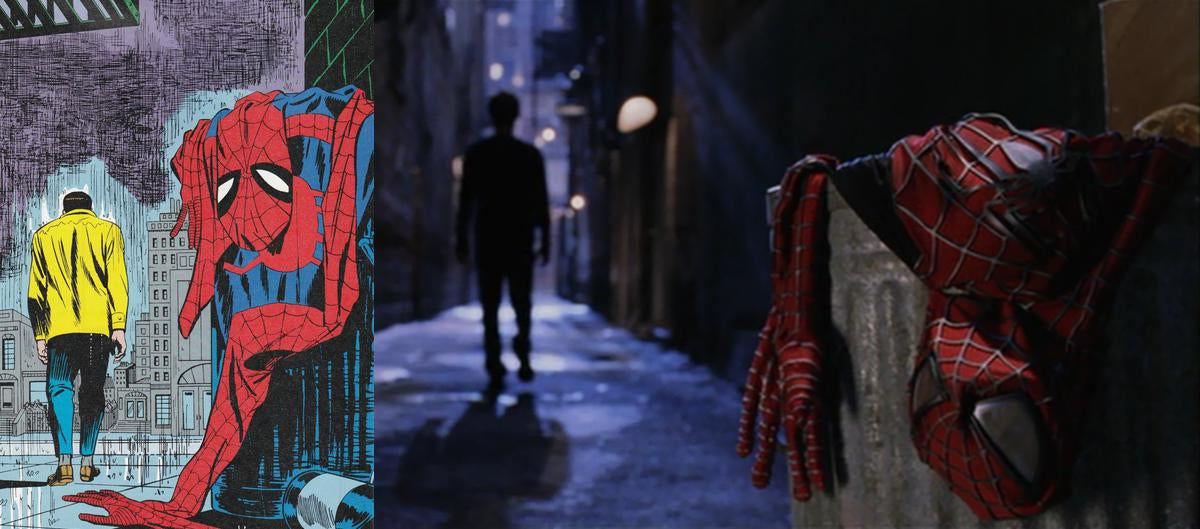
The most iconic moment of the Spider-Man No More! arc is without doubt the panel drawn by John Romita Sr., where we see Peter Parker from behind, walking away down a dark alley while his suit lies thrown in a dustbin.
This image has become emblematic of the character's inner struggle , standing for his wish to walk away from the role, even though the world still needs him. It has been reused dozens of times in the comics, the films, the series and even across Spider-Man merchandise.
A symbol of human fragility
This moment matters because it shows that Peter Parker is not only a superhero, but also a young man facing immense pressure. Hurt, exhausted, rejected by the very people he is trying to help, he decides — temporarily — to stop.

Stan Lee's script then highlights something rarely dealt with in the comics of the time: superhero burnout. A masked form of depression, driven by a pile-up of crushing responsibilities.
Peter Parker face to face with himself
But of course, Spider-Man's nature quickly takes over again. Peter learns that an ordinary passer-by has been attacked when he could have stepped in. That scene sets off a deep moral dilemma, and marks his return beneath the mask.
A turning point in Marvel comics
On release, Amazing Spider-Man #50 marked a turning point. Readers had never seen a hero so human, so fallible. This was no god, no billionaire, no soldier: this was a broke, exhausted student who just wanted to live a normal life.
That is also why Spider-Man has touched so many generations, and still does today, through stories such as Life Story. You can visit our full page to see all the story arcs.
🧥 The design and the products inspired by this scene
The abandoned-suit scene is so powerful that it has become a graphic theme in its own right. You will find its look in:

There are vintage Spider-Man posters faithfully reproducing the cover of the issue. There are stylised t-shirts showing the artwork of the suit in the dustbin. And there are collector figurines of Peter without his mask, deep in thought.
Romita's panel
John Romita Sr. draws Peter from behind, walking away while his suit is thrown into a dustbin.
Heroic burnout
Stan Lee tackles a masked form of depression, born of crushing responsibilities.
The return
A passer-by attacked when he could have stepped in brings Peter back under the mask.
A fallible hero
A broke, exhausted student, a long way from the god, the billionaire or the soldier.
A lasting influence on modern adaptations
The impact of the Spider-Man No More! arc goes far beyond the comics. It has deeply shaped the film and television adaptations of Spider-Man, reinterpreting that moment of rupture in modern settings, often darker and more emotional.
🎬 Spider-Man 2 (2004): the tribute scene
Directed by Sam Raimi, Spider-Man 2 with Tobey Maguire offers an almost direct adaptation of this sequence. Peter, worn out by his double life, decides to take back control of his daily life… by giving up being Spider-Man. The film even reprises the image of the suit abandoned in an alley, faithful to the 1967 comic.
This moment of doubt is heightened by the staging and the narrative choices of the film, reinforcing the character's vulnerability, a theme close to Sam Raimi's heart.
📺 Spider-Man: The Animated Series (1994)
The cult 1990s series also revisited the idea. In the episode where Peter loses his powers, we watch a Peter gripped by confusion and by that same feeling of uselessness, reinforcing the themes of identity and sacrifice.
🕷️ Spider-Man: No Way Home and the burden of power
In Spider-Man: No Way Home, we never explicitly see Peter give up his role, but he accepts extreme loneliness in order to protect the people around him, which is a direct evolution of the same philosophy: 'With great power comes great responsibility.'
That sense of absolute duty, which pushes Peter to give up his own social and emotional life, is a modern echo of the spirit of Spider-Man No More!
💬 Merchandise and tribute collectibles
This cult moment now comes in collector form. You will find in particular:
🎨 There are Spider-Man blankets carrying the artwork of the suit in the bin, often reworked in a retro or neon style. 🧸 There are collector figurines of Peter walking in the rain, or looking at his suit and hesitating. 👕 And there are Spider-Man jumpers inspired by the comic, often carrying famous quotes about duty and resilience.
This merchandise shows just how far this moment of doubt has come: it is now as iconic as Spider-Man's greatest fights. It is a reminder that Peter Parker's humanity is his greatest strength.
📚 In modern comics: variations and legacies
The 'No More' arc has inspired countless stories across the wider universe. It gave rise to variations such as:

'Miles Morales No More'
in some stories from the Spider-Verse, Miles temporarily gives up the suit after a tragedy.
'Superior Spider-Man'
Otto Octavius, in Peter's body, tries to do 'better' than him. But the Spider-Man identity always ends up returning to its rightful host.
'Spider-Man: Reign'
an older Peter, broken by events, puts the suit back on in a dystopian future.
Every version of this theme reinforces the idea that Spider-Man is defined by his sacrifice — and that giving it up means giving up part of himself.
🎮 In video games: interactive introspection
In Marvel's Spider-Man (PS4), Peter is regularly faced with dilemmas where his hero identity clashes with his private life. The player acts those decisions out, which deepens the emotional attachment.
These narrative elements are key to understanding why Spider-Man is a hero who looks like us, far from the all-powerful archetypes. For fans of every age, it is also what makes his adventures so popular in merchandise, from Spider-Man pyjamas to kids' slippers.
🕸️ Spider-Man No More! remains one of the most powerful stories in Marvel's history. It reminds us that real power lies not in superpowers, but in the ability to get back up, again and again, even when everything seems lost.

