
14-Day Money-Back Guarantee
0
The short answer
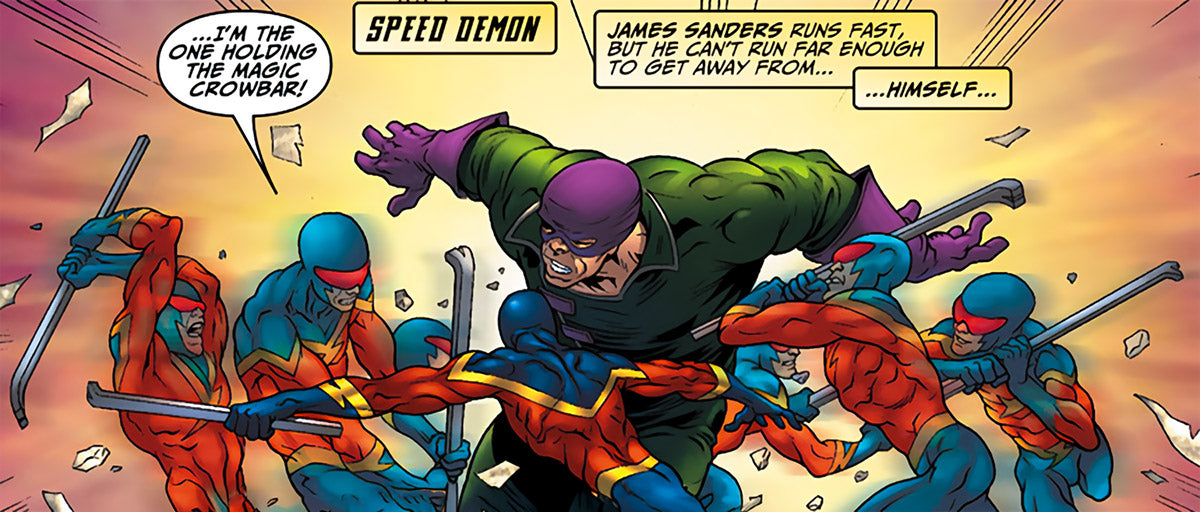
Speed Demon, alias James Sanders, was born in October 1969 in Avengers #69: an ordinary man turned into a speedster by the Grandmaster. First called the Whizzer, he took the name Speed Demon in 1981 in Amazing Spider-Man #222, where he faced Spider-Man for the very first time, before joining the Sinister Syndicate in 1986. Below, we retrace his career as a clear-eyed loser.
There is, in the endless gallery of Peter Parker's villains, a category of characters no casual fan ever names off the top of their head, but that every dedicated reader secretly adores. Those second-tier criminals, those professional losers in improbable costumes, those magnificent failures who stubbornly refuse to give up the job. Speed Demon, alias James Sanders, is probably the most emblematic of them all. A speedster born of a cosmic accident, renamed because of an in-house trademark clash at Marvel, recycled into almost every villain team imaginable and turned, without ever aiming for it, into the unofficial mascot of those washed-up crooks the wall-crawler runs into between two more serious cases.
This article is a full deep dive into the editorial and fictional life of this underrated villain. A strange origin courtesy of the Grandmaster, promotion to pillar of the Sinister Six through the back door, a fleeting stint with the Thunderbolts, and a tragicomic apotheosis in the pages of Superior Foes. James Sanders has never won a major battle — and that is exactly why he fascinates.
A cosmic origin that should never have happened
To understand Speed Demon, you have to start very, very far from New York. Far from Brooklyn Bridge, far from the rooftops of Queens, far from everything that usually makes up Spider-Man's backdrop. You have to go back to October 1969, to the pages of Avengers #69, an issue written by Roy Thomas and drawn by Sal Buscema. What plays out there has nothing to do with Peter Parker's life: it is a pure Avengers story, one in which Marvel quietly builds a tribute-cum-satire of the Distinguished Competition's Justice League.
The Grandmaster, one of those Elders of the Universe obsessed with games on a galactic scale, decides to put Kang the Conqueror to the test. The format is a classic one: two teams of champions, one match, one stake. For Kang, it will be three Avengers. For the Grandmaster, it will be a team invented entirely for the occasion, four super-humans created from scratch out of ordinary human beings. That team is called the Squadron Sinister. It includes Hyperion (a Superman parody), Nighthawk (a Batman parody), Doctor Spectrum (a Green Lantern parody) and a speedster (a Flash parody) initially named the Whizzer. That speedster is James Sanders.
The delicious detail: Marvel already had a character called the Whizzer, Robert Frank, a Golden Age hero. That in-house clash of names would eventually push the editors to rename Sanders twelve years later. At his birth, in 1969, Sanders is therefore an ordinary citizen propelled to the rank of cosmic villain by an entity that plays with universes the way a child plays with toy figures. No family tragedy, no revenge, no bite from a mutant spider. Just an ordinary man drafted into a chess match between demigods, who works out within seconds that he can run faster than sound.
From the Whizzer to Speed Demon: the editorial makeover of 1981
The Squadron Sinister loses its first match against the Avengers, like every team the Grandmaster creates. The characters, though, do not disappear. Marvel immediately recycles them into other arcs, looking for a lasting use for them. For Sanders, the turning point comes in November 1981, when he resurfaces in Amazing Spider-Man #222 — but the confusion with Robert Frank has become untenable. The editorial team makes the call: James Sanders will from now on be Speed Demon.
That change of name is more than a cosmetic operation. It places Sanders in a family of villains whose very name sounds like self-deprecation. Speed Demon, in English, is nothing heroic: it is the everyday expression for a reckless driver, a speed freak. Where Quicksilver evokes mercury, where Flash evokes lightning, where even Northstar evokes a pole star, Speed Demon evokes a speeding ticket handed out by a New York cop. From birth, the name carries a charge of irony that will follow the character throughout his career.
This makeover coincides with a thematic shift: Sanders leaves the orbit of the Avengers for Spider-Man's. The move is immediate, it plays out in the very pages of Amazing Spider-Man, and the trajectory is clear. Marvel has worked out that Speed Demon will never be a credible opponent for Thor or Iron Man. In the more modest landscape of Peter Parker's villains, however — a landscape populated by Shocker, Scorpion, Rhino and dozens of other second-string criminals — a costumed and slightly pathetic speedster fitted right in.
A lasting foothold in Spider-Man's orbit: the Sinister Syndicate of 1986
Sanders' consecration within Spider-Man canon arrives with The Amazing #280-281, in September 1986. Written by Peter David and drawn by Bob McLeod, this two-part arc carries a programmatic title: 'The Sinister Syndicate'. Peter David assembles a group of villains knowingly inspired by the original Sinister Six of Stan Lee and Steve Ditko, but with a twist: the members making up the team are lower-ranking villains, less iconic, less powerful, more opportunistic.
The initial line-up says a lot. It features Beetle (Abner Jenkins), the Hobgoblin of the period (Ned Leeds at that point), Boomerang (Fred Myers), the Rhino, and therefore Speed Demon. This team is presented not as an apocalyptic threat, but as a criminal operation run by the Rose, the criminal heir then manoeuvring in the shadow of the Kingpin. The Sinister Syndicate are not trying to conquer the world. They are trying to draw a wage.
For Sanders, that framework is perfect. He has never had the metaphysical ambition of a Doctor Octopus, nor the tragic romanticism of a Sandman. He does not aspire to break the wall-crawler, he aspires to rob banks fast enough not to get caught. The team logic of the Sinister Syndicate — a group content to make a living from crime instead of fulfilling a cosmic destiny — fits his pragmatic runner's psychology perfectly.
This 1988-1995 stretch becomes the character's quiet golden age: an opportunistic climber, a nimble runner, an irritating but never lethal opponent for Peter Parker. He lets writers stage fast action scenes without calling on the heavyweights of the cast. He is, literally, the warm-up villain.
CULT VILLAINS — Green Goblin

Green Goblin Action Figure
€29.90
Speed Demon ran with the biggest villains in Peter Parker's world: pay tribute to Spider-Man's number one rival with an articulated Green Goblin figure.
Discover →Anatomy of a clear-eyed loser: the psychology of Speed Demon
What sets James Sanders apart from the mass of second-tier villains is a trait that is rare in the genre: he knows he is a loser. The great criminals of the Spider-Man pantheon all suffer from a flaw in perception. Norman Osborn thinks he is a brilliant megalomaniac. The Green Goblin thinks he is a prophet of chaos. Mysterio thinks he is a genius director. Kraven thinks he is the supreme hunter. Sanders, for his part, mostly thinks he is tired.
That clear-sightedness, patiently developed by Peter David then exploited to the full by Nick Spencer in the 2010s, makes Sanders a strikingly modern character. He embodies the late twentieth-century villain who refuses the Faustian pose. He does not want to match God. He wants to pay his rent, stay out of prison, pull off a heist discreet enough not to attract Peter Parker's attention. His internal monologues, in the rare moments when Marvel spells them out, read less like Nietzschean raving than like the soliloquies of a disillusioned pensioner.
This dimension is there from his earliest solo appearances. Sanders sometimes gives his lawyer a speech that will become his trademark: he cannot understand why his colleagues insist on wearing ridiculous costumes to attack superheroes they are going to lose to, when it would be enough to run fast along empty pavements and clean out jewellery shops with no witnesses. He is, literally, the villain who wonders why his colleagues do not think things through more efficiently.
The Thunderbolts detour: when a villain brushes against redemption
Like most second-tier Marvel villains, Sanders was at some point swept up by the redemption concept so dear to the Thunderbolts. After the apparent fall of the Avengers during Onslaught, Baron Zemo assembles a team of villains who claim to be new heroes. The idea is brilliant and shameful in equal measure: take advantage of the void left by the missing heroes to manipulate public trust, gain legitimacy, then strike.
Speed Demon joins the movement late, in a spin-off iteration of the concept. He is part of the roster during the post-Civil War era, at a point when the American government, under the influence of Norman Osborn, turns the Thunderbolts into a paramilitary squad tasked with hunting down unregistered heroes. Sanders ends up there because he has no choice: it is that or Ravencroft, incarceration with no horizon.
This period is interesting because it reveals one thing: Sanders never really redeems himself. Where Songbird or Fixer, to varying degrees, commit to the redemption project, he passes through the Thunderbolts the way he passes through everything else — running. He carries out the missions, he collects his pay, he waits for the moment he can go back to his real trade: robbing banks without getting caught by Spider-Man. There is no dramatic arc of moral conversion. There is a villain using an institution the way other people use a temp job.
That blurred stretch is a powerful giveaway. Some villains are beyond saving by nature — Carnage, for instance, whose psychology rules out any notion of redemption. Others, like Harry Osborn, swing constantly between light and shadow. Speed Demon occupies a third position: he is neither redeemable nor radically evil. He is simply there. That moral neutrality is probably what allows him to cross the decades without ever really dying or ever really winning.
COMIC ART — Iconic Duel

Villain Duel Poster
€22.90
Speed Demon faced Spider-Man alongside the worst villains going: hang the most emblematic graphic duel in the Spider-Man universe on your own wall.
Discover →Superior Foes: the tragicomic breakthrough of 2013
Yet the finest moment of Sanders' career does not come in an epic clash with Spider-Man. It comes in December 2013, when Marvel launches The Superior Foes of Spider-Man, a monthly series written by Nick Spencer and drawn by Steve Lieber. The concept is as simple as it is bold: follow a team of failed villains exclusively, never giving Peter Parker the lead role.
The make-up of that team is a joy: Boomerang (Fred Myers) as the narcissistic leader, Shocker as the jittery sidekick, Speed Demon as the weary veteran, Overdrive as the ambitious young gun, and Beetle (Janice Lincoln) as the opportunistic femme fatale. This quintet embodies exactly what Nick Spencer wanted to explore: the daily life of professional criminals who no longer dream of conquering the world, but of surviving New York rent.
For Sanders, this series is a gift from the heavens. He takes a central place in it, not as an antagonist but as a comic figure. Nick Spencer exploits his character's potential to the full: an ageing speedster who has watched thirty years of villains rise and fall, who knows every arrest procedure by heart, who knows exactly how many seconds he has left before a police officer calls for backup. His cynicism is encyclopaedic. His one-liners, often a single panel long, go viral in the reader community.
Nick Spencer's run ends in 2015 after eighteen issues. Despite its critical success — the series is regularly cited as one of Marvel's best publications of the decade — it never finds a readership large enough to survive. Its editorial impact, though, is immense. It lastingly revives the character in fan imagination, it directly inspires several later arcs of Sinister War, and it installs James Sanders as an essential figure of the second tier. The villain who has never won a major battle has just won his cult legitimacy.
Powers, limits and micro-tactics of a second-tier speedster
Technically, Speed Demon has an extremely powerful gift. His top speed, according to the official Marvel handbooks, hovers around the speed of sound at cruising pace, with occasional bursts capable of breaking Mach 1 over short distances. He has mastered running on walls, running on water thanks to surface tension, and a metabolism that absorbs kinetic energy without destructive overheating. On paper, he ought to be unbeatable.
In practice, he never is. That contradiction sits at the heart of his narrative interest. Every time he fights the wall-crawler, he loses. Every time he attacks an Avengers team, he loses. Every time he attempts a solo job without being noticed, it falls apart halfway through. This accumulation of failures is not down to lazy writing: it is consistent with the character's psychology. Sanders is tactically clever, but he lacks strategic discipline. He runs too early, he runs too late, he never stops running even when the situation calls for him to hide.
His most dangerous opponents are not, in fact, the most powerful heroes. Against Hyperion, he knows he will lose quickly and painlessly. Against Peter Parker, on the other hand, every confrontation drags on indefinitely, because spider-sense systematically anticipates his bursts of acceleration. Spider-Man does not need to see Sanders coming: he feels the ripple of disturbance generated by the run before the villain has even passed 40 km/h. That set-up turns every fight into a game of chess in which the speedster is permanently a move behind.
That strategic flaw is no small thing. It places Sanders in the same category as Molten Man or Black Tarantula: villains with objectively impressive abilities, yet always neutralised by Spider-Man's combination of agility, real-time analysis and pragmatic intelligence. Spider-sense is, for Sanders, a bespoke curse.
SINISTER SYNDICATE — Electro

Electro Action Figure
€29.90
Speed Demon has shared more than one job with Electro in the orbit of Peter Parker's villains: add the mad energy man to your collection of iconic bad guys.
Discover →Speed Demon against the other speedsters in the Marvel stable
A point commentators often overlook: Sanders is not the only speedster in the Marvel stable, and his position within that family says a great deal about his narrative fate. Quicksilver, a long-standing member of the Avengers and the X-Men, is the prototype of the arrogant, aristocratic speedster, insufferable but admired. Northstar is the refined, sophisticated speedster, tied to Alpha Flight. Whirlwind is a combat-oriented villain speedster, a regular opponent of Giant-Man and the Wasp. Speed, a member of the Young Avengers, is the generational speedster, young heir of the Scarlet Witch.
In that gallery, Sanders occupies a very precise slot: he is the speedster of the daily grind. Not an aristocrat, not refined, not young, not heroic. A labourer of speed, an artisan of petty crime, an almost unionised employee of New York organised crime. That class identity, rarely spelled out but always perceptible, is one of the reasons Nick Spencer was able to do so much with the character. Sanders carries, without ever saying so, a social commentary on the criminal working class — a category few Marvel villains embody so completely.
On the strictly physical level, his stats put him mid-table — faster than Scorpion or Rhino, well below Quicksilver. That middling position condemns him always to be too slow to compete with the elite, and always too fast to be treated as a mere gangster. Editorially, he floats in a grey area he will never truly escape.
The New York criminal ecosystem and Sanders' place in it
Understanding Speed Demon means grasping the social geography of crime in the Marvel universe. New York is a structured criminal fabric, with its hierarchies and its rungs to climb. At the top, figures like the Kingpin or Tombstone run sprawling organisations. Below them, lieutenants like The Rose manage operational cells. Below them again, the independent costumed villains — Sanders, Shocker, Boomerang, Beetle — offer their services to the highest bidder.
This hierarchical structure is essential to understanding why the character has never had a major personal arc outside teams. Without Hydra, without the Rose, without the Sinister Syndicate, there is no operational Speed Demon. He has neither the intellectual nor the financial means to set up his own organisation. That structural dependence is also why he turns up regularly in the stories linked to Ashley Kafka and to Ravencroft, where he appears clear-eyed, ironic, almost resigned.
Speed Demon in the great Spider-Man crossovers
Though rarely front and centre, Sanders has been present in just about every major event of Spider-Man mythology. He appears on the fringes of Maximum Carnage, not as the main antagonist but as an opportunist trying to take advantage of the chaos to loot Manhattan. He passes through the Clone Saga without playing any notable role — which is telling in itself, since the character is present while the Spider-Man universe fractures, yet stays focused on his own minor jobs.
In Back in Black, the arc in which Peter Parker sinks into a dark rage after his aunt's death, Sanders appears briefly. He is granted a moment of pure fear: in that period, when Spider-Man turns merciless, every second-tier villain lives in dread of being targeted first. The speedster, with his usual pragmatism, decides to suspend all criminal activity in New York until the crisis passes. He temporarily relocates to Boston. It is perhaps the only strategically brilliant decision of his career.
More recently, in the arcs of Superior Spider-Man — the period when Doctor Octopus was living inside Peter Parker's body — Sanders' room for manoeuvre narrows considerably. Ock, with his killer-scientist mindset, is no longer content to let minor villains slip away. The speedster feels the pressure and becomes even more cautious. That period is traumatic for every second-tier villain, as Nick Spencer documents across several issues of his series.
Why Speed Demon matters: the legacy of a minor character
At first glance, a character who has never won a major battle, who never appears on the cover of the big crossovers, who survives in no film deserves no in-depth analysis. The opposite is true. Sanders matters precisely because he embodies an essential facet of the Spider-Man myth that the star villains permanently obscure: the banality of crime, the weariness of criminals, the real economy of the underworld.
Without James Sanders and his kind, Peter Parker's world would be a permanent opera in which every opponent belongs to Shakespearean tragedy. It is precisely the opposite that makes the Spider-Man universe so rich: around the monumental figures — Norman Osborn, Doctor Octopus, Kingpin — a multitude of losers swarm, fail, get back up and get arrested again. This second-tier fauna forms the realistic bedrock on which the great tragedies can unfold. Take away the Sanders and the Myers of this world, and you get an opera with no extras, a theatre with no audience.
Nick Spencer understood that perfectly. By giving Sanders a central role in Superior Foes, he rehabilitated a whole category of characters that the cult of the great villain had gradually made invisible. Speed Demon is a blue-collar worker in a red and yellow costume. His career, flat on the surface, says a great deal about what Marvel means by villainy.
Conclusion: a villain who exists only thanks to his defeats
The great narrative lesson of Speed Demon fits into a single sentence: he literally exists only thanks to his defeats. Every victory Spider-Man scores over Sanders is one more stone added to the minor monument he constitutes. Every arrest, every humiliation, every escape followed by a fresh capture feeds a character whose richness is built entirely in the negative. James Sanders is the only Marvel villain whose value grows the more he loses.
For new readers discovering the Spider-Man universe today, diving into the Sanders catalogue is an excellent way into the richness of the second tier. Start with The Amazing #280-281 to discover the original Sinister Syndicate. Follow up with the eighteen issues of The Superior Foes of Spider-Man by Nick Spencer, the absolute cornerstone of the character. Then explore the recent crossovers to gauge how Marvel keeps using this weary but indispensable villain.
Carry on reading with our complete guide to the iconic villains, our full panorama of the Spider-Man characters, as well as our chronological list of Spider-Man's major story arcs. For collectors, our range of classic villain figures, our selection of vintage comic posters, our themed LEGO aisle, our collector mug range, our decorative items and our Spider-Man villain costumes catalogue all let you carry this exploration into everyday life. Speed Demon is waiting round the corner: fast, tired, pathetic and magnificent.

