
14-Day Money-Back Guarantee
0
The short answer
A former professional baseball pitcher banned for match-fixing, this Australian turned mercenary first appeared in Tales to Astonish #81 back in 1966, long before he ever crossed paths with Spider-Man. His arsenal of specialised projectiles and his cheerfully accepted mediocrity have made him a cult tragicomic figure. Here is the full story of his career below.
There is a category of villain in the Marvel universe that the comics kept in the shadow of the emblematic supervillains for a very long time. Not the evil geniuses with unfathomable IQs, not the powerhouses who make skyscrapers tremble, not the psychopaths with angelic faces. Just losers. Blokes who get up every morning in a ridiculous costume, with a themed gadget impossible to take seriously, and the unshakeable conviction that this time they are going to pull off the heist of their lives. Frederick 'Fred' Myers, alias Boomerang, is probably the purest representative of this brotherhood of second-rate villains. A former Australian baseball pitcher thrown out of the Major League for taking bribes, turned mercenary in a purple and yellow costume, kitted out with an arsenal of rigged boomerangs. On paper, the whole thing is ridiculous. And yet, ever since his first appearance in Tales to Astonish in 1966, Boomerang has never left the Marvel universe. Better still: from 2013 onwards, he became one of the best-loved and most tragicomic characters in the Spider-Man pantheon.
This paradox — the astonishing longevity of a character everyone should have forgotten long ago — is worth dwelling on. Because behind the jokes about his boomerangs and his forced Australian accent, Fred Myers says something very profound about the nature of evil in Marvel comics. Not the monumental evil of a Kingpin ruling the New York underworld with the cold detachment of a CEO, not the scientific sophistication of a Doctor Octopus able to reprogram his own brain. No: the mediocre, weary, almost likeable evil of the bloke who botches his robberies and has to talk his landlord into giving him another month to pay the rent.
Who is Fred Myers? The origin of an Australian turned boomerang thrower
Frederick Myers was born in the suburbs of Sydney, Australia. Physically gifted as a child, he developed a talent for precision throwing very early on: cricket balls, assorted projectiles and, of course, the traditional boomerang, which he handled with a dexterity his schoolmates found unsettling. His parents emigrated to the United States when Fred was about ten, and that is the moment his destiny swerved towards American baseball. Blessed with a prodigious arm and millimetre-perfect accuracy, young Myers climbed the minor league ladder quickly before joining the Major League as a professional pitcher. For a few brilliant seasons he was tipped for a glittering future. Then came the scandal that would destroy his career: Fred took money to fix matches, was exposed by the league, banned for life from all professional sport and branded a public cheat.
It is in that disgrace that the criminals of the Marvel universe came looking for him. A criminal organisation working for the Secret Empire — one of those shadowy groups that populate Marvel — spotted the wasted talent of Myers and offered him a new trade: mercenary. They funded the design of a themed costume, supplied him with an arsenal of boomerangs rigged by their engineers, and gave him a mission. That is how Frederick Myers became Boomerang. His first public appearance in that costume dates from Tales to Astonish #81 in 1966, written by Stan Lee — the same Stan Lee who co-created Spider-Man a few years earlier with Steve Ditko, the visual architect of the web-slinger. Originally, Boomerang was not even an enemy of Spider-Man: he fought the Hulk, the Inhuman Triton and various other Marvel heroes before his path finally crossed that of the hero from Queens in the late 1970s.
What makes the origin of Fred Myers fascinating is that it is entirely free of heroic tragedy. No traumatic death of a loved one, no scientific accident turning an innocent scholar into a monster, no noble quest for revenge that might have tipped the wrong way. Just a bloke who cheated at baseball, got sacked, and took the first criminal job he was offered. The triviality of his origin is precisely what makes him, decades later, so human.
The costume, the arsenal and the rigged boomerangs that define the villain
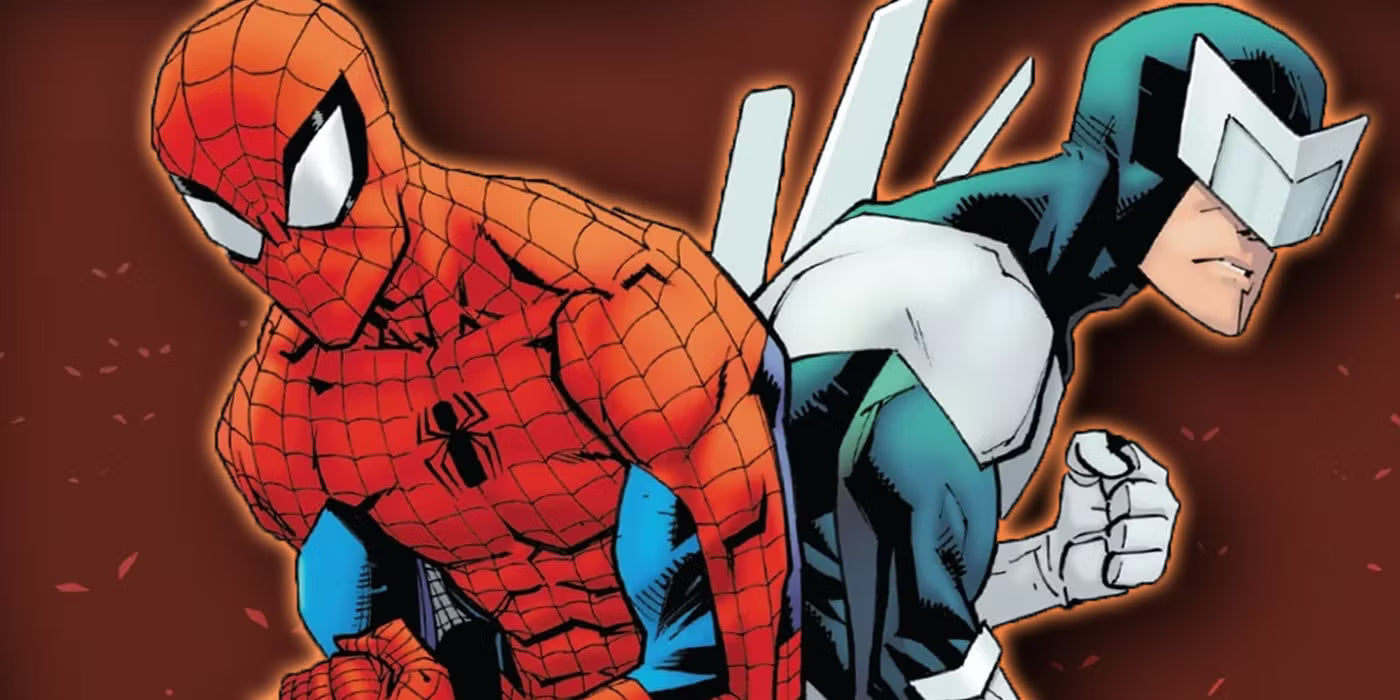
Visually, Boomerang is a textbook case of Silver Age Marvel design. A skin-tight dark purple suit with touches of yellow, triangular wings fixed to his flanks letting him glide short distances, a full helmet covering his whole face and leaving only his eyes visible. The overall effect suggests a 1960s comic book character as much as an amateur cosplayer who has taken his hobby slightly too seriously. That deliberately offbeat aesthetic is an integral part of the character: Boomerang never set out to be intimidating. He set out to have a theme.
His arsenal is organised entirely around that thematic obsession. Fred Myers permanently carries around a dozen specialised boomerangs, each designed for a precise function. The 'razor boomerang' is razor-sharp and can slice through metal. The 'shatter boomerang' explodes on impact like a small grenade. The 'smoke boomerang' releases an opaque cloud to cover his escape. The 'gas boomerang' disperses a neurotoxic agent. The 'screamer boomerang' emits a disorienting sound wave. The 'atom boomerang' — the most dangerous of the lot — carries a miniaturised nuclear charge capable of levelling an entire neighbourhood, though Fred uses it extremely rarely, aware that killing too many civilians would draw the sort of attention he would rather avoid.
This kit echoes the arsenals of other gadget-based villains in the Spider-Man universe, starting with Shocker and his vibro-gauntlets or the themed weapons collected by the Scorpion in his mechanical shell. The difference is that Boomerang has no superhuman power to compensate. He is no powerhouse like Rhino, who can charge straight through a wall, he is no master of illusion like Mysterio, who can convince a hero he is fighting a dragon, he cannot control electricity like Electro, who can drain an entire transformer. Fred Myers is an ordinary man who throws things. And who, statistically, misses more often than he hits.
Boomerang and the Sinister Six: how a loser gatecrashes the big league
One of the finest ironies of the career of Fred Myers is his complicated relationship with the Sinister Six, the cult team founded by Doctor Octopus to defeat the New York web-slinger once and for all. For decades, Boomerang watched that elite criminal outfit from a distance, made up of the six most dangerous villains in the Spider-Man stable. Otto Octavius, Norman Osborn, Adrian Toomes, Maxwell Dillon, Flint Marko, Mysterio — the cream of the crop. Boomerang, meanwhile, belonged to the 'B-team' of New York criminals, the ones you call when the real professionals are unavailable or behind bars.
And yet, on several occasions across the arcs, Fred Myers has managed to worm his way into alternative or expanded versions of the group. During Return of the Sinister Six, the explosive union of the most emblematic enemies of the web-slinger in the 1990s, Boomerang featured in the extended ranks of the Sinister Twelve, an XXL version of the team orchestrated by Norman Osborn. Later, during the Sinister War that broke Spider-Man, Fred took part in several opposing factions and navigated the alliances with disarming opportunism.
This intermittent presence on the fringes of the Sinister Six says a great deal about the standing of Boomerang in the Marvel criminal hierarchy. He is never important enough to be a founding member, but he is reliable enough — or desperate enough — to be called back whenever the enemies of the web-slinger need cannon fodder. That position of eternal substitute feeds a deep frustration in Fred Myers, a sense of being perpetually next to greatness without ever reaching it. And that feeling, paradoxically, makes him infinitely more endearing than the mega-villains he envies. Because everyone, at one point or another, has felt like Fred Myers: competent without being brilliant, present without being indispensable, determined without being gifted.
Superior Foes of Spider-Man: the tragicomic crowning of Fred Myers
Everything changed for Boomerang in 2013, when Marvel launched The Superior Foes of Spider-Man, a monthly series written by Nick Spencer and drawn by Steve Lieber. The concept is brilliant in its simplicity: follow a team of second-rate villains — Boomerang, Shocker, Speed Demon, Overdrive and Beetle (Janice Lincoln) — painfully trying to earn a living in the shadow of the big criminals. And it is Fred Myers who inherits the lead role, that of the lying, manipulative, charming, pathetic, hilarious narrator. The subject is covered in more detail in Speed Demon: the failed speedster of the Grandmaster who became the unofficial legend of the Sinister Syndicate.

The series revolutionised how the character is seen. For the first time, we get inside the head of Boomerang. We discover a man eaten up by debt, who owes a hundred thousand dollars to Hammerhead, the mobster with the reinforced skull, and who spends his time inventing twisted schemes to pay it back. We discover a man who chats women up while systematically lying about his identity, who betrays his own teammates for laughable sums, who dreams of writing his autobiography as though anyone would want to read it. Above all, we discover a man who lies to himself constantly, who sees himself as a misunderstood criminal genius while everyone around him knows he is just a likeable loser.
The voice-over narration of Fred Myers became one of the finest comic turns Marvel produced in the 2010s. When he describes his own exploits, he does it with the heroic tone of a mythographer recounting Odysseus. When reality is shown in parallel in the panels, it is invariably pathetic. That permanent gap between the image Fred has of himself and the reality of his existential misery is the raw material of the humour of the series. And beyond the humour, it says something very true about the human condition: we are all, to some degree, the lying hero of our own inner narrative.
COLLECTION — Premium Villain Figure

Spider-Man No Way Home Green Goblin Collector's Figure
299,90 €
Boomerang remains a satellite of the great villains. To truly own the court of the enemies of the web-slinger, start with their tragic king: the Green Goblin in his No Way Home version, a premium figure for the display cabinet of the demanding collector.
Discover →Why Boomerang is the most human villain in the Spider-Man universe
Beyond the gag, Fred Myers carries a psychological dimension that the more powerful villains of the stable never reach. When the Vulture soars above the New York rooftops with the rage of an old man robbed of everything, we are watching a Shakespearean drama. When Doctor Octopus takes possession of the body of Peter Parker in Dying Wish, we touch the boldest kind of science fiction. But those characters, however well written, stay within the register of superheroic tragedy. Boomerang, by contrast, operates in the register of ordinary tragedy — the one we recognise in our own lives.
Fred Myers pays his rent late. Fred Myers drinks too much beer. Fred Myers argues with his girlfriend about things that do not matter. Fred Myers makes promises he does not keep. Fred Myers wakes up in the morning with a hangover and the conviction that this time, really, he is going to get his life back on track. And every time, twenty-four hours later, he falls back into the same patterns of self-sabotage that keep him mediocre. That resemblance to the daily life of ordinary readers — who are neither criminal geniuses nor costumed heroes, just people trying to make ends meet — is what tips Boomerang from visual joke to profoundly human character.
He is not the only villain of the Spider-Man stable to embody this working-class dimension. Tombstone, the merciless godfather of the New York underworld, comes from a deprived Harlem and knew the same precariousness before tipping into organised crime. The Rose, the criminal heir of Kingpin, lives in the permanent shadow of a father whose stature he can never match. All these characters describe an evil that is not an elegant aesthetic choice but a consequence of failing social structures and a run of mediocre personal decisions. Banal evil, in short. The kind we walk past every day without recognising it.
The essential arcs where Boomerang shines (and makes a fool of himself)
For anyone wanting to explore the career of Fred Myers beyond Superior Foes, several arcs are worth a look. His first appearance in Tales to Astonish #81 remains a Silver Age classic, interesting mainly for the graphic quality of the aerial fights. His early confrontations with the web-slinger, in the 1970s under the pen of Marv Wolfman, lay the foundations of the character as we would come to know him: ridiculous but persistent, beaten but never discouraged.
The Spider-Man: Sinister Twelve arc by J. Michael Straczynski, in the early 2000s, deserves a special mention. Boomerang is used there as a founding member of that expanded version of the Sinister Six, and the scenes where he interacts with Norman Osborn and Doctor Octopus are especially delicious: you can feel the full condescension of the evil geniuses towards this little gadget man they tolerate out of tactical necessity. That dynamic would be taken up and amplified in Dark Reign, the arc in which Norman Osborn runs America and persecutes the web-slinger, and in which Boomerang serves as a minor enforcer for the Green Goblin at the height of his power.
But it is of course The Superior Foes of Spider-Man, his 2013-2014 solo series, that stands as his undisputed masterpiece. Seventeen issues of absolute black comedy, where every page pushes the limits of what a Marvel comic can do in terms of anti-heroic storytelling. The series ends on one of the most cynical cliffhangers in the recent history of Marvel, and even though Nick Spencer never got the chance to write the follow-up, the work remains an unmatched high point of the genre. For French-speaking readers, Superior Foes is available as a collected edition from Panini under the title Les Sinistres Six : Les Pires de Spider-Man, and is probably the best way in to discovering Fred Myers in depth.
More recently, Boomerang resurfaced in the Nick Spencer run on The Amazing Spider-Man from 2018, where Fred temporarily becomes the flatmate of Peter Parker in a Brooklyn flat. That improbable house-share generates some of the best comic sequences of the Spencer era, as well as serving as a springboard for a wider arc around the Stacys and the problematic resurrection of certain characters. For fans who want to follow the web-slinger through all his strange living arrangements and his New York arcs, the Brooklyn Bridge is the most iconic location of the arachnid myth and it appears several times in these shared adventures.
POSTER — Comics Wall Piece

Spider-Man Comics Battle Poster
19,90 €
Boomerang throws, the web-slinger dodges. This eternal dynamic of absurd combat deserves a wall of its own. XXL comics poster format, premium matte finish, ideal above the desk or in the bedroom of a devoted teenage fan.
Discover →Boomerang against the other 'failed' villains: the brotherhood of second-stringers
To fully grasp the place Fred Myers occupies in the Marvel ecosystem, you have to put him back in the long tradition of 'B-list' villains who populate the universe of the web-slinger. These characters form a coherent sociological category: they never have the cultural standing of the Green Goblin who haunts the nightmares of Peter Parker, they never have the brute power that turns a story on its head, but they tirelessly populate the margins of the universe, acting as a Greek chorus of criminal mediocrity.
Shocker, alias Herman Schultz, shares with Boomerang that quality of the methodical loser. A competent engineer but no genius, Schultz designed his vibro-gauntlets to burgle banks without having to hurt anyone — a modest objective that clashes violently with the world-domination ambitions of the great villains. Speed Demon, alias James Sanders, is a former member of the Squadron Sinister recycled into a low-rent mercenary, able to run at superhuman speeds but incapable of planning a heist without botching it. Beetle, in her Janice Lincoln version (the daughter of Tombstone), brings the Superior Foes team a touch of glamour that contrasts with the surrounding mediocrity.
What sets Fred Myers apart from his fellow also-rans is his ability to embody criminal mediocrity with a certain flair. Boomerang does not have the almost touching innocence of Shocker, nor the calculating cynicism of Beetle. He has a unique blend of vanity, cowardice, geniality and self-delusion that makes him the ideal narrator of an urban black comedy. When you read Superior Foes, you quickly understand why it is him, and not another member of the team, who inherited the lead role: he is the only one who tells his own story with enough bad faith to make the lie interesting.
Boomerang in the asylum, in hospital and at Ravencroft: the medical and penal record of a loser
One of the peculiarities of the career of Fred Myers is his ongoing relationship with the punitive institutions of the Marvel universe. Unlike the front-rank supervillains who systematically escape every prison they are locked in, Boomerang spends a significant part of his life in cells. He has done time at Rikers Island several times, at Ryker's Bay, at the Vault — that federal penitentiary for super-criminals designed specifically to neutralise superhuman powers — and even, during one particularly dark arc, at the Ravencroft Institute, the cursed psychiatric asylum that houses the worst mentally unstable criminals.
These institutional stays often serve as narrative pivots: it is in prison that Boomerang meets new accomplices, and it is on leaving prison that he accepts the most desperate jobs to repay the debts he ran up while inside. His relationship with psychiatry is particularly interesting: several arcs suggest that Fred suffers from a grandiose narcissistic disorder mixed with a compulsion to lie that borders on clinical mythomania. The conversations he might have had with Ashley Kafka, the Ravencroft psychologist who probed the most twisted minds in the universe, remain one of the great 'what ifs' we would have loved to see developed in a comic.
The New York press, for its part, has never taken much interest in Fred Myers. Too ridiculous for the front page, too secondary to deserve an investigative feature, Boomerang is mentioned only in the crime briefs. Norah Winters, the Daily Bugle journalist who nearly revealed the whole truth about the web-slinger, interviewed him once in prison for an in-depth piece on 'forgotten villains' and described the experience as one of the most depressing of her career. Ben Urich, the fearless Daily Bugle journalist facing the truth, has never thought it worth devoting a single paragraph to him — a sign that Fred Myers, even in the press, remains a second-rank villain.
Verdict: why Fred Myers deserves his place in the Spider-Man pantheon
Boomerang will probably never appear in a big-budget film. No Hollywood studio will invest two hundred million dollars to tell the story of a washed-up Australian who throws boomerangs and drinks too much beer. He does not have the visual power of Venom, nor the tragic depth of the Green Goblin, nor the philosophical complexity of Mysterio. And yet there is something in Fred Myers that those more famous characters will never reach: a raw, mediocre, recognisable humanity that speaks directly to any reader who has ever felt next to greatness without ever reaching it.
The strength of a narrative universe like that of Marvel lies precisely in its capacity to house characters of every level of importance and every emotional register. Without the seven most powerful enemies of the web-slinger who structure the main story, the universe would lack its central drama. But without the Boomerangs, the Shockers and the Speed Demons who populate the margins, the universe would lack its texture, its social density, its peripheral humanity. The great villains are the pillars of the story. The small villains are its hunting ground, its connective tissue, its comic shadow.
There is also a generational dimension to the persistence of Boomerang. The character has existed for nearly sixty years. He has lived through the Golden Age of comics, the Bronze Age, the Modern Age, the grim and gritty era of the 1990s, the Quesada revival of the 2000s and the contemporary era. In every generation, writers have dug Fred Myers out of the Marvel archives, dusted him off and decided he still deserved to exist. That continuity is no accident: it proves the character answers a structural narrative need. The Spider-Man universe needs its official loser, its eternal failure, its charming no-hoper. And since 1966, it is Frederick Myers who has held that post.
FIGURE — Iconic Dynamic Pose

Spider-Man Articulated Figure
99,90 €
Boomerang throws, the hero dodges. To replay the absurd fights of the Superior Foes series, nothing beats a premium articulated figure, poseable at 25 points, capable of every acrobatic stance Fred Myers will never manage to dodge.
Discover →For fans who want to take their exploration of the complex universe of the New York web-slinger further, the full page on Peter Parker covers every facet of the central character and those around him across the decades of comics. The collector's figures let you physically bring to life the most iconic heroes and antagonists of the saga, including second-rank villains like Boomerang who deserve their place in the cabinets of serious collectors. And the Spider-Man cosplay outfits cover every costume variant of heroes and villains alike, because playing Fred Myers for the length of a geek event takes at least as much courage as playing the heroes at the top of the bill. Boomerang will never be centre stage. But it is precisely that position of eternal second-stringer that makes him, in his own mediocre and magnificent way, irreplaceable.

