
14-Day Money-Back Guarantee
0
The short answer
Wilbur Day, an engineer cheated out of his own work, helps himself to his employer's blueprints to build an armour mounted on hydraulic stilts and strike from above. Mocked from his very first duels with Daredevil, then with the web-slinger, he owes his longevity to that gap between daft gadget and outsized ambition. Below, we look at how he became a cult figure.
In the vast gallery of villains in the Marvel universe, some characters stand out for their power, their cruelty or their tragic aura. But others, like Stilt-Man, have lodged themselves in the collective imagination for an entirely different reason: how absurd they look. Created in 1965 in Daredevil #8, Stilt-Man quickly became one of the most 'ridiculous' and yet unforgettable antagonists Marvel has ever printed. With his telescopic armoured legs, he embodies both technological ingenuity… and the limits of certain ideas from the Silver Age of comics.

A strange concept that became a cult favourite
Real name Wilbur Day, Stilt-Man is a frustrated engineer who stole his boss's blueprints to build an armour fitted with extending hydraulic legs. They let him reach impressive heights, spy on people, or surprise his enemies from the rooftops of New York. The idea may sound comical, but it has produced spectacular and often memorable clashes with Spider-Man, Daredevil and other Marvel heroes.
Stilt-Man stands for a category of villain that fans love despite the lack of credibility. Where enemies such as the terrifying Morlun embody absolute menace, Stilt-Man stands instead for the unbridled creativity of 1960s comics, where anything seemed possible.
For collectors, Stilt-Man has become a cult character, often turned into Spider-Man figures or Marvel figures that remind fans of the humour and eccentricity of that era. That mix of the ridiculous and the nostalgic has kept the character in the history books, despite his status as the 'loser' of the villain gallery.
Clashes with Daredevil… then Spider-Man
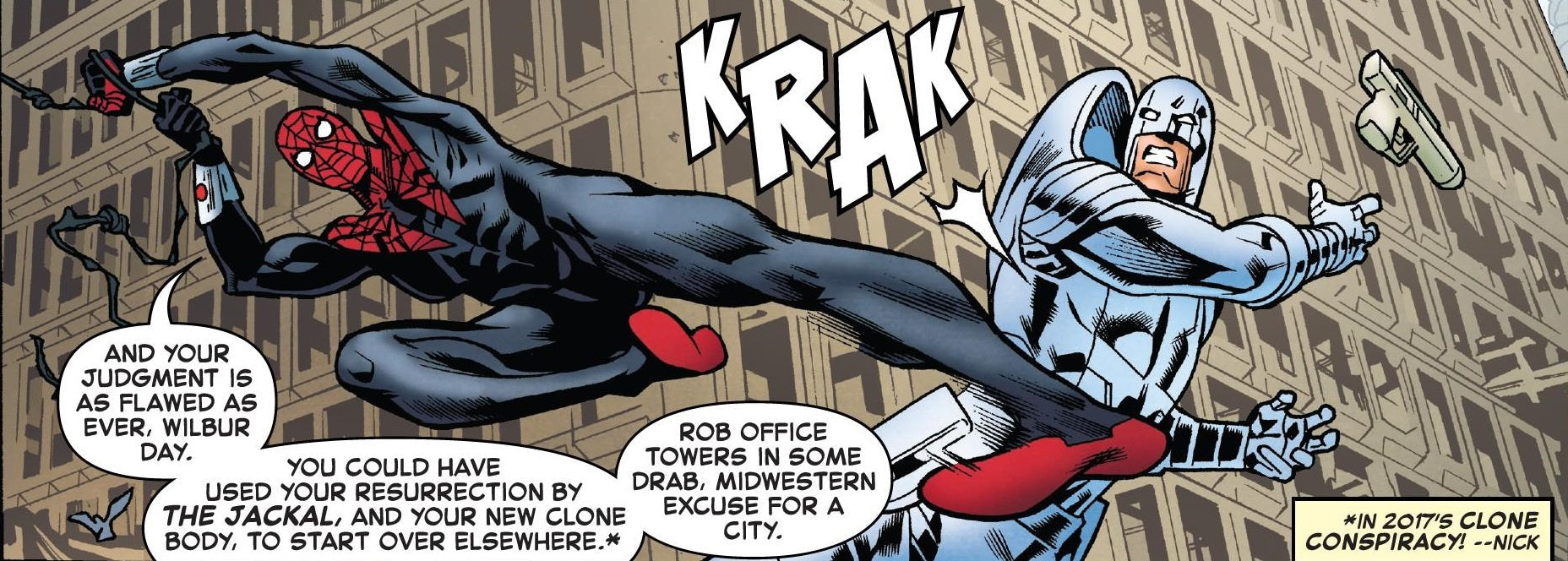
Stilt-Man made his debut against Daredevil, who quickly became his main adversary. His telescopic legs give him a surprising advantage: reaching Daredevil from a height no ground-based fighter can answer. Before long, though, the Man Without Fear learns to exploit the armour's weaknesses and to make his enemy look foolish. These confrontations, more comic than tragic, helped build Stilt-Man's reputation as a 'second-string' villain, but an entertaining one.
It was not long, however, before Stilt-Man crossed paths with Spider-Man. For Peter Parker, facing an enemy like this is also a test of adaptability. The wall-crawler, able to leap from skyscraper to skyscraper, finds in Stilt-Man an opponent who is both absurd and unpredictable. Their fights almost always end in a win for Spidey, but they leave behind memorable moments that recall the lighter tone of certain eras of the comics.
An evolution across the decades
Stilt-Man has often been played for laughs, yet he has enjoyed real longevity in the Marvel universe. Other characters have even taken up the costume after Wilbur Day, such as Carl Kaxton and Turk Barrett, each bringing something of their own to the concept. Some writers have enjoyed turning him into a tragic figure, the persistent loser who can never raise himself to the rank of the great villains such as the Kingpin or the Green Goblin.

In some modern stories, Marvel has chosen to play with his cult image. Sometimes Stilt-Man turns up in humorous tales, sometimes as a nostalgic reminder of a time when creativity came before logic. That contrast has turned him into an almost meta character, a nod to the way the tone of comics has evolved.
Today, Stilt-Man may not be a fearsome threat to the Marvel universe, but he remains a powerful symbol of comics history: the mad ideas that, for all their strangeness, leave a lasting mark.

You can find other characters from that era in our pillar page on Spider-Man's story arcs, which explores how even second-string villains shape the hero's development.

Stilt-Man in the modern Marvel universe
Despite his status as a 'ridiculous villain', Stilt-Man has kept turning up in modern arcs. He regularly appears at big gatherings of criminals, usually in the shadow of far more powerful figures such as Venom or Carnage. Writers generally use these appearances to bring in a touch of humour or to remind us how varied the Marvel universe is, a place where even the stubborn losers have their spot.
In some arcs, Stilt-Man is even presented as an almost endearing figure: a man who, despite repeated defeats, keeps believing in his invention. His persistence illustrates another kind of struggle, less spectacular than Peter Parker's but every bit as human: refusing to give up, even against all logic.
The unexpected moments of glory
Although his appearances are often punctuated by defeats, Stilt-Man has had a few standout moments. In certain stories, his mechanical legs have been upgraded to the point of giving him impressive striking power, making him a far more credible threat than you would imagine. These episodes show that even the most far-fetched concepts can find a new lease of life thanks to the imagination of the writers.
Stilt-Man is also used at times as a metaphor for delusions of grandeur and the ridiculousness built into certain ambitions. His towering silhouette, striding above the streets of New York, has become a cult image that fans love to see again. It is a reminder that Marvel does not always take itself seriously, and that even in a universe full of gods, symbiotes and mutants, there is room for oddball antagonists.
For other characters with an unusual fate, you can read our article on Big Wheel, another cult villain who is mocked just as often, or discover far more terrifying opponents such as The Thousand.
Stilt-Man: from ridiculous to cult icon
Today, Stilt-Man is no longer seen simply as a recurring loser in the Marvel universe. Thanks to his absurd side and his string of defeats, he has become a cult character in pop culture. Fans see in him a sort of accidental mascot, a symbol of misplaced ingenuity and endless perseverance.
Stilt-Man has even shown up in video games, in parodies and in humorous references inside the comics themselves. He has become a kind of insider nod, appreciated by readers who enjoy these second-string villains for the lightness they bring to often very dark stories. That blend of the absurd and the nostalgic has given Wilbur Day an unexpected legacy.

A role in the narrative balance
Stilt-Man's existence underlines something essential: in a universe that holds existential threats such as Knull or Morlun, it matters just as much to have secondary opponents, lighter ones, reminding readers how vast and varied the Marvel universe is. Without Stilt-Man, Spider-Man and Daredevil would lose part of the contrast that makes their stories so distinctive.
For you as a reader, Stilt-Man may be a source of amusement, but he is also a way into a lesser-known corner of the Marvel universe. And if you want to take it further, have a look at our Spider-Man masks and costumes, which let you play the heroes as well as their cult enemies, whether they are formidable… or deliciously ridiculous like Stilt-Man.
In the end, Wilbur Day has proved one thing: even a villain on giant stilts can become unforgettable. And perhaps that is Stilt-Man's real superpower: staying in our memories no matter what.

