
14-Day Money-Back Guarantee
0
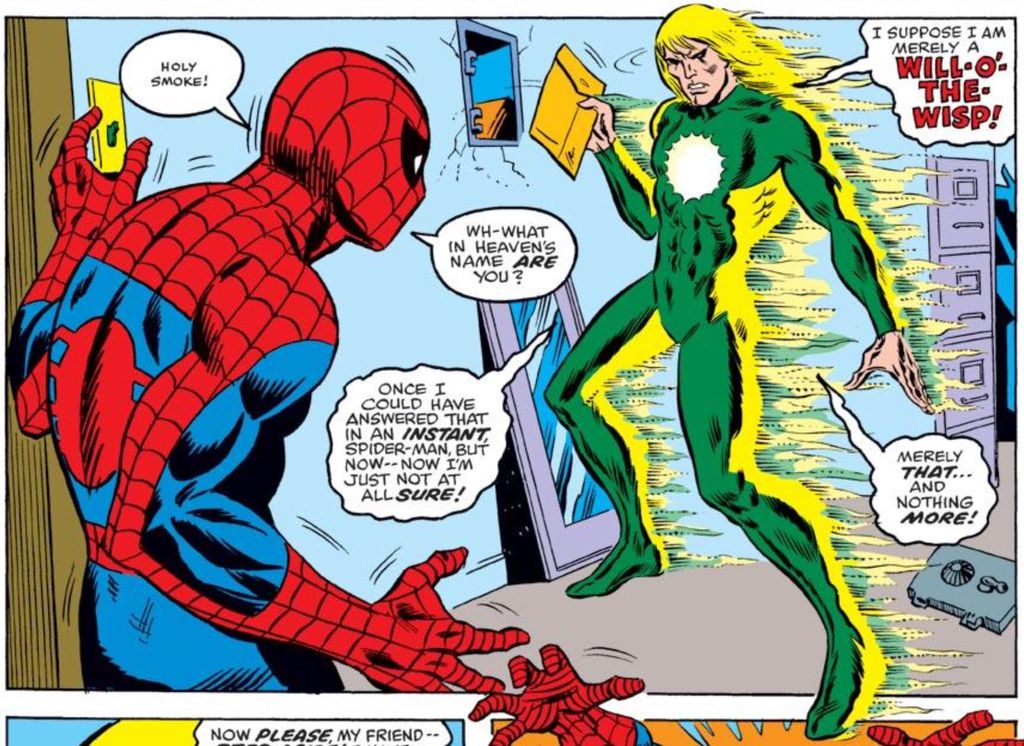
There is a category of villains that comics enthusiasts talk about with a particular tenderness, those characters who never enjoyed the spotlight of a Green Goblin or a Doctor Octopus, but whose underground mythology fascinates anyone who dares to dig beyond the iconic covers. Jackson Arvad, alias Will-o-the-Wisp, belongs to this discreet brotherhood. A brilliant scientist, the victim of an industrial accident, turned into a spectre made of pure energy and unable to touch the person he loves, he is less an enemy than a philosophical question embodied in the cyan costume of a minor 1970s supervillain.
Condensed, his story reads like an ancient myth rewritten in the vocabulary of quantum physics. But behind the translucent silhouette and the spectral cape hides a character of rare moral complexity, able to swing between villain and antihero within a handful of panels, and whose appearances punctuate the work of Stan Lee, John Byrne and J. Michael Straczynski with a strange consistency. This article is an act of rehabilitation: giving Jackson Arvad back the light he lost, and explaining why a modern comeback would be one of the best editorial choices available for Spider-Man's scientific rogues' gallery.
A scientific genesis: Brand Corporation and one accident too many
Jackson Arvad makes his first appearance in Marvel Team-Up #36, written by Gerry Conway in 1975, at a time when Marvel was diversifying its secondary villains to flesh out an already crowded rogues' gallery. His professional background sets him apart immediately: Arvad is not a reformed criminal, nor an activist ready for anything, but a particle physics researcher employed by Brand Corporation, a fictional Roxxon subsidiary famous for its ethically dubious research. His speciality? Manipulating magnetic fields to stabilise matter at the atomic level, territory close to the ground explored by Mark Raxton before his own incandescent accident.
The accident happens late one evening, while Arvad is testing a prototype energy containment unit. His supervisor, James Melvin, refuses to stop the experiment despite the anomalies picked up by the sensors. The unit explodes. Jackson Arvad's body does not die, it transforms: his atoms come apart and begin to oscillate freely between the solid and the gaseous state, trapped in an unstable quantum condition that only a magnetic belt manages to hold together. Without that belt, Arvad dissolves into the air, which is exactly where his name comes from: the wandering marsh light of folklore that leads travellers astray.
What makes the Will-o-the-Wisp mythology so powerful is the obvious analogy with other industrial tragedies in the Marvel universe. The fascination for these scientists destroyed by their own experiments runs right through the cosplay gallery of Spider-Man's villains, from Curt Connors, the victim of his own regeneration serum, to Miles Warren, consumed by his genius for cloning. Arvad shares a common genealogy with them: that of men who wanted to understand matter and who became matter itself.
Powers: what it means to live as a cloud of energy
On paper, Jackson Arvad's abilities look like an explosive cocktail. He can turn intangible, pass through walls, hover in the air, unleash devastating electrical discharges, hypnotise his opponents with a single shimmering stare, and generate offensive magnetic fields powerful enough to push back a fighter like Adrian Toomes himself. On a first reading you would think you were looking at a fusion of Vision, Magneto and Mysterio, which is precisely what makes Arvad so unusual on the Marvel power scale.
But that scale hides a fundamental catch. Every one of Arvad's powers is tied to a condition of stability. Without his magnetic containment belt, his molecules scatter and he loses any capacity for coordinated action. If he pushes a discharge too far, he burns away part of his own cohesion. If he passes through an object that is too dense, he risks total dissociation. And above all, the most tragic detail in his entire arsenal: he is physically incapable of touching a human being without killing them instantly with a discharge. No contact, no embrace, no kiss. The villain who has everything it takes to become a hero lives inside a spiritual Faraday cage.
This mechanic comes close to, without ever quite matching, the tragic beauty Stan Lee built into the ambiguous psychology of Sandman or into the glassy loneliness of Quentin Beck, sealed inside his aquarium of illusions. There is something profoundly Marvel about the idea: giving a character spectacular powers purely in order to take away what makes life bearable. Arvad illustrates that doctrine to a degree rarely equalled, perhaps only surpassed by the fate of a Curt Connors turned into the Lizard and unable to see his family again without tearing them apart.
Key appearances: from the first fight to a gradual redemption
Will-o-the-Wisp's editorial journey follows the path of a character who refuses to be nothing more than filler. His first appearance sees him face Spider-Man and The Thing in a plot where he is desperately searching for a scientific way to stabilise his body. The wall-crawler beats him by a hair, but the story already insists that Arvad has no genuinely criminal intent: he steals to fund his own medical research, following a logic close to the one later adopted by Phineas Mason, the silent armourer of New York's underworld.
In the 1980s, John Byrne took hold of the character for Marvel Team-Up #84, pitting him against a still-young Spider-Man in a darker plot. Arvad appears there as a revenant out for revenge on Brand Corporation, which for the first time places his silhouette in the long line of villains driven by industrial justice, alongside Aleksei Sytsevich, reduced to his armoured hide or Dimitri Smerdyakov, stripped of his face. Byrne adds a further layer: Will-o-the-Wisp uses his hypnotic ability to confront the web-slinger with his own fears, in a scene of almost dreamlike intensity.
The character's most ambitious arc arrives in the pages of The Amazing Spider-Man under the pen of J. Michael Straczynski. There Arvad meets a researcher from Empire State University who might, just might, be able to stabilise his body. For the first time since his transformation, he glimpses the possibility of resuming a human existence. The story never fully pays off, but it marks a turning point: Jackson Arvad is no longer merely a translucent silhouette, he has become a character with a biography, with hopes and with regrets, comparable in that sense to Martha Connors and the weight of families broken by science.
More recently, Will-o-the-Wisp has reappeared briefly in arcs tied to Otto Octavius's Superior Spider-Man, where his spectral nature is put to work in urban crime plots, with a narrative mechanic close to the one Brian Michael Bendis used to reintroduce second-string villains to the streets of Hell's Kitchen.
LUMINOUS DECOR — NEON LAMP

Spider-Man Spider Neon Lamp
€79.90
The perfect nod to Jackson Arvad for a comics reading corner: a spectral glow that turns the room into a tribute to the energy-based silhouettes of the rogues' gallery.
Discover →Psychology: the man who could no longer touch
When you strip Jackson Arvad of his arsenal of powers and look only at the man, what remains is a character inhabited by loneliness. Arvad is not villainous out of cruelty, nor out of greed, nor out of ideology. He is villainous by default, because he no longer exists within the ordinary social fabric. The rare panels where we see him interact with a non-hostile human being show a man held back, calculating every centimetre of physical distance, refusing affectionate gestures for fear of killing the other person.
This theme of untouchability resonates with particular force in superhero mythology. Rogue, over in the X-Men, shares part of that curse. But Arvad pushes the dial further: he does not even have the option of learning to control his touch, because his body itself is no longer stable. He cannot train, he cannot relearn, he can only accept a permanent state of being on the border. In that sense, his psychological arc converses at a distance with that of Kaine, the tragic clone condemned to cellular degeneration, or with the trajectory of Stunner, Doctor Octopus's virtual lover trapped in a digital body.
In an interview given to an American fanzine in the 2000s, Gerry Conway is said to have explained that he thought of Will-o-the-Wisp as a metaphor for modern loneliness in research laboratories: those scientists who spend their nights alone with machines, who end up preferring the company of particles to the company of colleagues, and who slide imperceptibly towards a form of professional withdrawal. Arvad never left his laboratory, metaphorically speaking. The cyan costume and the cape are only a poetic dramatisation of that condition.
His place in the lesser-known rogues' gallery
Spider-Man's rogues' gallery has several strata. At the top sits the aristocracy of the great recurring enemies, the faces everyone knows even without ever having opened a comic. Then comes an intermediate stratum of solid villains, the ones who turn up in the video games and the cartoons. And right at the bottom, in a category you could call the lesser-known rogues' gallery, sit characters like Will-o-the-Wisp, whose record of appearances stretches across four decades but who have never been promoted to the mainstream media.
This lesser-known rogues' gallery deserves editorial treatment of its own, and the recent rehabilitation of Stegron in the fan conversation proves that there is a real appetite for these characters who have fallen out of fashion. Alongside Arvad you will find Gog, the monstrous creature, obscure heirs such as Ana Kravinoff or Alyosha Kravinoff, and a whole cohort of secondary threats that the Spider-Man figurine collection would do well to honour more often.
Why did Will-o-the-Wisp never break through? The answer probably comes down to a cluster of editorial reasons. His design is less immediately readable than a Green Goblin or a Doctor Octopus with four mechanical arms. His power, intangibility, is complex to animate and redundant with other, more visible characters. And above all, his psychological arc lacks an emblematic duel with Peter Parker: Arvad has never faced the web-slinger in a story readers would cite as a high point, unlike a Kraven whose last hunt redefined the genre.
WALL ART — NEON CANVAS

Spider-Man Neon Canvas Print
€24.90
The exact aesthetic of a post-transformation Jackson Arvad: translucent silhouette, spectral palette, energy that seems to escape the frame. A piece that speaks to fans of the rarer villains.
Discover →Why he deserves a modern revival
The case for an ambitious return for Will-o-the-Wisp comes down to a few points worth setting out clearly. First, his design is visually very modern. A character made of cyan energy, intangible, capable of spectacular electromagnetic displays, lends itself perfectly to the animation techniques and the visual effects of contemporary cinema. The sequence where Miles Morales uses his electrical powers in Into the Spider-Verse showed that we know how to draw the invisible.
Next, his emotional arc is calibrated for the sensibilities of a present-day audience. Jackson Arvad is, at bottom, a character who suffers from a heightened form of professional isolation, a theme that is extremely present in the popular culture of the 2020s. His loneliness is not that of a misanthrope, it is that of a man who can no longer reach the presence of others, a situation that millions of viewers have understood intuitively since the pandemic lockdowns.
Finally, his narrative logic makes it possible to write stories that no other villain in the rogues' gallery supports so well. A story in which Spider-Man has to stop Arvad from absorbing the energy of an entire power station in order to stabilise his body for good poses an exemplary moral dilemma: preventing the antagonist from becoming human again at the cost of a collective disaster. It is exactly the kind of plot that Dan Slott knew how to exploit in Ends of the Earth and that the Dying Wish diptych took to its peak.
A comparison with contemporary spectral villains
Will-o-the-Wisp is not alone in the category of spectral or energy-based villains. But a methodical comparison brings out what sets him apart. Will-o-the-Wisp shares with Vision the idea of a body made of unstable matter, but Vision has a stable positronic brain and a clear identity, whereas Arvad swings permanently between dispersal and cohesion. He shares with Miles Warren the archetype of the scientist broken by his own discovery, but the Jackal seeks power through his clones, where Arvad seeks nothing but stability.
More broadly, Arvad belongs to a family of characters that American comics multiplied from the 1960s onwards: the accidental survivors, those men and women caught in laboratory explosions, radioactive leaks and technological malfunctions, who emerged with a rewritten body. That family includes Jennix and his role as genetic architect among the Inheritors, certain members of the Spencer Smythe dynasty and its Spider-Slayers, and a whole cohort of villains who never set out to become villains at all.
What sets Arvad apart within that family is the complete absence of an agenda. Curt Connors wants to become human again. Mark Raxton wants to put out his fire. Norman Osborn wants to rule New York. Arvad simply wants to be able to put a hand on someone's shoulder without killing them. It is the modesty of his goal that makes his character so universal: he is not asking for power, he is asking for the possibility of contact, and that is precisely what physics itself refuses him.
A work of art waiting for a great author
For a contemporary writer looking for a challenge, Will-o-the-Wisp is a rare playground. The source material is solid without being saturated: a few dozen appearances spread across fifty years, enough to provide continuity, not enough to lock any new idea into a straitjacket. The character has an instantly readable design, a poetic name (Will-o-the-Wisp, the wandering light that leads travellers astray), and a power set rich enough to justify several arcs without repeating itself.
It is easy to imagine what a Tom King would do with Arvad, the man who turned Vision into a psychological masterpiece over at DC. Or what a Jonathan Hickman could build by folding the character into a wider scientific fresco, perhaps by exploring the ethical consequences of Brand Corporation's experiments on other employees who vanished. Or what a Saladin Ahmed would bring in terms of identity, by exploring what it means to be a body when you no longer have a body.
The contrast with other tragic villains in the rogues' gallery is instructive. Venom went through his own wilderness years before becoming a cultural icon. The Jean DeWolff arc redefined the place of urban crime fiction in the pages of Spider-Man. Will-o-the-Wisp is still waiting for his moment, his Vision, his Kraven's Last Hunt, the founding arc that would take him from footnote to established figure.
COMICS POSTER — RETRO

Retro Comics Spider-Man Poster
€22.90
The exact look of the issues of Marvel Team-Up where Will-o-the-Wisp appeared, perfect for anyone hunting down the second-tier villains of the 1970s in the Spider-Man poster collection.
Discover →Legacy and cultural afterlife
If Will-o-the-Wisp has not won over the general public, he has not disappeared either. His occasional appearances in video games (notably a fleeting silhouette in certain spin-offs), his cameos in the cartoons of the 1990s, and his regular presence in the Marvel handbooks keep a minimal visibility alive. For a character who has never had a major cover, that is already a great deal. Above all, his name circulates in collector communities like a password between seasoned enthusiasts, the ones who know that the web-slinger's real rogues' gallery is not limited to six iconic faces but extends to several dozen secondary figures.
Perhaps the time has come to push that recognition further. Marvel's editors have recently shown that they know how to bring forgotten characters back into value, as the media attention given to the editorial resurrection of Doctor Octopus as Superior Spider-Man or the return to the spotlight of Stunner as a tragic figure of virtual cloning demonstrates. Will-o-the-Wisp has every asset needed to benefit from a similar operation: a strong design, a calibrated emotional arc, a gap in the publishing grid, and a latent audience ready to come along if someone offers them an ambitious story.
For anyone who would like to discover Jackson Arvad for themselves, the natural entry point remains Marvel Team-Up #36, followed by John Byrne's run. More seasoned fans can then trace the scattered references through the pages of The Amazing Spider-Man, alongside other classic explorations of the secondary rogues' gallery, from the seminal arc Kraven's Last Hunt through to more recent cosmic explorations. And for anyone who collects figures of rare villains, a regular look at the Spider-Man lamp collection and the Spider-Man poster collection often turns up themed editions that pay tribute to the spectral silhouettes of the catalogue.
Jackson Arvad deserves more than his footnote. He deserves a great author, a great story and a great send-off. Until that moment comes, he goes on haunting the margins of the rogues' gallery like a true will-o'-the-wisp: visible one instant, gone the next, but never entirely put out. And perhaps that, in the end, is the fate most faithful to his character that could ever have been given to him.

