

14-Day Money-Back Guarantee
0
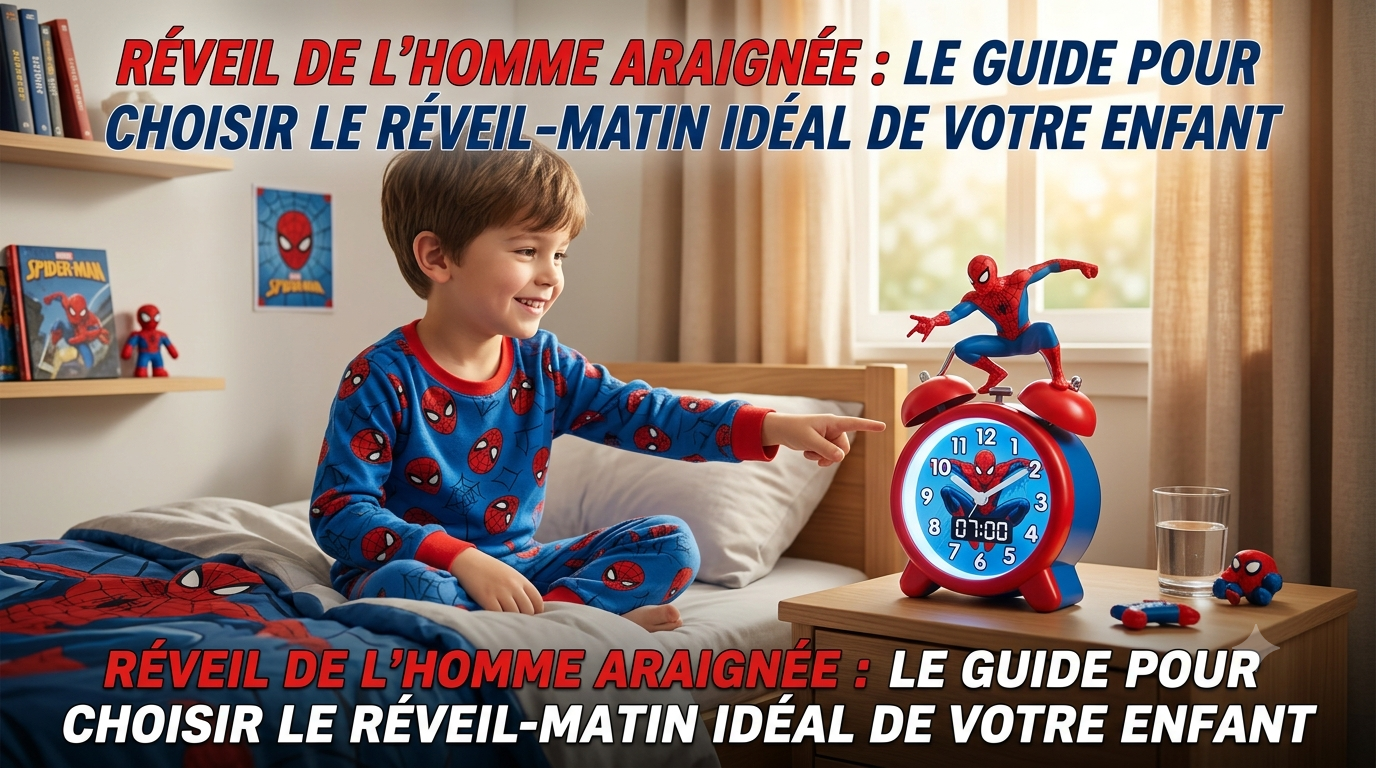
There is one precise moment, every morning, when the whole house tips over. The moment when you have to get a child out of sleep without shouting, without pulling the duvet back ten times, without turning the wake-up into a battle. What if the solution came down to a small object sitting on the bedside table? A Spider-Man alarm clock isn't just one more piece of decoration in the bedroom. It's a daily ally that speaks directly to your child's passion. When it's the web-slinger himself announcing that it's time to get up, the morning stops being a chore and becomes a little ritual to look forward to. Your child gets up because their favourite hero is inviting them to, and you gain in calm what you used to lose in repeating yourself.
But between a vintage model with hands, a bright digital display, a built-in night light or a clock with a spectacular effect, how do you make the right choice? Not all alarm clocks are equal, and the right one depends as much on your child's age as on the layout of their bedroom. This complete buying guide walks you through it step by step: why an alarm clock really does change things, which types exist, which specifications to look at before you buy, which designs to choose according to your little hero's personality, and how to fit this object into a bedroom that hangs together. By the end, you'll know exactly which alarm clock to slip under the tree or add to your Boxing Day gift shortlist.
Why giving a child a Spider-Man alarm clock really does change daily life
People sometimes think a children's alarm clock is a needless gadget: after all, parents are there to wake them up. That's precisely the problem. As long as you're the one playing that role, your child stays dependent, and the morning rests entirely on your shoulders. Giving an alarm clock means giving a first building block of independence. Your child learns that time belongs to them, that they have a personal appointment with their day, and that they can handle it like a big kid. This gentle sense of responsibility, dressed up in their favourite superhero's colours, often works far better than a long speech about punctuality.
Then there's learning to tell the time. For a child of five, six or seven, reading a clock face is still an abstract skill, hard to fix in place with school exercises. An alarm clock sitting on the bedside table turns that learning into daily, concrete practice: they look at the little hand, the big hand, and gradually link those positions to real moments in their life. Snack time, cartoon time, bedtime. Spider-Man becomes, almost without seeming to, a patient teacher who repeats the lesson without ever losing his temper.
The getting-up ritual is built through repetition. When a child associates the morning with an object they love, getting out of bed loses its painful edge. The alarm is no longer an assault but an invitation. And then there's a benefit many parents are looking for today: fewer screens. Giving your child a real dedicated alarm clock avoids handing them a phone or a tablet 'just for the time', with all the detours that implies. The alarm clock does one thing, but it does it well, and it keeps the bedroom as a calm space. To take this idea of a useful object that extends a passion further, have a look at the guide to Spider-Man watches by type, the natural companion to the alarm clock when your child grows up and wants to take the time with them everywhere.

The dynamic alarm clock
Climbing Spider-Man Alarm Clock
A design that raises a smile the moment they wake up, with a clear display and an effective alarm. To start the day like a hero.
€29.90View product
Analogue or digital: understanding the two big families
Before you even look at the designs, the first real decision comes down to the type of display. It's what will determine how the alarm clock is actually used and how well it suits your child's age. Two big families go head to head: the analogue clock, with hands, and the digital clock, with bright numbers. Each has its own logic, its strengths and its ideal audience.
The analogue clock with hands, the ally of learning
The clock with hands has a timeless charm and an unbeatable teaching advantage: it forces your child to read the time 'for real'. With its numbers in a circle, its two hands and often a dial decorated with the mask or the spider logo, it turns the bedside table into a permanent learning tool. It's the ideal model for children from five to eight, right in the phase where school is asking them to master telling the time. The movement of the hands, silent on the better models, keeps your child company without distracting them. Visually, analogue also evokes vintage comic covers, which appeals hugely to families attached to the character's classic look.
The digital clock, readability and modern features
The digital clock, for its part, plays the card of instant clarity. The numbers are displayed large, often backlit in red, blue or white, and can be read in a split second, even by a child who is half asleep or who hasn't quite mastered analogue time yet. It's the format that packs in the most features: dual alarm, snooze, sometimes a temperature display, a calendar, and above all a built-in night light. For younger children, or for those who wake in the night and need to see the time at a glance, digital is reassuring. The one thing to watch: screen brightness, which must be adjustable so it doesn't disturb sleep. A good digital model always offers some way to dim it.
Do you have to choose one over the other? Not necessarily. Many parents start with a digital model with a night light while their child is small, then move to an analogue one when the time comes to learn to read a clock face. Both families have their place in the Spider-Man alarm clock collection, and the right choice depends above all on your child's profile.
Glowing clocks and built-in night lights, to tame the dark
Fear of the dark affects the vast majority of children at one point or another. This is where a well-designed alarm clock becomes far more than a practical object: it becomes a reassuring landmark in the darkness. Models with a built-in night light give off a soft glow, often adjustable in intensity, that helps a child drift off without turning the bedroom into broad daylight. Some Spider-Man alarm clocks project the spider logo or the hero's silhouette onto the ceiling, creating a protective atmosphere: your child falls asleep under the watchful eye of their favourite guardian.
The point of having that night light built into the alarm clock, rather than as two separate objects, is simplicity. One device on the bedside table, one socket, one switch. The light stays within reach if your child wakes in the middle of the night and wants to check the time or simply reassure themselves. The best models offer a warm, amber light, far more sleep-friendly than a cold white one. Avoid night lights that are too blue-toned, as they stimulate alertness instead of soothing it.
This question of light ties in with a wider thinking about how the bedroom is lit. The clock-cum-night-light plays the role of a discreet extra, while a proper mood light completes the picture. If you want to think about lighting as a whole, our article on which Spider-Man lamp to choose explains how to combine light sources according to age. And for those who really want to work on the night-time atmosphere, the subject of the lamp that transforms a bedroom into a superhero lair explores how light can completely change a space.

The high-tech look
Iron Spider Alarm Clock
The golden Iron Spider armour on the bedside table: perfect for fans of the MCU suit who want a bedroom at its very best.
€29.90View product
Novelty alarm clocks: when the web-slinger climbs to get you out of bed
Beyond the classic models, there's a whole category of alarm clocks designed to make an impression: novelty clocks. The most emblematic in the web-slinger's world is probably the model where a Spider-Man figure appears to climb up the dial or the clock itself, as if he were scaling a skyscraper. The visual effect is spectacular and turns a utilitarian object into a genuine animated collector's piece. Your child no longer sees their alarm clock as a simple time display, but as a frozen scene from their favourite adventures.
Other novelty models play on sound or movement when the alarm goes off: a voice, a musical theme, a light animation that kicks in at the set time. These clocks have real motivational power for children who baulk at getting up. When the alarm becomes a little show, the morning loses its painful side. Do watch out for how long the novelty lasts, though: these effects impress enormously at first, but what matters is that underneath, the clock does its basic job properly — ringing on time, being easy to read, lasting. A lovely effect sitting on fragile mechanics always ends up disappointing.
These novelty models are often the ones that create the strongest 'wow' moment when the wrapping comes off, which makes them particularly successful gifts. They sit naturally within a wider decorating approach: an object that tells a story and plays its part in the bedroom's world, exactly in the spirit of the simple, affordable decorating ideas that transform a room without blowing the budget.
Choosing well: readability of the display above all
Now that the types are clear, let's get into the concrete criteria that make the difference between a good alarm clock and one that ends up at the back of a drawer. The first of them, and by far the most important, is readability. An alarm clock your child can't read easily is useless. For a digital model, look at the size of the numbers: they need to be large, high-contrast and visible from the bed without your child having to get up or squint. The backlight needs to be strong enough for night-time but adjustable so it doesn't dazzle.
For an analogue model, the clarity of the dial comes first. The numbers need to be clearly there, ideally one to twelve, and not replaced by simple markers that make learning harder for the youngest children. The hands need to contrast with the background, and many good models add luminous markers that glow in the dark. Be wary of dials overloaded with illustrations: a magnificent Spider-Man drawing that eats into the readability of the numbers is a poor compromise for a child who is still learning to tell the time. The design should serve the function, not crush it.
Think too about the real reading distance. A child reads their alarm clock from their pillow, often in the half-light of early morning. The good test, in a shop as much as online, is to ask yourself: 'Would I read the time in two seconds, without my glasses, from a metre and a half away?' If the answer is no, move on to the next model.
Alarm, snooze and volume: the heart of what an alarm clock does
An alarm clock is there first of all to wake someone up, and that obvious fact hides several subtleties worth attention. The volume of the alarm is a delicate criterion: too quiet and it won't wake a deep-sleeping child; too loud and it drags them out of bed in a panic, which is never a good way to start the day. The best models offer an alarm with adjustable volume, and ideally a gradual ring that builds slowly in intensity. Your child surfaces gently rather than being torn abruptly from sleep.
The tone matters as much as the volume. An aggressive, shrill ring creates a negative association with waking up, whereas a familiar musical theme or a gentle melody makes the moment more pleasant. Some Spider-Man alarm clocks carry themed sounds that turn the alarm into a nod to the hero's world, a detail that raises a smile the moment your child wakes up.
As for the famous snooze button, its usefulness depends on age and temperament. For older children, it offers those precious transition minutes. For the youngest, it can on the contrary encourage dawdling and complicate getting up. A good alarm clock offers a snooze of a reasonable length, reachable through a big button that's easy to find by touch. Above all, check that the function is simple for your child to set themselves: an alarm clock only the parent knows how to programme misses part of its independence goal. Ease of handling is, here too, a criterion for success.

The new generation
Miles Morales Spider-Man Alarm Clock
In the colours of the new-generation Spider-Man, ideal for learning to tell the time and gaining independence in the morning.
€29.90View product
Power and sturdiness: an alarm clock built for real life with children
An alarm clock destined for a child's bedroom has to survive real life: falls from the edge of the bed, slightly rough handling, being moved around, sometimes a knocked-over glass of water. Sturdiness is therefore not a detail but a central criterion. Favour solid materials, shells that absorb knocks, designs without fragile parts that come away. An alarm clock that's too delicate won't last a season in a child's hands.
The question of power deserves proper thought. Battery models offer great freedom: you can put the clock anywhere in the bedroom, with no constraint of a socket or a trailing cable your child could pull. It's safer and more flexible, but you have to remember to change the batteries and accept that some functions will be more modest in brightness. Mains models, permanently plugged in, guarantee an always-bright display and easily power night lights and energy-hungry effects, but they require a socket nearby and a cable to make safe. The ideal solution for many families remains the hybrid model, which runs off the mains while keeping back-up batteries: that way, a power cut doesn't wipe out the time or the next morning's alarm.
Finally, think about general ergonomics. A stable clock that doesn't slide about, with buttons big enough for small fingers and easy to find by touch in the dark, makes all the difference in use. It's these apparently minor details that separate an object you keep for years from a purchase quickly forgotten.
Iron Spider, Miles Morales, vintage comics: choosing the right design
Once the technical criteria are ticked off, the fun part remains: choosing the design. And here, the Spider-Man world offers a rare richness. Every version of the character carries a strong visual identity, and the right alarm clock is the one that chimes with your child's favourite version. The classic red and blue suit, with its iconic spider logo, remains the timeless safe bet: it appeals at every age and goes with any decor.
The Iron Spider armour, with its red and gold tones and its mechanical legs, appeals to children fascinated by the recent films and the high-tech look. It brings a more modern, more spectacular touch. Miles Morales, meanwhile, speaks to a whole generation: his black and red suit, his graffiti, his urban energy make him a powerful figure to identify with, and a clock bearing his image has real contemporary personality. Fans of the original spirit will fall for the vintage comics designs, which pick up the graphic codes of the drawn pages, the sound effects and the bold colours of the earliest adventures.
Finally, the simple stylised spider logo offers an elegant, discreet option, perfect for a more understated bedroom where you want to hint at the passion without saturating everything. To choose, always start from the child: which version of Spider-Man do they wear on their T-shirts, which films did they prefer, which characters do they draw? The ideal alarm clock extends an attachment that already exists. This logic of coherence through detail is, in fact, the same one that guides the choice of a watch: if the subject interests you, the guide on which Spider-Man watch for a child applies exactly the same age-use-style reasoning.
Fitting the alarm clock into a coherent Spider-Man bedroom
An alarm clock never lives alone. Sitting on the bedside table, it takes its place in a whole: the colour of the walls, the bedding, the lamp, the posters, the storage. The secret of a successful bedroom isn't to pile up objects bearing the hero's image until everything is saturated, but to create a harmony where each element answers the others. The alarm clock plays the role of a finishing touch here, that small coherent detail which proves the room has been thought through with care.
For the fit to work, play on colour echoes. A red and blue clock will naturally find its place in a bedroom that picks up those tones, even if only in small touches. If the bedroom is rather understated, a clock with a discreet design centred on the spider logo will bring just the right dose of passion without upsetting the balance. The bedside table itself can become a small coherent shrine: the alarm clock, a matching lamp, perhaps a figure, all following one overall logic. To build that coherence from A to Z, the article on how to create a complete Spider-Man bedroom sets out the steps to follow, from the bedding to the overall atmosphere.
And if your ambition goes beyond the bedroom alone, know that the web-slinger's world can invite itself into the whole house. The alarm clock is then only one piece of a much bigger puzzle, as the guide on the art of turning every room into the web-slinger's lair explores. But even for more modest budgets and ambitions, a beautiful alarm clock remains one of the objects with the best pleasure-to-price ratio: it's used every day, it decorates, and it makes eyes light up.

The retro touch
Vintage Comics Alarm Clock
A retro look for lovers of the original pages. A genuine decorative piece that wakes up the bedroom as much as the child.
€29.90View product
The Spider-Man alarm clock, the gift idea that never disappoints
Finding the right gift for a child who loves Spider-Man can be a puzzle: you want something that pleases immediately, but also something useful that won't end up forgotten after two days. The alarm clock ticks both boxes with rare obviousness. It creates a genuine 'wow' moment when the wrapping comes off, especially in its novelty or glowing versions, while settling durably into your child's daily routine. Where a toy wears out and palls, an alarm clock keeps your child company every morning for years.
For a birthday, a party, Christmas, a Boxing Day treat or simply a good excuse, it's also a gift with a controlled budget that still makes a big impression. It can stand on its own or complete a wider set: paired with a lamp, bedding or a figure, it becomes one piece of a more ambitious 'bedroom' gift. For the parent giving it, it's also a message slipped in gently: 'here's an object that will help you grow up, manage your time, become a little more independent'. A gift that delights the child and reassures the parent is exactly what you're looking for.
The right instinct, when it comes to choosing, is to start from real needs before falling for the design. How old is the child? Are they afraid of the dark? Are they learning to tell the time? Do they wake easily, or do you need a hefty alarm? Cross those answers with the criteria in this guide and the choice becomes simple. And the whole selection is gathered in one place in the Spider-Man alarm clock collection, ready to transform your little hero's mornings.
Frequently asked questions about Spider-Man alarm clocks
From what age should you give a child a Spider-Man alarm clock?
There's no single age, just uses that evolve. From three or four, a digital clock with a night light can be reassuring at night and mark out the first sense of time, even if your child can't read the time yet. From five or six, the analogue clock comes into its own to support learning to read a clock face. Around seven or eight, your child manages the alarm clock completely independently, sets the alarm and takes charge of getting up. The right moment is the one where the object matches a real need: fear of the dark, learning, or the wish to be independent in the morning.
Analogue or digital: which should I choose for my child?
It all depends on the goal. If you want your child to learn to tell the time, the analogue model with hands is unbeatable because it makes them practise every day. If the priority is instant readability, modern features and a built-in night light, digital wins. Many families start with a digital model while their child is small, then move to an analogue one when the time comes to learn the clock face at school. Both options have their place, depending on your child's profile.
Does an alarm clock with a night light really help with fear of the dark?
Yes, provided you choose the right light. A built-in night light gives off a soft glow that reassures your child without turning the bedroom into broad daylight, and lets them check the time or simply feel safe if they wake in the night. Favour a warm, amber light, ideally adjustable in intensity: shades that are too blue or too bright stimulate alertness instead of soothing. The advantage of a clock-cum-night-light is that it brings the time and the reassuring glow together in one simple object.
Is a battery or a mains alarm clock better?
Both have their advantages. The battery model offers total freedom of placement and avoids any cable your child could pull, but means keeping an eye on the battery level. The mains model guarantees an always-bright display and easily powers night lights and effects, at the price of a socket nearby and a cable to make safe. The ideal is often the hybrid model, plugged into the mains with back-up batteries: that way, a power cut never wipes out the time or the next day's alarm.
Is a Spider-Man alarm clock a good gift?
It's one of the safest gift ideas of all for a child who's a fan of the web-slinger. It combines the surprise at unwrapping with genuine everyday usefulness, which makes it far more durable than a classic toy. Its budget stays reasonable, and it fits perfectly into a wider gift built around the bedroom. To choose well, start from the child's real needs — their age, their relationship with the night, their learning of the time — then let them fall for their favourite hero's design. The perfect alarm clock is the one that extends a passion that's already well established.

