
14-Day Money-Back Guarantee
0
The short answer
Electro is the criminal identity of Max Dillon, a high-voltage line worker whose body turned into a living capacitor after he took a lightning strike and a surge from the grid in the middle of a storm. He stores, absorbs and hurls electrical current. His whole story is traced below.
In the gallery of Spider-Man's most iconic enemies, a few names come up every single time: the Green Goblin, Doctor Octopus, Venom. Yet among the web-slinger's most formidable opponents, there is one whose raw power goes far beyond what most fans imagine. Electro, real name Maxwell Dillon, has embodied the threat of uncontrollable energy since 1964, the kind that can fry an entire power grid or reduce a New York neighbourhood to ashes in seconds. Created by Stan Lee and Steve Ditko in the pages of The Amazing Spider-Man issue 9, this super-villain has crossed six decades of comics, several film adaptations and countless clashes with Peter Parker. His story is that of an ordinary man turned into a living weapon, a narrative that echoes the core themes of the Spider-Man universe. If you think Electro is nothing more than a second-tier villain, this article is going to change your mind.
Max Dillon's origins — an ordinary electrician struck by lightning
Maxwell Dillon's story begins a long way from the skyscrapers of Manhattan and superhuman battles. Born into a modest New York family, Max grew up with an absent father and an overprotective mother who smothered every one of his ambitions. When the young man dreamed of becoming an electrical engineer, his mother convinced him he was not clever enough to manage it. That fundamental wound shaped a frustrated man, underestimated by everyone, who ended up taking a job as a high-voltage line worker for the New York electricity company.

Everything changes during a violent storm. While he is working in the middle of the tempest, Max is struck simultaneously by lightning and by a massive surge from the grid. Instead of killing him, the accident rewrites his biology at a molecular level. His body becomes a living capacitor, able to store, generate and project electricity with phenomenal power. Max Dillon, the man nobody ever looked at, becomes Electro. That journey from invisible citizen to overpowered super-villain is typical of the antagonists created by Stan Lee, who liked to root his characters in real human social conditions. Electro was not born evil: he is a man broken by a system that ignored him, then transformed by an accident that hands him the power he had always been denied. To understand the depth of the characters in this universe, the complete guide to the Spider-Man characters offers a fascinating panorama of these trajectories.
Electro's powers — electrical control, overload, flight and absorption
What makes Electro genuinely terrifying is the sheer range of his abilities. At his baseline level, Max Dillon can generate and project electrical arcs of more than a million volts. To put that in perspective, a natural lightning bolt reaches around 300 million volts, and Electro gets dangerously close to it when he absorbs enough energy. His discharges can paralyse, burn or instantly kill an ordinary human being. Even Spider-Man, despite his superhuman resilience, takes considerable damage in every direct confrontation.
Manipulating the electromagnetic field
Beyond simply hurling lightning, Electro manipulates electromagnetic fields at will. He can travel through power cables by literally turning himself into current, appearing anywhere on the grid in a fraction of a second. He can short-circuit any electronic device within a radius of several hundred metres, disable the most sophisticated security systems and even create electromagnetic force fields able to deflect projectiles. In the modern comic arcs, his powers have been amplified to the point of letting him control the bioelectric impulses of the human brain, which brings him close to the abilities of telepaths such as Professor X. That versatility makes him an opponent who can strike on every front, a tactical nightmare for the most powerful enemies of Spider-Man.
Flight and energy absorption
Electro can propel himself through the air by riding the lines of the Earth's magnetic field, an often underestimated power that gives him formidable aerial mobility. But his most dangerous ability remains absorption. By plugging into an energy source, whether a nuclear plant, a city grid or lightning itself, Electro can increase his power exponentially. In some story arcs he has absorbed enough energy to threaten the entire East Coast of the United States, turning his body into a living bomb. That constant escalation of power is one of the things that makes every confrontation with Spider-Man so tense: nobody ever knows exactly what charge level Electro is running at when the fight begins. Fans of Spider-Man figures often find Electro in dynamic poses that show off this raw electrical power.
Electro vs Spider-Man — a rivalry across the decades
The first confrontation between Electro and Spider-Man, in Amazing Spider-Man issue 9 in 1964, immediately sets the tone of this rivalry. Peter Parker, still at school at the time, faces an opponent whose powers make close combat suicidal. Every contact with Electro risks a potentially lethal discharge, which forces Spider-Man to improvise constantly, to use his scientific intelligence as much as his physical powers, and to find creative ways of neutralising his enemy's charge.
Over the decades, that rivalry has gained emotional layers. In J.M. DeMatteis's run, Max Dillon is presented as a deeply unhappy man, unable to maintain normal human relationships because of his electrical nature. He cannot touch anyone without risking killing them, a curse that echoes Peter Parker's loneliness. That tragic dimension has become a central element of some of the saddest moments in Spider-Man's history.
The most memorable showdowns
Among the most memorable fights, the 'Power to the People' arc stands out for its brutality. Electro, pushed to breaking point, decides to prove his worth by attacking the Daily Bugle and holding the city hostage. In another major arc, he causes a total blackout across Manhattan, plunging the city into chaos and forcing Spider-Man to hunt him in complete darkness, guided only by his spider-sense. These confrontations are a reminder that the greatest defeats of Spider-Man often came against underestimated enemies.
The Sinister Six — Electro as a founding member
If Electro is formidable on his own, he becomes truly cataclysmic within the Sinister Six. The group, founded in Amazing Spider-Man Annual issue 1 in 1964 by Doctor Octopus, brought together the six most dangerous enemies Spider-Man had at the time: Doc Ock, Vulture, Sandman, Kraven the Hunter, Mysterio and Electro. The idea is simple but terrifying: if Spider-Man can beat each of them individually, what happens when they attack together? The answer, as Peter Parker discovers the hard way, is absolute chaos. Within the group, Electro brings the raw firepower, the ability to knock out defence and communication systems, and an unpredictability that perfectly complements Doctor Octopus's methodical strategy. For everything about this legendary line-up, the article devoted to the Sinister Six and its explosive history gives you the full picture.

Through the group's many reformations, Electro has been an almost permanent member, proof of his strategic value in the eyes of the criminal masterminds who put these alliances together. In Erik Larsen's 'Return of the Sinister Six', Electro is used as the team's weapon of mass destruction, the one who covers the retreat and stops reinforcements from arriving. In Dan Slott's modern version, the Sinister Six evolves towards an even more ambitious concept, with Electro's amplified powers threatening to trigger an extinction-level event. That recurring role within Marvel's most iconic villain team confirms that Electro is absolutely not a secondary character. Anyone interested in the power dynamics between Spider-Man's enemies will find a fascinating analysis in the article on the smartest villains in the Spider-Man universe.
Electro and group dynamics
What is fascinating about Electro's role within the Sinister Six is the permanent tension between his raw power and his lack of leadership. Max Dillon has the strength to dominate any member of the group, but he has neither the strategic intellect nor the confidence to take command. In some arcs he tries to break away from the group, with catastrophic results. In others he accepts his position and becomes the centrepiece of a much bigger plan. That relational complexity explains why some Spider-Man enemies deserve a solo film.
Electro on screen — Jamie Foxx in The Amazing Spider-Man 2 and No Way Home
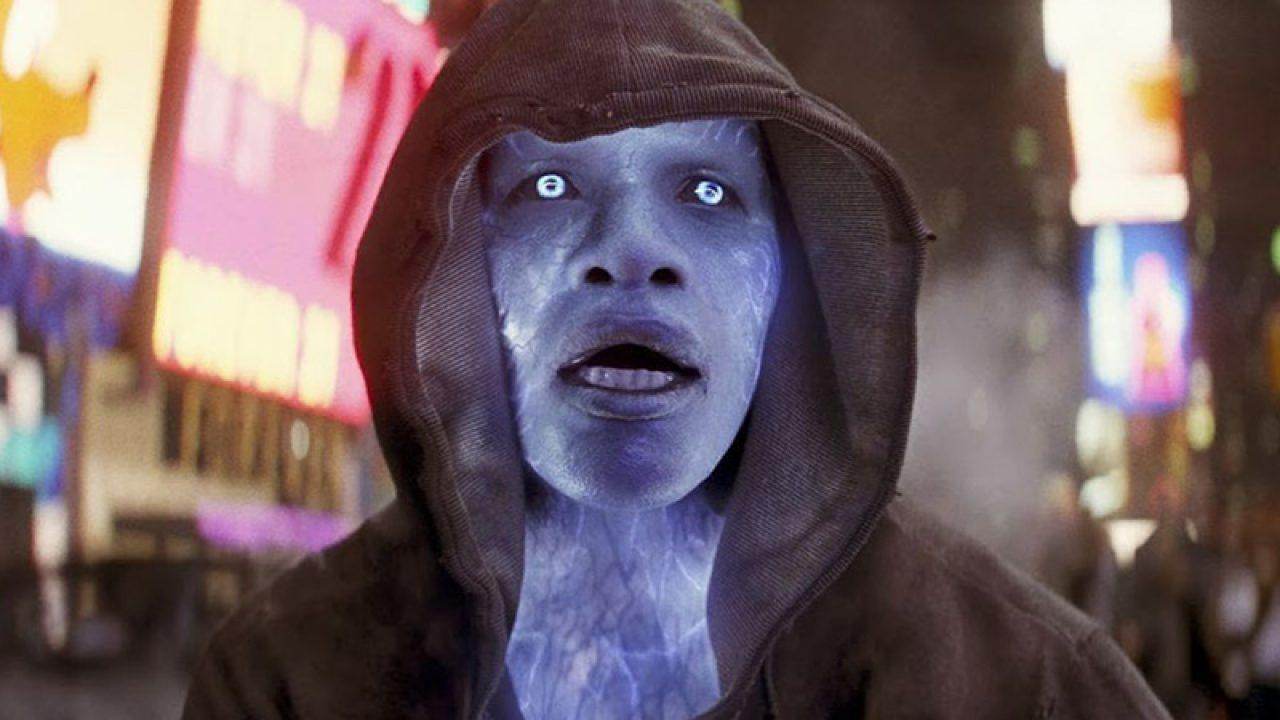
Electro's screen adaptation has had two radically different incarnations, both played by Oscar-winning actor Jamie Foxx. In The Amazing Spider-Man 2, released in 2014, Foxx plays Maxwell Dillon as an invisible, socially awkward Oscorp employee, obsessed with Spider-Man, whom he sees as his only friend after the hero saves him in the street. That version reinvents the character's origin: instead of being struck by lightning, Max falls into a tank of genetically modified electric eels in the Oscorp laboratories, which turns him into a being of pure energy with translucent blue skin. The visual design, inspired by the Ultimate Comics version, divides fans but delivers spectacular fight sequences, notably the Times Square showdown, which remains one of the most impressive visual moments in the franchise. To place this film in the full timeline, the guide to the Spider-Man films breaks down every version and every universe.

It is in Spider-Man: No Way Home in 2021, however, that Electro reaches his full cinematic glory. Jamie Foxx returns to the role, but this time with a completely rethought design: the blue skin is gone, replaced by a flesh-and-blood Electro who channels energy through an arc reactor reminiscent of Stark technology. That new look, far more faithful to the classic comics, comes with a transformed personality. The Electro of No Way Home is charismatic, funny and dangerously aware of his own power. The scene where he takes on three versions of Spider-Man at once, alongside four other multiversal villains, became instantly iconic. Foxx brings a gleeful energy to the character, like a man who finally discovers what it feels like to be powerful and flatly refuses to give it up. Anyone who enjoys picking apart the hidden details in the Spider-Man films will find Easter eggs linked to Electro in several No Way Home scenes.
Electro's impact on the multiverse
Electro's presence in No Way Home raises fascinating questions about the multiverse. Electro absorbs whatever energy is available, and the MCU, with its omnipresent Stark technology, offers him an unprecedented energy feast. The idea that advanced technology could power humanity's worst enemies is a recurring theme in the Spider-Man universe, and Electro is its perfect embodiment. For fans following the evolution of the MCU, the article on Spider-Man's role in Avengers Secret Wars explores the future ramifications, while the analysis of Spider-Man's role against Doctor Doom in Avengers Doomsday takes that thinking further.

Spider-Man Web Shooter Toy
Faced with Electro's devastating discharges, Spider-Man has only one answer: his web-shooters. Recreate the epic battles with this launcher, complete with balls and a target for precision shooting worthy of the web-slinger.
34,90 €
Shoot your webs like Spider-Man!
The evolution in modern comics — new identity, new powers
Electro has not stayed frozen in his 1960s incarnation. Modern comics have profoundly transformed the character, both in terms of his powers and of his identity. One of the major turning points comes in Dan Slott's run on Amazing Spider-Man, where Max Dillon temporarily loses his powers after a massive overload. Stripped of his only source of power and recognition, he sinks into an existential crisis that makes him more dangerous than ever when he gets his abilities back, amplified beyond anything he had known before. That cycle of loss and reconquest is a powerful narrative motif that gives the character a psychological depth rarely reached by comic-book villains.
Francine Frye — a new Electro
In a bold development, the comics introduced Francine Frye, a young woman who inherits Electro's powers after kissing Max Dillon at the very moment his powers were becoming unstable, which kills Dillon and transfers his abilities to Francine. This female Electro brings a completely new dynamic: more impulsive, more violent and free of Max's inferiority complexes, Francine uses her powers with an uninhibited glee that makes her unpredictable and terrifying. Her very existence raises the fundamental question of inherited evil in the Marvel universe: do the powers make the villain, or is it the villain who defines the powers? This theme of transmission and transformation resonates with other complex characters in the universe, such as Chasm, the broken clone of Spider-Man, or indeed Carrion, the macabre clone who haunts the web-slinger's universe.
Max Dillon eventually comes back from the dead, as tradition demands in Marvel comics, and recovers his powers, now amplified by the experience of death. The contemporary Dillon is a more mature, more strategic character and, above all, far more aware of the extent of his abilities. He is no longer the frustrated little electrician who was happy robbing banks. He is a being who has touched the limits of existence and who understands that electricity is not only a weapon: it is the fundamental language of the universe, from the synapses of the brain to the stars. That philosophical evolution makes Electro a far more interesting opponent in the recent runs, where his motivations go beyond simple material gain to touch on questions of existential power. The story of that transformation recalls Peter Parker's own, whose little-known family origins shaped the hero he became.
Electro in video games and animated series
Beyond the comics and the cinema, Electro has left his mark on practically every Spider-Man adaptation in video games and animation. In the classic 1994 Spider-Man animated series, broadcast on Fox Kids, Electro appears in a memorable arc that explores his relationship with his father, the Red Goblin, adding an unexpected family dimension to the character. That animated version, with its green and yellow costume faithful to the comics, marked a whole generation of British fans who discovered the Spider-Man universe on the small screen. For anyone passionate about these adaptations, the article devoted to the Spider-Man animated series retraces this whole television history.
Video games: a recurring and feared opponent
In the world of video games, Electro is a recurring boss who has been testing players' skills since the first Spider-Man games on the Super Nintendo and the Mega Drive. Spider-Man 2: Enter Electro on PlayStation 1, released in 2001, gives him the role of main villain, a first that proves his ability to carry an entire story. In the Insomniac games, Marvel's Spider-Man on PS4 and PS5, Electro is part of the Sinister Six put back together by Doctor Octopus and delivers one of the most dynamic boss fights in the game, where the player has to dodge electrical arcs while looking for windows to attack. The sense of danger is palpable, and the character design, a blend of realism and comic book, is unanimously praised by players. The complete guide to the Spider-Man video games details every appearance and every memorable showdown in this gaming saga.
In Marvel's Spider-Man 2, released in 2023, his presence is felt through side missions and references to the events of the first game. PS5 technology renders the electrical effects with striking realism. For fans of Spider-Man toys, these adaptations have inspired plenty of product ranges, and the Spider-Man posters immortalise the most spectacular scenes from these games.
Why Electro is more dangerous than people think
Electro is often seen as a second-rank villain, an opponent Spider-Man beats regularly. That perception is not only wrong, it is dangerously complacent. In terms of raw power, Electro outstrips most of Spider-Man's enemies. He can power an entire city or plunge it into total darkness. His ability to travel at the speed of electricity makes him almost impossible to intercept, and his absorption power means that every energy source in his environment is a potential weapon.
A systemic threat
What sets Electro apart is the systemic nature of his threat. The Green Goblin goes after the people close to Peter Parker, Venom targets Spider-Man himself, but Electro can paralyse the infrastructure of modern civilisation. From hospitals to military defence systems, a being able to cut the power at will represents a national-level threat. Several writers have shown him capable of triggering stock market crashes, bringing down aircraft or causing nuclear meltdowns. The article on what nobody tells you about Spider-Man explores exactly how the web-slinger faces threats that go far beyond street-level fighting.
That underestimation mirrors the one Max Dillon suffered his whole life. Nobody took him seriously as an electrician, and nobody takes him seriously as a villain, until it is too late. When Spider-Man makes that mistake, the results are devastating, as shown by the moments when the hero hit rock bottom. The parallel with other marginalised characters such as Calypso or Ashley Kafka shows that the Spider-Man universe excels at giving depth to the characters the public overlooks.
A villain built for the digital age
In 2026, a world without electricity no longer simply means candles and cold: it means the end of communications, of transport, of modern medicine. A contemporary Electro could theoretically take control of the internet, manipulate data and plunge whole nations into information chaos. Fans thinking about the character's future in the MCU find these questions in the discussions around the Spider-Man cinema event of the year. Wearing a Spider-Man T-shirt with Electro on it has become a badge of recognition among clued-up fans.
Max Dillon never wanted to become a monster. He is a man who simply wanted to be seen, recognised and respected. That journey from silent frustration to explosive violence feels troublingly current, and that is exactly what makes Electro a timeless villain. Anyone who loves darker stories will find the same intensity in the arc Back in Black, when Peter Parker lets go of his morals, in the founding tragedy told in the story of Uncle Ben's death, or indeed in the most defining moment in the Spider-Man comics which echoes the irreversible consequences of Electro's actions.
The character of Electro has inspired some remarkable merchandise, from Spider-Man mugs with electric designs to fancy dress and costumes that let you play the hero as well as his opponents. The web-shooters are the perfect accessory for reliving these battles, the shop best-sellers satisfy the most demanding collectors, and the Spider-Man masks let you slip into the skin of the hero who faces living lightning. As for the Spider-Man soft toys, they are a reminder that the web-slinger's universe knows how to be comforting too.

Spider-Man Big Time Figure
To defeat Electro and his electrical overloads, Spider-Man had to push technology to its limits. The Big Time suit was born of that necessity. This collector's figure captures all the power of that high-tech era.
89,90 €
Add this collector's piece
Conclusion — the underestimated villain who can short-circuit everything
Electro is living proof that you should never judge a villain by his popular reputation. Behind the green and yellow costume, behind the lightning bolts and the special effects, hides one of the most complete antagonists in the Marvel universe. Max Dillon carries within him the tragedy of the ordinary man rejected by society and the power of an uncontrollable natural force. From his humble origins in the pages of Stan Lee and Steve Ditko in 1964 to his cinematic incarnation by Jamie Foxx in No Way Home, by way of his iterations in video games, animated series and modern comics, Electro has crossed six decades of storytelling without ever losing his relevance.
His raw power places him among the most serious threats Spider-Man has ever faced, and his ability to exploit the weaknesses of our hyperconnected world makes him a villain of burning relevance. The Sinister Six would not exist without him, Spider-Man's most spectacular fights would not carry the same tension without the threat of a fatal discharge, and the web-slinger's universe would be infinitely poorer without this electrician turned living storm. The next time somebody tells you Electro is only a minor villain, remind them that it takes a single short circuit to plunge the world into darkness. To keep exploring the depths of the Spider-Man universe, discover which Spider-Man is the most popular, dive into the Big Time era and its high-tech reinvention, or explore the best Spider-Man gift ideas for fans of every age.

