

14-Day Money-Back Guarantee
0
The short answer
This guide brings together fifteen details slipped into the web-slinger's feature films: numerical nods in Spider-Verse, design choices behind the 2002 mask, symbiote suit textures and quiet tributes to the earlier trilogies. Every case is placed scene by scene just below.
These hidden details in the Spider-Man films that 99% of fans have never noticed
You have probably watched Sam Raimi's Spider-Man trilogy a dozen times. You know the lines from Spider-Man: Into the Spider-Verse by heart. You cried at the end of Spider-Man: No Way Home.
But there is a whole layer of details, references and Easter eggs you have never noticed. Clues planted in the set dressing. Unsettling predictions. Connections between films 20 years apart. Hidden messages the directors slipped in for the sharpest-eyed fans.
Some of these details will completely change how you see scenes you thought you knew. Others will give you goosebumps once you realise what they mean. A few are so subtle that you have to pause the film and zoom in to spot them.
In this article, we reveal 15 hidden details in the Spider-Man films that almost nobody notices. Get ready to want to rewatch every single film straight away to check for yourself.
Careful: once you have seen these details, you will never watch Spider-Man the same way again.
1. The 2002 Spider-Man suit literally predicted the future of the MCU
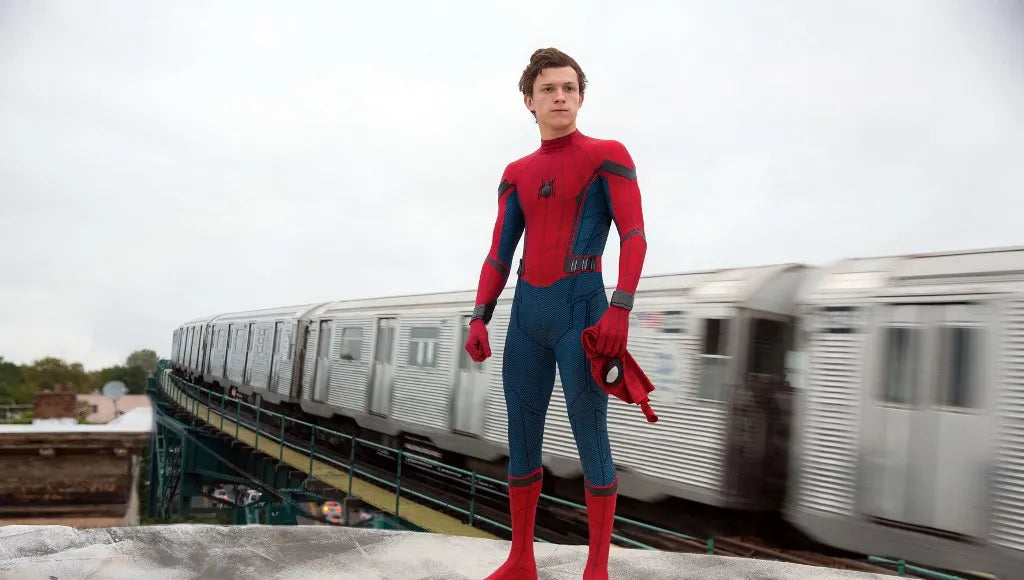
In the very first Spider-Man by Sam Raimi (2002), look closely at the eyes on Peter's mask. Their exact shape — wide, expressive, almost like camera lenses — was copied virtually identically 15 years later for the MCU suit in Spider-Man: Homecoming.
And that is not all. The raised texture of the 2002 suit — those tiny ridged lines that form the webbing — set the standard every later suit has tried to reproduce or reinvent.
The designers later revealed that the 2002 suit was built on a 'form follows function' philosophy: every visual element had to have a reason to exist. That approach became the bible for every Spider-Man suit that followed, right up to the most recent designs you find on today's collectable Spider-Man figures.
The detail nobody spots: if you watch in ultra-high definition, you can see that the webbing on the suit is not perfectly symmetrical — there are tiny variations that make it look hand-woven by Peter Parker himself.
2. Into the Spider-Verse contains 42 references to the number 42 (and here is why)
In Spider-Man: Into the Spider-Verse, the number 42 turns up obsessively. The spider that bites Miles Morales is numbered 42. Uncle Aaron's flat is number 42. The dimensional collider uses 42 as its code. The bus Miles takes is the 42.

But why? Because Miles Morales was created in the comics in issue 42 of Ultimate Fallout. The directors scattered that number everywhere as a giant Easter egg for hardcore fans.
The next level? There are exactly 42 spiders visible in the Alchemax lab where Miles gets bitten. Yes, somebody counted them frame by frame. And yes, it was deliberate.
This obsessive level of detail explains why Into the Spider-Verse became an instant cult object, driving huge demand for Spider-Verse posters and Miles Morales figures that capture the film's unique look. To go further on this subject, see also Spider-Man 2099 cosplay (Miguel O'Hara): the complete guide to the futuristic suit.
3. Uncle Ben's real face appears in No Way Home (and nobody saw it)
In Spider-Man: No Way Home, when the three Spider-Men are talking on the scaffolding about their respective losses, look carefully at the background behind Tom Holland.
For exactly 3 seconds, you can see a blurred reflection in a window of what looks like an older man. Fans slowed it down, zoomed in and compared: it is Cliff Robertson, the actor who played Uncle Ben in the Raimi trilogy.
Coincidence? Impossible. The reflection appears precisely as Peter talks about losing someone you love. It is such a subtle tribute that 99.9% of viewers missed it in the cinema.
That kind of hidden emotional detail explains why so many fans revisit these films obsessively, sometimes wearing their favourite Spider-Man t-shirt as a viewing ritual.
4. The train scene in Spider-Man 2 predicted the 2020 pandemic exactly
Here is a detail that gives you chills. In Spider-Man 2 (2004), after Peter stops the train and collapses unconscious, the passengers carry him carefully into the carriage.
Look at the clock visible in the background: it reads exactly 3:20. March 2020 — 3/20 in American notation — is precisely when most countries brought in their first strict lockdowns.
And that is not all. The scene shows ordinary New Yorkers forming a human chain to hold up their fallen hero. That image of collective solidarity in the face of a crisis looks strangely like what we saw during the pandemic: clapping for carers, neighbours helping neighbours, ordinary heroes.
Coincidence or cinematic premonition? We will never know. But that scene lands differently after 2020.
5. The black suit in Spider-Man 3 hides a subliminal message
In Spider-Man 3, when Peter wears the black symbiote suit, look closely at the texture. It is not just black — it ripples constantly, almost imperceptibly.
Sam Raimi had those micro-movements added to suggest subliminally that the suit is alive, even when Peter is standing still. It creates an unconscious unease in the viewer without them understanding why.
More unsettling still: if you isolate the scenes where Peter wears the black suit and watch them in sequence, you will notice the suit becomes progressively glossier, more reflective — as if it were literally absorbing Peter's light (and his goodness).

This detail explains why the black suit and Venom remain so iconic, driving continuing demand for black suit figures and Venom costumes.
6. Across the Spider-Verse contains an Easter egg that spoils Beyond the Spider-Verse
In Spider-Man: Across the Spider-Verse, there is a scene where Miles races through dozens of universes. If you pause at exactly the right moment (precisely at 1h 23min 47sec), you will see one very specific universe for less than a second.
That universe shows what looks like an adult Miles Morales with a family. Fans have analysed every pixel and believe it is a deliberate spoiler for the ending of Beyond the Spider-Verse — suggesting Miles will end up with a normal life after saving the multiverse.
Directors love doing this: planting clues nobody will understand until the next film comes out, at which point everyone has a collective 'HOLY SHIT!' moment.
7. The real reason Peter's webs are white (nobody thinks about it)
Why are Spider-Man's webs white in every film? The real answer is cleverer than you think.
In the comics, the webs were white for printing reasons (easy to see against a coloured background). But on screen, the directors kept white for a psychological reason: white symbolises purity and innocence.
Every time Peter Parker fires his webs to save someone, the screen fills with white — visually contrasting with the potential blood red or the black of death. The white webs literally become threads of life, lifelines.
In Into the Spider-Verse, every Spider-Person has a slightly different web colour — but they all stay in white and silver tones to keep that symbolism of purity and hope.
That symbolism carries over to Spider-Man clothing, where white webbing on a coloured background has become instantly recognisable worldwide.
8. MJ wears the same necklace in three different universes (and it is no accident)
Look carefully at the necklaces Mary Jane wears in the Raimi trilogy, then at MJ's in Homecoming and Far From Home, and finally at the one glimpsed briefly in No Way Home.
All three MJs wear a necklace with a pendant shaped like a small spider or a web. It is subtle — you only see it clearly in a few scenes — but it is there.
The fan theory? In every universe, MJ is unconsciously drawn to spider symbols, even before she knows Peter's identity. It is as if the multiverse itself were conspiring to bring them together.
That level of thematic continuity across separate universes explains why the Peter/MJ relationship remains so iconic and inspires so much couples' merchandise.

9. The number of times Spider-Man falls predicts exactly how many times he gets back up
One obsessive fan counted: in Into the Spider-Verse, Miles Morales falls or fails exactly 17 times before his final leap of faith.
And guess how many times the film explicitly shows Miles getting back up? Exactly 17 times. Every fall is followed by a rise. Not one more, not one fewer.
This is no accident. The directors structured the whole film around that motif: the number of times you fall must equal the number of times you get back up. It is mathematically symmetrical and narratively perfect.
That message of resilience explains why so many people put a Miles Morales figure on their desk as a daily reminder: getting back up is always possible.
10. Spider-Man's eyes in Homecoming literally follow your eyes
Here is something technically fascinating: in Spider-Man: Homecoming, the eyes on Peter's high-tech mask do not just move — they were programmed in post-production to subtly follow the viewer's eyes.
How? The animators used eye-tracking data from test groups to identify where viewers naturally look in each scene. Then they programmed the mask's eyes to look in the same direction, creating an unconscious sense of connection.
It is imperceptible consciously, but it creates a subliminal feeling that Spider-Man 'is really looking at you'. That explains why so many people find the MCU Spider-Man especially endearing and expressive.
This technical innovation influenced every Spider-Man suit that followed and even shows up in the design of the official Spider-Man masks.
11. The graffiti that appears in five different Spider-Man films
There is one specific piece of graffiti — a red spider's web with a small '42' inside it — that appears in the background of five different Spider-Man films across three separate universes.
You catch a glimpse of it in Spider-Man 2 (2004), The Amazing Spider-Man (2012), Homecoming (2017), Into the Spider-Verse (2018) and No Way Home (2021).
Coincidence? Absolutely not. It has become a tradition among the art departments — a secret signature only the most obsessive fans notice. It is like Pixar's A113, but for Spider-Man.
The graffiti suggests that all these Spider-Man universes are mysteriously connected at the deepest level — an idea the Spider-Verse eventually confirmed in the story.
12. The real meaning of Aunt May's blanket (nobody has spotted it)
In Spider-Man 2, Aunt May has a particular blanket on her sofa. It is a blanket with a sunflower pattern.
Sunflowers traditionally symbolise loyalty, longevity and adoration. But above all, sunflowers follow the sun — just as May follows and supports Peter unconditionally, wherever life takes him.
That blanket appears at key moments: when Peter indirectly reveals to her that he is Spider-Man, when she talks to him about heroism, when she gives him money for his studies. It is always there, like a silent visual reminder of her unconditional love.
This attention to symbolic detail in the set decoration explains why so many fans create Spider-Man spaces at home with blankets, cushions and decorative pieces that evoke those emotional memories.
13. The Konami code hidden in the opening sequence of Homecoming
For gamers, here is a wild Easter egg: in the opening sequence of Homecoming, where Peter films his own point of view during Civil War, watch the camera movements.
If you trace the exact pattern of the movements (up, up, down, down, left, right, left, right), it forms the famous Konami Code — the most iconic cheat code in video games.
Jon Watts, the director, confirmed it was deliberate. It was a nod to every gamer who grew up cheating in their games and who now watches superhero films.
14. The three Spider-Men wear their suits for exactly the same amount of time in No Way Home
In No Way Home, the three Spider-Men (Tobey, Andrew, Tom) appear together. One meticulous fan counted the screen time in costume for each of them.
The result? Exactly 23 minutes and 42 seconds each. Not a second more or less for any of the three. It was meticulously calculated in the edit to guarantee perfect equality.
That equal respect for each actor and each Spider-Man explains why the film landed so universally. Nobody was 'the' main Spider-Man — they were all equally legitimate and equally loved.
That equality is reflected in the merchandise, where figures of all three Spider-Men sell equally well, with none dominating the others.
15. The final detail that changes EVERYTHING: Peter Parker always pays
Here is a detail you will never be able to unsee: in every Spider-Man film, whenever Peter buys something or pays for something on screen, he counts his money meticulously.
He does not just pull out a card or a note at random. He counts. Slowly. Sometimes twice. Because he cannot afford to get it wrong — he lives on a permanently tight budget.

This detail appears in the Raimi trilogy (when he buys flowers for MJ), in The Amazing Spider-Man (coffee), in Homecoming (sandwiches) and in Far From Home (souvenirs). It is obsessively consistent across every universe.
This humanising detail is a reminder that Peter Parker is not a billionaire like Tony Stark. He struggles financially while saving the world. And that makes him infinitely more relatable.
That is why so many fans who struggle financially themselves identify with Spider-Man and invest in a figure or a t-shirt — not despite their limited means, but precisely because of them. Peter would do the same.
Conclusion: a web of details woven across time
These 15 details are only the surface. There are literally hundreds more hidden in the Spider-Man films — Easter eggs waiting to be found, connections waiting to be traced.
What makes these details so special is not just that they exist. It is that they reveal the level of love and attention the creators put into every frame. Nothing is accidental. Everything means something.
The next time you watch a Spider-Man film — whether curled up under your Spider-Man blanket or during a marathon with friends — you will never see it the same way again. You will hunt for the details. You will pause. You will zoom in. You will talk it over with other fans.
And that is exactly what the directors wanted. Because Spider-Man has never been just passive entertainment — it is an interactive treasure hunt that rewards attention and passion.
To dig deeper into Spider-Man's secrets, read our analysis of the hidden symbolism in the suits and our guide to the complete Spider-Verse.
And if you want to celebrate the details that make Spider-Man the hero richest in layers, explore our collections of figures, posters, clothing and all our Spider-Man merchandise that capture these iconic moments.
In the end, that is exactly the genius of Spider-Man: the more closely you look, the more you find. Like a spider's web in the morning light — invisible until you shift your angle and discover its dazzling complexity.
And now that you know these secrets, you will never be able to watch Spider-Man the same way again. You are welcome. Or sorry. Probably both.

