
14-Day Money-Back Guarantee
0
The short answer
Spider-Man Unlimited deserves rediscovering because this 1999 animated series foreshadowed the big ideas of today's multiverse. Peter Parker heads off to Counter-Earth, a mirror planet created by the High Evolutionary and ruled by the Beastials, wearing a red and black nano-tech suit. Venom and Carnage are reinvented there. Cut short after 13 episodes on a cliffhanger, the series has been available in its original English version on Disney+ since 2024.
Contents
1999: why Marvel sent its hero into another dimensionCounter-Earth, the mirror planet created by the High EvolutionaryThe red and black nano-tech suit: a forgotten but visionary designJohn Jameson, Naoko Yamada-Jones and the Counter-Earth supporting castThe Beastials: a mutant bestiary that foreshadowed the animated X-MenWhen Venom and Carnage land on Counter-Earth13 episodes, then silence: why was the series cancelled?The legacy of Spider-Man Unlimited in the modern Spider-Verse
In October 1999, Fox Kids slipped a strange, almost clandestine series into its Saturday morning schedule. Just thirteen episodes, a web-slinging hero flung far from New York, a new red and black nano-tech suit, and a mirror planet named Counter-Earth. Plenty of fans never saw it. Those who remember it still talk about it as a visionary experiment cut off too soon. In 2026, now that the idea of a spider multiverse has moved from cult comic to mainstream blockbuster, it is time to reopen this forgotten file.
This series has a simple name: Spider-Man Unlimited. No number, no marketing subtitle, just that promise of the unlimited, like a horizon nobody had time to reach. And that is exactly what happened. Cancelled after one season on a cliffhanger that was never resolved, it was long filed away as a curiosity for collectors. Yet watching it today, you find the DNA of everything that Spider-Verse and Into the Spider-Verse made popular two decades later.
This article puts the series back in context, takes apart its forgotten suit, explores Counter-Earth and its creator the High Evolutionary, walks through the supporting characters the show invented and explains why its underground influence is still felt in today's spider multiverse. For fans, it is a dive into a pivotal era. For newcomers, it is a way into a side of the hero that recent films are only beginning to touch on.
1999: why Marvel sent its hero into another dimension
By the late 1990s, the wall-crawler was coming off a run of animation that stayed very close to the comics: the series Spider-Man: The Animated Series (1994-1998) kept fans hooked for five seasons and adapted nearly every major arc. When it ended, Marvel and Saban Entertainment were looking for a follow-up. The odd gamble was not to do the same thing again. Rather than keep Peter Parker in New York, the producers chose to tear him out of his own world.
The creative context matters a great deal: Marvel was emerging from its 1996 bankruptcy and wanted to use its characters without wearing them out. Counter-Earth, which had existed in Marvel comics since the 1970s, offered fresh ground, almost untouched on screen. It also made it possible to work around the fragmented film rights that blocked certain appearances by iconic supporting characters. Putting the web-slinger in another dimension meant giving him his own playground, far from the editorial constraints of canonical Manhattan.
The other real reason is ambition. With Counter-Earth, the writers could invent a world in their own image, populated by characters whose mirror versions contradicted or exaggerated the originals. That parallel-planet logic foreshadows, years ahead of time, what the map of the multiverse's Earths has become in modern comics. Spider-Man Unlimited was, in its own way, one of the first laboratories of parallel storytelling for the wall-crawler.
No repeats
After The Animated Series (1994-1998), the producers refused to keep Peter in New York.
Marvel's context
Coming out of the 1996 bankruptcy, with fragmented film rights to work around.
Ambition
Inventing a world peopled with mirror versions of the characters.
Counter-Earth, the mirror planet created by the High Evolutionary
Counter-Earth is an exact copy of our planet, placed on the far side of the Sun on the same orbit and therefore invisible from Earth. The idea comes from Roy Thomas and Gil Kane, who introduced it in The Incredible Hulk in 1971. This world is not merely a cosmic anomaly: it was created from scratch by the High Evolutionary, a mad scientist turned demiurge, obsessed with engineering a 'perfect' humanity through genetic science.
In Spider-Man Unlimited, the plot starts exactly there. John Jameson, the astronaut son of J. Jonah Jameson, crashes on Counter-Earth during a mission. Convinced that his son is still alive, the web-slinger stows away aboard the rescue rocket. He lands on a planet that looks like his own, but where everything is skewed: the cities are run by animal dictators, humanity is enslaved, and he himself is not welcome.
In the series, then, Counter-Earth is far more than a backdrop. It is a blunt political metaphor: pollution, one class oppressing another, constant surveillance. The show explores themes that are dark for children's animation — eugenics, genetic manipulation, totalitarianism — which place it closer to adult comics than to classic kids' programming. Worth noting: the High Evolutionary concept has since been pushed back into the spotlight by Guardians of the Galaxy Vol. 3, directed by James Gunn, which indirectly reopens a route for mainstream audiences in 2026 to rediscover Spider-Man Unlimited.
To understand how this mirror-planet logic fits into the rest of the spider multiverse, picture Counter-Earth as a 'hidden Earth' on the official map: Earth-31916 in Marvel's numbering, distinct from Earth-616 (the main Earth) or Miles Morales's Earth-1610.
A mirror planet
Counter-Earth is a copy of our world on the far side of the Sun, created by the High Evolutionary: Earth-31916 in Marvel's numbering.
The red and black nano-tech suit: a forgotten but visionary design
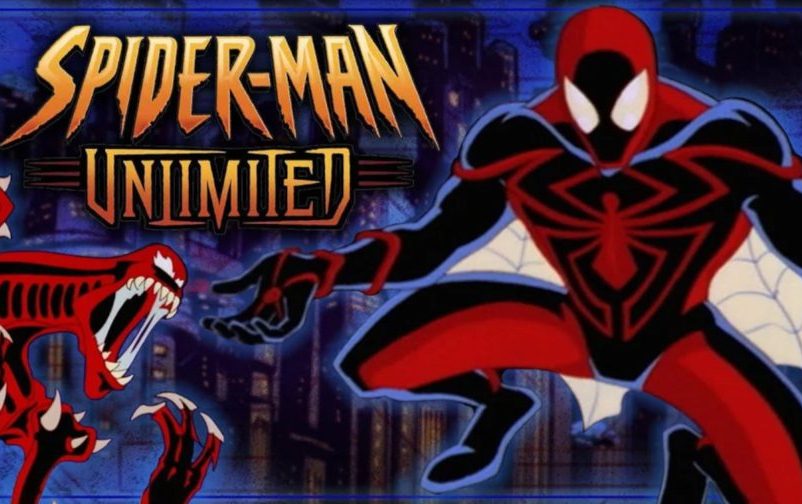
This is probably the most striking detail of the series, the one that hits you straight away watching an episode today: Peter Parker gives up the iconic red and blue suit. In its place he wears a red and black outfit, ribbed like an insect shell, fitted with internal web glands that finally do away with his mechanical web-shooters, and above all with a pair of retractable mechanical wings built into the sides. The suit is designed by Reed Richards (yes, of the Fantastic Four) before the departure for Counter-Earth.
Visually, the choice is radical. At the time, the red and blue palette was sacred. The series does the opposite: deep black at the extremities, scarlet red in the centre, a stylised spider motif on the chest, an organic hood. It is a suit that anticipates, decades early, Tony Stark's Iron Spider, the Symbiote suit, and even, in its silhouette, the Stealth suit from the Insomniac video game. Designer Audu Paden and his team created something that looks like nothing else, while staying instantly recognisable as the wall-crawler.
The retractable wings in particular are worth pausing on. They fan out between the arms and the sides to allow gliding, much like what Tony Stark's Iron Spider suit does in Infinity War. The logic is clear: on a planet with no skyscrapers to swing between, you need another way to get around. The series invents what would later become a recurring standard in the hero's high-tech suits.
This 'alternative suit' angle has become a cult object for collectors. If it speaks to you, the shop lists the full range of Spider-Man fancy dress and costumes that have marked his history, including several direct tributes to the dark palette inspired by Counter-Earth.
COSTUME — Counter-Earth tribute

Black Spider-Man Costume for Kids
39,90 €
Red and black is the forgotten visual DNA of Spider-Man Unlimited. This kids' costume picks up its spirit for nostalgic fans who want to share that cult palette with the next generation.
Discover →Red and black palette
Deep black at the extremities, scarlet red in the centre, a break with red and blue.
Internal web glands
They do away with the need for mechanical web-shooters.
Retractable wings
Gliding on a planet with no skyscrapers to swing between.
John Jameson, Naoko Yamada-Jones and the Counter-Earth supporting cast
On Counter-Earth, Peter Parker is never alone. Around him orbits a band of human and hybrid rebels resisting the oppression. John Jameson, the astronaut son of J. Jonah Jameson, becomes a central ally — thoroughly ironic when you know that in comics canon John is also the man behind Man-Wolf, a supernatural creature who would later get his own comic series. Unlimited never digs into that side, but it plants the seeds of the transformation.
Naoko Yamada-Jones, a news reporter and John's partner, is the clear-eyed critical voice. She is one of the few strong female characters in the series, able to run an investigation, stand up to authority and act as an emotional anchor for the isolated web-slinger. Karen O'Malley, a rebel scientist, completes the trio. And around them, Sir Ram and the Bromley Brothers, who lead the underground resistance.
The writing of these characters shows unusual care for a 1999 animated series: their arcs are built over time, their motivations overlap, and several romantic subplots are left open. The show works less like an episodic serial than like a genuine novel in instalments, which was rare in Saturday morning schedules at the time. That mode of storytelling across 13 episodes foreshadows the modern comics of the Dan Slott run and the continuous storytelling of Spider-Man UK.
For anyone wanting to widen their map of Spider-Man's allies and antagonists, the shop offers a full overview through the encyclopaedia of the Spider-Man universe and its villain counterpart the guide to the iconic villains.
John Jameson
The astronaut son of J. Jonah Jameson, a central ally of the web-slinger.
Naoko Yamada-Jones
News reporter, critical voice and emotional anchor.
Karen O'Malley
Rebel scientist who completes the trio.
The resistance
Sir Ram and the Bromley Brothers lead the underground resistance.
The Beastials: a mutant bestiary that foreshadowed the animated X-Men
Counter-Earth is ruled by the Beastials, humanoid creatures crossed between humans and animals, born of the High Evolutionary's genetic manipulations. Sir Ram (the scholar-ram), Lord Tyger (the tiger aristocrat), Lady Ursula (the bear empress), Lord Phoenix (the bird strategist). This bestiary brings to animation an imagination Marvel had never really used on screen: a parallel civilisation where humanity is no longer the dominant species.
That inversion is powerful. The wall-crawler, himself a human-spider hybrid by genetic accident, suddenly becomes a minority figure among a majority that is hybrid by design. The series plays on that mirror with real subtlety: the vigilante who was the exception on Earth becomes the norm on Counter-Earth. It is probably the finest story idea in the show, and the one that resonates most in 2026 against today's debates about identity, otherness and the boundaries of the human.
Visually, the Beastials are also a technical challenge. Fluid 2D animation combined with pre-rendered 3D backgrounds creates a very particular hybrid look. This is probably where the series has aged worst — 1999 3D looks crude — but it is also where it innovated. The same approach would be reused and perfected by Into the Spider-Verse almost 20 years later.
Sir Ram
The scholar-ram.
Lord Tyger
The tiger aristocrat.
Lady Ursula
The bear empress.
Lord Phoenix
The bird strategist.
When Venom and Carnage land on Counter-Earth
A few episodes into the season, the show introduces a spectacular event: Venom and Carnage, classic enemies of the web-slinger back on Earth, arrive on Counter-Earth too through a dimensional rift. But their Unlimited versions are deeply reinvented. Venom here becomes a strategic agent of the High Evolutionary, manipulated into carrying out a specific mission. Carnage is wilder still than in the comics, almost purely animal.
This rereading of the two most famous symbiotes is worth dwelling on. In Earth-616 canon, the story of Venom and Eddie Brock is marked by a complex parasitic bond and a gradual redemption. In Spider-Man Unlimited, Venom is more mechanical, almost robotic in his loyalty to his creator. It is a reading that shocks purists but fits the alternative logic of Counter-Earth perfectly. For his part, Carnage and his host Cletus Kasady become a force of pure chaos, almost mythological.
The series also asks a rarely explored question: how do symbiotes behave in an environment where genetic pollution is already the norm? The answer, in Unlimited, is that they adapt and grow stronger. It is an intuition picked up years later in the alternative versions of Venom across the multiverse, in the Planet of the Symbiotes arc and in the wider cosmology around Knull, the god of the symbiotes.
MASK — Symbiote version

Electronic Black Spider-Man Mask
149,90 €
Moving electronic eyes and dark finishes: this mask pays tribute to the Symbiote version and to the dark suit of the Unlimited series. A cosplay piece for the demanding collector.
Discover →| Symbiote | Unlimited version |
|---|---|
| Venom | A strategic agent of the High Evolutionary, almost robotic in his loyalty |
| Carnage | Wilder than in the comics, an almost animal force of chaos |
13 episodes, then silence: why was the series cancelled?
The end of Spider-Man Unlimited after a single 13-episode season is one of the great regrets of Marvel animation in the 1990s and 2000s. The series was not cancelled because of catastrophic ratings. The numbers were respectable, especially for a Saturday morning Fox Kids slot. The real reason was financial and strategic: Marvel had barely come out of bankruptcy, Saban was going through its own editorial crisis, and priority went to safer relaunches around the X-Men franchise and the future live action films.
The tragedy is that season 1 ends on a massive cliffhanger: the web-slinger discovers that a return to Earth is possible, but only at the cost of a sacrifice. No resolution was ever produced. The planned season 2 was to introduce a Counter-Earth version of the Sinister Six, deepen the Naoko-John-Peter love triangle and reveal the High Evolutionary's final motives. All of it stayed in the writers' drawers, picked up here and there in spin-off comics but never in animation.
The fate of Spider-Man Unlimited recalls that of several other spider series cancelled too soon: Spider-Man and His Amazing Friends (1981-1983), which lasted only 24 episodes, or more recently Marvel's Spider-Man (2017-2020), cut off mid-season 3. That tragic fate has become a signature of spider animation, where creative risk rarely pays off in the short term. But it is also what makes these works precious: they never had time to run out of steam, and every episode keeps its density of experiment intact.
A strategic cancellation
No ratings disaster: Marvel was coming out of bankruptcy, Saban was in crisis, and priority went to the X-Men and the films.
The legacy of Spider-Man Unlimited in the modern Spider-Verse
Without Unlimited, there probably would not have been the same creative risk-taking in the spider works of the 2010s and 2020s. The series normalised the idea that you can send the web-slinger into another dimension and invent a new cast around him. That is exactly the gamble of Into the Spider-Verse, and exactly the gamble of Across the Spider-Verse and Beyond the Spider-Verse.
Several supporting characters who appeared in Unlimited later spread into other media. The Beastial version of Sir Ram partly inspires the designs of Peni Parker and her SP//dr — the idea of a human living alongside a hybrid entity. The red and black suit is regularly cited by designers as a reference for the hero's new experimental looks, and several recent comics pay it explicit tribute.
Counter-Earth, as a narrative concept, has also been brought back into the main Marvel universe thanks to Guardians of the Galaxy Vol. 3, which has revived interest in the original series. Fans revisiting the High Evolutionary comics rediscover the 1999 show as an ideal way in, more visual and more accessible than comic arcs scattered over 50 years. The route to rediscovery is open, but few British fans know about it yet.
At the heart of the spider multiverse as we understand it today, the Unlimited version holds a quiet but structural place. It was never officially folded into the mystical ecosystem of the Spider-Totems, but its logic of dimensional switching lays the ground for the mythology of Morlun and the Inheritors that would define Spider-Verse in 2014.
Another dimension
The gamble taken up by Into, Across and Beyond the Spider-Verse.
Red and black suit
Cited by designers for the new experimental looks.
Counter-Earth
Brought back thanks to Guardians of the Galaxy Vol. 3.
How to rediscover Spider-Man Unlimited in 2026
The series has not been shown on French television since the early 2000s, and official VHS and DVD releases in French have become almost impossible to find outside the second-hand market, where prices climb fast. The simplest route today is the original English version, legally available on Disney+ since 2024 in the Marvel Classics catalogue. The French dub, sadly, is still not offered on any official streaming service, which remains a real gap for nostalgic French-speaking fans.
For those who want to take the experience further, several resources exist. The comics Spider-Man Unlimited Vol. 1 and the crossover Spider-Geddon nod directly to the series. And to place the show in the context of all the spider screen output, the shop has put together a complete timeline of the films and adaptations that helps put each version back in its era, as well as the complete encyclopaedia of the Spider-Man video games for fans who want to carry the journey over into gaming.
If the red and black look of the series won you over, you can also explore the modern clothing versions: the Spider-Man hoodies, the embroidered caps and the costume t-shirts often pick up codes close to the Unlimited palette. And for collectors, the action figure collection brings together several takes on the dark suit that pay indirect but readable tribute to this forgotten era.
For enthusiasts wanting to widen their knowledge of the alternative arcs, the Spider-Geddon crossover, the End of the Spider-Verse event and the No Way Home arc in the MCU are three complementary ways into modern multiverse mythology. Each lights up from a different angle what Spider-Man Unlimited had sketched out two decades earlier.
POSTER — For the nostalgia

Retro Spider-Man Poster
16,90 €
A vintage look that recalls the opening titles of the 1999 Fox Kids line-up. Frame it to wake up a whole generation's memories, or give it to a collector who loves pop culture.
Discover →Streaming
Original English version on Disney+ since 2024, no French dub.
Second-hand
French VHS and DVDs are impossible to find, and prices climb fast.
Comics
Spider-Man Unlimited Vol. 1 and Spider-Geddon nod directly to it.
What Spider-Man Unlimited teaches us in 2026
Revisiting Spider-Man Unlimited in 2026 is not just nostalgia. It is understanding that the big ideas of today's multiverse — dimensional switching, signature suits, parallel teams, mirror mythology — were already there, in a series cancelled too soon, watched by too few people and forgotten by almost everyone. The show paid for its daring with a cruel commercial fate, but it planted seeds that are still growing. When you see Miguel O'Hara today in Across the Spider-Verse or the many spider versions in No Way Home, you are looking at the indirect legacy of a gamble taken in 1999.
For anyone who wants to keep digging, this shop's ecosystem offers a full overview of the spider multiverse in all its forms, from the Spider-Gwen collection devoted to the Earth-65 dimension through to the Web Warriors, the secret order of the Spider-Society, by way of figures such as Cindy Moon, alias Silk, Spider-Punk, Pavitr Prabhakar, the Indian Spider-Man, Spider-Boy or the gloriously daft Spider-Ham.
The red and black suit, the Beastials, John Jameson as an exiled astronaut, Counter-Earth as a parallel playground: so many pieces of a puzzle that deserve to be put back into the wider story of the web-slinger. Season 2 never existed, but the 1999 show is still there, available to anyone willing to dig. To join the full universe, the Spider-Man accessories collection brings together the pieces that let you honour every era, every suit, every dimension.
A gamble taken in 1999
Dimensional switching, signature suits, parallel teams, mirror mythology: the ideas of today's multiverse were already in this series.
