
14-Day Money-Back Guarantee
0
The short answer
The symbiote has no fixed personality: it amplifies the traits of whoever wears it, which is why its variants can be as opposed as Agent Venom the disciplined soldier, Anti-Venom the white healer or Carnage the killer who broke free. The tour of the major incarnations starts just below.
Ask a Marvel fan what Venom is and the answer usually comes back in a flash: 'the enemy of Spider-Man'. That definition, though, is terribly reductive. Because in the narrative reality of the comics and all their adaptations, Venom is not a character — it is an entity that has gone through dozens of radically different incarnations depending on the hosts the symbiote has bonded with. Eddie Brock the journalist, Flash Thompson the soldier, Peter Parker himself for a while, Mac Gargan the Scorpion, Anne Weying as She-Venom, Ngozi in the African corner of the multiverse, Gwen Stacy in Spider-Gwen — every host turns the symbiote into a different creature, with its own motivations, its own powers and its own relationship with good and evil. The subject is covered in more detail in Phage: the bladed symbiote that its own writers misnamed.
This article explores the most striking alternative versions of Venom in the Spider-Man multiverse — the ones that deeply renewed our understanding of the character and prove that the black symbiote is probably the most malleable antagonist Marvel has ever created. From the government agent to the purifying white version, by way of extreme mergers with other superheroes, here is the complete panorama of an entity that never stops evolving.
The Original Symbiote: More Than a Villain, a Life Form
Before diving into the alternative versions, you need to understand the exact nature of the Venom entity in its canonical origin. Created in 1984 in Amazing Spider-Man #252, the symbiote is neither a man in a costume nor a mutant — it is a genuine alien life form, an organic parasite from a distant planet that needs to merge with a living host to survive. That parasitic nature sits at the heart of the whole Venom mythology: the symbiote does not control its host, it amplifies the psychological traits already there. An aggressive host becomes hyper-aggressive, a vengeful host becomes relentless, while a disciplined host can actually channel the entity.
That narrative mechanic explains why Venom can wear so many different faces. When the symbiote bonds with Eddie Brock, a bitter journalist who hates Peter Parker and Spider-Man, it becomes a terrifying revenge machine. When it bonds with a disciplined soldier like Flash Thompson, it becomes a controlled military weapon. When it bonds with Cletus Kasady, a pure psychopath, it gives birth to Carnage — the bloodiest version of the symbiote, one that ends up becoming an independent entity. The symbiote is a magnifying mirror of the souls it bonds with, and that plasticity is what explains its inexhaustible narrative richness.
Agent Venom: When the Symbiote Becomes a Government Weapon
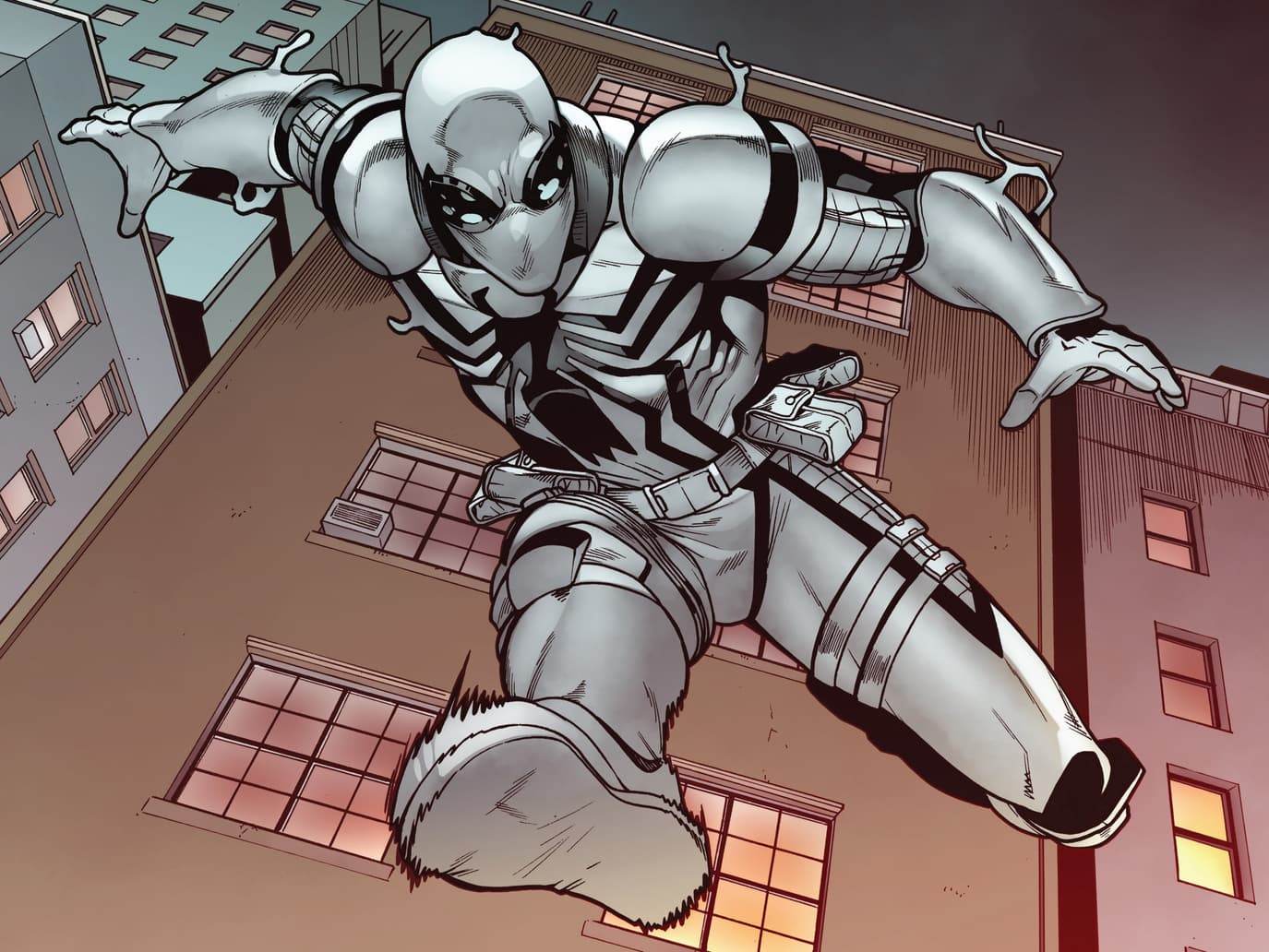
One of the most brilliant alternative versions of Venom is Agent Venom — the merger between the symbiote and Flash Thompson, Peter Parker's old schoolmate turned war veteran who lost both legs. This version, launched in 2011 in the Venom series by Rick Remender, offers a completely fresh reading of the symbiote: what if you used it for good? What if military discipline could tame this untameable entity? The experiment held up across several years of comic arcs, creating one of the most convincing anti-heroes in the Marvel universe.
The central idea behind Agent Venom is a clever one: the US government agrees to graft the symbiote onto Flash Thompson, but with a strict limit of forty-eight hours per mission, on pain of irreversible toxic effects. That constraint turns every use of the symbiote into a dramatic countdown. Flash has to complete his mission quickly or tip permanently into the dark side of the entity. This narrative mechanic creates a constant tension no other version of Venom had managed to reach. Agent Venom even ends up joining the Guardians of the Galaxy and taking part in major cosmic missions — confirming once and for all that Venom is no longer simply Spider-Man's enemy, but a fully fledged player in the Marvel multiverse.
Symbiote Edition — Iconic Design

Spider-Man Symbiote MagSafe Case
39,90 €
The black symbiote suit as a tech accessory — for fans who own the duality of the corrupted Spider-Man and every Venom variant in the multiverse.
Get the Symbiote Case →Anti-Venom: The White Version That Purifies Instead of Destroying
One of the most unexpected versions of Venom is Anti-Venom — created by Dan Slott and John Romita Jr. in 2008 in the crossover New Ways to Die. This extraordinary mutation of the symbiote is born from the meeting between Eddie Brock and the healing powers of Mister Negative, turning the black, destructive creature into an immaculate white entity able to purge bodies of toxins, of diseases and even of other symbiotes. The narrative irony is perfect: Spider-Man's former sworn enemy suddenly becomes a healing force, almost a saviour, able to treat what conventional medicine cannot reach. To go further on this subject, see also Spider-Man Symbiote, Venom & Anti-Venom Costumes: The Dark Side Cosplay Guide.
This version divides fans, but it has one essential merit: it proves the symbiote has no fixed moral identity. Its darkness or its whiteness depends entirely on the specific chemistry between the entity and its host. Eddie Brock with Anti-Venom becomes an almost religious figure of redemption, a man who spent years destroying and who starts rebuilding. Several major arcs explore that dimension: Anti-Venom heals addicts on the streets of New York, rids sick bodies of their cancers and even fights other hostile symbiotes. It is probably the most optimistic version in the whole Venom mythology — the one that reminds us even monsters can find their humanity again.
Carnage: The Symbiote That Outgrows Its Creator
No panorama of Venom's alternative versions can skip Carnage — the symbiote offspring that broke away from Venom to become an even more dangerous independent entity. Born in 1992 in Amazing Spider-Man #361, Carnage embodies the purest version of symbiote corruption. Where Eddie Brock keeps a certain morality thanks to his structured grudge against Peter Parker, Cletus Kasady is a psychopath with no brakes who sees in the symbiote the chance to finally express his destructive nature freely. The merger gives birth to a blood-red monster with uncontrollable tendrils, capable of large-scale massacres that go far beyond anything Venom himself would have dared. To go further on this subject, see also Mania: Andi Benton's symbiote, the heir to Agent Venom.
The Maximum Carnage arc published in 1993 remains one of the most brutal crossovers in Marvel comics history. Carnage gathers a team of psychopaths (Shriek, Demogoblin, Doppelganger) and tries to plunge New York into a generalised bloodbath. What makes this arc fascinating is that it forces Spider-Man to team up with Venom — his sworn enemy — to fight an even more terrifying threat. The lesson is clear: Venom and Carnage are two sides of the same coin, but the first keeps enough residual humanity to recognise that some lines must not be crossed.
Carnage Edition — The Bloodthirsty Variant

LEGO Spider-Man — Carnage
69,90 €
The blood-red variant of the symbiote in LEGO bricks — pure chaos made solid, the piece that completes any serious symbiote collection.
Discover the Carnage LEGO →Spider-Gwen Symbiote: The Female Version of the Multiverse
With the rise of the Spider-Verse, Marvel opened the door to radical alternative versions of all its characters — and Venom did not escape that creative explosion. On the Earth-65 timeline, the one belonging to Gwen Stacy alias Spider-Gwen, the black symbiote bonds with Gwen herself, creating a female version of Venom that is nervy and extraordinarily fast. This interpretation surprises through its narrative economy: rather than repeating the usual symbiote tropes (grudge, revenge, bestiality), it plays on grace and speed, turning Venom into an almost dancing creature instead of a brute force.
This Gwen-Venom version illustrates the philosophy of the multiverse perfectly: secondary characters from the classic comics can become central in parallel universes, and antagonists can merge with heroes to create unprecedented hybrids. The narrative success of this variant inspired a whole generation of Marvel writers to explore the symbiote concept beyond its usual borders. Today, almost every major universe in the Marvel multiverse has its own Venom version — proof that the entity has definitively transcended its initial role as Spider-Man's enemy.
Ultimate Venom: The Scientific Reboot With No Alien Origin
In the Ultimate Marvel universe, launched in 2000 to rejuvenate the catalogue, Brian Michael Bendis completely rethought Venom's origin by removing the alien dimension. In this version, Venom is not a cosmic parasite but the result of a scientific experiment run by the respective fathers of Peter Parker and Eddie Brock — a medical project aiming to create a serum capable of curing cancer. The serum, named 'the Venom project', becomes unstable and corrupts its users, turning Eddie Brock into a starving black monster.
This reinvention completely rationalises the character by anchoring him in contemporary science rather than cosmic mythology. It also deeply changes the psychological dynamic: Venom becomes the tragic result of a good scientific intention gone wrong, rather than a threat from elsewhere. This version strongly inspired the film Venom from 2018 starring Tom Hardy, which skilfully mixes the original cosmic elements with the scientific dimension of the Ultimate line. The result on screen was a massive box-office success, proving that alternative versions of Venom can carry their own franchises without Spider-Man as an antagonist.
The Unexpected Mergers: Wolverine, Deadpool and the Others
In the most experimental corners of the Marvel multiverse, Venom has merged with just about every hero and anti-hero going, creating hybrid creatures that defy imagination. Poison Wolverine combines Logan's healing factor with the raw power of the symbiote — the result being a near-indestructible monster that can survive any wound. Venompool, the merger between Deadpool and the symbiote, keeps the Merc with a Mouth's absurd humour while adding the parasite's powers on top. Venomized Hulk pushes past the limits of physical resistance and would probably create an apocalypse if he existed on the main timeline.
These mergers are never published in the canonical arcs but turn up regularly in multiverse crossover events (What If?, Venomverse, and so on). They serve an essentially playful function: they let writers explore combinations that are impossible on the main timelines while feeding the collective imagination of fans. For the attentive reader, they mostly confirm one thing: Venom is not a character with a fixed identity, it is a narrative concept able to graft itself onto any other concept to produce brand-new results.
Why Venom's Alternative Versions Really Matter
Beyond the obvious pleasure of discovering all these variants, Venom's alternative versions serve a deep narrative function: they turn what was a simple antagonist into a philosophical meditation on human nature. Each version asks the same fundamental question in its own way: what decides whether a destructive force becomes an evil or a good? The answer always seems to be the same — it is the host's soul that decides, not the entity itself. That philosophy places Venom at a level of narrative complexity few supervillains reach in the Marvel universe.
For fans who want to explore the symbiote mythology in all its depth, there are several ways in depending on your taste. If you prefer psychological drama, dive into The Alien Costume Saga, which tells the story of the first meeting between Peter Parker and the symbiote. If you prefer pure action, read Maximum Carnage or Rick Remender's Agent Venom arcs. If you are after the cosmic dimension, explore the Venomverse and Absolute Carnage arcs, which bring together dozens of alternative versions. And for a more contemporary approach, the Venom films with Tom Hardy offer an accessible way into this whole complex mythology.
Everyday Symbiote — Iconic Duality

Spider-Man and Venom Mug
24,90 €
The hero-symbiote duality on your mug — the everyday object that pays tribute to every version of Venom across the multiverse.
Discover the Symbiote Mug →The Venom Visual Universe: How to Bring It Into Everyday Life
For fans who want to carry their symbiote passion beyond reading, the Venom universe offers a merchandise line-up that is particularly rich and aesthetically coherent. The deep black colour, the piercing white eyes, the blood-red tongue — these visual codes are so powerful that they turn any everyday object into an instantly recognisable fan piece. A Venom iPhone case on a work phone sends a subtle but clear signal: its owner knows the symbiote mythology inside out. A Spider-Man duvet cover in symbiote colours turns a bedroom into an immersive space.
To go further, explore the Spider-Man phone case collection, which includes several different symbiote designs, dive into the figurine collection, which immortalises the best alternative versions of Venom, or let yourself be tempted by the LEGO sets dedicated to Venom and Carnage that complete any serious symbiote collection. The Venom multiverse is probably one of the most fertile playgrounds in the Marvel universe — dive in, you will keep coming back.

