

14-Day Money-Back Guarantee
0
The short answer
This bridge owes its status to the death of Gwen Stacy, published in June 1973 in Amazing Spider-Man #121 and written by Gerry Conway. The script actually named the George Washington Bridge; it was Gil Kane's art that imposed the other silhouette. We untangle the controversy below.
Picture a red-and-blue figure clinging to a steel cable, the wind snapping at his mask, and behind him the Manhattan skyline stretching to the horizon. Now take the bridge away. Everything collapses. Not just the composition — the very soul of the New York web-slinger disappears with that cable. Since 1962, no place has shaped the visual identity of the masked wall-crawler more than the Brooklyn Bridge. No setting has carried more drama, more trauma, more founding moments. And yet, oddly, few fans really know why this particular bridge — and no other — became inseparable from the Spider-Man mythos.
This article digs deep into the visceral relationship between the Brooklyn Bridge and Peter Parker's world. From June 1973, when Gerry Conway and Gil Kane changed comics forever, to the web-swinging scenes of Insomniac on PS5, by way of the unforgettable cult shot from the Sam Raimi trilogy, this bridge tells a story. A story where architecture, grief and heroism meet in a single real geographical place, one you can visit, touch and cross on foot. To understand Peter Parker, you have to understand his bridge.
The bridge that forged the web-slinger's visual identity
When Stan Lee and Steve Ditko launched the web-slinger in Amazing Fantasy #15 in August 1962, they did not immediately choose the Brooklyn Bridge as a visual totem. The earliest adventures unfold mainly at Midtown High, in the home of Aunt May in Forest Hills, or in the offices of the Daily Bugle. The bridge shows up shyly, in the background, as one of the many New York settings that Ditko uses as a visual architect. But something gradually crystallises in the years that follow.
The bridge has a geometry all of its own. Its taut cables form natural diagonals that guide the eye. Its neo-Gothic granite towers recall the buttresses of a medieval cathedral. Its height — twenty-six metres above the East River — offers a vertical theatre where the silhouette of a climber can be cut out against the light. For artists like Ditko and later John Romita Sr., it was a graphic gift. A single panel was enough to say: this hero is New York, and New York is the city where the steel of the bridges holds up millions of lives. The web-slinger's visual fabric was built there, in the taut cables of the Brooklyn Bridge.
That visual identity left such a mark that it became the norm. When Marvel commissions an emblematic illustration today for its official merchandise, you almost always find the same motif: the web-slinger mid-swing, a bridge behind him, the city stretching out. The bridge is no longer a backdrop — it is a fully fledged character in the story.
June 1973: the night the bridge became a graveyard
The Amazing Spider-Man #121 and #122, June 1973. On the cover, a simple, terrible title: The Night Gwen Stacy Died. Written by Gerry Conway and drawn by Gil Kane, a scene plays out over a handful of panels that would change the medium forever. Norman Osborn, the Green Goblin, kidnaps the hero's girlfriend, Gwen Stacy, and throws her from the top of a bridge. Peter Parker dives after her and fires a web to catch her. He catches her. The line stops her fall. A small 'snap' rings out in the last panel. Gwen is dead.

That moment, analysed over and over by comics scholars, is generally seen as the end of the Silver Age of superheroes and the beginning of the Bronze Age. Before June 1973, sidekicks and heroes' girlfriends were kidnapped, tied up, threatened — but they always survived. Conway broke that unspoken contract between author and reader. A young woman, loved, central to the protagonist's life, dies — and the hero is complicit in her death. His web stopped Gwen too abruptly. Whiplash. Peter is the one who killed her, while trying to save her. The full arc of that event remains one of the most painful pillars of the great Spider-Man saga.
And that scene takes place on a bridge. Not in an anonymous warehouse, not in the sewers, not in a secret laboratory. On a real New York bridge. The geographical place instantly became sacred for millions of readers. From 1973 onwards, when artists draw Peter Parker in mourning, they draw him on that bridge. When his guilt is evoked, those cables are evoked. The bridge became an emotional graveyard — a place the hero returns to in his mind every time he doubts, fails or weeps.
Brooklyn Bridge or George Washington Bridge? The controversy that never ends
Let's be honest: the comics contradict each other. In Amazing Spider-Man #121 from June 1973, the text explicitly names the George Washington Bridge — that giant suspension bridge linking Manhattan to New Jersey, far further north than Brooklyn. Gil Kane, though, drew something much closer to the Brooklyn Bridge, with its distinctive neo-Gothic towers and its fanned cables. The George Washington Bridge is a modern steel structure with two rectangular lattice towers and no Gothic dimension at all.
That contradiction between script and art has become legendary among fans. Gerry Conway himself explained in several later interviews that he had written 'George Washington Bridge' because that was the bridge he pictured, but that Gil Kane had drawn from memory what he associated with a New York bridge — the Brooklyn Bridge. Marvel's editors never really settled the matter. Some later reprints even 'corrected' the text to say Brooklyn Bridge, retroactively validating Kane's visual choice.
The result? In the collective imagination, the Brooklyn Bridge won. When a fan mentions 'the bridge where Gwen died', they picture the stone arches of the historic 1883 crossing, not the imposing 1931 suspension structure. Film and video game adaptations have almost all chosen the Brooklyn Bridge or a fictional bridge that looks like it. The controversy rumbles on, but the popular verdict is final. The Gwen Stacy death arc belongs, in the fan subconscious, to the Brooklyn Bridge.
Why a bridge? The architecture that matched the web-slinger
Beyond the Gwen Stacy event, there is something deeper to grasp: the bridge is the natural architectural extension of the masked wall-crawler's power. His webs, his web-shooters, his ability to travel by swinging from anchor point to anchor point — all of it finds an ideal playground in a suspension bridge. The cables become vanishing lines. The towers serve as footholds. The deck offers a platform. The steel web strung up by nineteenth-century engineers literally converses with the organic web spun by the hero.
That resonance is no accident. Stan Lee wanted a hero who moved differently from the other superheroes of the day. Peter Parker does not fly like Superman. He does not run at lightning speed like the Flash. He does not leap from building to building like Daredevil — at least not with the same grace. His physical signature is the swing. Pendulum motion. And what is a suspension bridge if not an immense series of taut pendulums? It is an object that shares its character's kinetic DNA.
Comics historian Peter Sanderson even developed a theory that the choice of the Brooklyn Bridge in the series' early years was not only aesthetic but ideological. The bridge, a public work built to connect two populations separated by a river, embodies the masked vigilante's civic mission: protecting the ties between the city's inhabitants. When the bridge is threatened — by an attack from Doctor Octopus, by a kidnapping by the Green Goblin, by a disaster caused by Oscorp Industries — the whole of New York is threatened in its social fabric. Saving the bridge means saving the community. That quiet political dimension runs through the entire Spider-Man mythology.
From page to screen: Sam Raimi and the cinematic coronation
In 2002, Sam Raimi released his film trilogy and lifted the bridge once and for all to mainstream icon status. But the moment that stays with everyone comes in the first film, in 2002: the Green Goblin puts Peter in front of an impossible choice — save Mary Jane as she falls, or save a cable car full of children. The web-slinger saves both. And the scene unfolds on the Queensboro Bridge — not the Brooklyn Bridge, but the principle is the same: a New York bridge becomes the arena of a founding moral dilemma.
Raimi had fully understood the visual grammar of comics. He knew that the audience, even newcomers, would intuitively feel the power of a bridge scene. The verticality, the depth of field, the void underfoot, the black water glinting below — all of it creates a unique cinematic tension. When Mary Jane falls and the woman Peter loves hangs in mid-air, you cannot help thinking of Gwen. The bridge becomes a mirror. A loop. On screen the hero replays the tragedy he lived through in the comics — except that this time he succeeds. It is almost an act of symbolic repair.
Andrew Garfield picked the motif back up in 2014 in The Amazing Spider-Man 2, but this time inverting the resolution: Gwen Stacy dies, in a clock tower that visually echoes the vertical structure of a bridge. Tom Holland, for his part, walks across the Brooklyn Bridge in Homecoming and uses it as the final battlefield in No Way Home. Three actors, three eras, one single bridge. Tobey, Andrew and Tom share that setting like a signature common to the role.
LEGO COLLECTOR — BRIDGE BATTLE

LEGO Spider-Man — Bridge Battle
€169.90
Recreate the most emblematic scene in Spider-Man lore at home. A collector's set that turns your shelf into the witness of a legend.
Discover →The bridge in video games: the Insomniac obsession
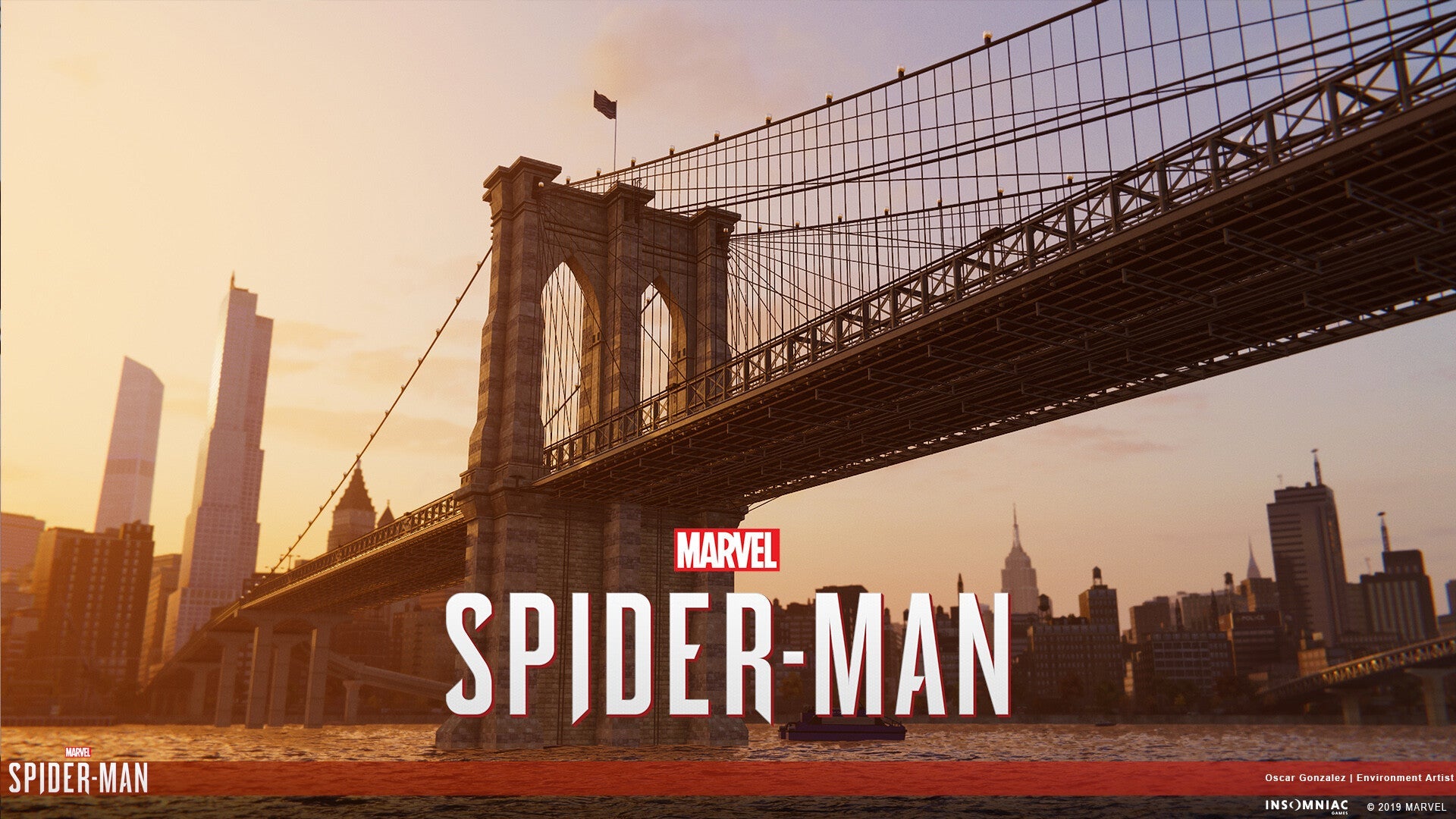
When the Insomniac studio released Marvel's Spider-Man in 2018 on PS4, the development team spent two full years mapping Manhattan, Brooklyn, Queens and the Bronx, in an urban reproduction of a precision rarely seen in video games. Bridges hold a central place there — not as scenery, but as gameplay pivots. The Brooklyn Bridge becomes one of the most iconic crossing points, the trigger for side missions, timed challenges and several major cutscenes.
In Miles Morales in 2020 on PS5, the studio pushed the use of the bridge even further. An entire mission unfolds around a bomb planted on the deck by the Underground, the criminal organisation led by the Tinkerer. The player has to defuse the device while evacuating civilians, in a vertical choreography that directly recalls the legendary comics scenes. Miles Morales himself crosses the bridge at the end of the game, in a shot that condenses the web-slinger's whole New York mythology.
The 2023 Marvel's Spider-Man 2 widened the map to Brooklyn and Queens, which let players cross the bridge on foot, stop on it and take pictures with the game's photo mode. That contemplative dimension is new: for the first time, the web-slinger does not merely cross his bridge in motion — he settles on it. It is a deep shift in the relationship between the character and his setting. The bridge is no longer only crossed: it is inhabited. And the whole body of Spider-Man video games built that relationship step by step, from the Atari 2600 to the PS5.
Brooklyn Bridge, Manhattan Bridge, Queensboro: three bridges, three moods
New York has several emblematic bridges that fans often confuse. Yet each has a distinct narrative function in the comics and the adaptations. The Brooklyn Bridge (1883), with its granite towers and fanned cables, is the historic, neo-Gothic, sacred one. It is the bridge linked to Gwen Stacy, to tragedy, to memory. The Manhattan Bridge (1909), more recent and more industrial, often serves as secondary scenery — you glimpse it in the background of certain panels, but it rarely carries a major event.
The Queensboro Bridge (1909) has held a special status since Sam Raimi's film in 2002. It is on that cantilever structure that the cable car scene and the impossible choice play out. The bridge is rawer, more industrial, more metallic than the Brooklyn — and that look suited the end of the first film, a moment when the hero begins to understand that his life will never be simple. The bridge becomes a fully fledged architectural character, whose look mirrors the protagonist's emotional state.
The George Washington Bridge (1931), finally, is the one Gerry Conway originally named in the 1973 script. It is more modern, more utilitarian, more American in its architecture. Its metallic straightness, with no Gothic ornament, does not carry the symbolic weight of the Brooklyn. That is probably why the wider public unconsciously pushed it out of the mythology: the mythic bridge has to have an old, almost religious visual grammar to carry the web-slinger's drama.
Beyond the tragedy: the bridge as a heroic playground
It would be unfair to reduce the Brooklyn Bridge to Gwen Stacy's death alone. In the comics, this bridge is also — and above all — a stage for positive heroism. How many magnificent scenes show the web-slinger swinging between the cables to intercept a fleeing thief? How many fights against Kingpin, against Venom, against Carnage, against Doctor Octopus unfold in that aerial ballet?
The bridge offers a unique choreography: gravity converses with movement, the black water under the deck creates a permanent threat, the passing cars are a reminder of what is at stake for ordinary people. Every fight on the bridge is a display of virtuosity. For the emblematic villains, it is also strategic ground: taking hostages on a bridge creates an agonising dilemma for the hero — save the civilians or chase the enemy. That narrative mechanic has been used dozens of times since 1962, and it still works.
In the alternative versions of the Spider-Verse, the bridge takes strange forms. Spider-Man 2099 (Miguel O'Hara) moves along futuristic bridges of transparent plastic and holograms. Spider-Punk (Hobie Brown) crosses an alternative London whose bridges are painted with anarchist graffiti. Spider-Gwen, in her Earth-65 universe, has her own Brooklyn Bridge — but this time she is the one mourning Peter Parker, dead in Gwen's place in a poetic inversion. All these alternative bridges point back to the original, founding bridge.
RUG DECOR — SWINGING THROUGH NEW YORK

Spider-Man Rug — Swinging Through New York
€37.56
Set your feet on the Manhattan skyline every morning. The web-slinger's New York soul turns your bedroom into a spider's lair.
Discover →Visiting the bridge today: a fan pilgrimage
The Brooklyn Bridge is a major New York tourist site — around four million pedestrians cross it every year. But within that crowd, a far from negligible share is made up of fans on pilgrimage. They stop in the middle of the bridge, look out over the East River towards Manhattan, and picture a red-and-blue figure swinging between the cables. It is an intimate, almost secret ritual, one the official guidebooks usually ignore but the specialist forums describe in detail.
Several companies now run 'Spider-Man Walking Tours' in New York, which always take in the Brooklyn Bridge, the Daily Bugle (in reality the Flatiron Building, chosen by John Romita Sr. as visual inspiration), and the Forest Hills in Queens where Aunt May lived. The bridge remains the highlight of these tours. Guides tell the story of Gwen Stacy, sometimes reading aloud extracts from Amazing Spider-Man #121. Some visitors cry. The real geographical place and the fictional story contaminate each other — the fiction takes shape in the concrete, and the concrete fills with fiction.
This pilgrimage dimension explains why the bridge is so present in the posters and prints, in the decorative rugs and the figurines that fans put up at home. Owning an object that shows the bridge means keeping a fragment of that sacred geography with you. It makes an attachment to a myth visible, in your living room or your bedroom.
The bridge, mirror of the hero's moral dilemma
If the Brooklyn Bridge became the most iconic place in Spider-Man mythology, it is ultimately because it condenses every narrative tension of the character into a single architectural object. The bridge connects — as the web-slinger weaves ties between the city's inhabitants. The bridge also separates — it marks a border between Manhattan and Brooklyn, just as Peter Parker swings between his civilian life and his masked identity. The bridge can collapse — as the hero's life can collapse, as it collapsed in June 1973. And the bridge asks to be protected — as Peter must protect his city, his family, his friends.
Every one of the hero's great traumas has passed through this bridge, directly or indirectly. Gwen's death, of course, but also the moral fall after Aunt May's death in Back in Black, where Peter wanders the bridge at night in the black suit, ready to abandon his principles. The meeting with his clone Ben Reilly, in the Clone Saga, plays out partly on that same structure. The bridge is where Peter Parker faces his doubles, his ghosts, his failures.
In wider pop culture, this phenomenon of identifying a character with a geographical place remains rare. Batman is associated with Gotham, but Gotham is an entire fictional city. Daredevil is tied to Hell's Kitchen, but the neighbourhood is diffuse. The web-slinger, though, is tied to one precise, identifiable, mappable bridge. That geographical precision is a singularity of Spider-Man mythology — and it partly explains why the myth has survived more than sixty years of reinventions and adaptations so well. As long as you can walk across that bridge in New York, the myth stays alive.
One bridge, one hero, one mythology
The Brooklyn Bridge is not just scenery in Peter Parker's adventures. It is a fully fledged character, a silent witness to sixty years of stories, an improvised altar for fans on pilgrimage, and the architectural mirror of everything that makes the New York web-slinger singular. When you look at an iconic cover of the character, the bridge is almost always there, in the background, like a geographical signature saying: this hero is this city, and this city is this bridge.
From Stan Lee and the original inspiration to Marvel's Spider-Man 2 on PS5, the thread holds. The bridge keeps carrying the myth. It will go on carrying the next generations of fans, the next reinventions of the character, the next dramas of the masked hero. And every time an artist, a filmmaker or a game developer wants to say in a single image that this hero is the soul of New York, they will draw that bridge. Because there is no other. Because there never will be another.

