
14-Day Money-Back Guarantee
0
The short answer
It was Steve Ditko who fixed the character’s look right from Amazing Fantasy #15 in 1962: red and blue suit, big white eyes, spiral webbing. He also shaped the silhouettes of the Green Goblin and Doctor Octopus, then left Marvel in 1966. Here is a look back at his graphic legacy.
When you think of Spider-Man, most people immediately picture Peter Parker, Stan Lee or the cult films of the Spider-Verse. But behind the pencil strokes that brought the web-slinger to life stands a quiet, perfectionist and deeply influential artist: Steve Ditko. Without him, the face and the visual soul of the wall-crawler would never have marked entire generations.
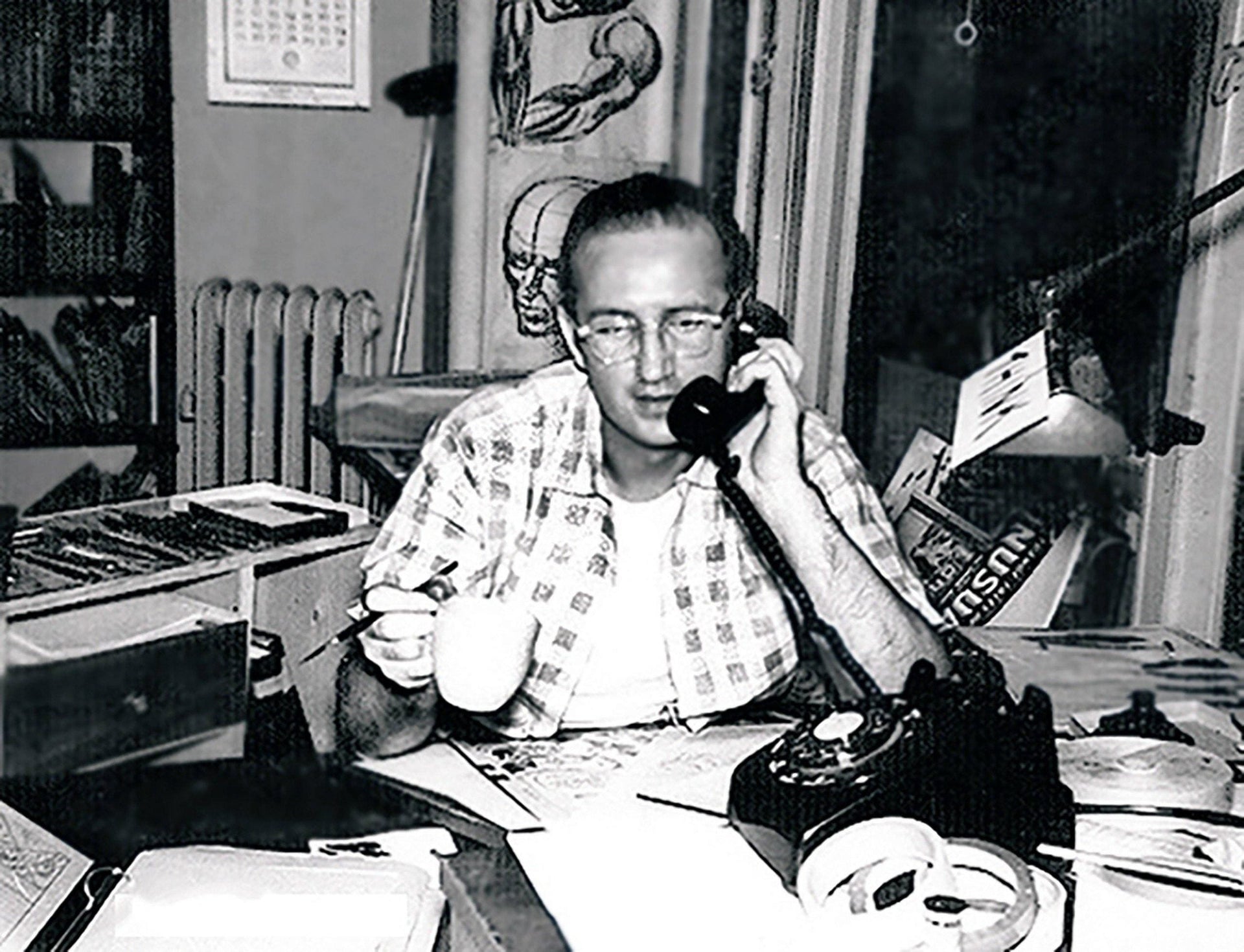
Steve Ditko was born in 1927 in Johnstown, Pennsylvania. Passionate about drawing from a very young age, he was fascinated by Batman and The Spirit comics, but also by the illustrator Jerry Robinson, to whom he owes part of his precise, expressive style. After the Second World War, he enrolled at the Cartoonists and Illustrators School in New York, a place where the talents who would shape the golden age of comics were already crossing paths.
August 1962 — The birth of Spider-Man (Amazing Fantasy #15)
In the early 1960s, as Marvel was looking to diversify its heroes, Stan Lee imagined a teenager juggling secondary school homework with the responsibility of being a superhero. That is the precise moment Ditko stepped in. While the idea of Spider-Man came from Stan Lee, it was Steve Ditko who designed his red and blue suit, his expressive white eyes and his spiral-shaped webs. A design that became legendary, instantly recognisable the world over. The subject is covered in more detail in Why is Spider-Man’s suit red and blue?.
What sets Ditko apart is his ability to blend realism and dynamism. Where other artists focused on frozen heroic poses, he captured Spider-Man’s feline agility, his impossible acrobatics and his urban fight scenes in a living, believable New York. Every panel becomes a piece of drawn cinema, a total immersion in the action.
🎯 If you want to relive that era and own a piece of history, discover our Spider-Man figurine collection inspired by Ditko’s earliest versions, or dive into our vintage posters that capture this unique graphic style perfectly.
Unlike other artists of his time, Steve Ditko never tried to make his characters artificially ‘perfect’. In his pages, Peter Parker does not have the smooth face of a Hollywood hero: he looks like a real teenager, sometimes tired, sometimes worried. This approach humanises Spider-Man and reinforces the ‘everyday hero’ side that fans still love today.

Ditko also excels at creating visual worlds. The dark alleyways, the dizzying rooftops, the shadows stretching across the façades… everything in his drawings works to reinforce the unique atmosphere of the web-slinger’s early adventures. Even the fights feel more fluid, almost choreographed, with an exceptional command of movement and perspective.
March 1963 — The Amazing Spider-Man #1: the Ditko visual grammar
At the same time, he dreamt up some of Spider-Man’s most iconic enemies. From the Green Goblin to Doctor Octopus, every antagonist gets a considered design, often strange and memorable. Ditko loved playing with shapes and textures to give his villains an instantly recognisable visual identity.
This artistic demand was not limited to Spider-Man. Steve Ditko also helped enrich the Marvel universe with landmark work such as Doctor Strange, where he developed a unique psychedelic style, exploring dimensions and mental landscapes never seen before in comics.
🎯 If you want to step inside Ditko’s creative mind, our Spider-Man story arcs page will let you rediscover these founding adventures, while our blankets are perfect for reliving his legendary designs.

In 1966, to everyone’s surprise, Steve Ditko left Marvel. The exact reasons for his departure remain unclear, feeding plenty of theories. Some point to tensions with Stan Lee over the creative direction of Spider-Man and over the identity of the Green Goblin. Others believe that Ditko, attached to his artistic freedom, could no longer put up with certain editorial constraints.
Either way, his departure marked the end of an era. For four years, Ditko had shaped the web-slinger’s world, defined its visual codes and left an indelible mark. His contribution is such that even after he left, many artists carried on drawing inspiration from his layouts, his eye for detail and his realistic vision of New York.
True to his private nature, Steve Ditko refused interviews and public appearances. He focused on other projects, notably for DC Comics, where he created cult characters such as The Question and Hawk and Dove. But in the minds of fans, he remains above all the visual architect of Spider-Man.

His narrative and graphic style also laid the foundations for more intimate storytelling in comics. Where others focused on cosmic battles, Ditko concentrated on personal dilemmas and moral choices, an approach you still find today in arcs such as Spider-Man: One More Day or Kraven’s Last Hunt.
Decades after his creation, the influence of Steve Ditko on Peter Parker is still everywhere. His drawings continue to serve as a reference, whether in the comics, the animated series or film adaptations such as Spider-Man: Homecoming. Even in modern works, you find that dense, living, sometimes oppressive New York inherited from his vision.
July 1966 — The end of the Ditko era at Marvel and an eternal legacy
Ditko also marked the Marvel universe with his philosophy: that of the flawed, vulnerable hero driven by a sharp sense of responsibility. That notion, summed up in the famous line ‘With great power comes great responsibility’, is not just a slogan: it is the soul of Spider-Man and the narrative engine running through all his arcs, from the classics to the most recent such as No Way Home.

His legacy goes beyond the character of Spider-Man. With Doctor Strange, Blue Beetle and other creations, he proved he could explore radically different genres and worlds while keeping a unique visual signature. But for fans, Ditko will forever remain the man who gave the web-slinger a face, a soul and a world.
Tributes are not in short supply: collector reissues, figurines inspired by his designs, vintage posters… all objects that keep his influence alive. To find that original spirit again, explore our selection of Spider-Man figurines or our jumper collection.
More than an artist, Steve Ditko was a world-builder. His work proves that a hero, however spectacular, gains depth through his flaws, his choices and the world around him. It is that vision, more than his pencil strokes, that carries on spinning its web in the collective imagination.

