
14-Day Money-Back Guarantee
0
The short answer
No official confirmation at this stage: the studios have signed off on neither Tobey Maguire's return nor Andrew Garfield's. The theories rest on the inter-universe rifts the main villain would tear open, on the colossal success of the previous crossover and on the actors' evasive comments. Full breakdown below.
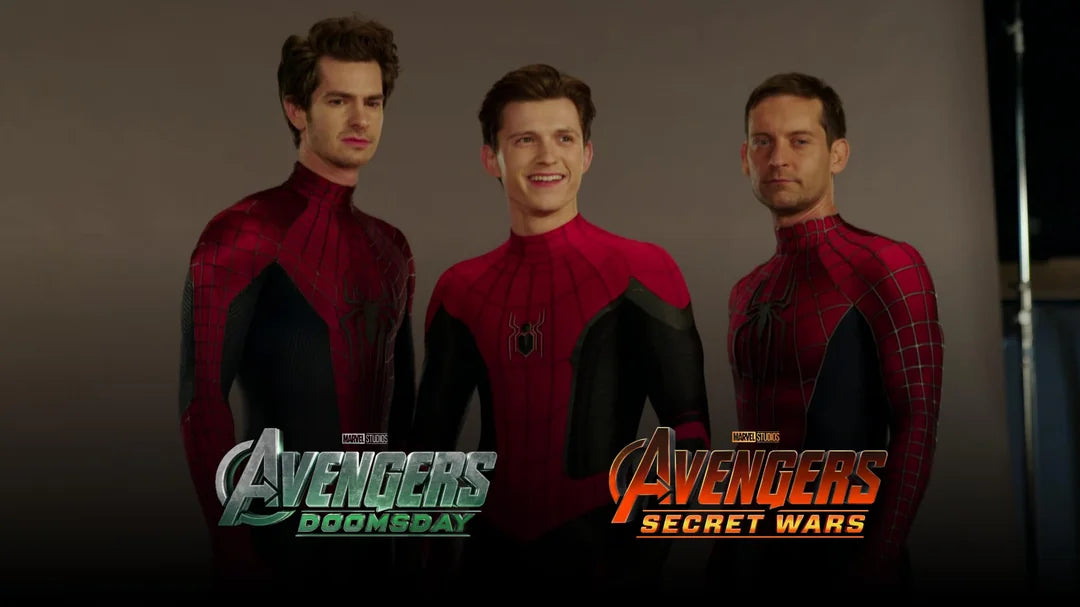
Ever since Avengers: Doomsday was announced, one question has obsessed Spider-Man fans around the world: are we going to see all three Spider-Men together on the big screen again? Tobey Maguire, Andrew Garfield and Tom Holland, the three faces who have played Peter Parker on screen since 2002, already proved in No Way Home that their reunion could set off a cultural earthquake. More than two billion dollars at the worldwide box office, entire cinemas on their feet screaming, tears across social media for weeks. And now that Doctor Doom is threatening to tear the multiverse apart, that the Avengers are facing their greatest threat since Thanos, and that the Multiverse Saga is reaching its climax, everyone can feel that the conditions are in place for it to happen all over again.

But this time, the stakes are different. No Way Home was a celebration. Doomsday will be a war. And having the three Spider-Men in that conflict would change everything, not just for the film itself, but for the future of the Spider-Man franchise on the big screen.
No Way Home changed everything: why the return of the three Spider-Men became possible
Before December 2021, the idea of seeing Tobey Maguire and Andrew Garfield put the Spider-Man mask back on belonged to the realm of Reddit forum fantasy. Sony and Marvel Studios had always kept their universes in separate boxes. Sam Raimi's trilogy existed in a space of its own. The Amazing films by Marc Webb in another. And Tom Holland's Spider-Man belonged exclusively to the MCU. Three Peter Parkers, three tones, three eras, and no commercial reason to merge them.
Then No Way Home smashed that logic to pieces. The film proved three things that redefined the rules of the game. First, the three actors are not only willing to come back, they visibly enjoy playing together. The chemistry between Maguire, Garfield and Holland on screen was not an editing trick, it was pure alchemy, fed by mutual respect and a shared understanding of what it means to wear the suit. Second, audiences do not just want a nostalgic cameo. They want scenes loaded with emotion, complete narrative arcs, moments where each Spider-Man brings something the other two cannot offer. And third, the box office has spoken: putting the three Spider-Men together is the most profitable recipe in the history of superhero cinema.
Marvel Studios took note. Kevin Feige, who plans his phases with the precision of a chess player, has not forgotten those figures. And above all, he has not forgotten the audience's emotional reaction, the screams in the cinemas, the videos of viewers in tears, that planet-wide shockwave when Andrew Garfield catches MJ as she falls, finally healing the wound of Gwen Stacy's death. That kind of moment cannot be manufactured with special effects. It is built on twenty years of history shared between a character and his audience.

The clues pointing towards a reunion in Doomsday
Let us be clear: neither Marvel Studios nor Sony has officially confirmed that Tobey Maguire or Andrew Garfield will appear in Avengers: Doomsday. But anyone who followed the No Way Home marketing campaign knows that official denials are worth absolutely nothing in the Marvel universe. Andrew Garfield spent months swearing on every television sofa that he was not in the film, with such convincing nerve that even the most seasoned journalists believed him. On release day, half the internet discovered that he had been lying with a smile for a year. Since No Way Home, the rule has been simple: as long as Marvel denies it, you should treat it as possible.
And the clues, this time, are more numerous than ever. Doomsday is a film about the multiverse. Doctor Doom, in the comics, is the character who literally shattered the barriers between universes in Secret Wars. If Doom starts tearing the fabric of reality apart in Doomsday, which the title and the casting of Robert Downey Jr. strongly suggest, then the doors between universes swing open. And when the doors between universes swing open in a Marvel film, the Spider-Men are never far away.
There is also the logistical question. Doomsday already brings together a colossal cast: the Russo brothers directing, RDJ as Doctor Doom, and potentially a dozen active Marvel heroes. Adding three Spider-Men to that mix would be a production nightmare for any other studio, but Marvel and the Russos proved with Infinity War and Endgame that they know how to handle ensembles of that size without sacrificing narrative coherence.
What Andrew Garfield and Tobey Maguire have said since No Way Home
The two actors' statements since 2022 deserve close analysis. Andrew Garfield, in an interview with GQ magazine, said it would be 'silly to close the door' on a return, while making clear that he would only come back if the story justified it. That nuance is crucial. Garfield is not an actor who takes a role for the cheque. His performance in No Way Home, that blend of pain, humour and vulnerability, proved that he took the character seriously. If he says the story has to justify it, it means he has narrative demands, not that he refuses to return.
Tobey Maguire is more discreet, as usual. The actor, who has largely stayed out of the spotlight since the 2010s, has given only a few evasive interviews on the subject. But his very presence in No Way Home, a film he could have turned down with no consequence for his career, proves that he remains attached to the character. Maguire's Spider-Man is the patriarch, the veteran, the one who carries twenty-five years of memories in every gesture. His presence in Doomsday would not be fan service. It would be an emotional anchor for the audience who grew up with his films.

If you are one of those who grew up with Tobey's Spider-Man, who discovered the hero with Andrew, or who get a thrill from Tom Holland, there is something powerful about having all three incarnations together at home. The collectable resin Spider-Man figure captures that timeless essence of the character: beyond the actors, beyond the eras, this is Peter Parker in his purest form. The kind of piece that travels across generations exactly like the character it represents.
Discover the Premium resin Spider-Man figureWhat each Spider-Man would bring to the battle against Doctor Doom
One of the most convincing arguments in favour of reuniting the three Spider-Men in Doomsday is that each version brings something irreplaceable to the combat and team dynamic. These are not three copies of the same hero. They are three different philosophies of what it means to be Spider-Man, and against an antagonist as complex as Doctor Doom, that diversity of approaches could make the difference between victory and catastrophe.

Tobey Maguire's Spider-Man is the scientist. He is the Peter Parker closest to the classic archetype of the original comics, a physics genius, able to grasp the principles of nuclear fusion at the age of twenty, brilliant enough to impress Otto Octavius before he had even become Spider-Man. Against Doom, who is himself a genius scientist doubling as a sorcerer, the Tobey Spider-Man would be the one who understands Doom's machines, who spots the flaws in his technology, who speaks the same intellectual language as the villain. His maturity, now in his forties, with decades of experience as a hero, would make him the natural strategist of the trio.
Andrew Garfield's Spider-Man is the heart. Nobody in the history of superhero cinema has played Peter Parker's pain with as much raw truth as Andrew Garfield. His Peter lost Gwen Stacy, not in a cosmic battle, not against a god, but in a clock tower, against an enemy he knew. That loss broke him in a way neither Tobey nor Tom has experienced. But it also gave him something unique: bulletproof empathy. The Andrew Spider-Man is the one who sees the humanity behind Doom's mask, the one who hesitates before striking because he knows what it costs to lose someone, the one who reminds the others that their mission is not to destroy Doom but to save the people Doom is threatening.
And Tom Holland's Spider-Man is the soldier. He is the only one of the three who has fought alongside the Avengers, who survived the Thanos snap, who crossed the multiverse and came back from it alone. The Tom Spider-Man has not been a teenager since the end of No Way Home. He is a veteran. He knows the Avengers protocols, he knows how large-scale battles work, and above all, he knows Doom's face. Because that face was Tony Stark's, his mentor, his spiritual father. That personal connection with the enemy makes the Tom Spider-Man the emotional pivot of any confrontation with Doom.

The trio against Doom: a dynamic never seen before in the MCU
What would make the scene of three Spider-Men facing Doom absolutely electric is that Doom could not use his usual manipulation tactics against them. Doom is a master of division: in the comics, he has systematically exploited tensions between heroes to turn them against one another. But three Peter Parkers share a bond nobody can break: they are the same man. They think the same way, they feel the same instincts, they share the same spider-sense that warns them of danger. Doom could divide the Avengers, turn Thor against Hulk, manipulate Wanda Maximoff, but faced with three versions of the same mind, his strategy of division collapses.
In the comics, this dynamic was explored in the Spider-Verse arc, where dozens of Spider-People unite against a common threat. But the film would have the advantage of simplicity: three Spider-Men, not thirty. Three distinct but complementary personalities. Three actors who have already proved they can share the same screen without overshadowing one another. It is the perfect recipe for a scene that would shake the foundations of every cinema on the planet.
The most likely scenario: how the three Spider-Men could appear
If Marvel Studios decides to bring the three Spider-Men into Doomsday, several staging scenarios are possible. The most likely one leans on the multiverse mechanics the MCU has established since Loki and No Way Home. When Doom starts fracturing the barriers between realities, which his character does systematically in the comics, the universes overlap. Sam Raimi's Peter Parker and Marc Webb's are then pulled into the MCU, not by choice but by cosmic accident. They are not coming to help. They are caught in the storm, like everyone else.
That scenario is narratively superior to a classic 'call for help', because it puts the three Spider-Men in a position of shared vulnerability. Nobody is the self-appointed leader. Nobody is the heroic reinforcement who turns up at the last moment. All three are survivors in a collapsing world, and their strength comes from their ability to organise themselves in the chaos, exactly as in No Way Home, where the three Peters work in a laboratory to make cures for the multiverse villains.
Another, bolder scenario would involve Doom deliberately recruiting or trapping the Spider-Men from other universes as part of his plan. In the great Marvel sagas, Doom leaves nothing to chance. If he knows that Spider-Man is one of the few heroes capable of threatening his plans, thanks to his intelligence, his agility and above all his moral unpredictability, he might seek to neutralise every version of Spider-Man simultaneously. Which would mean that the three Peter Parkers find themselves not in a position of strength, but in a trap designed specifically for them. A cosmic spider cage, dreamed up by the most dangerous genius in the multiverse.
Why Doomsday cannot settle for a single Spider-Man
The most powerful argument in favour of having the three Spider-Men in Doomsday is neither commercial nor nostalgic. It is narrative. Doctor Doom, as the comics have built him over the decades, is an antagonist whose complexity exceeds the capacity of a single hero. Thanos had a simple philosophy: balance through extermination. Doom has no simple philosophy. Doom is simultaneously a dictator, a scientist, a sorcerer, a diplomat, a family man, a man traumatised by the loss of his mother, and a visionary convinced that he alone can save humanity from itself. Taking on Doom is not a fight. It is a philosophical debate, a technological race, a duel of wills and a physical battle, all at the same time.
A single Spider-Man, however talented Tom Holland is in the role, cannot answer all of those dimensions at once. But three Spider-Men can. Tobey analyses Doom's technology while Andrew negotiates with his residual humanity and Tom leads the physical assault. It is a division of labour that perfectly reflects the multidimensional nature of the enemy. And it is exactly the kind of narrative synergy the Russo brothers excel at staging: think back to the final battle of Endgame, where every hero had a precise role in the overall plan.
Three Spider-Men, three generations, one single identity. If you are the kind of fan who has thrilled to every incarnation of Peter Parker, the articulated Spider-Man costume captures that spirit of handing down, every detail telling twenty years of the hero's evolution on screen. The kind of piece you put on a shelf that starts a conversation every time a friend notices it, especially while Doomsday is still fresh in everyone's memory.
See the articulated Spider-Man figureThe impact on the future of each Spider-Man on screen
Beyond Doomsday itself, reuniting the three Spider-Men would have major consequences for the future of each iteration of the character. For Tom Holland, whose Spider-Man 4 is in preparation, the experience of fighting alongside his older alter egos would definitively anchor his Peter Parker as the MCU's main Spider-Man, not because the others are inferior, but because it is in his universe that the battle takes place. It is his responsibility, his world, his rules.

For Andrew Garfield, whose Amazing Spider-Man saga came to an abrupt halt after two films, Doomsday could be the chance to close his arc properly. No Way Home began that work: the scene where he catches MJ was a brilliant narrative redemption. But imagine a Doomsday in which the Andrew Spider-Man faces Doom and refuses to give ground, not out of blind heroism but out of a conviction that even monsters deserve an attempt to save them. It would be the perfect conclusion for a character whose entire story is built on loss and resilience.

And for Tobey Maguire, whose Spider-Man has become an almost mythological figure in popular culture, Doomsday would offer the chance to show what becomes of a hero after thirty years. The Tobey Spider-Man no longer has the fire of his youth. His knees creak, his webs may not be quite as strong any more, and his civilian life has probably taken over long ago. But his experience, his wisdom, and above all his ability to see the bigger picture make him an irreplaceable asset in a multiversal war. The best Marvel teams have always needed an elder to guide the young ones. Tobey would be that elder.
And if Marvel does not do it? What Doomsday would lose without the three Spider-Men
Let us ask the opposite question. What happens if Doomsday comes out without Tobey or Andrew? The film will obviously be a commercial success, as any Avengers with Robert Downey Jr. in the cast would be. But something would be missing. Something fans would feel in their chest without being able to name it. No Way Home set an irreversible precedent. Viewers now know the reunion is possible. They know the actors are willing. They know the multiverse is open. Not bringing the three Spider-Men back in the biggest multiverse film in history would feel like a broken promise, and broken promises are what kill franchises.
The risk is all the greater because the narrative competition is fierce. The audience of 2026 is not the audience of 2012 that marvelled at Joss Whedon's first Avengers. They have seen Endgame. They have seen No Way Home. They have seen Across the Spider-Verse. The bar for what counts as an 'event' in superhero cinema has been set so high that only bold narrative choices can still produce that feeling of collective surprise. And reuniting the three Spider-Men against Doctor Doom, in a film directed by the makers of Endgame, would objectively be the boldest choice Marvel Studios could make.
The die-hard fans of the Spider-Man universe who follow every rumour, every leak, every clue hidden in the trailers know that the truth will come out in the end. Perhaps with the first trailer, perhaps at a secret preview screening, perhaps not before the first screenings in May 2026. But one thing is certain: if Tobey Maguire, Andrew Garfield and Tom Holland appear together on screen against a Doctor Doom wearing Robert Downey Jr.'s face, it will be the most memorable moment in the entire history of the MCU. Not just a cinema moment. A moment of global popular culture.
And Spider-Man, all three of him, will have proved one last time that nobody saves the world better than the web-slinger.

