

14-Day Money-Back Guarantee
0
The short answer
Their first official meeting dates back to Marvel Team-Up #20 (April 1974), written by Len Wein and drawn by Sal Buscema: the two heroes join forces on the streets of New York, all the way to Broadway, against Stegron the Dinosaur Man and his horde escaped from the Savage Land. Mark Millar's Civil War arc later redefined that bond, somewhere between diplomatic asylum and opposing ideas of power. We trace those crossovers below.
There are Marvel duos that belong to an obvious continuity — Iron Man and Captain America, the web-slinger and the Fantastic Four, Daredevil and his New York neighbour. And then there are the ones that surprise you by their geographical and cultural distance. T'Challa, king of Wakanda, heir to a thousand-year line of Black Panthers; Peter Parker, a student from Queens living at his aunt's, freelance photographer at the Daily Bugle. On paper, nothing should bring an African monarch and the New York wall-crawler together. And yet, for fifty years, Marvel has kept them talking — with a regularity that deserves a proper investigation.
This article traces the main encounters between Black Panther and Spider-Man — from Marvel Team-Up #20 (1974) to Civil War (2016), by way of the successive editorial civil wars and the implications of the modern Spider-Verse. You will understand why two heroes separated by geography and politics ended up recognising themselves in one another, and what that alliance says about Marvel's grand project: making worlds that should never meet talk to each other.
Marvel Team-Up #20 (1974): the first handshake with claws in Harlem
The official meeting between the two heroes dates back to Marvel Team-Up #20, written by Len Wein and drawn by Sal Buscema. The story is typical of the team-up formula of the era — Peter Parker, on a photo assignment in Harlem, gets caught up in a case involving Stilt-Man and an international plot. Black Panther, then on a diplomatic visit to New York, crosses paths with the wall-crawler almost by chance. The contrast is immediate: T'Challa moves with a hunter's precision, the arachnid improvises with his usual humour.
What makes this meeting so fascinating is the immediate clash of codes. Black Panther says little, observes, strikes. Spider-Man jokes, negotiates, dodges. Yet from this very first mission something takes hold: T'Challa recognises in Peter a moral discipline he had not expected. And Peter discovers that there are heroes who combine cutting-edge science with hand-to-hand combat at a level he cannot imagine. To grasp how much this first meeting mattered to the publisher, remember that collaborations between Peter and Marvel's more exotic heroes were still experimental at the time.
The team-up ends on a rare note: T'Challa invites Peter to Wakanda, an invitation he politely declines for lack of means. The promise of a sequel hangs in the air — it will come, years later, in far more political arcs.
Two kingdoms, two philosophies of power
The heart of the Black Panther/Spider-Man duo does not lie in their powers — it lies in their philosophies of power. T'Challa inherited an entire nation, the most precious vibranium on the planet, and a responsibility that has weighed on him since childhood. His morality is institutional: protect his people, preserve his heritage, negotiate with the great powers. Peter Parker, for his part, inherited a canonical line from his Uncle Ben — 'with great power comes great responsibility'. His morality is individual, almost hand-made. He saves an old lady because he happened to be passing by. To dig into that inner compass, the article the double identity of Peter Parker traces the weight of that everyday life.
This philosophical opposition extends to their relationship with secrecy. T'Challa is a king: his identity is public, his role codified. Spider-Man spends half his life protecting his own. The article why the wall-crawler hides his identity sets out the narrative reasons behind that permanent veil, which stands in sharp contrast to Wakanda's transparency. And it is precisely that contrast that makes their dialogue interesting: two opposing models of the hero — one institutional, the other civilian — learning to work together all the same.
The pillar Peter Parker: everything about the real face of Spider-Man shows just how much Peter is, in his narrative DNA, the antithesis of the institutional hero. T'Challa works as a mirror image: a hero just as mature, but written into a lineage. That polarity has rarely been used as well as in recent arcs — and the recent Dan Slott relaunch in 2022 put Black Panther back into several crossovers.
Civil War (2006-2007): the arc that divides, then reconciles
The arc that lastingly redefined the relationship between the two heroes is Civil War (2006-2007), written by Mark Millar. The premise is well known: a Superhuman Registration Act splits the heroes between pro-registration (Team Iron Man) and anti-registration (Team Captain America). In the middle, T'Challa and Spider-Man find themselves in opposing, then converging, political positions. Peter, initially won over by Tony Stark, publicly removes his mask at a press conference — an unprecedented gesture that changes everything. T'Challa, for his part, refuses to take part in the conflict as a sovereign head of state — Wakanda is not subject to the American register.
What Civil War says most deeply is the way T'Challa becomes a silent mediator. When Peter defects to Team Captain America after realising the register was a mistake, it is Wakanda that becomes a political refuge for the hunted heroes. The king of vibranium grants diplomatic asylum, negotiates with Washington and quietly supports Spider-Man at key moments. The arc Back in Black, which follows straight after Civil War, shows Peter broken by the death of Aunt May — and it is T'Challa who offers to put him up for a while, one of those political gestures worth more than a thousand words.
To measure the political scale of that arc, the epic Spider-Man: Life Story offers a useful counterpoint — it imagines what Peter's life would have become on a real-time timeline. And for the editorial context of the moment, the great pillar the complete saga of Spider-Man places Civil War within the character's overall evolution.
MCU — Civil War & Endgame

Tom Holland Spider-Man Figure
79,90 €
The MCU incarnation of Spider-Man, the one who meets T'Challa as early as Civil War at Berlin airport and then on the battlefield of Wakanda. The piece that sums up the meeting of New York and the kingdom of vibranium.
Discover →Infinity War & Endgame: the battle of Wakanda
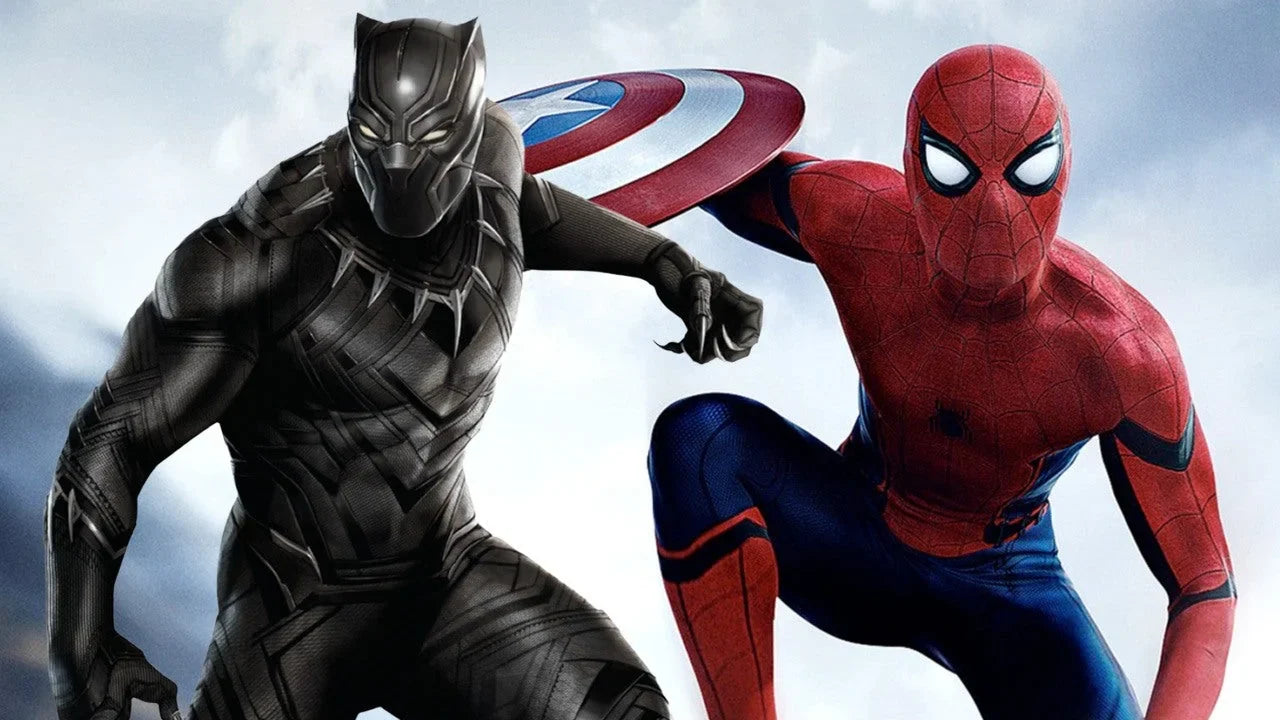
The Peter/T'Challa relationship reached the screen in two major MCU films: Captain America: Civil War (2016) first, where Berlin airport becomes the setting for the first meeting between Tom Holland and Chadwick Boseman, then Avengers: Infinity War (2018), where the final battle takes place at the very heart of Wakanda — a web-slinger in the Iron Spider armour fighting alongside Black Panther against Thanos's Outriders. To place those two blockbusters in the MCU timeline, the pillar the MCU films in chronological order remains the reference read.
The battle of Wakanda in Infinity War is probably the moment when the duo takes on its full visual scale. Spider-Man, in Stark's technological armour, fights on ground T'Challa has defended since childhood. The complete analysis of the Iron Spider armour explains how that suit bridges Stark Industries' high tech and Wakanda's ancestral craft — two schools of engineering meeting in a single costume. It is that aesthetic synthesis that makes the scene memorable.
The return in Avengers: Endgame (2019) confirms the duo's place in MCU iconography. During the great final battle, Peter and T'Challa share several shots side by side — a moment that closes, without ever underlining it, the circle opened in Berlin three films earlier. To understand the scale of that integration, the article how Spider-Man joined the Avengers looks back at the long editorial journey that made those scenes possible. And the article what role for Spider-Man in Avengers Doomsday anticipates the crossovers likely to come.
Wakanda versus New York: a symbolic geography
One fascinating way to read this duo is through geography. Wakanda is an isolated nation, closed around its vibranium secret, self-sufficient thanks to its technology. New York is an open metropolis, crossed by every flow in the world, vulnerable precisely because of that openness. Peter and T'Challa embody those two models: the vernacular hero and the dynastic heir. When they meet, the urban meets the institutional, the tinkerer talks with the state engineer. To explore the symbolic weight of New York geography in the arachnid myth, the pillar the complete universe of Spider-Man characters documents the hero's urban roots.
The article Spider-Man and the New York police digs into the relationship between Peter and local institutions — a relationship made of mistrust, occasional cooperation and structural misunderstanding. With T'Challa it is exactly the opposite: cooperation is immediate, the king's legitimacy recognised, the mistrust absent. That comparison shows how far the meeting with Black Panther works as a revealer of Spider-Man's political blind spots. The article Spider-Man and S.H.I.E.L.D. documents a similar dynamic with another institution.
This geopolitical dimension is one of the rare ones in the Marvel universe — most duos are strictly urban. For the spatial counterpoint, the article the Marvel teams Peter has belonged to lists the publisher's other attempts to get Spider-Man out of Queens.
COLLECTOR — Iron Spider in Resin

Iron Spider Bust Figure
229,90 €
The exact armour Peter wears in Wakanda during Infinity War — when Stark technology meets the thousand-year-old soil of T'Challa's kingdom. A sculptural piece, ideal for a demanding collector's display cabinet.
Discover →What T'Challa taught Peter (and the other way round)
Reducing the duo to a clash of styles would be missing the point. Black Panther and the wall-crawler have transformed each other over the long run, and each still carries traces of the other in the way he operates. From T'Challa, Peter learned strategic patience. The king of Wakanda never reacts on first instinct — he observes, measures, plans. That quiet teaching shows in later arcs, where Spider-Man finally accepts holding a position rather than rushing off at every alert. The article why Peter Parker finds it so hard to balance private life and hero life documents that constant tension — a tension T'Challa defuses, across a few occasional arcs, by bringing in the long-term perspective.
From Peter, T'Challa learned humour as a weapon. The king of Wakanda, in his earliest appearances, had no comic register at all. But from crossing paths with a web-slinger who defuses tension with a joke, Black Panther sometimes allows himself quiet ironies you would have thought impossible. That shift, found across many recent runs, is one of the least documented legacies of the duo — and one of the deepest. It is also worth noting that this pair reinvented, in its own way, the dynamic between an institutional hero and a vernacular one. Where the Peter/Tony Stark relationship swings between fatherhood and toxicity, the Peter/T'Challa relationship refuses both extremes: neither filiation nor manipulation. It is a dialogue between equals, despite the gap in status.
That horizontality echoes other strategic alliances in Spider-Man's gallery — the one with Daredevil, for instance, or with Silver Sable, who shares with T'Challa a near-diplomatic status. But none has the political density of the Black Panther duo.
The duo in the multiverse and beyond
With the rise of the Marvel multiverse, the Peter/T'Challa duo has multiplied endlessly. Spider-Verse variations open up countless possible crossovers — a Wakandan Peter, a New York T'Challa, multiversal fusions where the two characters blend together. The great pillar Spider-Verse: every version of Spider-Man lists several of those variants, which extend the canonical fascination by scattering it across dimensions.
These variations are not editorial gimmicks. They confirm something deeper: in Marvel's eyes, the Peter/T'Challa duo belongs to no particular timeline — it belongs to the very structure of the universe. As if, in every possible reality, a vernacular hero had to meet an institutional one for the balance to hold. To grasp how the multiverse works as a whole, the pillar the Marvel multiverse explained simply is a good way in. And for fans of radical variants, the article the wildest What If…? offers several scenarios where the duo takes unexpected forms.
For fans of the wildest multiversal crossovers, the article the wildest crossovers documents several arcs where T'Challa appears in unexpected configurations — including a brief encounter in Avengers Secret Wars.
COSPLAY — Complete Miles Morales Jacket Set

Complete Miles Morales Cosplay
189,90 €
The Miles Morales costume from the multiverse — the one who shares with T'Challa the status of African American hero and who extends, within the Spider-Verse, the diversity that Black Panther brought to the screen. For conventions and demanding themed nights.
Discover →Why this duo still fascinates in 2026
Fifty years after Marvel Team-Up #20, the Peter Parker / T'Challa duo remains one of the most politically interesting in the Marvel universe. Three reasons explain it. First, because the vernacular hero / institutional hero dynamic has become a universal narrative matrix, particularly useful since the expansion of the MCU. The duo set the canon in comics long before the studios, and keeps refining it. The analyses of Spider-Man's greatest enemies show how T'Challa has become, paradoxically, the only ally able to offer Peter political refuge when the American authorities turn their backs on him.
Next, because pop culture is hungry for duos that cannot be reduced to a binary moral opposition. Peter is not 'the good citizen' and T'Challa is not 'the exotic king' — they are two complete models, one urban, the other dynastic, talking as equals. That subtlety runs through the richness of the universe documented in the pillar the real face of Spider-Man — a character who has resisted simplification since 1962.
Finally, because the question of public versus secret identity remains central to the arachnid myth. T'Challa, who has never hidden his face from his people, works as the mirror image of the mask. One exposed, the other veiled. One protecting a throne, the other protecting those close to him. That polarity is inexhaustible, and Marvel knows it. Superior Spider-Man, for example, which questions Peter's very identity, speaks implicitly to the questions of legitimacy T'Challa faces in his own royal arcs.
For collectors and fans who would like to extend the experience off the page, the Spider-Man figures collection offers several iconic pieces from the Avengers period, while the soft toys collection remains a good entry point for younger readers. Those who prefer to step into the role will head instead for the cosplay section or the fancy dress page, which bring together the official outfits used at conventions.
When Wakanda and New York learn to talk
In the end, the Peter Parker / T'Challa duo is not an unlikely friendship in spite of their opposites — it is a friendship made possible by them. If Spider-Man spent his time with another New York urban hero, they would agree on everything and challenge each other on nothing. If T'Challa met another monarch, their dialogue would stay purely protocol. It is precisely the gap between the two worlds that creates the productive tension, and it is that gap Marvel has known how to use for fifty years.
Beyond the comics and the films, this duo has inspired a great many of the Marvel pairings we see today: Spidey with Daredevil, the arachnid with Doctor Strange, the wall-crawler with Silver Sable — all variations on the same principle of fertile opposition. But none has the geopolitical dimension of the Peter Parker / T'Challa duo. What remains, deep down, is a simple truth: the best heroes never reveal themselves alone. They need a contrast, a mirror image, a witness who does not think as they do. T'Challa was that witness for Peter, and Peter was that bright unpredictability for T'Challa. As long as Marvel publishes comics and Disney makes films, those two will keep crossing paths — because they simply cannot exist without each other.

