

14-Day Money-Back Guarantee
0
The short answer
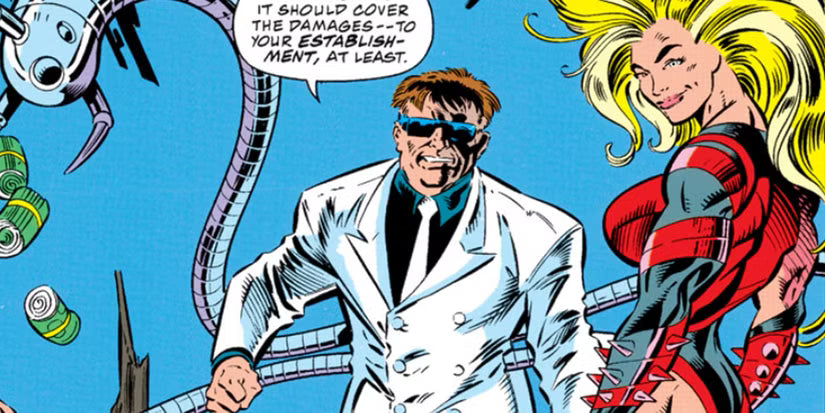
Stunner is a holographic avatar: Doctor Octopus wired Angelina Brancale into a virtual reality system that projects into the real world a fighter capable of lifting cars. Born in the mid-1990s, she handed the web-slinger a humiliating defeat. The full story below.
Across the whole rogues' gallery of the wall-crawler, few characters carry a sadness as pure as that of Angelina Brancale. She is not a mad scientist, not the heiress of a criminal dynasty, not a mutant hunted by her past. She is, to begin with, a woman so faded that nobody looked at her — until the day a man almost as lonely as she was laid eyes on her solitude. That man was Otto Octavius, alias Doctor Octopus. The woman he transformed in order to keep her close is called Stunner, and her story remains one of the most heartbreaking the Clone Saga has ever produced.
Stunner was born in the shadows. She appears briefly in the pages of Amazing Spider-Man in 1994, in the middle of a creative wave that would redefine the web-slinger's entire universe. At that time, the writers were looking to enrich Peter Parker's bestiary with figures more complex than the traditional villains. They wanted mirrors, reflections, psychic doubles. And in Angelina Brancale they found a woman whose tragedy was in no way superhuman: she hates herself, she erases herself, she waits to be rescued. When Otto Octavius offers her a way out, she walks through it without hesitating.
This article tells the story nobody has really wanted to tell in the UK: how a love story turned into a holographic weapon, how pseudo virtual reality allowed a woman to become a feared enemy of the web-slinger, and why Stunner, despite her relative anonymity, deserves a place in the memory of the great narrative arcs.
An ordinary woman nobody noticed
Angelina Brancale is a middle-aged woman, single, modestly employed, living a flat New York routine. The first pages she appears in show her sitting alone at home, in front of a mirror, turning over the compliments nobody pays her any more and the ones nobody ever paid her. She does not think herself beautiful, or interesting, or useful. She has given up on being liked and, by extension, on existing. That detail matters: the rest of her story would make no sense if you did not understand the depth of the emptiness she carries around.
That emptiness, in comics, is often the favourite hunting ground of the great manipulators. Mephisto exploited Peter Parker's emotional fragility in exactly the same way, during another sadly famous arc. Norman Osborn knew how to read the psychological flaws of those he wanted to break. And Otto Octavius, spotting Angelina, acts on the same logic: he offers her a second chance that looks like a gift, but is in reality a bespoke prison.
The Maggia, New York's great crime family, is going through a reshuffle at the time. Otto Octavius has briefly become one of its leaders. He needs a strong arm to terrorise his rivals. But he also needs something more intimate: an affectionate presence to reassure him about his own humanity. It is this double order, mob and romance, that will give birth to Stunner.
Meeting Otto Octavius: love, manipulation and illusion
The relationship between Angelina and Otto is one of the strangest Marvel's writers have ever imagined. Otto is ugly, ageing, paranoid, saddled with a destructive ego. Angelina is invisible. When they meet, they recognise each other as two complementary solitudes. He wants to be loved unconditionally, because no woman has ever accepted his real body. She wants to be loved at all, because no man has ever looked at her for more than three seconds. The pact they make is not a heroes' pact: it is a pact between the walking wounded.
But Otto is no ordinary man. He is one of the most brilliant scientific minds in the universe of New York's vigilante, capable of inventing devices that defy the known laws. And he decides, rather than loving Angelina for who she is, to offer her a gift he believes divine: a dream body. Not a real body — a virtual one. A holographic shell that Angelina can put on the way you slip into an outfit, and that will give her everything nature denied her: beauty, power, fear in other people's eyes.
That shell is Stunner. And what this arc is really telling, between the lines, is a question still burning decades later: is loving someone accepting them as they are, or is it wanting to turn them into a projection of your own fantasy? Otto, believing he is giving a gift of love, commits the worst kind of violence. He tells Angelina that what she is is not enough. And she, in her despair, agrees.
How Doctor Octopus turned his mistress into a holographic weapon
The science behind Stunner is ambitious, even by Marvel standards. Otto Octavius hooks Angelina up to an immersive system from her flat. While she sleeps, concentrates or thinks about her lover, the machine projects an avatar physically present in the real world: a tall, muscular, magnificent woman, with strength comparable to that of Peter Parker's most formidable enemies. This avatar can strike, take punishment, lift cars. She is the perfect embodiment of fantasy in a world where the body has become programmable.
This mechanism is not a trivial detail. It makes Stunner one of the first Marvel villains to exist through virtual reality, long before the theme became commonplace in pop culture. Where the Jackal manipulated living matter by creating biological clones, Otto takes the opposite road: living matter is only a shell, and true identity runs through the digital signal. This inversion foreshadows everything later arcs such as The Clone Conspiracy would do, where the question of true identity haunts every page.
Stunner quickly becomes an effective weapon in the Maggia's service, then a personal tool for Otto against his enemies. She faces Peter Parker and inflicts a humiliating defeat on him in one of their first fights. Her strength places her in the web-slinger's premium enemy category, alongside figures such as Kingpin on the strategic level, or the body-breakers of the extended universe. But what makes Stunner unique is not her power. It is that she strikes with a sad rage behind every blow: that of a woman who has finally been given a body but who knows, deep down, that she is asleep in another one.
COLLECTION — The Evil Genius

Doctor Octopus Figurine
119,90 €
The man who created Stunner out of love and out of calculation. Having Otto Octavius in your collection means keeping in mind the complexity of the web-slinger's great scientific villain.
Discover →Stunner in the Clone Saga: the virtual weapon against Ben Reilly
Stunner's arrival coincides with one of the most controversial arcs in Marvel's history. The Clone Saga of the 1990s upends the web-slinger's universe by introducing Ben Reilly as Peter Parker's legitimate clone, then multiplying the variants: Kaine, the tragic clone, Spidercide, the unstable clone, and later Carrion, the macabre clone. In this maelstrom of fragmented identities, where every page questions the authenticity of a body, Stunner naturally finds her place.
When Ben Reilly puts on the scarlet costume of the Scarlet Spider and takes up the arachnid vigilante's mantle while Peter Parker steps back, it is he who faces part of the rogues' gallery. Stunner crosses his path several times. For Ben, who doubts his own humanity — being technically a clone of flesh created by the Jackal — facing a woman who exists only through digital projection is vertiginous. The two characters are strangely alike: neither Ben nor Angelina is really what they appear to be. One is a biological copy, the other a virtual copy. Both live on borrowed terms.
This thematic resonance is not accidental. It lights up what Marvel was trying to say through the Clone Saga: the question of identity is not settled in the body. It is settled in commitment, in choices, in bonds. Ben Reilly would eventually fall into darkness under the name Chasm, broken by the cruelty with which his existence had been treated. Stunner follows a parallel path: her borrowed body makes her both invincible and invisible, and the stronger she grows, the more she disappears.
Stunner's power: physical strength, psychological fragility
On paper, Stunner is a bombshell. She can lift several tonnes, absorb blows that would break an ordinary man, and her speed outstrips that of most of the vigilante's enemies. In combat, she makes fools of heroes who are used to winning. Her reputation, quickly established, makes her one of the most feared figures in New York's underworld in the mid-nineties. Otto Octavius, who loves to show off his inventions, uses her as a trophy and as a bodyguard.
But that power has a major flaw, and it is that flaw that makes the character so deeply human. When the virtual body takes too much damage, the return to Angelina's real body is brutal. She feels the blows in her own flesh, sometimes with a delay. And when the avatar is destroyed, her biological body can sink into a coma. Stunner is therefore no heroine of denial: with every blow absorbed, with every victory dearly bought, she pays a price written into her real body, the one she hates, the one she would like to forget.
It is in this gap between the woman who acts and the woman who sleeps that the whole drama of the character sits. Stunner is dissociation made flesh. And when she appears in the comics, she opens a question fans have not finished debating: can you be happy living entirely inside a body that is not your own? The answer, in her case, is no. And it is precisely that no which makes her arc so moving.
Why her story still unsettles (and fascinates) fans
Stunner never had her own title. She does not have the fame of a Black Cat or a major romantic figure. She is a supporting character in the strongest sense of the term: a presence off to the side, summoned by the writers when they need a certain kind of tension. And yet the fans who know her always speak of her with a particular emotion, almost protective.
The reason is simple. Stunner puts her finger on a truth few comic characters dare to tackle head-on: self-hatred is as powerful a narrative force as ambition. Where Norman Osborn is devoured by ego, where Otto Octavius is devoured by an inferiority complex, Angelina is devoured by the simple feeling that she does not deserve to exist. That nuance makes her an almost contemporary figure, closer to the heroines of adult series of the 2020s than to the standards of mainstream nineties comics.
That modernity explains why British readers discovering Stunner today are so struck by her emotional power. Reading her arc means taking a detour through the web-slinger's great saga by a back door, the door of repressed female psychology. And it also means running into themes Marvel would later pick up with other figures, such as the complexity of romantic relationships in the Spider-Man universe, which runs through so many stories since.
COLLECTION — The Scarlet Heir

Spider-Man Ben Reilly Soft Toy
29,90 €
The man who faced Stunner while Peter Parker stepped back. Keeping Ben Reilly close means honouring the forgotten hero who wore the scarlet costume when nobody believed in a clone's redemption any more.
Discover →Stunner's place in the gallery of female villains
The universe of New York's vigilante is largely male across the first half of its editorial life. The emblematic enemies — Norman Osborn in his Green Goblin persona, the Lizard, the Vulture, the Chameleon — are almost all men. Female villains do exist, but they are marginalised for a long time, either treated as romantic rivals or as anecdotal silhouettes. Stunner belongs to a wave that changes this from the mid-nineties onwards, alongside other female avatars quietly present in the gallery.
This female wave is not just a matter of numbers. It introduces into the web-slinger's universe a kind of antagonism nobody had seen before: an antagonism that does not run through direct rivalry with Peter Parker, but through a psychological detour. Stunner does not attack the hero because she wants him dead. She attacks him because she crossed his path on the wrong road, at the wrong hour, while she was simply trying to exist. That nuance, once again, places the character in a deep narrative zone, almost Russian at moments.
You can trace a thread between Stunner and several other female figures who haunt the web-slinger's great character gallery. Black Cat shares her moral ambiguity, without the tragic dimension. Madame Web shares her relationship with a body that does not work like other people's. And even Mary Jane, who has carried so much of the weight of Peter Parker's double identity, shares with Angelina that idea of a woman who bears the consequences of a man's choice without ever having been consulted.
When Doctor Octopus dies: Stunner's collapse
The arc that seals Stunner's fate is also one of the most moving in the Clone Saga. Otto Octavius is killed by Kaine, the tragic clone, in a brutal scene that shocks the criminal community. For Angelina, who loved Otto with all the clumsiness of a woman never loved, this death is a catastrophe. She loses the man who gave her a body. She also loses, by ricochet, the only link tying her to her own existence as Angelina. Without Otto, what is the point of being Stunner? And if she is no longer Stunner, who is she?
Her reaction is, in its way, heroic. She uses all her power to try to avenge Otto, hunts down those she holds responsible, and ends up sinking into a coma after a devastating fight. Angelina's body, in her flat, stays wired to the machine, motionless, while the avatar vanishes from the world. That image — a woman lying in an armchair, her face peaceful, while her powerful version has gone dark elsewhere — is one of the most beautiful metaphors for grieving love Marvel has ever produced.
Later, Otto Octavius comes back to life. He even ends up becoming a version of the vigilante in the Superior Spider-Man arc, where he literally takes Peter Parker's place. But Angelina, in this new era, does not reappear straight away. It takes years for the writers to bring the character back and give her a second chance. When she does return, the couple can finally be reunited — but the damage is done. The woman who lost her body to win a man's love has lost that love too, and everything left to rebuild now runs through her own self-acceptance.
What Stunner reveals about the Clone Saga
When you reread the Clone Saga with Stunner in mind, a lot of things fall back into place. The arc, often criticised for its excesses and its twists, gains a reading it is not credited with enough: that of a long meditation on the ownership of the self. The Clone Conspiracy, years later, would extend that questioning by putting resurrection squarely on the table as an ethical problem. But Stunner was already posing, in silence, the intimate version of the same dilemma.
Stunner's digital avatar anticipates, by almost thirty years, today's debates on virtual identity, filters and the algorithmic aesthetics of the face. When Angelina plugs in her machine and becomes another woman, she performs the operation that millions of image-editing app users carry out today without realising it. With this difference: Angelina, unlike them, pays the neurological price of a total dissociation between the body that acts and the body that sleeps. The metaphor is powerful and has not aged a day.
In the same way, her relationship with Otto Octavius is one of the rare examples, in the vigilante's rogues' gallery, of a genuinely constructed romance. Most of Marvel's villain couples rest on rather crude elective affinities: they are wicked, so they get together. Stunner and Otto tell a different story. They tell of two wounds that recognise each other and that choose, failing any chance of healing, to keep each other company. Like Eddie Brock and Peter Parker in another register, they are bound by a shared pain rather than by a common ideology.
Stunner today: why she deserves a comeback
In recent years, Marvel has multiplied the returns of forgotten nineties characters. The Brand New Day era reopened narrative building sites long since closed, and many fans hope to see Stunner return under the pen of a writer alive to psychological complexity. The character has everything needed to work today: she speaks of emotional dependency, virtual reality, romantic manipulation, self-reinvention. These are burning themes for the current generation of readers, who consume adult stories and who ask comics to go further than black-and-white morality.
A Stunner comeback could also rebalance the vigilante's female gallery. Alongside Black Cat, who traditionally occupies the place of the ambiguous antagonist, Stunner would offer a different voice: that of a woman who does not play on her beauty, who does not seduce in order to win, but who suffers from having believed that a different body would solve her problem with love. That voice is missing, and it would usefully complete the panorama you discover in the great guide to the emblematic villains of the web-slinger.
There is finally a more pragmatic argument. Technology has caught up with the science fiction of the nineties on the subject of the digital avatar. Virtual reality headsets exist. Personalised avatars have become the norm in certain digital spaces. And the notion of an identity distributed between a real body and a virtual body is now discussed as far up as the universities. Stunner, who seemed a little far-fetched in 1994, has become prophetic. Marvel would have a great deal to gain by bringing her back to handle, through mainstream comics, questions fans are already asking themselves in their daily lives.
A figure who keeps the memory of the Clone Saga alive
Filing Stunner away in the living memory of the Clone Saga means admitting something many fans in the UK take time to accept: this arc, unloved, overloaded, sometimes confusing, produced characters of rare depth. Ben Reilly, of course, is the figurehead. But Kaine, Spidercide, Carrion, and even Doppelgänger in a neighbouring register, each contributed to enriching one central question: what makes a person authentic?
Stunner answers, in her own way, that no copy can fill the emptiness inside. That programmed beauty does not bring real love. That virtual strength does not heal the old wound. And that the only way out, for a character like Angelina Brancale, runs through a return to herself that takes time, falls and rebirths. What is beautiful is that this return to the self is precisely what the best contemporary writers know how to handle today. The window is open.
For British readers, there is a fine opportunity to rediscover Stunner through recent reprints and collected editions. The volumes devoted to the full set of the web-slinger's great narrative arcs give more and more visible space to the Clone Saga. And online communities, long wary of this arc, are rediscovering its qualities as contemporary fiction picks up its themes. Stunner deserves that rediscovery, and deserves it ahead of many others.
COLLECTION — 90s Comics Memory

Spider-Man Retro Comics Poster
22,90 €
Honour the era that gave birth to Stunner, Ben Reilly, Kaine and the whole Clone Saga gallery. A retro visual to remind you that the real gut punches are often the ones from nineties comics.
Discover →What Stunner leaves to every forgotten heroine
Stunner's legacy goes beyond comics. When you close her arc, you feel she opened a path. She showed that a female villain could be something other than a sexy silhouette, a psychopath, a jealous rival. She could be a damaged woman who reaches for the wrong cure, and whose fall stays more moving than the triumph of many a hero. That path has since been taken by other characters, in other narrative universes, to the point of becoming a standard of contemporary writing.
For the reader diving into the Clone Saga for the first time, running into Stunner is a particular experience. You leave the classic fights behind and enter a rawer, more intimate zone. You understand why Gwen Stacy's death marked the history of comics, but you also discover that Marvel knew how, as early as the nineties, to write female arcs far more complex than collective memory remembers. The Dying Wish arc, years later, would pay tribute to that tradition by placing Otto Octavius at the centre of an existential drama of similar intensity.
Stunner remains, in the end, a gift for those who love the characters nobody celebrates on covers. She will not appear in the films, perhaps ever. She has no massive action figure, no iconic t-shirt. But once you have read her arc, you keep a trace of it, and that trace does not fade. That is what we ultimately want from great supporting characters: not that they dominate the stage, but that they stay with us long after the last page.
Going further into the clone cluster
If Stunner's trajectory moved you, several follow-ups are worth the detour. The portrait of the Jackal, the web-slinger's most tragic scientific enemy, opens up the perspective on the creator of all the clones. The one on Kingpin and his criminal rise helps you understand the mob environment Otto Octavius was operating in when he met Angelina. And the treatment of the Back in Black arc, where Peter Parker lets morality go, shows that serious emotional wounds sit at the heart of the vigilante's universe, touching his enemies as much as his loved ones.
For collectors and enthusiasts, the curiosity can carry on into objects. The figurines from the web-slinger's universe let you make the figures you loved on the page physical. The fancy dress and costumes open the door to cosplay, where inventive fans are starting to recreate Stunner and other secondary female villains at conventions. And the general accessories offer a thousand more discreet ways of keeping the universe close, right into daily life.
Finally, to place Stunner in her wider context, several internal resources map out the ground. The great portrait of Peter Parker gives the human framework of the hero Stunner faced. The character panorama places Angelina among her peers. The exploration of the Spider-Verse reminds us that in an infinite multiverse, every secondary character is a universe in embryo. And the ultimate guide to merchandise offers a map for those who want to extend the experience into the real world. Stunner is not the best known. She is, nonetheless, one of the deepest. And now you know why.

