
14-Day Money-Back Guarantee
0
The short answer
Behind the creature hides Vincent Stegron, a jealous biochemist who trained in Curt Connors' laboratory and injected himself with DNA taken from a stegosaurus fossil. His first appearance dates back to Marvel Team-Up #19, in 1974. Origins, powers and a possible return: the full file follows below.
Every Spider-Man fan knows by heart the twisted face of the Green Goblin, the mechanical arms of Doctor Octopus or the black symbiote of Venom. But there exists, in the most obscure pages of Marvel comics, a villain that even devoted readers regularly forget: a human scientist turned into a giant dinosaur-man, a former colleague of the Lizard, dreaming of dragging the Earth back to the Jurassic era. His name is Stegron — and in 2026, as Marvel resurrects second-tier villains for its upcoming events, it is time to rediscover this utterly unhinged character that the Spider-Man rogues' gallery has long kept locked away in its monster cupboard. Further reading: Will-o-the-Wisp (Jackson Arvad): the tragic spectre turned into pure energy that Spider-Man never really saved.
Stegron has never had a film, never had a series, almost never an official figurine. Yet his story condenses everything that makes the Spider-Man character gallery so singular: mad science running out of control, a horrific mutation, boundless ambition and a perfectly absurd visual design — that of a two-and-a-half-metre humanoid stegosaurus, standing on its hind legs in the heart of Manhattan. This article invites you to dive deep into the Stegron file, from his comics origins to his most striking appearances, by way of the reasons that make him one of the most underrated villains of the Spider-Man multiverse.
Stegron in 2026: why this dino-mutant villain is suddenly interesting again
Since Norman Osborn's return to editorial prominence at Marvel and the resurgence of arcs centred on secondary antagonists — we saw it recently with Norman Osborn's return in recent comics or the resurrection of Green Goblin Reborn — the comic-book market is massively reinjecting forgotten villains into the main runs. Stegron has everything it takes to be part of this comeback wave: he offers a visual you could never mistake for anything else, he is rooted in a rich scientific mythology (that of the Curt and Martha Connors circle) and he provides an inexhaustible playground for oversized action arcs.
2026 is also the year in which directors are eyeing the most eccentric corners of the gallery of enemies who deserve a solo film. If Marvel Studios has already dared Morbius, Madame Web and Kraven, a dinosaur-man is hardly any more far-fetched — especially now that Brand New Day is introducing Savage Hulk on screen. The Stegron moment may well be coming, and this article is a way of getting a head start on understanding why this character, in his total improbability, says something profound about the Spider-Man universe.
Vincent Stegron, an ambitious assistant in Curt Connors' shadow
Before becoming a prehistoric beast with green scales, Stegron was called Vincent Stegron — a doctor of biochemistry, brilliant but deeply frustrated, who worked as an assistant in the laboratories of the famous Curt Connors. The trajectory is familiar: a gifted scientist, condemned to second-rank work, watches his mentor land the glory and the funding, and starts dreaming of imposing his own revolutionary vision. You will find that same ego dynamic in several scientist enemies of Spider-Man, starting with the Jackal or Doc Ock himself.

Where the Lizard is the story of a man — Connors — who wants to rebuild an arm and accidentally tips over into monstrosity, Stegron embodies the exact opposite: a man who deliberately chooses metamorphosis, who decides in full awareness to become something other than human. That nuance is essential to understanding the character's psychology. Stegron is not a cursed scientist, he is a willing one. He does not flee his condition, he knowingly trades it for another, in a logic that sometimes recalls the excess of Norman Osborn in his quest for absolute power.
For months, Vincent Stegron studies Connors' research notes on reptilian cell regeneration. He realises the work can be diverted. Where Connors is trying to regenerate a human limb from lizard DNA, Stegron dreams of far more: he wants to recreate the prehistoric kingdom and place himself at its head. That trigger — the silent betrayal, the scientific jealousy — puts him in the direct lineage of Peter Parker's great antagonists, those ordinary men who eat themselves alive with ambition before exploding into monsters.
Marvel Team-Up #19 (1974): the birth of a prehistoric nightmare
Stegron first appears in Marvel Team-Up #19, published in March 1974. Writer Len Wein and artist Gil Kane deliver a story unlike anything else in the great narrative saga of Spider-Man: Spider-Man crosses paths with a character who is neither a superhero nor a classic supervillain, but an evolving creature in mid-mutation. The issue introduces a half-transformed man, still able to speak but already deformed, demanding scientific artefacts to complete his becoming-dinosaur.
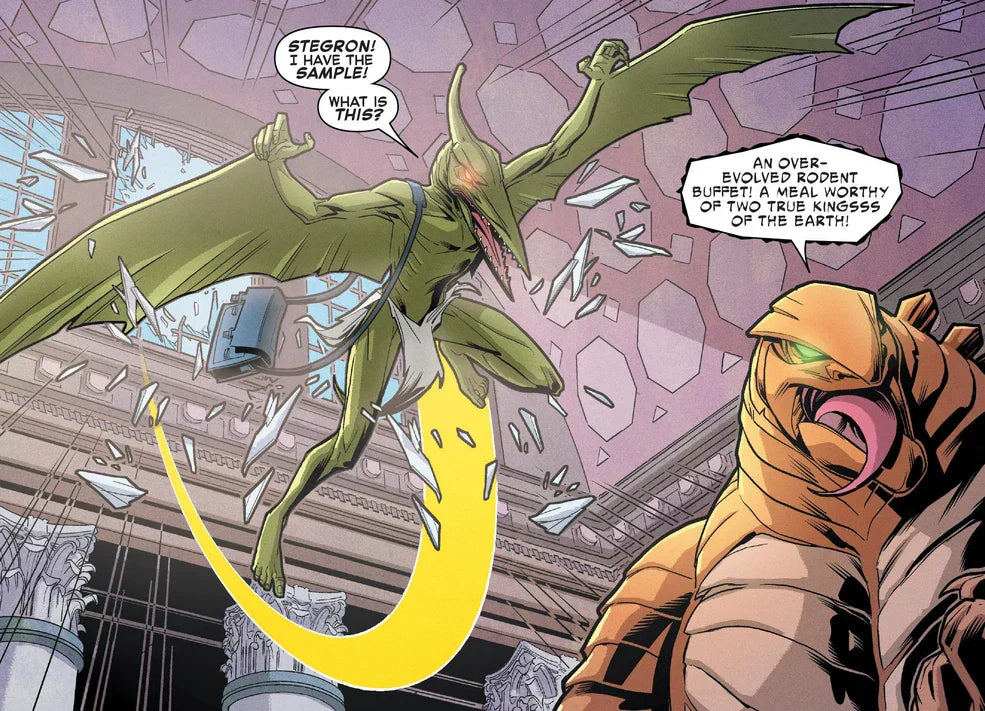
The pitch fully owns its madness. Vincent Stegron manages to steal samples of DNA preserved on a stegosaurus fossil, held in an exhibition at the American Museum of Natural History in New York. He injects them into himself. The transformation is gradual but irreversible. Little by little his bones thicken, his skin turns scaly, his spine bristles with the bony plates characteristic of stegosaurs, his tail lengthens into a deadly bone whip. By the end of the process the scientist is gone — all that remains is a saurian humanoid creature some two and a half metres tall, endowed with colossal strength, startling resilience and an intelligence that is intact but perverted.
The issue also introduces what will become the character's trademark: Stegron dreams of bringing dinosaurs back to Earth on a massive scale. He does not merely want to be a solitary monster, he wants to be the first of a new worldwide prehistoric era. That apocalyptic ambition places him a long way from the petty schemes of a Shocker or the decorative burglaries of a Hydro-Man. Stegron plays in the league of eschatological schemes, alongside the great end-of-the-world dreamers of the Marvel universe.
ROGUES' GALLERY — BESTIAL VILLAIN

Spider-Man Toy Figurine — Rhino
€29.90
If the idea of a dinosaur-man appeals to you, Rhino is his perfect cousin in the rogues' gallery: massive, brutal, bestial. Stand him on your shelf next to your villain figurines for the full rogues' gallery effect.
Discover →The mad science behind the metamorphosis: stegosaurus serum and reptilian DNA
To understand Stegron, you have to understand Marvel's scientific mythology of mutation serums. Curt Connors lost his arm in Vietnam and is trying to regenerate it from lizard DNA, hence his accidental transformation into the Lizard. Stegron pushes the same logic one notch further: if modern reptilian DNA can produce cell regeneration, then prehistoric reptilian DNA — theoretically more powerful because it comes from far more massive creatures — should allow a complete metamorphosis, and not just a local repair.
The scientific idea is of course fanciful, but it fits the internal consistency of the Marvel Universe. Symbiotes obey a similar logic: an outside agent capable of transforming its host. Stegron's serum is that symbiote, but in injectable, permanent form, with no emotional dependency between the creature and its original human. Vincent Stegron literally vanishes into the Stegron creature — his consciousness remains, but his human body no longer exists.
This irreversible-serum mechanic also lets Marvel avoid the usual narrative get-out. Where Eddie Brock can separate from the symbiote, where Curt Connors can turn human again between two mutations, Vincent Stegron is permanently transformed. That permanence makes him a tragic character who is paradoxically harder to handle in a script, because he rules out easy redemption. It is also why he is less used — a villain whose humanity cannot really be saved offers fewer dramatic handles than a fallen hero.
Why Stegron is more dangerous than he looks: a breakdown of his powers
Beyond the look, Stegron is a genuine heavyweight in a fight. His superhuman strength sits somewhere between that of Rhino and that of a Juggernaut on a light day — enough to lift roughly twenty tonnes, depending on the source. His scaly hide offers notable ballistic resistance, and the bony plates running along his spine work as natural armour. His articulated tail serves both as an attacking whip and as a third load-bearing limb, giving him surprising balance in urban fights.
More worrying still: Stegron has partial mental power over primitive reptiles. This limited telepathy lets him summon dinosaurs in certain circumstances, particularly when he operates from the Savage Land, that lost Antarctic territory where, in Marvel continuity, prehistoric fauna has survived to the present day. Combined with his intact scientific intelligence, this ability makes him a formidable strategist: he can plan attacks, manufacture extra serums, infiltrate laboratories, and also raise a bestial army when he needs one.
This dual nature — a scientist's brain, a monster's body, animal allies — explains why Spider-Man has such trouble neutralising him. Where villains such as the Chameleon play on illusion alone and where the Vulture relies on aerial speed, Stegron poses an equation with several unknowns: you have to beat him physically, stop him making serum, and neutralise his beasts. Three fights in one, which makes him a tactical nightmare.
ROGUES' GALLERY — MUTATED SCIENTIST

Spider-Man Figurine — Doctor Octopus
€119.90
Stegron, Doc Ock, the Jackal, the Lizard: Spider-Man's rogues' gallery is full of scientists broken by their own ambition. This Doctor Octopus collector's figurine captures that aura of scientific arrogance exactly. Place it between your comics and your deluxe editions.
Discover →The Savage Land, the Lizard and Sauron: the prehistoric trio of the rogues' gallery
Stegron does not operate alone in Marvel's prehistoric ecosystem. He belongs to a small brotherhood of characters whose fate is tied to the Savage Land and to dinosaurs. Stegron's first natural companion is obviously the Lizard — Curt Connors, his former mentor, who has also become a humanoid reptile. The two characters have regularly been set against each other or allied depending on the arc, in a constant mirror game: Connors is a man who dreams of becoming human again, Stegron a man who dreams of never being human again.
The other major figure of the trio is Sauron — Karl Lykos — a mutant scientist able to drain life energy and turn into a giant pteranodon. Sauron rules over the Savage Land and Stegron has set up several bases there. The two characters share a taste for deviant science and a prehistoric superiority complex. Their occasional alliance in the comics produces some of Marvel's wildest visual sequences: a pteranodon-man and a stegosaurus-man doing battle with Spider-Man and Wolverine in a lost Antarctic jungle.
This shared mythology gives Stegron a narrative footing that not every second-tier villain has. Where a Scorpion or a Vermin operates alone and on the periphery, Stegron belongs to a Marvel geography — the Savage Land — and to a family of scientific antagonists. That membership gives him a reuse potential few background villains have. It is probably why, despite his long absences, he always ends up coming back in one arc or another.
Stegron through the decades: his most memorable clashes with Spider-Man
After his first appearance in 1974, Stegron has come back intermittently but regularly in Marvel continuity. Marvel Team-Up #20, coming immediately after his introduction, sees him pursue his dinosaur quest across Manhattan, in a memorable finale where Spider-Man has to improvise a cold-based strategy to slow him down — dinosaurs, and therefore Stegron, remaining sensitive to low temperatures as their ectothermic reputation would have it. That defeat by cold becomes a recurring weakness, sometimes exploited by the heroes who fight him.
In the 1980s and 1990s, Stegron reappears sporadically in The Spectacular Spider-Man, in Web of Spider-Man and in several Iron Man runs. The character is often used as a second-half-of-the-arc threat, when a writer wants to introduce an element of prehistoric chaos without disturbing the gallery's major figures. That is one of the traditional narrative functions of villains like Stegron: they vary the menu without anyone having to bring back the weight of a Kraven the Hunter or a Doctor Octopus.
In the 2000s and 2010s, Stegron comes back through the Savage Land several times, crossing paths with Ka-Zar, Shanna or X-Men on a prehistoric detour. His most striking appearance of that era is probably in Spider-Man: Web of Doom, where he teams up with another minor villain to try to spread his reptilian serum across New York on a large scale. The operation is doomed to fail, but it confirms the character's tendency to aim systematically very, very high. More recently still, in certain mini-series of the wider Sinister Six, his name has come up as an occasional candidate for coalitions of second-tier villains looking to pull off something big.
Why Stegron has never appeared on screen — and what that could change
To date, Stegron has never been adapted into a film or a live-action series. He has appeared in a few animated series from the 1990s and 2000s — notably The Spectacular Spider-Man in 2008 — but never in the big Hollywood circuit. The reason is mainly budgetary and cultural: for a long time, a photorealistic dinosaur-man required a massive CGI investment for a character whose profile did not justify the effort. Where a Green Goblin can be done with a costume and a mask, Stegron demands a design built entirely from visual effects.
That equation has changed. Visual-effects costs have fallen, hybrid motion-capture pipelines make creatures believable, and the success of productions built around improbable monsters — Godzilla, Pacific Rim, Jurassic World — has got audiences used to the idea that anything can be convincing on screen if the writing keeps up. Above all, the Marvel Cinematic Universe has shown with Werewolf by Night or Moon Knight that it is ready to explore its most monstrous corners. In that context, Stegron becomes conceivable again.
More interesting still: Stegron offers a perfect entry point for introducing the Savage Land to the MCU. And the Savage Land is a door to Ka-Zar, to the reptilian versions of the X-Men, to Sauron, and therefore to a Marvel sub-universe still largely untapped on screen. A Spider-Man film or a Disney+ mini-series centred on Stegron could, almost casually, unlock a whole narrative geography the MCU has yet to make the most of. That is exactly the kind of calculation studios are making right now, and it is why second-tier villains are back in force in development discussions.
The archetypal mad scientist: Stegron in the Marvel lineage
To put Stegron back in his typological context, you have to compare him with his cousins in Marvel's scientific gallery. Within the gallery of Spider-Man's iconic enemies there is a specific category of villain: scientists broken by their own ambition. It obviously includes Doctor Octopus and his scientific pride turning to megalomania, the Jackal and his cloning obsessions, Electro in his more recent versions where he is portrayed as a frustrated engineer, and of course the Lizard.
In that typology, Stegron occupies a unique niche: he is the scientist who does not merely build a weapon or a serum, he becomes his own weapon. Where Doc Ock keeps his human body and only adds a prosthesis, where the Jackal preserves his appearance the better to hide his dealings, Stegron sacrifices the whole of his human condition to inhabit another form. That act — literally becoming what he studies — brings him closer to the Lizard than to the others, but with one crucial difference: will.
That intentionality makes Stegron an almost philosophical figure. He is not an industrial accident like the bat-related accident that creates Morbius, he is not a stroke of bad luck like the electric harness of Electro. He is the result of a decision, almost of a human suicide carried out for the sake of prehistoric rebirth. That existential dimension places him in a zone of the rogues' gallery that deserves to be re-explored by contemporary writers, who have understood since Garth Ennis and Tom King just how much the most interesting villain is the one who lucidly chooses his fate.
ROGUES' GALLERY — BEAST HUNTER

Spider-Man Costume — Kraven the Hunter
€299.90
If you find Stegron fascinating as a prehistoric creature, Kraven embodies the other side of the coin: the hunter who dreamed of bringing down the ultimate beast. This complete big-game hunter costume is the perfect piece for playing that archetype at your next Marvel convention.
Discover →What Stegron reveals about the deep DNA of the Spider-Man universe
Beyond his individual case, Stegron says something important about how enemies are written in Peter Parker's universe. Stan Lee, Steve Ditko and then John Romita built a gallery of antagonists whose common trait is neither power nor pure wickedness, but deformation through excess. They are nearly all ordinary men and women who pushed a human obsession to a biological or mental breaking point. On that logic, Vincent Stegron is a textbook case: a scientist who turned his curiosity into a chosen curse.
This moral grammar links Stegron to most of the major figures in the character gallery. Norman Osborn is entrepreneurial ambition pushed to madness. Otto Octavius is intellectual pride pushed to man-machine fusion. Curt Connors is the scientific dream pushed to reptilian nightmare. Stegron is the urge to rewrite the world's biological order pushed to prehistoric self-mutation. All share the same pattern: a human excess degenerating into monstrosity.
It is precisely that pattern which makes these characters more interesting than most villains in other franchises. Where a DC villain is often defined by an originating trauma — Bane by his prison, the Joker by his vat of acid — the Spider-Man villain is defined by a choice. He tipped over willingly, not by accident. It is that moral responsibility which makes the web-slinger's rogues' gallery so dense, and it explains why a character like Stegron, secondary though he is, never becomes entirely obsolete. As long as there are ambitious scientists in Marvel comics, there will be someone who decides, one morning, to inject himself with a forbidden serum to prove he was right.
Stegron and you: how to bring this villain into your Spider-Man culture
If this article has made you want to explore Stegron beyond these few pages, here are some concrete leads. On the reading side, the bare minimum is Marvel Team-Up #19-20 from 1974, which is his canonical introduction and remains more accessible than you might think through Marvel's digital archives. His appearances in The Spectacular Spider-Man in the 1980s are also worth a look, particularly those written by Bill Mantlo, who grasped the character's tragic dimension especially well. More recently, certain mini-series involving the Savage Land or the return of a coalition of second-tier villains have put him back in the spotlight.
On the visual side, Stegron is almost absent from official Marvel merchandising, but he holds a prime place in the imagination of hardcore collectors. A custom Stegron figurine is a fan-show grail. Failing that, bringing Stegron into your Spider-Man world starts with figurines of his rogues' gallery cousins: Rhino, Doc Ock, Kraven, the Lizard. A shelf that gathers those four tells, by its composition alone, the story of mad science in comics — and Stegron is the great absentee whose missing silhouette you can sense in the gap.
Finally, if you are building a cosplay around this universe, be aware that Stegron himself is extremely hard to play without a special-effects budget, but that his themes (hunter, monster, mad scientist) are perfectly served by the Kraven, Doc Ock or Lizard costumes. Think of Stegron as a ghost presence in your Spider-Man culture: invisible most of the time, but structural as soon as you dig a little beneath the surface of the rogues' gallery. And who knows — in two or three years, when Marvel finally decides to bring him to the screen, you will be able to say you were following him before it was trendy.
To carry on exploring, take a look at the complete guide to Spider-Man's iconic villains, at our complete character universe, and dive into our Spider-Man figurines, our Spider-Man cosplays or our Spider-Man fancy dress and costumes to give shape to your passion for the web-slinger's rogues' gallery.

