
14-Day Money-Back Guarantee
0
The short answer
Jonathan Ohnn is a scientist working for Kingpin who, in 1985, became a villain covered in living portals — and the laughing stock of the Marvel catalogue for almost forty years. The 2023 film turns all of that on its head: he becomes the man responsible for Miles Morales existing at all, and therefore the only truly personal enemy the character has. Here is his full trajectory, from start to finish.
There are few examples in the whole of Marvel history as clear-cut as this one: a supporting character promoted to the rank of major threat without a single line of his concept being changed. The Spot was not rewritten, not beefed up, not handed new powers: he was simply taken seriously. And that shift in perspective was enough to turn an opponent people laughed at in 1985 into the most unsettling antagonist of the animated multiverse. Here is a look back at a trajectory quite unlike any other.
Jonathan Ohnn: a scientist working for Kingpin
The character was born in the pages of Peter Parker, The Spectacular Spider-Man, with a cameo in issue 97 in late 1984 and then a full appearance in issue 98 in January 1985. He is the work of Al Milgrom and Herb Trimpe. Jonathan Ohnn is not a career criminal but a brilliant researcher, hired by Wilson Fisk for one precise job: to reproduce Cloak's dimensional powers in the laboratory, since Kingpin covets the ability to make whatever he touches disappear.
The experiment worked far too well. Ohnn really did open a passage to another dimension, but he made the classic comic-book scientist's mistake: he stepped through it. He came back out with his body covered in black spots, each one working as an independent portal. Kingpin, who wanted a weapon, ended up with an employee turned into a walking wormhole. This pattern of the scientist crushed by his own discovery runs right through Spider-Man's world, as shown by the complete guide to the villains.
How his spots actually work
The principle is devastatingly simple. Each spot is an opening onto an in-between dimension, and those openings are all connected to one another. The Spot can peel one off his body, throw it at a wall, a floor, the air itself, then step through another spot and come out wherever he chooses. He can also place an opening in front of a fist thrown at him and make that fist come out again in the back of the attacker's neck.
This mechanic produces an opponent against whom Spider-Man's usual reflexes count for nothing. Strength does not reach him, speed does not catch him, and his spider-sense, designed to anticipate a trajectory, becomes useless against an enemy who simply abolishes the very notion of a trajectory. It is one of the hero's rare structural weaknesses, examined in detail in our feature on the spider-sense.
Why the comics treated him as a joke for forty years
With a power like that, the Spot should have become a front-rank opponent. Instead he became a punchline. The reason lies entirely in his appearance: a man in a white bodysuit dotted with black circles suggests pyjamas rather than terror, and Spider-Man never once passed up the chance to tell him so mid-fight.
There is a writing problem on top of that. For a long time Ohnn had no clear ambition, no personal tragedy and no particular relationship with the hero. He robbed banks because villains rob banks. Writers therefore used him as comic relief between two serious arcs, whenever a visually inventive opponent was enough to fill a few pages. He ended up joining the recurring second-stringers, alongside figures such as Shocker or Rhino, never seriously threatening anyone.
2023: the film that takes the joke seriously
The 2023 animated feature pulls off a remarkable piece of writing: instead of correcting the character's absurdity, it makes that absurdity the subject. The Spot begins the story as a laughable opponent, unable to control his own openings, humiliated in a corner shop, treated with condescension by a Miles Morales who does not even remember his name. The film lets the audience laugh along with the hero. Then it turns that scene against them.
Because every humiliation feeds the character's determination. Ohnn learns to master his portals, then works out that he can travel between universes and absorb the energy of other realities' colliders to make himself stronger. His progression is no plot device: it is motivated, methodical, and caused directly by the contempt he was shown. The film as a whole is analysed in our feature devoted to Across the Spider-Verse.

Become the anomaly
Spider-Man Costume — Spot Spiderverse
The most recognisable pattern in the animated multiverse, and the costume that turns heads at a convention because nobody else has picked it.
View the product — 119,90 €The revelation that changes everything: he created Miles Morales
The film pushes the logic one notch further by establishing a causal link between the villain and the hero. Ohnn was working on the collider, and it was that machine which brought into Miles's universe the spider from another reality — the very one that bit him. It was then Miles's destruction of the collider that turned Ohnn into the Spot.
Each is therefore literally the cause of the other. That symmetry makes the Spot the first genuinely personal antagonist Miles has faced, where Kingpin or the Prowler belonged to other characters' stories. It also extends the saga's central theme, that of imposed destiny, which we explore in our explanation of canon events. To place the hero himself, his full profile and the Prowler's complete the family picture.

The other half of the equation
Hoodie — Miles Morales Spiderverse
The red and black silhouette of the one the Spot holds responsible for everything. A piece you can wear every day, a long way from a full costume.
View the product — 54,90 €A power more dangerous than brute force
Most of Spider-Man's opponents threaten his body. The Spot threatens the coherence of the world. An enemy who hits hard can be dodged, tied up, worn down; an enemy who decides where space begins and ends leaves nothing to grab hold of. He does not need to win a fight: he only needs to open a breach in the right place.
That is what places him in a category of his own within the rogues' gallery, the one holding conceptual rather than physical threats — the neighbourhood of Morlun or the Inheritors, of whom Karn is the most ambivalent figure. The difference lies in his origin: where those predators come from an outside mythology, the Spot is an industrial accident, produced by a human company — the one we describe in our article on Alchemax.
The challenge of animating a character made of empty space
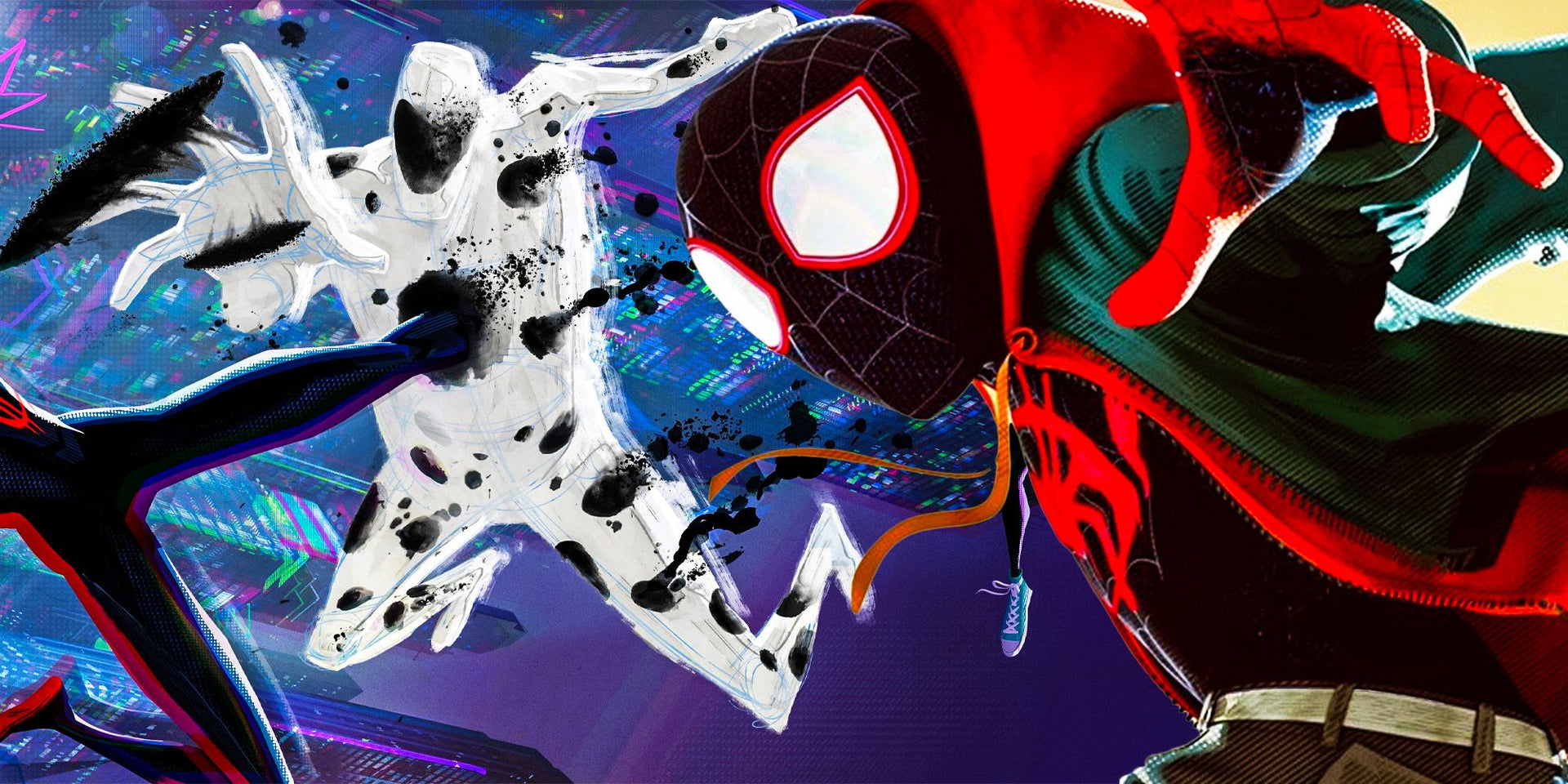
The character owes a great deal of his success to a graphic gamble. The Spot is not drawn as a man wearing a spotted costume, but as a white silhouette punched through with genuinely empty holes. His spots are not painted onto him: they go through the image, and you can see straight through them.
The film takes the idea as far as altering his line style as he grows in power. The character starts out in simple, almost childlike flat colours, then drifts towards an increasingly abstract inked rendering, until he becomes an almost illegible shape. Few antagonists have their threat level written directly into the animation technique. That formal virtuosity is what had already made the reputation of the saga's first film. The posters and figures in the shop draw heavily on that same art direction, as it happens.

The art direction on your wall
Spiderverse Poster — Miles Morales and Gwen
The flat colours and halftone dots that redefined superhero animation, in a format that fits on a bedroom or office wall.
View the product — 22,90 €How do you beat an opponent like that?
The question is still open, and that is precisely what makes the character interesting in narrative terms. The three usual answers to a villain of this calibre do not work here. Hitting him means reaching him, and he moves the point of impact. Locking him up means a sealed room, and no room is sealed for him. Outrunning him means a trajectory, and he never takes one.
Two avenues remain, and the film hints at both without developing either. The first is technical: his openings are physical objects he can lose, have torn away or see turned against him, which suggests a victory through manipulation rather than through combat. The second is psychological, and probably the real one: a character whose entire power springs from a wound to his pride can be disarmed by the very thing he was refused at the start, namely some form of recognition. This logic of the villain you defuse rather than defeat runs through Spider-Man's best stories, starting with those devoted to Doctor Octopus.
What his case reveals about second-tier villains
The Spot's promotion is not an isolated accident. Cinema has got into the habit of digging through the archives for characters judged minor and giving them the depth the comics never granted them. Vulture, long reduced to an old man in a green suit, became an antagonist of social class; Mysterio, a fairground illusionist, turned into a perfectly contemporary manipulator of images.
What these successes have in common comes down to one simple observation: the visual concept of these characters was already excellent, it was their writing that was poor. A man covered in portals was a remarkable idea as early as 1985; all that was missing was a reason to use it. As soon as a writer gave him a credible motive, the power stopped being a gimmick and became a threat.
That suggests the reserve of usable villains is far larger than people think, and that the Spider-Man catalogue still holds several dormant Spots. It is also a lesson for readers: a character treated as a joke for decades is not necessarily a failure, sometimes he has simply been badly served. The full panorama of that gallery is laid out in our analysis of the most powerful enemies, where the established hierarchy now deserves to be revised.
What the character still has to prove
The trajectory is not over. The Spot leaves the second film at the peak of his power, without ever having been confronted head-on, which leaves open the question of just how much damage he can really do. The theories in circulation, and the other possible threats in the final instalment, are set out in our analysis of the villain in Beyond the Spider-Verse.
On the comics side, the opposite movement has begun: recent publications treat the character with a new seriousness, as though forty years of mocking treatment had to be made up for. It is one of the rare occasions where an adaptation imposes its reading on the source material rather than the other way round. The overview of the multiverse places this development within the saga as a whole.
Why he works so well with audiences
The Spot is a character of resentment, and that is what makes him contemporary. He wants neither money, nor power, nor domination: he wants to be recognised by the one who did not see him. His engine is humiliation, his demand is to exist in someone else's eyes. Few superhero villains express a motivation so unheroic and so immediately understandable.
On top of that comes a form of narrative justice the audience relished: the character who had been mocked since 1985 takes his revenge, in fiction, on those who laughed. That tilt from the ridiculous to the tragic is the best argument in the Spot's favour, and it explains why his costume and his mask have become safe bets at conventions, alongside the t-shirts bearing the imagery of the multiverse. The other fancy dress options are reviewed in our guide to villain cosplay.
A workplace accident turned supervillain
One detail often goes unnoticed and yet holds the key to the character: Jonathan Ohnn never chose to become a criminal. He was an employee. He was carrying out an order, in a laboratory funded by an employer who knew the risks perfectly well and said nothing about them. His transformation is not a mythological curse, nor a pact entered into knowingly, it is a workplace accident for which nobody has ever answered.
That origin brings him closer to Doctor Octopus or Sandman than to the catalogue's demonic figures, and it gives his resentment a foundation that writers took forty years to exploit. A man damaged by a company, never compensated, never acknowledged, then mocked by the hero supposed to protect the innocent: the anger that follows is anything but irrational.
That is perhaps what explains the audience's attachment to him. Where many villains want to conquer or destroy, this one simply asks that people admit he existed before he became a monster. The theme is a constant in Spider-Man's world, whose best opponents are almost always victims of a system the hero himself never really fights.
Frequently asked questions about the Spot
Does the Spot really exist in the comics?
Yes, since January 1985. He appears in Peter Parker, The Spectacular Spider-Man issue 98, after a cameo in issue 97, written by Al Milgrom and drawn by Herb Trimpe. The film did not invent the character, it changed the way we look at him.
Is he more powerful than Venom or Green Goblin?
A direct comparison makes little sense: he plays in a different register. Venom wins in hand-to-hand combat, Green Goblin strikes at those around the hero. The Spot, for his part, acts on space itself, which makes him theoretically more dangerous on a large scale and far less effective in a conventional fight.
Why does he hold a grudge against Miles Morales specifically?
Because it was Miles who destroyed the collider whose explosion transformed him, and because he was treated as a negligible opponent at their first meeting. In his eyes, he lost everything because of someone who could not even remember his name.
Do his spots have any limits?
They have two. First, he has to know where he is sending whatever he passes through, otherwise he loses himself in the in-between dimension — which is what makes his early appearances so clumsy. Second, his openings are detachable objects: once separated from him, they can be picked up, moved, even used by someone else.
Why has his appearance changed so much between the comics and the film?
In the comics he wears a white bodysuit printed with black circles, which explains a good part of the mockery. The film drops the costume idea altogether: the spots become genuine holes in the image, and the character no longer has a stable face or outline. The concept is identical, the rendering shifts register completely.
Do you need to have read the comics to understand the character on screen?
No, the film is entirely self-contained and rewrites his origin around the collider. Knowing the comics version only adds a layer of pleasure: you can then measure the scale of the promotion granted to a villain long considered minor.

