
14-Day Money-Back Guarantee
0
The short answer
Karn belongs to the Inheritors, the bloodline that hunts the spiders of the multiverse, yet he turns against his own to stop them devouring everything. Maimed and then cast aside, he finally inherits the burden of the Weaver, the one who watches over the balance of the story. His path is set out below.
Contents
Karn: the Spider-Totem who defied his own nature
In the vast web of the Spider-Verse, some characters are neither heroes nor true antagonists. Karn is one of those tragic figures, caught between two irreconcilable roles. Born among the Inheritors, the mystical hunters of Spider-Totems, Karn is the only one to have questioned the established order… and to have paid the price for it.

Where Morlun embodies pure predation and divine arrogance, Karn represents doubt. He is not weak, he is clear-sighted. And in a universe ruled by implacable cosmic laws, that clarity is a capital offence.
His existence raises a question that sits at the very heart of Spider-Man mythology: can you escape your cosmic function when you were born to destroy?
The Inheritors: a family built on the hunt and on domination
To understand Karn, you first have to understand the Inheritors. This vampiric family does not feed on blood, but on totemic energy. Their mission is simple: track down, kill and consume every Spider-Man across the multiverse.
For them, the hunt is not a moral choice. It is a sacred duty, handed down like a religion. Every Inheritor is raised on the idea that Spider-Totems are prey the cosmic balance requires.
Karn, for his part, works out very early that this balance is a lie. That the survival of the Inheritors rests on systematic extermination… and that this logic will end up destroying the multiverse itself.
This dark mythology around the Spider-Totems and the Inheritors also runs through Spider-Man's visual universe. Whether through the costumes, the masks or even everyday clothing, every version of the web-slinger carries a part of that mystical heritage.
👉 Take it further with our Spider-Man masks , explore our Spider-Man fancy dress and costumes inspired by the multiverse's different incarnations, or settle into something cosier with our Spider-Man pyjamas , to keep the web-slinger's spirit alive right through your downtime.
From Karn to the Weaver: when the hunter becomes the weaver of destiny
What Karn grasps before any other Inheritor is that the Spider-Verse is not merely a stock of prey. It is a living, fragile structure, governed by invisible threads linking every Spider-Totem to a wider destiny. Where his family sees a cosmic food chain, Karn perceives a web of causes and consequences.
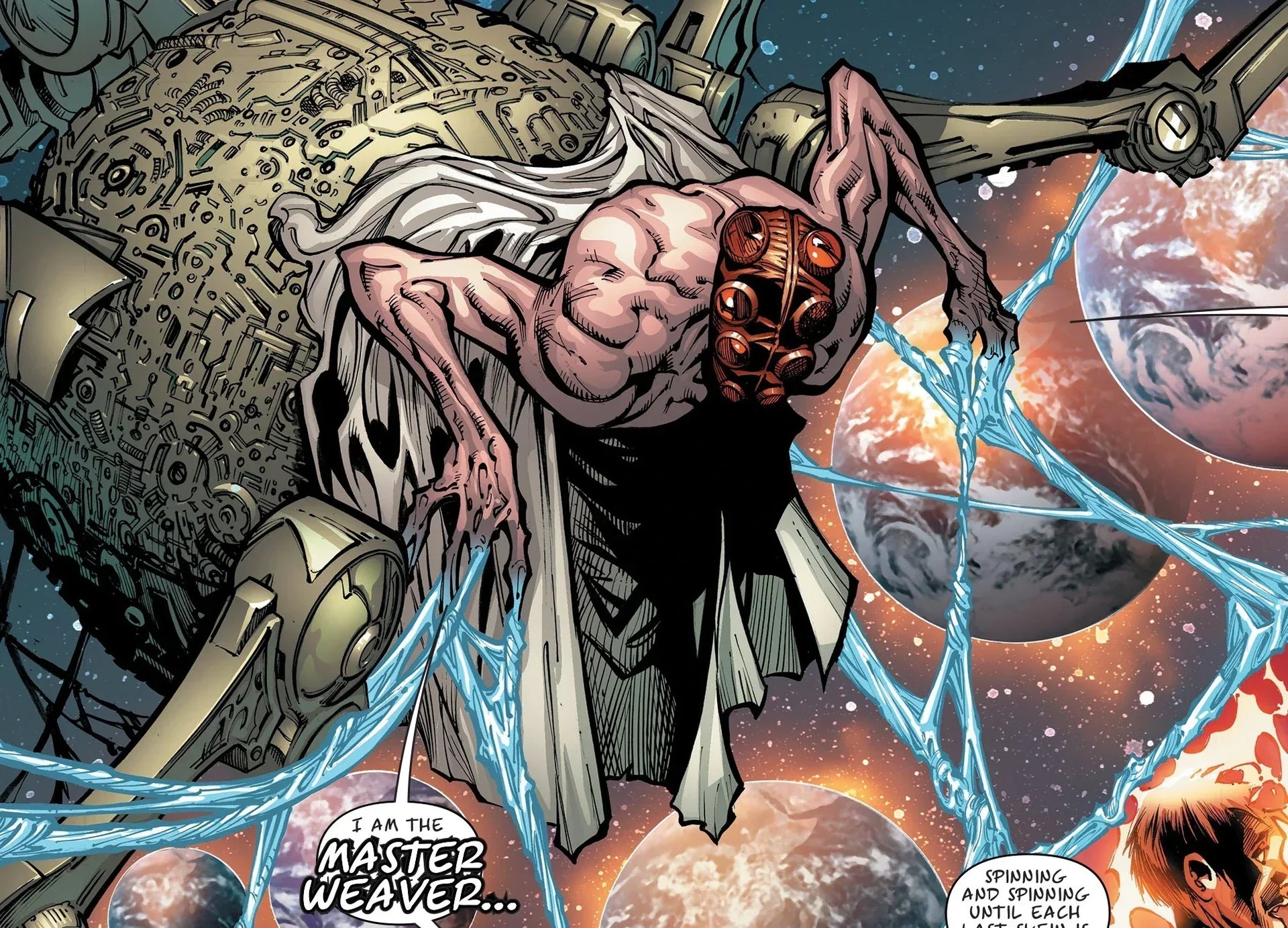
That realisation naturally sets him against his own… but above all, it leads him to cross paths with an entity fundamental to the multiverse: the Weaver . Unlike the Inheritors, the Weaver is not a predator. He is the guardian of the story, the one who observes, adjusts and maintains the narrative balance of the Spider-Totems across realities.

By betraying the Inheritors, Karn does not escape his destiny: he transforms it. Broken, punished, maimed by his own family, he is finally reassigned to a role more terrible still than the hunt: understanding and preserving the very web he helped put at risk. Karn does not become a hero. He becomes a cosmic instrument.
That is how he gradually takes on the role of new Weaver. Not out of ambition, but out of necessity. Where the former Weaver kept order at a distance, Karn acts with the memory of spilled blood. He knows the pain of the hunted Spider-Men, because he was one of the hunters. That guilt becomes his strength.
His arc is one of the most tragic and most profound in the Spider-Verse: an executioner turned archivist of destiny. Karn does not rewrite the web. He makes sure it is no longer torn apart by those who, as he once did, mistake survival for domination.
In that sense, Karn is the inverted mirror of figures such as Morlun — where Morlun consumes the Spider-Man myth, Karn becomes its silent guardian.
Karn against Morlun: two opposing visions of destiny
The opposition between Karn and Morlun is essential. Where Morlun sees Spider-Man as an infinite resource to exploit, Karn perceives something quite different: an anchor point of the multiverse.
He understands that Spider-Totems are not anomalies to be corrected, but narrative and cosmic pillars. Remove those pillars and you weaken the whole web of existence.
That realisation makes Karn a pariah among his own. He becomes the Inheritor who doubts, the one who hesitates… and therefore the one who must be watched, humiliated, broken.
A character who mirrors Peter Parker
What makes Karn fascinating is that he works as an inverted mirror of Peter Parker.
Peter is an ordinary man handed immense power who chooses responsibility. Karn is a being born into absolute power, who discovers responsibility… far too late.

Both are prisoners of a destiny written before them. Both try to break free of it. But where Peter fights to protect life, Karn fights to prevent a multiversal genocide.
In what follows, we will see how Karn crosses an irreversible line: betraying his own family to save the very beings he was meant to hunt.
| Figure | What it embodies |
|---|---|
| Morlun | Pure predation and divine arrogance |
| Karn | Doubt and clear-sightedness |
Karn's betrayal: when an Inheritor chooses to save the Spider-Men
From the moment Karn accepts a truth unthinkable for his bloodline, there is no way back. By understanding that the Spider-Totems are essential to the balance of the multiverse, Karn becomes a living anomaly among the Inheritors. And in their world, every anomaly must be eliminated.
Rather than confronting his family head-on, Karn adopts a subtler strategy: sabotage. He chooses to act from within, manipulating the very rules of the hunt.
Sabotaging the multiversal hunt
During the major events of the Spider-Verse, Karn becomes one of the key elements in the Spider-Men's survival. He diverts portals, delays attacks and passes crucial information to the hunted Spider-Totems.
Without Karn, figures such as Peter Parker, Miles Morales or Spider-Gwen would probably have vanished far sooner. He acts in the shadows, without recognition, aware that the slightest misstep would seal his fate.
That role recalls other ambiguous characters in the Spider-Man universe, such as Wraith or even some of Peter's temporary allies: figures who do good without ever being fully accepted.

A fragile alliance with the Spider-Totems
Karn is never fully taken into the heroes' camp. The Spider-Men know he is an Inheritor. That he belongs to those who slaughtered entire versions of Spider-Man across realities.
That permanent mistrust makes his journey even more tragic. Karn helps beings who cannot trust him, while being hunted by those he betrayed.

That in-between position deepens the character's dramatic dimension. Karn is not a glorified saviour, but a cosmic penitent, condemned to act without ever being absolved.
The Inheritors' punishment: humiliation and downfall
When his betrayal comes to light, the Inheritors react with absolute cruelty. Karn is not simply imprisoned. He is stripped of his dignity, symbolically maimed and reduced to the state of a parasite by his own family.
That punishment is meant to make an example of him: this is what it costs to question the established order. Where Morlun is celebrated for his brutality, Karn is crushed for his compassion.
That scene is one of the most emotionally violent in the Spider-Verse, far more so than many a physical fight. It is a reminder that, in the universe of Spider-Man, moral wounds often run deeper than blows.
In the next part, we will see how Karn attempts one last redemption… and why his fate remains one of the most tragic in the whole mythology of the Spider-Totems.
Diverting portals
Karn sabotages the hunt from within.
Delaying attacks
He buys time for the hunted Spider-Totems.
Passing on information
He briefs the Spider-Men, who stay wary of him.
Karn facing destiny: the impossible redemption of a failed Spider-Totem
Physically broken, humiliated by his own and rejected by those he is trying to save, Karn reaches a point of no return. His body is no longer that of a dominant Inheritor, but the shadow of a once-powerful creature. And yet it is precisely then that his role becomes essential.
In Spider-Verse mythology, Karn embodies an uncomfortable truth: redemption does not erase the wrong. It guarantees neither forgiveness, nor survival, nor recognition.

A sacrifice without glory
Unlike the great classic heroic sacrifices, Karn's is neither spectacular nor celebrated. He acts in the shadows, one last time, to put right a tiny part of the chaos he helped create as an Inheritor.
He does not become a Spider-Man. He receives no totem, no costume, no symbol. His sacrifice is functional, almost administrative on a cosmic scale: saving one line of reality, holding a fragile balance, delaying the collapse.
That approach is a world away from the trajectory of heroes such as Peter Parker, whose every sacrifice is seen, felt and told. Karn, by contrast, disappears without a glorious story.
Why Karn could not survive
Narratively, Karn is doomed from the moment he chooses compassion. The Inheritors' universe does not tolerate dissent, and the Spider-Verse itself does not always grant a second chance.
Had he survived, Karn would have embodied a dangerous possibility: that even cosmic predators can be saved. Yet Spider-Man mythology rests on one clear line: everyone can make the right choice, but not everyone survives it.
That principle runs through the work, from The Burglar to arcs such as Kraven's Last Hunt or Back in Black. The moral price is always paid, sometimes all the way to total destruction.
Karn as a cosmic warning
Karn does not represent hope. He represents a warning. He is proof that understanding what is right is not always enough to live up to it in time.
In a multiverse where Spider-Totems are defined by responsibility, Karn is a reminder that responsibility can also be a fatal burden. He is not a misunderstood hero: he is the silent cost of the balance.
In the final part, we will see why Karn remains one of the most underrated characters in all of Spider-Man mythology… and why his absence still weighs on the Spider-Verse.
A sacrifice without glory
Karn does not become a Spider-Man: his sacrifice is functional, meant to save one line of reality and delay the collapse.
Karn: the missing link in Spider-Man mythology
In a universe full of masked heroes, endless variants and cosmic threats, Karn holds a unique place: that of the necessary yet doomed character. He is neither an alternative Spider-Man, nor a flamboyant villain, nor a providential saviour. He is proof that the web-slinger's universe rests on fragile balances… sometimes held together by those nobody ever celebrates.
Where the Spider-Verse puts forward iconic figures such as Peter Parker, Miles Morales or Spider-Gwen, Karn operates in the story's blind spot. And yet, without him, some realities would simply have ceased to exist.
Why Karn is essential to the coherence of the Spider-Verse
Narratively, Karn acts as a moral counterweight. He shows that the multiverse is not governed by courage or bravery alone, but also by late repair. He reminds us that some mistakes are irreversible, but that the act of making amends – even far too late – still means something.
That vision reinforces the central philosophy of Spider-Man, explored in depth in our analysis of ‘great power’ — responsibility is not a reward, it is a debt.

Karn and the Inheritors: a broken mirror
Next to the other Inheritors – Morlun, Jennix or Verna – Karn looks almost weak. But that weakness is precisely what makes him dangerous… to his own side. Where the others embody pure predation, Karn embodies moral dissonance.
He is living proof that even an entity designed to hunt can understand the value of life. And in a universe where Spider-Totems are hunted like resources, that realisation is heresy.

Why Karn stays with readers
Karn moves us because he does not win. He does not survive. He does not become better than what he was. He acts, simply, because it is the only right thing to do.
In a universe often dominated by heroic victory, Karn points to a more grown-up truth: doing good does not guarantee redemption. And it is precisely that moral realism that makes him so memorable for readers.
That depth explains why Spider-Verse fans look to extend the mythology through symbolic objects: figures, posters or artwork depicting the great multiversal sagas.
Conclusion: Karn, proof that Spider-Man is a grown-up myth
Karn is not a hero. He is not a villain. He is a consequence.
Through him, Marvel reminds us that the Spider-Man universe is not a black-and-white tale, but a reflection on responsibility, guilt and the price of our choices. Karn is one of the very few characters to pay that price in full.
And that is precisely why he deserves to be recognised as one of the silent pillars of the Spider-Verse – a character you do not forget, even after he is gone.
A moral counterweight
Karn shows that the multiverse also rests on late repair: some mistakes are irreversible, but making amends still means something.

