
14-Day Money-Back Guarantee
0
The short answer
Dark Reign is the Marvel arc published between 2008 and 2010: hailed as a hero after Secret Invasion, Norman Osborn secures the dismantling of SHIELD, founds HAMMER and turns the web-slinger into a fugitive. He also puts criminals behind the masks of the Avengers. Full timeline below.
Imagine the worst possible nightmare for Peter Parker. Imagine that one morning, switching on the television, he discovers that the Green Goblin — the man who killed Gwen Stacy, who has tried to murder Aunt May dozens of times, who has haunted his nightmares since he was a teenager — has just been appointed director of the American secret services. Not as an escaped criminal. Not as a hunted threat. As a national hero, praised by the White House, applauded by the press, idolised by the public. Imagine that this man, in a government agent’s uniform, walks freely around New York with the power to have anyone arrested — including Spider-Man. Imagine that he publicly declares war on the web-slinger, brands him public enemy number one, and that nobody can do a thing about it because he is quite literally running America.
This nightmare has a name in the comics: Dark Reign. This major Marvel arc published between 2008 and 2010 is probably the most terrifying thing Peter Parker has ever lived through, and yet it remains largely unknown to the wider public in the UK, who discover Spider-Man through the films rather than through the comics. This article digs deep into the period when Norman Osborn was running America, when Spider-Man was a fugitive in his own city, and when the whole Marvel universe tipped over to the dark side. For fans who want to understand why the modern Spider-Man is the psychologically complex character he is today, Dark Reign is probably the missing key.
How Did Norman Osborn Seize Power? The Origins of Dark Reign
To understand Dark Reign, you have to go back to the event that set it off: Secret Invasion in 2008, the Marvel crossover in which the Skrulls (shape-shifting aliens) infiltrated Earth and secretly replaced many superheroes with copies. During the final battle in Central Park, it is Norman Osborn who deals the killing blow to the Skrull queen, live on television. That moment, watched by hundreds of millions of Americans, turns New York’s most dangerous criminal into an absolute national hero overnight.
The political timing is crucial. Tony Stark, then director of SHIELD, is discredited by the invasion he failed to anticipate. The American government is looking for a new face to reassure a traumatised population. Norman Osborn, now famous as the saviour, exploits this power vacuum with terrifying skill. He convinces the President to dismantle SHIELD and replace it with a new agency, HAMMER, which he would run personally. Within a few months, the former Green Goblin becomes the most powerful man in the American government — above the Pentagon, above the CIA, senior even to the traditional Avengers.
This rise is made possible by one terrifying thing: Osborn has learned to hide his madness. Where the classic Green Goblin cackled his deranged laugh while lobbing pumpkin bombs, the Norman Osborn of Dark Reign is suave, calculating, presentable in a three-piece suit. He takes his medication, he smiles for the cameras, he uses the vocabulary of an enlightened leader. Nobody suspects that beneath this social mask the psychopath who broke Peter Parker dozens of times is still simmering. That perfect duplicity is what makes the character so chilling for fans who have known him since the early years of Oscorp Industries.
The Dark Avengers: When the Villains Replace the Heroes
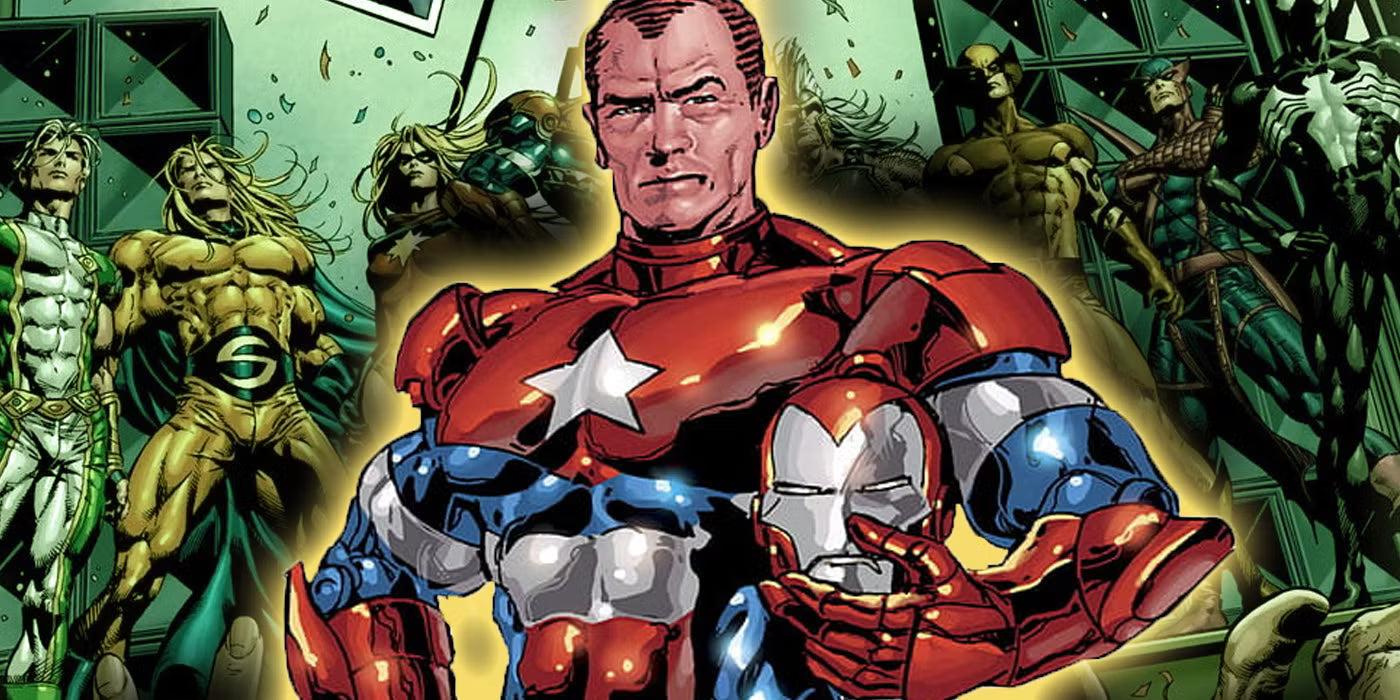
One of the boldest decisions in Dark Reign is the creation of the Dark Avengers — a team of supervillains that Norman Osborn dresses up as the government’s official superheroes. Bullseye wears Hawkeye’s costume. Daken, Wolverine’s son, becomes the new Wolverine. Mac Gargan, formerly Scorpion and now bonded to the Venom symbiote, takes the Spider-Man costume. Moonstone usurps the role of Ms. Marvel. Norman Osborn himself puts on red and blue armour and proclaims himself Iron Patriot, a symbolic fusion of Captain America and Iron Man.

This substitution is an act of unheard-of psychological cruelty for Peter Parker. Watching an impostor in a Spider-Man costume parade across the television as an official Avenger, watching the American public cheer him on while the real Spider-Man is hunted like a criminal — it is a permanent public humiliation. Mac Gargan in the Spider-Man costume does not behave like a hero: he literally devours his victims, he injures civilians, he commits acts of gratuitous violence. And every time he does something horrific, it is Spider-Man’s image that is dragged through the mud in the eyes of public opinion.
This diabolical strategy of Osborn’s works because it exploits a fundamental weakness in the Spider-Man concept: his anonymity. Nobody can prove that this Spider-Man is not the real one, because Peter Parker cannot reveal his identity without putting Aunt May and MJ in danger. The web-slinger is trapped by his own mask — the secret that protects him becomes the weapon Osborn turns against him. It is exactly the sort of manoeuvre that the Green Goblin has mastered better than anyone.
The Ultimate Antagonist — Green Goblin

Spider-Man Mask — Green Goblin
€59.90
The face of Norman Osborn — the essential cosplay piece for becoming the web-slinger’s worst nightmare at a Comic Con or on Halloween night.
Discover the Goblin Mask →Spider-Man on the Run: The Relentless Persecution of the Web-Slinger
For the two years that Dark Reign lasts in the Marvel timeline, Spider-Man officially becomes a fugitive from the American authorities. HAMMER regularly sends special intervention units out to capture him. The media demonise him daily — every heroic act he performs is turned against him by Osborn’s spin doctors, who present him as a masked terrorist refusing registration. Even J. Jonah Jameson, who had loathed Spider-Man for thirty years in the comics but had ended up developing a grudging respect for him, is politically forced to join the hunt.
The worst part for Peter is the isolation. Tony Stark is on the run too (Osborn also wiped the SHIELD database to erase the identities of registered heroes). Captain America has been dead since Civil War. The traditional Avengers are scattered or in hiding. Spider-Man finds himself alone in New York, with no backup and no institutional support, hunting Osborn while Osborn hunts him back. It is the most precarious situation of the web-slinger’s entire career — even worse than the Back in Black period, when Peter was mourning Aunt May.
This radical solitude forges a harder, more strategic, more paranoid Peter Parker. He develops new clandestine combat techniques, changes hideouts regularly, and grows wary even of his old allies in case they are being watched. It is also during this period that he reconnects with Harry Osborn — Norman’s son, his best friend from childhood — who finds himself torn between loyalty to his all-powerful father and his friendship with the man he knows to be Spider-Man. This father/son/enemy dynamic is one of the richest emotional cores in the whole Dark Reign arc.
American Son: The Central Spider-Man Arc of Dark Reign
At the heart of Dark Reign, the American Son arc published in Amazing Spider-Man #595-599 (2009) is probably the most spectacular confrontation between Peter and Norman Osborn ever written. Osborn, at the peak of his political power, decides he wants an heir worthy of his empire — and he launches the American Son programme, a new suit of super-powered combat armour that he intends for his son Harry, to make him the Avengers’ official successor.
But Norman Osborn is far too experienced a manipulator to genuinely trust Harry. He is in fact planning to kill Harry at the end of the programme and to embody American Son himself, as an even more powerful public identity. This ultimate betrayal — a father coldly sacrificing his son for his own power — reveals the true monstrousness of Osborn that Dark Reign had carefully made up behind his respectable-director persona. When Spider-Man uncovers the plan and tries to save Harry, it becomes a three-character family conflict — father, son, arch-enemy — that takes on Shakespearean dimensions.
The final fight between Spider-Man and Norman Osborn in American Son is one of the most brutal in modern comics. For the first time in years, Osborn’s social mask cracks completely — the Green Goblin comes back out, howling with rage, spewing death threats against everything Peter loves. It is a moment of pure catharsis for fans who have followed the web-slinger for a long time: at last, Norman Osborn becomes again what he had always really been, a murderous psychopath disguised as a civilised man. This public revelation is what will set off his final downfall in Siege in 2010.
The Emotional Fallout: How Dark Reign Changes Peter
Beyond the battles and the political intrigue, Dark Reign leaves lasting psychological scars on Peter Parker. The web-slinger comes out of this period with a new distrust of institutions — he has seen his government adopt his worst enemy as a leader, he has seen the media demonise him on political orders, he has seen his fellow Avengers manipulated or neutralised. This institutional trauma turns Peter from a hero who believed in legitimate authority into a cynic who trusts nobody but his inner circle. That shift sets the stage for the Brand New Day era that follows immediately afterwards.
For Mary Jane Watson and the other people close to Peter, Dark Reign is also a period of social erasure. While Osborn is running America, his supporters openly monitor Spider-Man’s known associates. MJ has to change jobs, Aunt May has to move away temporarily, Aunt Anna is questioned. The social cost for the civilians close to Peter is enormous — it is exactly the scenario he has feared since Amazing Fantasy #15, except that this time it is the American state itself leading the persecution.
The arc also teaches Peter a crucial strategic lesson: the individual enemies he fought for years (Doctor Octopus, Vulture, Mysterio) are in reality less dangerous than the institutional enemies who can mobilise the resources of an entire state against him. This new understanding redefines his approach to superheroics and explains why, in later arcs such as Big Time, Peter seeks to build his own institutional resources through Parker Industries.
Exceptional Piece — Green Goblin No Way Home

Green Goblin No Way Home Collector Figure
€299.90
The premium incarnation of Norman Osborn — for collectors who want to immortalise the web-slinger’s worst enemy in an exceptional display piece.
Discover the Figure →Siege: Osborn’s Spectacular Downfall (2010)
Every tyrannical reign comes to an end, and Osborn’s collapses in the Siege crossover in 2010. Blinded by his own power, Osborn decides to attack Asgard, the floating city of the Norse gods, on a fabricated pretext of national threat. He mobilises his HAMMER army and his Dark Avengers, and launches the most ambitious assault ever attempted by a supervillain in modern comics. The fight is titanic, chaotic, apocalyptic. And it is precisely what Captain America (recently resurrected after Civil War) had been waiting for in order to reveal Osborn’s true nature to the world.
During the battle, Osborn’s social mask cracks for good in front of the cameras. The Iron Patriot finish splits open, revealing the face of the Green Goblin. Norman screams demented incantations, attacks his own soldiers, loses all control. The media coverage is global, instant, devastating. The American public who had carried him to power a year earlier realise live on air that they have been manipulated by a psychopath. The fall is immediate: Osborn is arrested, put on trial and thrown into a special cell at the Raft (Marvel’s maximum-security prison).
That downfall lets Spider-Man recover his legal freedom, but it also leaves Peter Parker exhausted, traumatised, transformed. He has spent two years living as a fugitive in his own city, watching his reputation destroyed by an impostor, fearing for the lives of everyone close to him. For true fans of the web-slinger’s seven greatest enemies, Dark Reign remains the arc that proves once and for all that Norman Osborn is the worst — not because of his physical strength, but because of his ability to corrupt the institutions themselves in order to persecute Spider-Man.
Why Dark Reign Remains Spider-Man’s Most Grown-Up Arc
Dark Reign is probably the most politically ambitious Spider-Man arc ever written. Where most of the web-slinger’s stories operate on the scale of New York, or even of a single Queens neighbourhood, Dark Reign works on an American national scale and even a global one. Lead writer Brian Michael Bendis, joined by Dan Slott for the central Spider-Man arcs, builds an obvious political metaphor about the authoritarian drift of modern democracies — a subject that resonated particularly strongly in the post-9/11 context in which the series was written.
For fans who want to understand the narrative maturity Spider-Man can reach in the comics, Dark Reign is probably the best modern entry point. The arc is not an origin story for newcomers, it is a grown-up fresco that asks you to know the main supporting characters (Aunt May, MJ, J. Jonah Jameson, Harry Osborn, the Avengers). Once that groundwork is in place, Dark Reign offers a reading experience comparable to the best modern prestige television — Better Call Saul, House of Cards, or The Boys. It is precisely this dimension that probably makes it the comics version that a mature live-action series like Spider-Man Noir could adapt.
For hardcore collectors who want to follow Dark Reign chronologically, the optimal reading order begins with Secret Invasion (2008), continues with Dark Reign: The List, then Amazing Spider-Man #595-599 (American Son), carries on with the Dark Avengers and New Avengers titles of the period, and culminates in Siege (2010). That reading run amounts to roughly 600 pages of comics and forms one of the richest narrative frescoes ever devoted to Spider-Man within the wider Marvel universe.
Avengers Answer — Iron Spider

Spider-Man Iron Spider Figure
€119.90
The web-slinger’s technological armour — the collector’s piece that stands for modern resistance in the face of large-scale institutional enemies.
Discover the Iron Spider Figure →Verdict: The Arc That Defines the Modern Spider-Man
Dark Reign is probably the most important Spider-Man arc of the 2000s, and yet it remains the least known to the general public in the UK, who take in the web-slinger mainly through the cinema. That is a shame, because this arc probably contains the best pages ever written about the Peter Parker / Norman Osborn rivalry — the confrontation between the hero who believes in individual responsibility and the villain who believes in institutional corruption, between the man of the people and the oligarch, between artisanal good and industrial evil.
For fans who want to take their exploration of the web-slinger’s complex universe further, the complete page on Peter Parker covers every facet of the character across the decades. The Spider-Man collector figures let you physically immortalise the most iconic heroes and antagonists of this saga. And the Spider-Man cosplays include every costume variant on both sides of the Spider-Man / Green Goblin conflict. Because beyond the spectacular fights, what makes Dark Reign memorable is its ability to turn a superhero conflict into a political meditation on power, corruption and resistance — exactly the kind of depth that the best pop-culture works offer us when we agree to dig beyond the mainstream films.

