

14-Day Money-Back Guarantee
0
The short answer
His venom rests on three springs: a refusal to let a masked vigilante act beyond any democratic oversight, a buried envy of a physical glory that stayed out of his reach, and the belief that anonymous power escapes all accountability. Each of the three is unpacked below, comic arcs in hand.
Across the whole gallery of iconic characters in the Spider-Man universe, J. Jonah Jameson holds an absolutely unique place. He is neither a supervillain who fights the wall-crawler physically, nor a heroic ally who backs him up on his missions, nor even someone personally close like Aunt May or MJ. Jameson is something else, rarer and probably more dangerous: a media antagonist. The editor-in-chief of the Daily Bugle, the New York paper he has run with tyrannical authority since the 1960s in the Marvel comics, has waged a relentless press campaign against Spider-Man for six decades, convinced he is a masked public menace who must be unmasked at all costs.
This non-physical opposition is probably what makes Jameson so fascinating. Where the Green Goblin or Doctor Octopus attack Spider-Man with brute strength, Jameson attacks him with media power — able to turn public opinion against the web-slinger, to make Peter Parker doubt his own legitimacy, to turn a superhero into a suspect in the eyes of the authorities. This article digs deep into the psychological and sociological motives that have driven Jameson to hate Spider-Man for so long, and why that obsession remains one of the most brilliant narrative engines Stan Lee ever created.
The Daily Bugle: The Epicentre of Anti-Spider-Man Hatred
To understand Jameson, you have to understand the Daily Bugle — the paper that is his main weapon and the stage for his entire anti-Spider-Man obsession. Modelled on the big New York tabloids like the New York Post, the Bugle in Marvel fiction is one of the most influential papers in the city. Its front pages are read by millions. Its headlines shape public opinion. And ever since Spider-Man's first appearances in the 1960s, the Bugle has been the official mouthpiece of anti-wall-crawler suspicion.

Jameson runs his paper with near-dictatorial authority. He personally dictates the anti-Spider-Man front pages, screams at reporters who try to show the web-slinger in a favourable light, refuses balanced pieces and demands that every mention of Spider-Man be tinged with suspicion. That editorial obsession is so all-consuming that it ends up defining the very identity of the Daily Bugle — it is no longer just a New York paper, it is the anti-Spider-Man paper par excellence. The approach raises deep journalistic questions that Marvel keeps coming back to: can you run a newspaper while imposing such an obsessive editorial line? At what point does the editor's personal opinion compromise journalistic integrity?
The supreme irony is that Peter Parker works for the Bugle as a freelance photographer. He sells Jameson photos of Spider-Man in action — that is, photos of himself — to a paper that uses those images to smear him. That narrative double game is one of Stan Lee's most brilliant inventions. Peter funds his studies by feeding the media weapon of his fiercest critic. The permanent tension between Peter the photographer and Spider-Man the subject of the photo has produced dozens of delicious comic arcs where Peter has to juggle his two identities in front of a Jameson who never once suspects that the pictures come from the wall-crawler himself.
Iconic Piece — Jameson's HQ

Spider-Man Building Set — The Daily Bugle
239,90 € 299,90 €
The New York newsroom where J. Jonah Jameson has been shouting at Spider-Man for 60 years — rebuild the HQ of the wall-crawler's most iconic media antagonist.
Discover the Daily Bugle →The Real Reasons Behind His Hatred: A Complex Psychology
Why does Jameson hate Spider-Man with such ferocity? The answer plays out on several psychological levels that Marvel writers have gradually explored since 1962. The first explanation, the simplest, is an instinctive distrust of anonymous vigilantes. For Jameson, who defends the traditional values of public authority, transparent journalism and respect for institutions, a masked man acting above the law is an existential threat to democracy. That ideological objection is technically defensible — it raises a genuine moral question about the legitimacy of superheroes, one that no mainstream Marvel film tackles head-on.
The second explanation comes down to jealousy. Jameson is an accomplished man, wealthy and influential, yet he remains fundamentally a twentieth-century character caught in a twenty-first-century world where ordinary people can fly through the air and lift buses. Spider-Man embodies everything Jameson could never be: young, charismatic, popular, capable of impossible physical feats, adored by New York crowds. That buried envy turns ideological criticism into personal obsession. Several comic arcs suggest explicitly that Jameson would have liked to be a hero — his son John is a famous astronaut, his father was a decorated soldier — and that his inability to reach that glory gnaws at him from the inside.

The third explanation, more sophisticated, comes down to journalistic ethics. Jameson believes deeply that democratic transparency demands that every power be identified and held to account. Spider-Man, through his anonymity, escapes all accountability — he can do good or ill without any institution being able to stop or sanction him. For Jameson, that absence of oversight is intolerable, and his media crusade is aimed precisely at forcing Spider-Man to unmask and step into the normal institutional system. That motive is probably the most respectable of the three, and it is the one that the more mature Spider-Man arcs explore most deeply.
Jameson's Evolution: From Caricature to Deep Character
Over the decades, the character of Jameson has evolved considerably in the comics. In the 1960s and 70s he was essentially comic relief — a cartoonish grumpy boss you took pleasure in watching lose his temper in his Bugle office. His shouting, his bristling moustache, his ever-lit cigar and his deranged anti-Spider-Man front pages made up a running gag that amused readers without ever digging into the character's depth. That initial caricature lasted three decades and helped make Jameson one of the most recognisable supporting characters in the entire Marvel galaxy.
From the 1990s onwards, writers began to explore Jameson's psychological complexity. Several arcs give him genuine emotional depth: his authentic love for his astronaut son John, his loyalty to his Bugle staff (notably Betty Brant and Glory Grant), his vulnerability when threats close in on his family. Those moments of humanity contrast sharply with his anti-Spider-Man tirades and create a far more three-dimensional character than the one he started out as.

The most surprising arc is probably the moment Jameson becomes mayor of New York. That election, told across several arcs in the 2000s and 2010s, shows Jameson confronted with the realities of actual political power — handling super-heroic emergencies, taking hard decisions on public safety, negotiating with the federal authorities. Those new responsibilities force Jameson to reconsider part of his anti-Spider-Man certainties, and several superb scenes see him working secretly with the web-slinger to manage municipal crises. That narrative evolution shows that even the fiercest critic can soften his position when reality turns out to be complicated.
Gaming Aesthetic — JJ Jameson PS5

Spider-Man Video Game Mug
24,90 €
The PS5 gaming aesthetic where Jameson brilliantly plays the podcasting media antagonist — for fans who loved his modern version in Marvel's Spider-Man.
Get the Gaming Mug →J.K. Simmons: The Actor Who Defined Jameson For Good
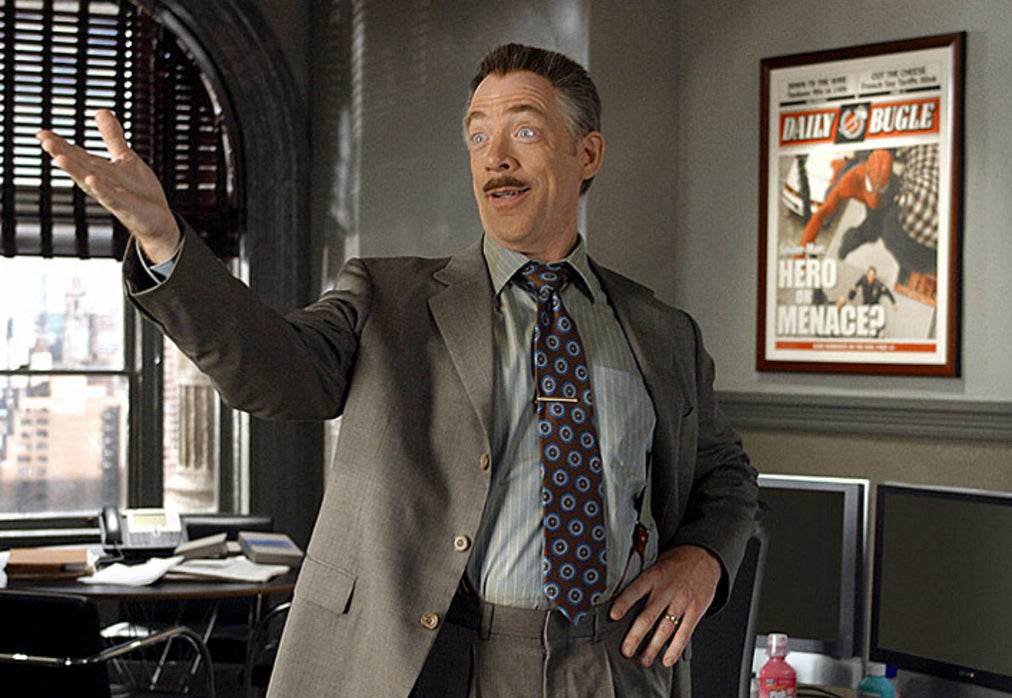
On screen, J.K. Simmons delivered what is probably the most definitive performance ever given on a Marvel character. His first appearance in Sam Raimi's trilogy in 2002 left such a mark that no fan can now picture Jameson any other way. The thundering voice, the eyebrows arched like circumflexes, the bristling moustache, the permanent cigar, the ritual bellowing at his newsroom team — Simmons captured the whole DNA of the comics character with almost supernatural precision.
What makes Simmons's performance so exceptional is that it balances the comic and the menacing perfectly. You laugh at Jameson, but you also fear his power. You find him ridiculous in his tirades, yet you respect his conviction. That double register is extremely hard to hit, and Simmons masters it with disarming ease. When the MCU decided to bring Jameson into Spider-Man: Far From Home and No Way Home, it was obvious that no other actor could take over the role — so Simmons was called back to play the same version of the character across two distinct cinematic universes.
That continuity of casting is exceptional in the history of superhero cinema. No other Marvel role has survived so many reboots and franchise transitions without changing actor. Simmons's Jameson has become the absolute reference, to the point that modern comics have started reproducing the visual codes of his performance rather than those of the original comics. It is probably the finest case of cultural feedback loop between film and comics ever documented in the industry.
Jameson in Video Games: Modernising the Character
In the Marvel's Spider-Man video games from Insomniac Games, and particularly in Marvel's Spider-Man 2 on PS5, Jameson is brilliantly reinvented for the twenty-first century. Instead of running a print newspaper, he hosts an online podcast called 'Just the Facts with J. Jonah Jameson'. That modernisation is more than a detail — it mirrors the real evolution of the media since the 1960s and puts Jameson at the heart of the contemporary media ecosystem. Opinion podcasts, disinformation YouTube channels, the permanent commentary of social media — Jameson now embodies that dimension of our modern media landscape.
While you are playing as Spider-Man across New York, you hear Jameson's podcasts in the background, criticising your actions in real time. That omnipresent audio creates an extraordinary sense of immersion — you genuinely feel like a Spider-Man hounded by the constant media commentary of his chief detractor. The Insomniac developers wrote dozens of hours of audio monologues for Jameson, who reacts to your actions, your victories and your defeats, creating a character so present that he becomes an involuntary companion in the game.
That modernisation proves the lasting richness of the character. Jameson is not frozen in his 1960s comics era — he can evolve, adapt to new media and stay relevant to new forms of communication. That is probably what explains his longevity: six decades after his creation, he still fascinates because his narrative function (the media antagonist) remains universally current. As long as there are media, there will be a Jameson to criticise the heroes he does not understand.
Why Jameson Is Indispensable to the Spider-Man Universe
Beyond the entertainment, Jameson fills an essential narrative function in the Spider-Man universe: he stands for doubt. Without him, Spider-Man would simply be a hero adored by everyone, which would strip away the whole complex moral dimension that has defined the character since 1962. It is because there is a Jameson shouting every day that Spider-Man is a menace that Peter Parker has to keep asking himself whether what he does is right. It is because part of the New York public believes Jameson that Peter can never rest on his popularity to validate his moral choices. That permanent tension between adoration and suspicion makes Spider-Man a more complete, more human, more questionable hero.
That narrative dynamic is probably what sets Spider-Man apart from most other Marvel superheroes. Captain America has no Jameson — he enjoys a near-universal popularity that shields him from any real challenge. Nor does Iron Man — his public fame as a billionaire places him above the media rather than at its mercy. Spider-Man is the only major Marvel hero who has to justify his existence constantly in the face of a persistent media detractor. That narrative singularity considerably deepens the psychology of the character and explains why so many fans identify so closely with Peter Parker.

Cartoon Aesthetic — Jameson Caricature

Spider-Man Cartoon Phone Case
29,90 €
The cartoon design that recalls the look of the animated series where Jameson bellows in his Bugle office — for fans who love the character's iconic humour.
Get the Cartoon Case →To dig further into the world of the Daily Bugle and the characters orbiting Jameson, dive into our analyses of John Jameson turned Man-Wolf, the Daily Bugle at the heart of Peter Parker's life, or explore the LEGO Spider-Man collection which includes the iconic Daily Bugle set. J. Jonah Jameson remains one of the most brilliantly conceived characters in all of Marvel mythology — proof that an antagonist needs no physical powers to become essential to a hero's identity.

