
14-Day Money-Back Guarantee
0
The short answer
Yu Komori is the arachnid hero of a Japanese series published between 1970 and 1971: a lonely young Tokyoite who experiences his powers as a curse and wants above all to become normal again, a world away from the New York optimism. Marvel tied this incarnation into its own continuity during Spider-Verse. Full origins and legacy below.
Picture Tokyo in 1970. American pop culture is sweeping across a country in full modernisation: Burger King opens its first counters, blue jeans invade the universities, and Marvel Comics signs an unprecedented deal with a local publisher that will give birth to the strangest Spider-Man ever published. A still-unknown young mangaka named Ryoichi Ikegami picks up the rights to the web-slinger and decides he is not simply going to translate him. He is going to rewrite him entirely, tear him away from Peter Parker, and turn him into pure psychological tragedy, a million miles from the goofy spirit of the American comics. The result? A character most British fans have never even heard named, whose existence stayed hidden for fifty years, and who nonetheless shaped the entire aesthetic of the modern spider multiverse.
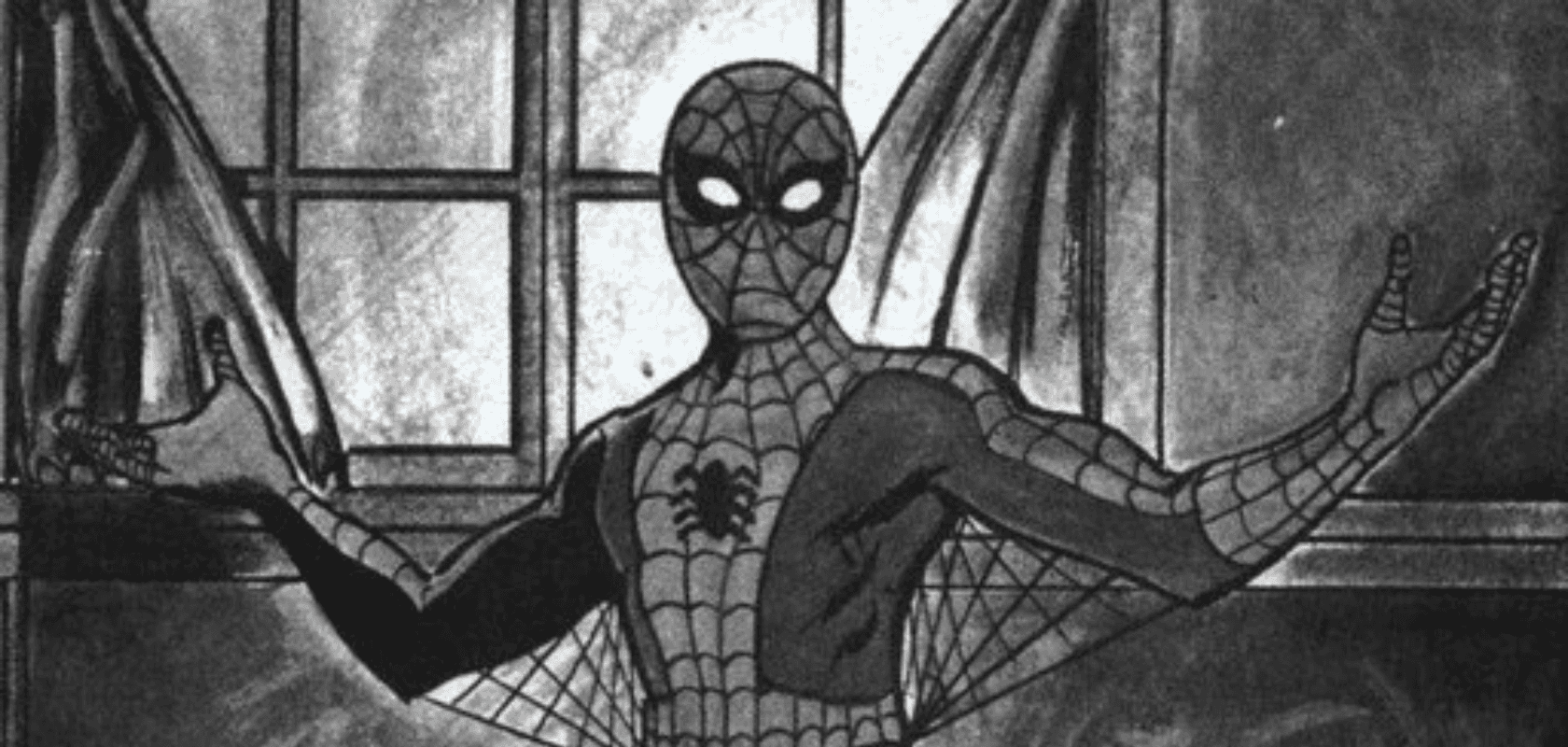
His name is Yu Komori. And between 1970 and 1971, in the pages of the Japanese magazine Bessatsu Shōnen Magazine, he wore the web-slinger's costume in a parallel universe where he was a Tokyo secondary school student haunted by guilt, bullied by his classmates, terrified of his own powers. Seven years later, his silhouette would inspire a second, even more radical Japanese reincarnation: Toei's televised Supaidaman, who pilots a giant robot called Leopardon and who would unknowingly lay the foundations of the global tokusatsu genre that later produced the Power Rangers. This article retraces that whole forgotten double history, from Ikegami's cult manga to the recent canonisation of these Japanese incarnations in the web-slinger's multiverse arc. If you thought you knew every version of the hero, brace yourself: the strangest one was clearly missing.
Yu Komori, the Spider-Man nobody in the UK knows
Yu Komori is a young chemistry student living in Tokyo in a tiny bedsit, broke, solitary and terribly clever. Unlike Peter Parker, he has no Uncle Ben, no Aunt May, no Mary Jane. He is alone in the world, and his only mental refuge is the makeshift laboratory where he runs experiments on radiation. One stormy evening, a spider irradiated by one of his own devices bites him on the back of the neck. A few hours later, he is climbing the walls of his building in a panic. The basic set-up deliberately echoes the American comics so that Japanese readers recognise the archetype, but Ikegami immediately makes a radical switch: where Peter Parker takes his destiny in hand with optimism and humour, Yu Komori sees his powers as a curse. He does not want to be a hero. He wants to be normal again.
That obsession with getting back to normal shapes the entire series. Yu desperately hunts for a cure for his bite, haunts underground laboratories, takes on shady contracts to fund his research. He crosses paths with yakuza, crooks and corrupt doctors. He does not fight supervillains: he fights poverty, social injustice and his own distress. The contrast with the psychology of the American Peter Parker is total. Where the New York web-slinger becomes a hero in spite of his doubts, Yu Komori stays a hero by accident, never by choice. That distinction, deeply Japanese, runs through all of Ikegami's work and gives it a psychological density the Marvel comics of the same era had not yet dared to approach.
The manga runs to five main chapters and has never had an official UK release. For decades its existence was passed along by word of mouth among collectors and hardcore fans of the work of Ikegami, the future cult artist behind Crying Freeman and Sanctuary. Even today, if you go looking for Yu Komori on the main English-language sites devoted to the web-slinger's universe, all you find are scattered mentions, often wrong. And yet this character has been canon since 2014. Marvel officially folded him into main continuity during the event Dan Slott's Spider-Verse, where he appears briefly as one of the Spider-Men recruited to fight the Inheritors.
Ryoichi Ikegami, the artist who turned Peter Parker into a Japanese tragedy
To understand what makes the Yu Komori manga so singular, you have to understand who Ryoichi Ikegami was in 1970. Born in 1944 in Fukui, Ikegami was 26 and starting to make a name for himself in seinen manga, manga for adults. His style was already recognisable: a realistic, almost photographic line that broke radically with the cartoon aesthetic dominant among his contemporaries. Where most mangaka drew stylised faces with huge eyes, Ikegami drew angular men, heavy stares, muscular bodies anchored in a brutally real Tokyo. He would later become one of the most admired artists in Japan, but at the time he was still looking for his voice. Spider-Man was his first genuinely major project.
The deal with Marvel went through the publisher Kodansha, and Marvel — then in a phase of aggressive international expansion driven by Stan Lee — gave Ikegami a completely free hand. A free hand no mangaka would ever be given again. Ikegami changed almost everything. The setting moved from New York to Tokyo. Peter Parker vanished in favour of Yu Komori. Mary Jane does not exist. The Green Goblin and the black symbiote are absent — those classic villains would only turn up later in the American chronology, but above all because Ikegami preferred to invent his own antagonists: Japanese criminals rooted in a harsh social reality, yakuza, corrupt businessmen. The violence is raw, the sex sometimes implied, the tone generally dark. Nothing at all like the American teen comics of the period.

Ikegami's work fascinated the handful of Western critics who came across it years later. Many consider his Yu Komori to be, psychologically, one of the most pessimistic incarnations of the web-slinger ever produced. The series ends on an ambiguous note: Yu never finds his cure, never becomes a beloved hero, never finds love. He remains an inner fugitive to the very end. For readers used to the bright tone of the New York web-slinger, it is almost unsettling. For lovers of seinen manga, it is an overlooked masterpiece.
What makes the work even more precious is that it prefigures everything Ikegami would go on to do: the social darkness of Sanctuary, the stylised violence of Crying Freeman, the moral ambiguity of Strain. The Yu Komori of those five Japanese chapters contains his whole inner cinema in seed form. And it indirectly inspired generations of seinen mangaka who read this supposedly failed adaptation as a manifesto: you can take a Western character, tear him out of his context, and make him into something else. Ikegami was one of the first to prove it.
VINTAGE — Comics Heritage

Spider-Man Retro Comics Poster T-Shirt
€34.90
Wear the cult legacy of the early covers that had Tokyo, Paris and New York dreaming at the same time. A piece that speaks to real fans, the ones who know the web-slinger's story did not start with the films.
Discover →From page to small screen — the birth of Supaidaman in 1978
Seven years after the Yu Komori manga ended, Japan came back to the web-slinger, this time through television. In 1978, the Toei studio — the same one that would later produce the first big televised Marvel adaptations — signed a deal with Stan Lee to adapt the hero into a live-action series. The deal was every bit as strange as the 1970 one: Marvel gave the Japanese studio total freedom, on the single condition that the costume stay recognisable. Everything else could be changed. Toei took the chance to reinvent the character from top to bottom all over again, giving him a different name from the Yu Komori of the comics — not out of carelessness, but because the new version was aimed at a younger family audience and wanted to sit inside the great Japanese tradition of tokusatsu, those handcrafted special-effects shows where costumed heroes take on giant monsters.
The new hero is called Takuya Yamashiro, a young Japanese biker who receives his powers from an alien named Garia, the last survivor of the planet Spider, wiped out by the intergalactic Iron Cross empire. No direct link to the Yu Komori of the manga, then, but an obvious kinship: a young Japanese man haunted by a mission he never asked for, who has to wear the web-slinger's costume. The series ran to 41 episodes, broadcast between May 1978 and March 1979, and it laid the visual groundwork for everything that followed in the genre. Takuya — Supaidaman to Japanese viewers — leaps from rooftop to rooftop across a beautifully shot night-time Tokyo, fires his webs from a wristband called the Spider Bracelet, and drives a transformable car named the GP-7 that can run up walls.
But Toei's real stroke of genius arrives fifteen minutes into the first episode. When a giant monster appears, Supaidaman does not fight alone. From a compartment above his GP-7 he summons a spaceship named Marveller, which transforms into an enormous battle robot called Leopardon. It is the first time in the history of the genre that the two archetypes — the human-sized costumed hero and the pilotable giant robot in the Mazinger Z mould — merge in the same show. Nobody had dared that synthesis before. Without knowing it, Toei had just invented the narrative formula that would dominate tokusatsu for the next forty years, right through to the American Power Rangers of the 90s and beyond.
Leopardon, the giant robot that invented a new kind of superhero
Leopardon deserves a paragraph of its own, because its existence is both absurd and historically decisive. Picture the scene: Spider-Man, in his red and blue suit with its web pattern, standing in the cockpit of a fifty-metre white and red giant robot that plunges laser swords into the belly of a latex kaiju monster. Everything pop culture would have called incoherent in 1978, Toei simply dared. And Japanese audiences loved it. The series pulled such ratings that Stan Lee himself, visiting Tokyo in 1980, publicly said he considered Leopardon one of the best things ever done with his creation — a quote American purists long refused to believe, and which nonetheless appears in several Marvel archive documents.
The success of Supaidaman and Leopardon directly inspired the Super Sentai franchise from 1979 onwards, which would later become, after a few years of adaptation for American audiences, the cult series Mighty Morphin Power Rangers. No Leopardon, no Megazord. No Supaidaman, no Tommy Oliver. And so, by domino effect, none of the whole giant-mecha costumed-hero aesthetic that today underpins a good chunk of children's pop culture around the world. That lineage is rarely acknowledged in official histories of the genre, but tokusatsu historians have been documenting it since the 2000s. The Japanese web-slinger accidentally fathered an entire sub-genre of global entertainment. The complete arc of the web-slinger's great sagas largely ignores this transmedia dimension, and yet it is one of the most important.
Visually, Leopardon is a red, white and blue robot — exactly the colours of the hero's costume — with a massive torso, pointed shoulder pads and a helmet vaguely suggesting a samurai mask. Its main weapon is the Sword Vigor, which slices monsters apart in a single spectacular scene in almost every episode. The repetition of that sequence became a running gag on the show and a nostalgic touchstone for generations of Japanese fans. Today, vintage Leopardon figures sell for astronomical prices on Japanese auction sites. For European collectors discovering that the series exists at all, it usually comes as a shock.
COSPLAY — Incarnation

Spider-Man Cosplay Mask with Rigid Shell
€199.90
Put on the web-slinger's mask the way Yu Komori, Takuya Yamashiro and Peter Parker each did, in their own way. A piece made for people who want to live the archetype rather than just look at it.
Discover →Why did Yu Komori stay so obscure in the UK?
The question deserves to be asked head-on. How is it that the UK, a country traditionally passionate about manga since the 90s and obsessed with the web-slinger since Sam Raimi's first films, completely ignored Yu Komori for half a century? The answer comes down to three overlapping factors. The first is commercial: the original manga never found a British publisher. By the time manga started breaking through here, in the 90s, Ikegami was known for Crying Freeman and Sanctuary, two series published in France by Glénat. But his 1970 Spider-Man remains legally locked: Marvel holds the rights to the character, Kodansha holds the rights to the Japanese work, and nobody has ever managed to get the two rights holders to line up and authorise a translation.
The second factor is cultural. Through the 90s and 2000s, the image of the web-slinger in the UK was dominated by the Fox Kids cartoons and then by Sam Raimi's films. British fans knew Peter Parker, Mary Jane, the Green Goblin, Venom. Nobody was asking whether foreign versions existed. And when Into the Spider-Verse popularised the idea of the spider multiverse in 2018, the film put the spotlight on Peni Parker, Spider-Ham, Spider-Man Noir and Miles Morales. Yu Komori does not appear. It would take the next instalment, or the trailers for Beyond the Spider-Verse, for him to resurface in the conversation.
The third factor is purely editorial. The comics that mention Yu Komori in official Marvel continuity are few and barely circulated here. His first canon appearance in Spider-Verse #1 in 2014 is a cameo of a few panels in the middle of an armada of hundreds of Spider-Men. Panini Comics did publish it, but with no particular fanfare, and readers did not grasp the character's historical significance. To work out who that hooded face in the margin really was, you already had to have read specialist English-language or Japanese analyses of Ikegami's work. Prior knowledge that new fans simply did not have.
The late canonisation — when Marvel rehabilitated its Japanese web-slingers
The official turning point came in 2014 with the arc Dan Slott's Spider-Verse, which brought together every arachnid version of the multiverse for the first time against Morlun and the Inheritor family. Slott and his editorial team made the bold choice of including both Japanese Spider-Men: Yu Komori from Ikegami's manga, and Takuya Yamashiro's televised Supaidaman with his robot Leopardon. Both characters appear in several scenes, even get dialogue, and take part in the final battle against the totemic hunters of the multiverse. It was the first time in fifty years that Marvel officially acknowledged their existence.
This canonisation is part of a wider Marvel trend of exploring its foreign corners. Around 2010 the publisher realised it had left a creative goldmine dormant by ignoring its international adaptations. Spider-Man India, with Pavitr Prabhakar, created in 2004 for the Indian market, became a recurring character. Spider-Man UK, with Billy Braddock, heir to a British bloodline, earned his stripes. Yu Komori and Supaidaman followed the same path of rehabilitation. For Marvel this is not just nostalgia: it is a commercial strategy aimed at enriching the multiverse experience for fans, and at reconnecting with the Asian markets that had been cold on the web-slinger for decades.
The second big moment in that canonisation comes with Across the Spider-Verse in 2023. Although Yu Komori is not explicitly named in the film, several Spider-Men glimpsed in the Spider Society scenes strongly evoke the Japanese designs of the 70s. Sharp-eyed fans have identified at least one hero recalling Ikegami's manga, and another whose mecha armour clearly suggests Leopardon. The producers have confirmed in interviews that these nods were deliberate, a sign that the influence of tokusatsu and seinen manga on the modern aesthetic of the Marvel multiverse is now recognised.
COLLECTION — Every Version

LEGO Spider-Man Figure
€59.90
For anyone who wants to collect the many faces of the web-slinger on a desk or in a display cabinet. A simple piece to display, and an easy door into a wider collection for multiverse fans.
Discover →The hidden legacy of the Japanese web-slinger on global pop culture
Beyond the Power Rangers, the influence of the two Japanese Spider-Men reaches far further than most British fans suspect. The dark tone of the Yu Komori manga inspired several mangaka who went on to produce famous works: Tsutomu Nihei (author of Blame!) has often cited Ikegami among his major influences, and his obsession with Kafkaesque urban architecture owes a great deal to the twilight Tokyo drawn in Yu Komori. Hiroaki Samura, the author of Blade of the Immortal, praised it in a 2009 interview. And more recently, artists such as Inio Asano have acknowledged the influence of Ikegami's photographic framing on their own work. The sequence in which Yu Komori climbs a Shinjuku skyscraper in a thunderstorm, in 1971, has been imitated dozens of times in later works without the original source always being credited.
On the Supaidaman side, the influence on tokusatsu is even more direct. The series inspired Toei to create the first official Super Sentai franchise in 1979, which has since run to 47 series. The founding concept — one or more costumed heroes who fight human-sized monsters and then summon a giant robot for the final battle — is exactly the one Supaidaman had introduced the year before. When Saban Entertainment bought the Super Sentai rights in 1992 to produce Mighty Morphin Power Rangers, the Japanese web-slinger's DNA travelled with them, without anyone in the United States realising it. The first-season Power Rangers of 1993 are literally distant cousins of Supaidaman.
The influence goes beyond tokusatsu too. Modern Marvel films have started weaving in increasingly subtle Japanese references. No Way Home contains a brief scene where Peter Parker mentions one of his alternate Spider-Men as a hero who pilots a mecha — an obvious nod to Leopardon. Sam Raimi, who would later direct Multiverse of Madness, has said in several interviews that as a youngster he watched episodes of Supaidaman on a family trip to Japan, and that the robot summoning scene marked him for life. The kaiju aesthetic of several recent films owes it something indirectly. Comparative analyses of the web-slinger's film versions rarely highlight this dimension, and that is a real gap.
Yu Komori and Supaidaman in today's multiverse — why they deserve their place
The debate is still alive in the fan community. Some purists argue that Yu Komori and Supaidaman should not be canon, because they were not created by Stan Lee and Steve Ditko, and because their tone strays too far from the original spirit of the classic Peter Parker. Others argue the opposite: that the multiverse would make no sense without these radical variations, and that the richness of the Spider-Verse arc comes precisely from that cultural diversity. Marvel's position, since 2014, is clear: both Japanese Spider-Men are officially members of the ecosystem, on the same footing as the more recent versions of the spider multiverse. They take part in the big events, appear on variant covers, and feature in the official guides.
For the British fan discovering their existence today, the point is not simply to tick a box on a checklist of obscure characters. It is to understand that the Spider-Man multiverse is far vaster and far more creative than the films let on. Yu Komori is proof that a single archetype can produce a raw psychological drama in the hands of a Tokyo mangaka. Supaidaman is proof that it can just as easily produce an inventive, joyful TV blockbuster in the hands of a studio of special-effects obsessives. The web-slinger belongs to no country, no tone, no single medium. He is, by nature, plural. And that is precisely why he has fascinated whole generations of readers and viewers on every continent for sixty years.
The adventure is probably not over. With the upcoming release of Beyond the Spider-Verse, the producers have hinted that even more obscure heroes will appear on screen. According to several sources close to the studio, Yu Komori will feature in a few seconds of footage where his hooded face is glimpsed in the crowd of assembled Spider-Men. If that is confirmed, it will be the first screen appearance of this forgotten manga character in fifty years. For fans who grew up with Tobey Maguire or Tom Holland, it is a chance to discover a hidden and fascinating part of the web-slinger's story. For the hardcore fans who have followed the saga since the earliest comics, it is a cultural victory they have waited far too long for. Every Earth in the multiverse has its own story to tell, and Supaidaman's Earth-7191, like Yu Komori's Earth-70019, deserve the light at last.
If you want to take the exploration further, dive into the pages devoted to the extended ecosystem of the spider multiverse and compare them with the other incarnations of the web-slinger that the shop has already mapped out. You will find dozens of other little-known characters whose stories are worth stopping for. The Japanese saga is only one fragment of that vast multidimensional tapestry that makes every reread of the web-slinger richer than the last. And that is exactly what today's fans love: an infinite mythology, made of variations, branchings, and small forgotten gems like Yu Komori and Supaidaman, which remind us that global pop culture is sometimes more connected than we think.

