

14-Day Money-Back Guarantee
0
The short answer
The heart of the story rests on 'canon events', the tragedies meant to strike every Spider-Man: refusing to go through one turns the hero into an anomaly in the eyes of the society that guards the balance. Every world you visit also gets its own graphic treatment. We break down what is at stake below.
Spider-Man: Across the Spider-Verse is not just the sequel to the hit animated film Into the Spider-Verse, it’s a genuine expansion of the wall-crawler’s multiverse. Released in 2023, this feature film directed by Joaquim Dos Santos, Kemp Powers and Justin K. Thompson propels Miles Morales into an even bolder, more complex and more visually spectacular adventure.
The film picks up exactly where the previous one left off, but it quickly reaches a scale never seen before. This time, Miles discovers the existence of a Spider Society, a group made up of countless versions of Spider-Man spread across the different universes. Led by the charismatic Miguel O’Hara, alias Spider-Man 2099, this organisation defends the stability of the multiverse… but at what price?
This new instalment digs deep into the themes of destiny, identity and rebellion. When Miles learns that he is an “anomaly” who should never have become Spider-Man, he finds himself at odds with the rules laid down by the Society. That moral dilemma echoes the great moments of the comics while laying solid narrative foundations for the rest of the saga.
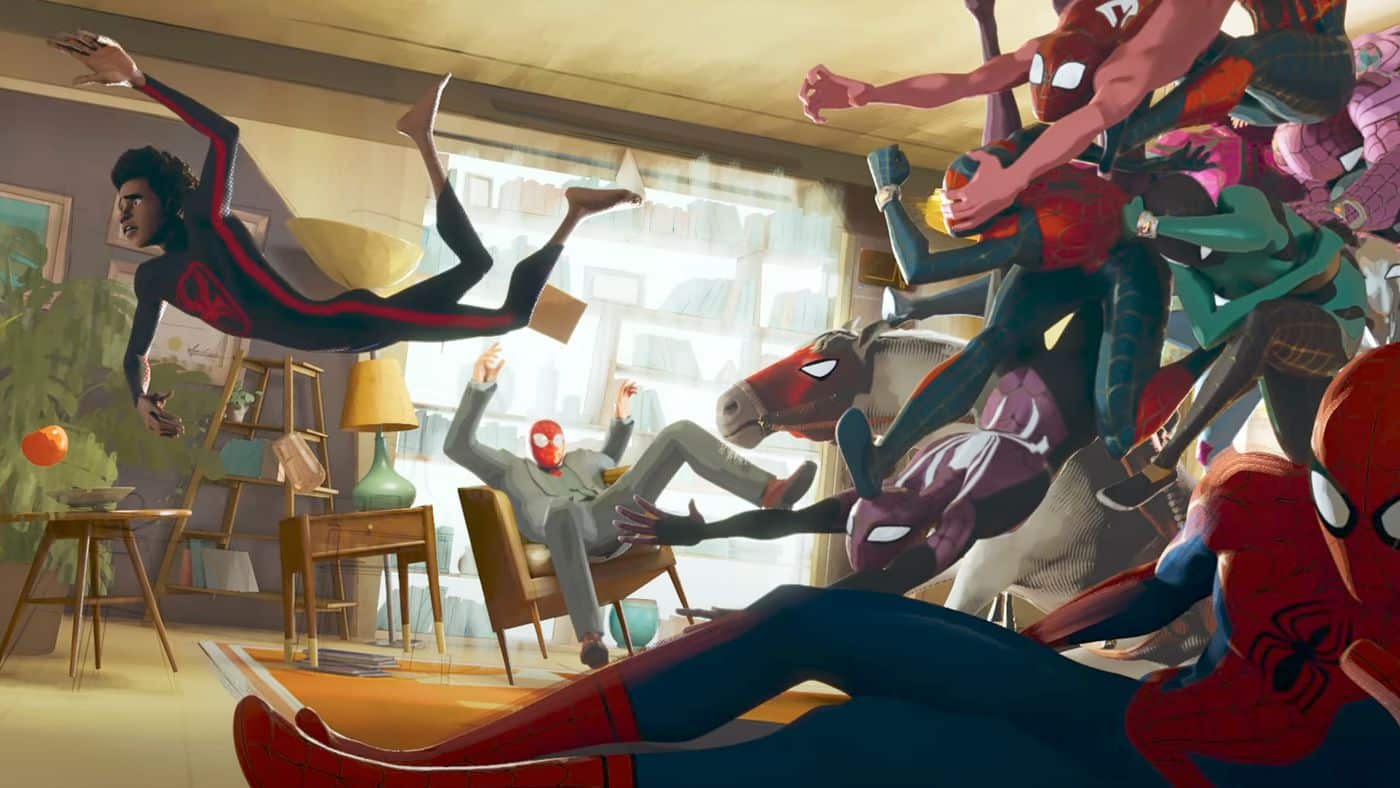
Visually, the film pushes the boundaries even further than its predecessor. Every universe you travel through has its own unique art direction, from Gwen Stacy’s watercolour style to the futuristic world of Spider-Man 2099. It’s an artistic knockout that fascinates fans of all ages.
To relive the adventures of Miles, Gwen, Miguel and all the other Spider-People, take a look at our full collection of Spider-Man costumes and Spider-Verse figures. Whether you’re Team Gwen or a Miguel O’Hara fan, there’s plenty here to grow your collection.
You can also read our blog article devoted to Spider-Man: Into the Spider-Verse to understand the foundations of this multicoloured universe, as well as our Spider-Verse page which introduces every Spider-Man in detail.


A complex plot at the heart of the multiverse
What sets Across the Spider-Verse apart from a classic animated film is the depth of its script. Unlike the first instalment, which focused on Miles’ personal growth, this sequel dives into the inner workings of the multiverse and everything at stake around 'canon events', the moments meant to happen in every Spider-Man timeline, such as losing a loved one or being betrayed.
When Miles discovers that he could break the balance of the multiverse by preventing the death of a key character, he faces a devastating moral dilemma. That choice puts him directly at odds with Miguel O’Hara, whose role goes far beyond that of a simple antagonist: he embodies rigour, discipline and the fear of universal chaos.
The film also introduces fascinating new Spider-Men: Spider-Punk, with his wild anarchist style, and Pavitr Prabhakar, the Indian Spider-Man of Mumbattan. Each of them reflects a different cultural vision of the hero, reinforcing the theme of diversity and of the universality of the spider symbol.

That narrative richness is reinforced by the finely honed dialogue, the deep interactions between characters and, above all, the constant tension that builds around one question: can you really be a hero without following the rules of fate?
If you want to recreate those epic showdowns or simply pay tribute to your favourite Spider-Man, explore our range of Spider-Man masks or treat yourself to our Spider-Verse posters featuring the film’s most striking heroes.
And to get a better grasp of what is at stake with 'canon events', don’t miss our dedicated article: What is a canon event in Spider-Man? It gives you the keys to decode every twist in the film.
A revolutionary art direction
Visually, Spider-Man: Across the Spider-Verse marks a new step forward in modern animation. Every universe has its own art direction: from Spider-Punk’s cut-out neo-punk lines to Gwen Stacy’s liquid pastel shades, by way of the vibrant, overloaded atmosphere of Mumbattan. Every shot becomes a living painting, a moving work of art that shows an almost obsessive attention to detail.
The soundtrack matches this aesthetic perfectly, mixing electronic sounds, urban rhythms and orchestral flourishes. It reinforces each character’s own identity and carries the emotion or the tension of every sequence, while paying tribute to the cultural roots of each Spider-Man.
This stylistic approach is not limited to form: it also reflects the substance of the story. Every visual style underlines the characters’ inner conflicts, their singularity within the multiverse and their most intimate emotions. Gwen, for example, moves through a world whose colours shift with her mood, making visible the complexity of her feelings towards Miles, her father and her destiny.

If you’re a fan of this breathtaking visual universe, take a look at our Spider-Man posters inspired by the Spider-Verse, or dress your room with a stylised Spider-Man lamp for total visual immersion. And to relive the iconic scenes at home, our collection of Spider-Man keyrings features some of the film’s most memorable heroes.
The Spider-Verse doesn’t just tell a story: it paints it, sculpts it and makes it vibrate in every single frame.

