

14-Day Money-Back Guarantee
0
The short answer
Four sonic signatures shape the saga: Danny Elfman's melancholy orchestra for Raimi, James Horner's intimate guitar, Hans Zimmer's electronics on Marc Webb's second instalment, then the Spider-Verse's hip-hop turn. Each score tells the story of an era. Film-by-film breakdown below.
There is one foolproof test for measuring a film's cultural impact: close your eyes, think of an iconic scene, and ask yourself whether the music that goes with it comes straight back to you. For Spider-Man, the answer is yes every single time. The opening notes of Danny Elfman's theme are enough to carry a whole generation into the streets of New York alongside Tobey Maguire. The heavy beat of Post Malone's 'Sunflower' instantly conjures up Miles Morales mid leap of faith. The deafening silence of the final scene in No Way Home rings louder than any symphony. The music of the Spider-Man films does not simply accompany the images — it carves them into our collective memory with a force the visuals alone would never reach. No other superhero franchise has produced a musical heritage this rich, this varied and this emotionally devastating.
This guide traces the complete sonic history of Spider-Man on screen — from Sam Raimi's monumental orchestral scores to the Spider-Verse's hip-hop revolutions, by way of the MCU's bold musical choices. Because understanding Spider-Man's music means understanding how every era of the character found its own voice — in the literal sense of the word.
Danny Elfman and the Raimi Trilogy: The Birth of a Legendary Theme
When Sam Raimi hired Danny Elfman to score Spider-Man in 2002, he made a choice that would define the sound of the superhero for two decades. Elfman, already famous for his work on Tim Burton's Batman and Edward Scissorhands, brought Spider-Man something no superhero film had yet dared: a main theme that blends heroism and melancholy in the same musical phrase. The opening bars of the 'Spider-Man Theme' — that rising string figure followed by a burst of brass — do not simply say 'here is a hero'. They say 'here is a hero who suffers, who doubts, but who carries on anyway'. It is with great power comes great responsibility translated into notes.
The Raimi trilogy uses music as a character in its own right. In Spider-Man 2, Elfman pushes his theme to emotional heights it had never reached before. The train scene — universally regarded as one of the greatest moments in superhero cinema — owes as much to the music as to the images. When Peter stops the train and collapses, exhausted, into the arms of the passengers, Elfman's score abandons the heroic brass for bare, fragile, almost religious strings. That orchestral passage has become one of the most analysed pieces in film-composition schools, because it achieves what the very best film music can: turning an action scene into a moment of spiritual grace. The fight against Doctor Octopus in the clock tower gets the same treatment — every blow traded is punctuated by the orchestra like a heartbeat, creating a visceral rhythm the editing alone could never produce.
Spider-Man 3 marks a controversial musical turning point. Christopher Young replaced Elfman for part of the score, introducing darker, more aggressive textures to carry the symbiote arc. The sequence in which Peter Parker, under the influence of the black suit, struts through the streets of New York convinced he is irresistible is underscored by a deliberately grotesque jazzy funk — a musical choice some find absurd and others consider satirical genius. But beyond that polarising sequence, the Spider-Man 3 soundtrack offers one heartbreakingly beautiful piece: the theme of the final forgiveness granted to Sandman, where the strings rise slowly as Peter chooses compassion over revenge — a musical moment that sums up everything Spider-Man stands for morally.
The Amazing Spider-Man: James Horner and Hans Zimmer, Two Opposing Visions
The Amazing Spider-Man by Marc Webb makes the bold choice of turning its back on Raimi's orchestral grandeur for something far more intimate. James Horner, the legendary composer of Titanic and Braveheart, wrote Andrew Garfield a theme that favours acoustic guitar and piano over brass. This Spider-Man does not sound like a mythic hero — he sounds like a lonely teenager playing guitar in his bedroom at night, and that is exactly the point. Horner's music renders in sound what Garfield renders in performance: a rawer, more vulnerable Peter Parker, closer to the ordinary boy than the finished superhero. The main theme, with its guitar arpeggios climbing gradually towards the full orchestra, tells the character's arc of transformation in three minutes — from shy kid to hero who owns it.
The Amazing Spider-Man 2 changes musical direction radically by handing the score to Hans Zimmer and a collective named 'The Magnificent Six', featuring Pharrell Williams and Johnny Marr of The Smiths. The result is the most experimental soundtrack in the whole Spider-Man franchise. The theme for Electro — schizophrenic whispered voices layered over dubstep bass — has become a textbook case in villain-theme writing. Zimmer uses electronic music to embody Electro's power literally: the bass vibrates like a current, the distortions crackle like electrical arcs, the sound itself feels dangerous. And when the scene of Gwen's death arrives — the moment that recreates the most devastating arc in the comics — Zimmer makes the bravest choice possible: silence. The sound cuts out. No tragic violins, no melancholy piano. Just the sonic void of a world that has just collapsed. That silence has become one of the most discussed musical moments in the history of superhero cinema.


Spider-Man Retro Comics Poster
22,90 €
The vintage look of the original comics captured in a poster that stirs nostalgia as powerfully as a Danny Elfman score. For fans who want the web-slinger's visual roots up on their walls — the perfect companion to a Spider-Man playlist in the background.
See the Retro Comics PosterThe MCU: Michael Giacchino and the Art of a Theme That Grows with the Hero
When Tom Holland pulls on the suit in Homecoming, Michael Giacchino is handed a delicate brief: create a Spider-Man theme that lives in the same sonic universe as the Avengers without being crushed by them. His solution is brilliant — a light, almost boyish theme, with playful woodwinds that give Holland's Peter Parker a sonic identity instantly recognisable and distinct from everything before it. The 'Spider-Man: Homecoming Suite' is built like a piece of teenage jazz — jumpy, skittering, full of energy but not yet under control. The music says exactly what the film says: this Spider-Man is a kid still learning, not a finished hero. His relationship with Tony Stark finds a subtle echo in the score — fragments of the Iron Man theme surface in the mentor scenes, as if Peter's music were not quite his own yet.

Far From Home matures Giacchino's theme by injecting a new gravity — the grief for Tony Stark weighs on every note, and the passages where Mysterio manipulates Peter come wrapped in orchestral distortions that translate illusion and paranoia into sound. Then No Way Home pulls off something magical: Giacchino brings back echoes of Danny Elfman's theme and of James Horner's when Tobey and Andrew appear. This is not mere fan service — it is musical storytelling: each Spider-Man literally brings his own music with him. The closing scene, with Peter alone in his empty flat after wiping himself from the world's memory, is carried by a stripped-back version of Giacchino's theme — just a piano, bare, fragile, no orchestra. Peter's sacrifice finds its most heartbreaking expression in that musical nakedness.
The Spider-Verse: The Sonic Revolution That Changed Everything
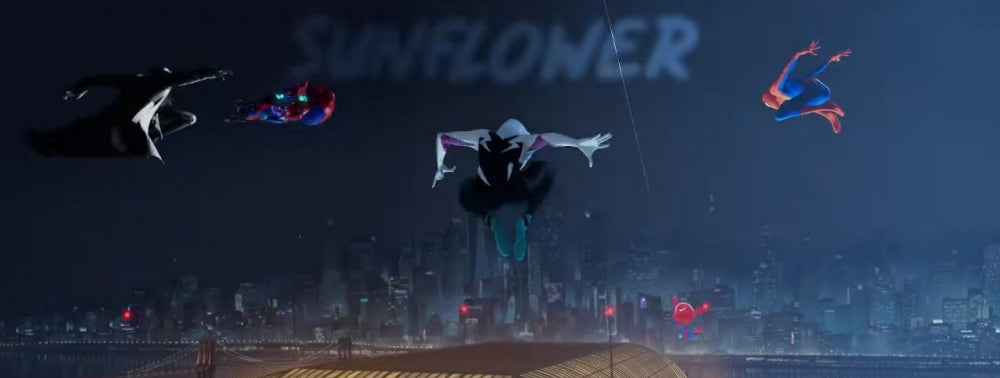
If every live-action trilogy enriched Spider-Man's musical heritage, the Spider-Verse blew it wide open. Into the Spider-Verse (2018) makes a choice nobody had dared before: the soundtrack is not an orchestral score — it is a hip-hop, trap and R&B album, featuring artists such as Post Malone, Swae Lee, Juice WRLD, Nicki Minaj and Lil Wayne. 'Sunflower' by Post Malone and Swae Lee became one of the most streamed singles of the decade, passing a billion and a half plays on Spotify — a track that exists independently of the film and that introduced Miles Morales to millions of people who had never opened a comic book. 'What's Up Danger' by Blackway and Black Caviar carries the leap-of-faith scene — the moment Miles throws himself off a skyscraper and the camera flips to show that he is not falling, he is flying — with a beat that raises your heart rate in a way no classical score ever could.
Across the Spider-Verse pushes that approach further still by tying a musical genre to each dimension of the multiverse. Miles's world sounds like hip-hop and R&B. The world of Spider-Gwen pulses with punk rock and riot grrrl — because Gwen plays drums in a band. Spider-Man India's world is carried by traditional Indian music fused with modern beats. Spider-Punk's world is literally anarchist punk played at full volume. That idea — every universe with its own soundtrack — is a narrative innovation with no equivalent in the history of animated cinema. The music no longer decorates the film, it builds the world. The Spider-Man multiverse is not only seen — it is heard, and every dimension sounds different. Beyond the Spider-Verse will have to take on the challenge of outdoing that sonic ambition — and fan expectations have never been higher.


Spider-Verse Poster — Miles Morales & Gwen
22,90 €
The iconic image of the duo that revolutionised animated cinema — and whose soundtrack conquered the global charts. Hung above a desk or in a bedroom, this poster is a permanent visual reminder of the moment Spider-Man changed the rules of film music for good.
See the Spider-Verse Poster
What the Music Reveals About the Essence of Spider-Man
Travelling through twenty years of Spider-Man soundtracks, one pattern emerges that says more about the character than any narrative analysis: every composer, whatever their style, ends up writing a moment of silence or absolute bareness at the heart of their score. Elfman does it in the train scene. Zimmer does it at Gwen's death. Giacchino does it in the empty flat in No Way Home. The Spider-Verse does it when Miles falls into the void before he flies. This pattern is no coincidence — it is a narrative necessity. Spider-Man is the only superhero whose most powerful moments are moments of vulnerability, not triumph. And the music knows it instinctively: it pulls back the brass, drops the volume, lets the silence do the emotional work. That is Spider-Man's invisible sonic signature — the hero who is strongest when he looks most fragile.
The musical diversity of the Spider-Man franchise also reflects the character's unique ability to reinvent himself for each generation. Raimi's symphony orchestra spoke to 2000s audiences raised on classic blockbusters. Zimmer's electronic experiments captured the era of dubstep and digital music. The Spider-Verse's hip-hop resonates with a generation that listens to Spotify more than it goes to the cinema. And Giacchino's evolving theme accompanies an MCU growing older alongside its audience. Every soundtrack is a mirror of its time, and Spider-Man is the only character whose music travels across so many genres without ever losing its fundamental emotional identity. The costumes evolve visually, the technology behind the special effects transforms, the actors change — but Spider-Man's music always tells the same story: an ordinary boy doing extraordinary things, and paying the price for it.
For fans who want to organise a film night with the soundtrack as its thread, the article on how to organise the perfect Spider-Man film night gives you the keys to total immersion, in sound and in vision. And to settle the ideal order in which to hear these soundtracks, the debate over the best Spider-Man film is a starting point that never gets everyone to agree — which is precisely what makes it so much fun. The posters from every era on the wall, the figures of the different Spider-Men lined up on the shelf, and a playlist that runs from Danny Elfman to Post Malone by way of Giacchino: that is all you need to turn a living room into a genuine sound museum of the web-slinger. The full range of Spider-Man merchandise and the guides and advice are waiting to round out the experience for every fan who once closed their eyes in a cinema and let the music of Spider-Man carry them away.

