

14-Day Money-Back Guarantee
0
The short answer
The alliance rests on a mutual calculation: Fury wants an agent who is agile, discreet and scientifically capable, while Peter is looking for an anchor after losing the father figures in his life. You see it take shape in the Ultimate continuity, then on screen in Far From Home. The missions and the friction are detailed below.
In the Marvel universe, Spider-Man is often seen as a lone hero, a neighbourhood vigilante fighting crime on a local scale. Yet over the years, Peter Parker has built close ties with some of the biggest institutions in the Marvel universe, and with S.H.I.E.L.D. in particular, the intelligence agency run by Nick Fury. Their collaboration has marked several major turning points in the web-slinger’s life, taking him from an ordinary teenager to a hero of international standing.
A first meeting under tension
The first notable interaction between Spider-Man and S.H.I.E.L.D. happens when Nick Fury decides to fold the young hero into his plans. In the Ultimate Spider-Man arc, Fury keeps a close watch on Peter Parker and plans to recruit him as soon as he comes of age. This modernised version of the character highlights a complex relationship in which trust and manipulation are tangled together.
👉 In the MCU, this dynamic is picked up again as early as Spider-Man: Far From Home, when Fury (or rather his Skrull double…) takes Peter under his wing after Tony Stark’s death. That moment marks the start of a much closer partnership between the web-slinger and the major institutions of the MCU.
Nick Fury, father figure… or manipulative strategist?
Spider-Man has always looked for stable figures in his life, ever since the tragic loss of his Uncle Ben. Nick Fury, with his authority, his charisma and his central role in keeping world peace, seems to offer the young hero a new anchor. But behind that benevolent stance there is often a desire for control and large-scale strategy.
- 🧠 Fury sees Peter as an asset for discreet, complicated missions.
- 🕵️ He tests him several times without ever telling him the whole truth.
- 🎯 He wants to shape a Spider-Man who is operational, yet compatible with the global stakes of the MCU.
This ambivalent relationship is brilliantly explored in our article on Nick Fury, where you discover every facet of the strategist.
🕸️ To understand how Peter evolves within the MCU, have a look at our page on Peter Parker and find out why his character makes him an ideal candidate for an organisation like S.H.I.E.L.D.
Spider-Man’s most memorable missions for S.H.I.E.L.D.
Although Spider-Man is often used as an independent hero on the ground, he has also been recruited for several official S.H.I.E.L.D. missions in the comics as well as in some animated adaptations. Those missions show just how indispensable the web-slinger has become, even in the eyes of the biggest organisations in the Marvel world.
- 🎯 In Spider-Man: Agent of S.H.I.E.L.D., Peter briefly joins the organisation to infiltrate a cell of international supervillains.
- 🛰️ He also helps defend secret S.H.I.E.L.D. facilities against attacks from Doctor Octopus or Kingpin.
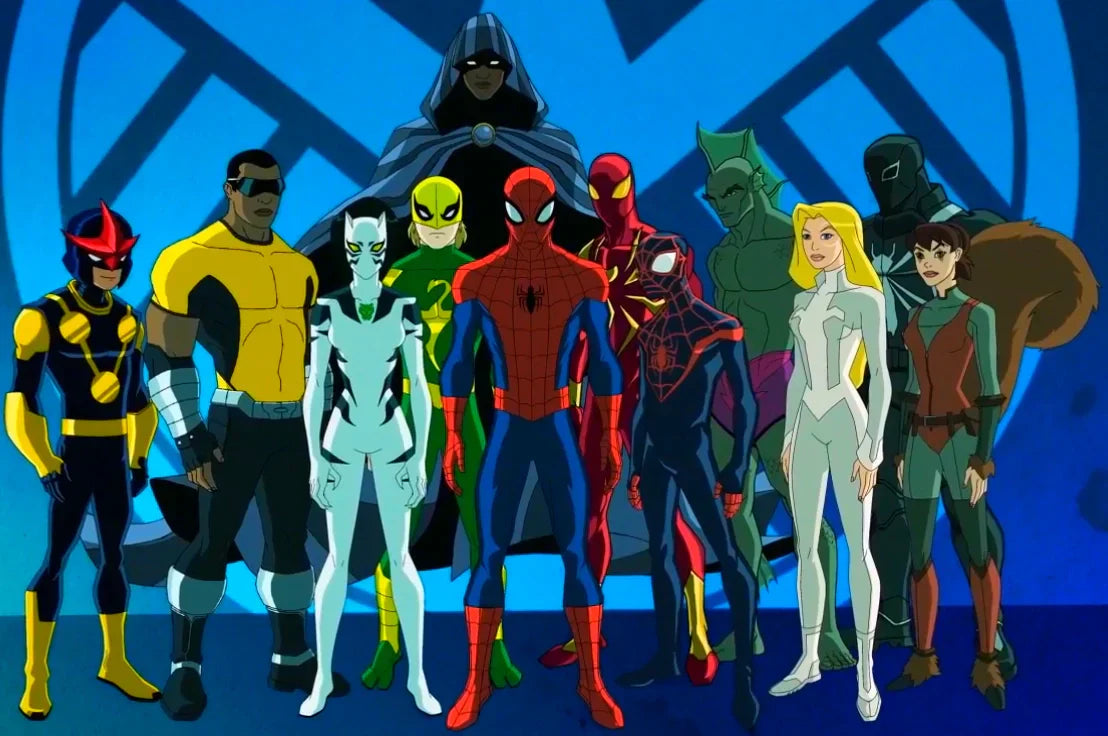
- 💻 In the Ultimate universe, Fury even puts him in charge of a special team of young heroes to mentor, a genuine step up in rank.
👉 These story arcs show a more mature Peter, faced with complex moral dilemmas. It is no longer just about saving his neighbourhood, but sometimes about acting on a global scale — all while holding on to his sense of ethics, even when confronted with S.H.I.E.L.D.’s questionable methods.

Spider-Man: the ideal profile for special operations
Why does S.H.I.E.L.D. call on Peter Parker so often rather than another Avenger? Several things explain the choice:
- 🧬 His agility and his discretion make him an asset on infiltration missions.
- 🧠 His scientific intelligence lets him grasp the technological stakes of a threat very quickly.
- 💡 His moral compass and his humanity make him more reliable than other, more impulsive heroes.
That “complete” profile makes him a perfect field agent in sensitive situations, while reinforcing his image as a trustworthy hero in Fury’s eyes.
📚 To dig into the most tactical, darkest versions of Peter, read our article on Spider-Man: Reign II, where you see a harder, more calculating Peter who is still guided by his principles.
🎯 Have a look too at our collection of Spider-Man figures to relive those missions in collector form, or explore our web-shooters worthy of S.H.I.E.L.D. kit.
The tension between independence and control
While the union between Spider-Man and S.H.I.E.L.D. looks obvious on paper, it is far from free of tension. Peter Parker has always been a deeply independent hero, driven by his own personal sense of justice. And S.H.I.E.L.D., with its military methods, its state secrets and its sometimes questionable operations, often represents everything Peter instinctively rejects.

When Spider-Man disobeys Nick Fury
Several story arcs show a Peter at odds with Fury’s orders:
- 🚫 He refuses to hand certain criminals over to S.H.I.E.L.D., preferring to leave them to the ordinary courts.
- 🕊️ He even protects young heroes Fury wanted to keep a closer eye on, such as Kamala Khan or Nova.
- 🔍 He sometimes investigates behind the organisation’s back, suspecting that its actions have gone off the rails.
That stance creates a subtle balance: Spider-Man agrees to cooperate with S.H.I.E.L.D., but never gives up his moral integrity. It is exactly that duality that makes him such a captivating character.
Constant surveillance… and oppressive with it?
In some versions, Peter is even placed under permanent surveillance: analysis of his DNA, of his movements, of the people close to him… An intrusion that creates growing unease, and that sometimes pushes the hero to withdraw from any cooperation at all.
👉 That theme is especially strong in the stories that follow No Way Home, where Peter has no official support left and finds himself entirely on his own. That rejection of control echoes his wish to remain a hero “of the people”, far from government strategy.
📖 To take that thought further, read our article on Why Spider-Man hides his identity: a crucial theme whenever he is dealing with organisations like S.H.I.E.L.D.
🕶️ You can also play the free, rebellious Spider-Man with our Spider-Man masks or relive his biggest dilemmas in our collection of Spider-Verse posters.
Conclusion: an ambiguous but formative relationship
Spider-Man and S.H.I.E.L.D. embody two opposing visions of the hero. One is young, spontaneous, morally uncompromising. The other is cold, structured, ready to make any compromise to preserve a global balance. And yet their alliance has produced some of the most memorable moments in Peter Parker’s history.
Whether it is one-off collaborations, secret missions or ethical confrontations, their relationship reflects a genuine clash of ideologies at the heart of the Marvel universe. And it is that complexity that makes their exchanges so rich.

🕸️ At a time when superheroes are more and more institutionalised, Spider-Man is a reminder that you can do good without always following orders. And that is probably what will keep him, for a long time yet, a deeply human and inspiring hero.
Go even deeper into Spider-Man’s secret alliances
Want to explore other tense, fascinating relationships in Spidey’s universe? Have a look at our article on Peter Parker and Tony Stark, or unpick the murky role of the Kingpin in the networks of influence.
To go further into this world of espionage and strategy, explore our Spider-Man web-shooters or our tactical backpacks so you are kitted out like a real S.H.I.E.L.D. agent!

