

14-Day Money-Back Guarantee
0
The short answer
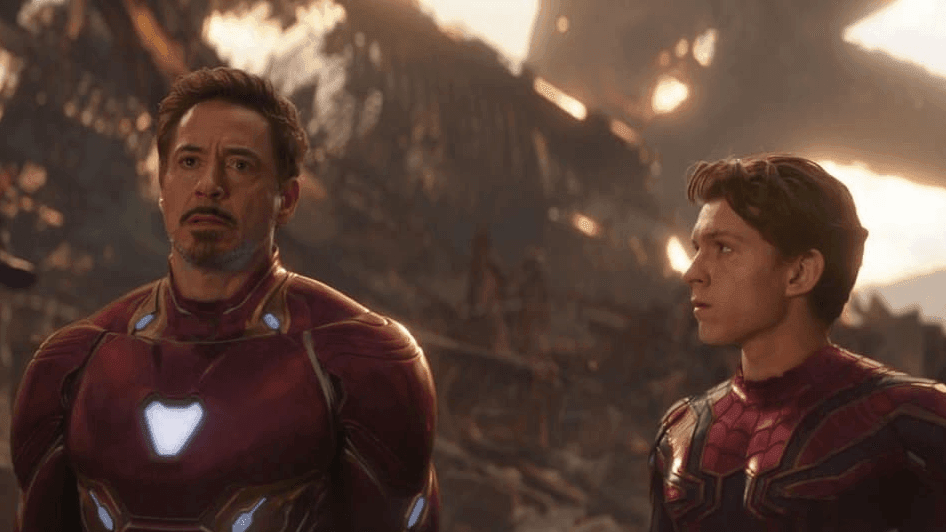
Yes, but a lopsided one: Stark takes on the father figure without ever taking on the presence, handing the day-to-day mentoring to Happy Hogan while arming a fifteen-year-old schoolboy. Hence the craving for validation that drives Spider-Man throughout the Tom Holland trilogy. We break it down film by film below.
In Marvel's recent film history, few relationships have marked fans as deeply as the one between Peter Parker and Tony Stark. From their first meeting in Captain America: Civil War in 2016 to Iron Man's tragic death in Avengers: Endgame in 2019, by way of the Homecoming and Far From Home arcs, this relationship has been one of the most emotionally rich narrative threads in the whole Marvel Cinematic Universe. Surrogate father to an orphaned teenager, scientific mentor, billionaire who opens the doors of the Avengers to a kid from Queens — Tony Stark was far more to Peter Parker than a mere superheroic colleague.
Yet this relationship, for all its apparent benevolence, raises deep narrative questions that fans still argue over today. Did Tony Stark genuinely guide Peter, or did he use him for his own ends? Did he give the boy real responsibility, or infantilise him by handing over tools he could not control? Is this father-son relationship an inspiring model or a problematic emotional dependency? This article digs deep into the nuances of that iconic MCU relationship, examining every film, every key scene and every psychological stake to offer a complete reading that goes beyond simple admiration or superficial rejection.
The First Meeting: Civil War and the Unexpected Recruitment
It all begins in Captain America: Civil War, in 2016, when Tony Stark knocks on the door of a modest house in Queens and asks an unknown teenager to help him fight Captain America. That scene, which looks harmless at the time, actually lays the groundwork for every narrative problem that follows. Tony Stark does not ask permission from Aunt May. He does not offer any gradual training. He takes a fifteen-year-old and sends him straight into a battle between the most powerful heroes on the planet, in Berlin, without the slightest psychological preparation.
That haste has deep narrative consequences. Peter Parker, who had never left New York, who until then had been fighting petty criminals in his own neighbourhood, suddenly finds himself facing international Avengers. The airport fight is shot with a light humour that masks the real scale of what is happening: Tony Stark has turned a teenager into a military weapon, without any informed consent from the child's family. Watch the scene with adult eyes and Stark's irresponsibility becomes glaring — a billionaire using a minor as a pawn in a private war.
This critical reading does not deny the emotion of the meeting. Peter Parker, an absolute Iron Man fan since childhood, is literally living the dream of every superhero-mad teenager — his idol knocks on his door and treats him as an equal. It is that blend of adolescent wonder and adult exploitation that makes the Peter-Tony relationship so unsettling in narrative terms. The meeting is filmed as a moment of joy for Peter, when in reality it lays the foundations of an unbalanced relationship that will weigh on the web-slinger's entire journey through the MCU.
Spider-Man Homecoming: The Absent Mentor and the Forced Apprenticeship
Spider-Man: Homecoming in 2017 explores in depth the consequences of that unbalanced relationship. All through the film, Peter desperately seeks Tony Stark's attention and validation. He rings Happy Hogan on a loop to pass messages to his absent mentor. He proudly wears the high-tech suit gifted by Stark Industries while mastering none of its functions. He constantly tries to prove he is worthy of officially joining the Avengers, like a child trying to please a distant father who never answers.
That psychological dynamic is filmed with subtlety by Jon Watts, but it remains fundamentally problematic. Tony Stark is technically present in Peter's life — he supplied the suit, he funds his operations indirectly, he recruited him for the Avengers. Emotionally, though, he is absent. He delegates his mentoring role to Happy Hogan, who clearly has no wish to raise a teenager on top of running Stark security. That emotional absence creates an attachment anxiety in Peter that becomes the main narrative engine of the film. The web-slinger does not fight the Vulture to save New York — he fights him to prove to Tony Stark that he deserves his attention.
The final scene of the film, where Tony Stark officially invites Peter to join the Avengers and Peter turns him down to stay a 'friendly neighbourhood hero', is probably the most mature moment in the whole Tom Holland trilogy. For the first time, Peter asserts his own identity in front of his mentor. He chooses not to become the mini-Iron Man that Stark wanted to build. He chooses to stay himself — a teenager from Queens, a local hero, attached to his community. That assertion of autonomy is the climax of the narrative arc of Homecoming, and it foreshadows the tension that will define every film that follows.
Avengers HQ — A Tony Stark Symbol

Spider-Man Building Blocks — Avengers Tower
299,90 € 329,90 €

Avengers Tower rebuilt brick by brick — the building where Tony Stark threw Peter Parker into the superhero deep end.
Discover Avengers Tower →Infinity War and Endgame: Death as the Conclusion of a Bond
In Avengers: Infinity War and Avengers: Endgame, the Peter-Tony relationship reaches its tragic peak. The scene where Peter fades away in Tony's arms during the Snap of Thanos is probably the most emotionally charged moment of the MCU's entire 2010s decade. Tony Stark, who had always kept an emotional distance from Peter, watches the teenager he had initially used die in his arms murmuring 'Mr Stark, I don't feel so good'. That scene made millions of viewers around the world cry, and it marks the definitive turning point of the relationship: for the first time, Tony fully realises that he loves Peter like a son.
That belated realisation becomes the main emotional engine of Endgame. Tony Stark agrees to risk his life to bring back Peter and everyone else who vanished, no longer out of Avenger duty but out of parental love. The scene where Peter finds Tony again on the final battlefield is one of the most beautiful emotional sequences Marvel has ever put on screen — Peter runs to Tony, hugs him, and tells him everything he has missed. Those few seconds of reunion condense all the paternal dimension that had stayed latent in the earlier films.
The death of Tony Stark at the end of Endgame shakes Peter emotionally, and shakes the franchise narratively too. The web-slinger loses his mentor, his surrogate father, his moral guide. That loss is handled with unusual gravity for a Marvel blockbuster — Peter goes through a genuine period of grief, which becomes the central subject of Far From Home in 2019. It is probably the first time a mainstream Marvel film has tackled the loss of a mentor head-on, and that narrative maturity largely explains the emotional success of the Tom Holland trilogy with adult audiences.
Far From Home: A Heavy Inheritance and Its Dangers
Spider-Man: Far From Home in 2019 explores the psychological fallout of Tony Stark's death on Peter. The film opens on a Peter deep in grief, crushed by the expectations everyone projects onto him — become the new Iron Man, take over from Tony as leader of the Avengers, inherit his moral and political role. That collective pressure is unbearable for a sixteen-year-old who only wanted a quiet holiday in Europe with his classmates.
The film brilliantly mines that anxiety through the character of Mysterio, who falsely presents himself as the new mentor Peter is desperately looking for. Mysterio plays exactly the role Peter had unconsciously wanted from Tony — an experienced superhero who takes the time to listen, who validates his fears, who guides him patiently. The manipulation works because it exploits a real psychological need in Peter. The web-slinger has not only lost a mentor, he has lost the very possibility of having one — and he is ready to accept any substitute father figure, even a malicious one. Our analysis of Mysterio sets out how this villain embodies precisely that manipulation.

The turning point of the film is when Peter accepts EDITH — the immensely powerful AI Tony Stark left him. The moment is filmed with ambiguity: the ultimate gesture of trust from Tony towards Peter, or a crushing weight nobody should carry at sixteen? The fact that Peter hands EDITH over to Mysterio almost immediately (out of mistrust in his own abilities) shows that the inheritance is too heavy. By entrusting that technology to Peter, Tony Stark gave him a responsibility no teenager could manage alone. Is that transmission an act of paternal love or one last piece of manipulation? The debate has stayed open among fans since 2019.
Tech Suit — The Stark Legacy

Classic Spider-Man MagSafe Case
39,90 €
The timeless red-and-blue suit with MagSafe — for fans who love the tech aesthetic Tony Stark gave Peter Parker.
Get the Classic Case →No Way Home: Peter Set Free for Good
It is in Spider-Man: No Way Home in 2021 that Peter Parker finally frees himself from the shadow of Tony Stark. The film methodically demolishes every remaining emotional dependency: the death of Aunt May takes away his last direct family support, the erasure by Doctor Strange takes away the friends who know him, the rejection by Happy Hogan marks the end of the Stark world in his life. By the end of the film, Peter is alone. Truly alone. No Tony, no Aunt May, no friends who remember him, no access to Stark Industries resources.
That radical solitude is paradoxically liberating. For the first time since Civil War, Peter Parker can be fully himself, without having to please a mentor, inherit a legacy or embody somebody else's expectations. The hand-stitched suit we see in the final scene is not merely an aesthetic choice — it is a declaration of independence. Peter Parker is no longer the protégé of Tony Stark. He is no longer the future Iron Man. He is no longer the heir to the Avengers. He is simply Spider-Man, as in the original 1960s comics. That return to the roots is one of the most brilliant narrative decisions in the whole trilogy.
Father and Son or Toxic Collaboration: The Final Verdict
Looking back at the five films of the complete Tom Holland trilogy, how should we judge this Peter-Tony relationship? Three readings coexist among fans, and each holds part of the truth. The first, the romantic one, sees Tony Stark as a flawed but loving mentor who sincerely tried to guide Peter with the tools he had to hand (wealth, technology, access to the Avengers). That reading peaks with the death of Tony in Endgame and with the many tributes we see in Far From Home. It is probably the reading favoured by Marvel and by the majority of viewers who loved the trilogy.
The second reading, the critical one, sees Tony Stark as a narcissistic billionaire who used a vulnerable teenager for his own ends without ever giving him the real emotional mentoring he needed. It insists on Stark's chronic absence from Peter's life, on the technological tools handed to a minor incapable of managing them, on the crushing pressure placed on a grieving teenager. It is a darker reading but entirely defensible in narrative terms, and it matches the sensibility of the many fans who ask more of a story's psychological stakes.
The third reading, the more nuanced one, sees this as a genuine father-son relationship — with its moments of authentic love, its ambivalence, its failures, its forgiveness. Like any real father-son relationship, it is neither wholly healthy nor wholly toxic. It is complex, imperfect and deeply human. That is probably the reading that does justice to the real richness of the trilogy, and it explains why so many viewers in their thirties saw in it a mirror of their own relationships with their fathers. The symbolic filiation between Peter and Tony echoes the biological filiation with the lost biological parents of Peter Parker, creating a deep narrative loop about the paternal absence that has defined the character since his creation.
Marvel Universe — A Wider Identity

Marvel Spider-Man Mug
24,90 €
The mug that owns its place in the wider Marvel universe — for fans who love the complete ecosystem where Spider-Man met Iron Man.
Discover the Marvel Mug →To go deeper into this narrative dynamic, dive into our analyses of how Spider-Man joined the Avengers, of the Iron Spider armour created by Tony Stark, or of Spider-Man Far From Home and the post-Endgame Peter. The Peter-Tony relationship is probably one of the richest narrative arcs in the whole MCU, and it will keep fascinating fans long after the official conclusion of the trilogy. Whatever the debate, it deeply humanised Spider-Man on screen — and that is probably the finest gift Tony Stark could leave his protégé.

