
14-Day Money-Back Guarantee
0
The short answer
Phage is the bladed symbiote among the five Life Foundation spawn, first seen in 1993. Its original host, the mercenary Carl Mach, is murdered by Scream's host. The symbiote survives, merges with three of its brothers to form Hybrid, and remains the most low-profile of the five — so much so that its own writers got its host's name wrong.
Of the five symbiotes the Life Foundation tore out of Venom, there is one we rarely talk about and usually talk about badly. Phage is the one that suffered most from the lack of interest: misidentified by its own writers, misdated by the profiles online, and regularly confused with a character who has nothing to do with it. Setting its history straight means correcting three errors before you even begin.
1993, one extraction and five bodyguards
The origin is shared by all five. The Life Foundation, a survivalist organisation that sold luxury bunkers to wealthy clients in anticipation of a nuclear holocaust, captures Venom and forcibly extracts its last seeds. Five creatures are born from them, grafted onto five members of the security staff.
The one that will take the name Phage goes to Carl Mach, described as a mercenary recruited to serve as a superhuman bodyguard, and presented as the nominal leader of the field team. Our article on the 1993 miniseries covers the full context, and the profiles of Riot, Agony and Lasher deal with three of the other four.
The first error to correct: the date
Plenty of profiles claim a first appearance in Amazing Spider-Man #362, in 1992. That is false, and the error spreads by copy-paste between aggregators. The correct reference is Venom: Lethal Protector #4, dated May 1993. No earlier appearance exists.
A second point, true for all five: they are not named on their debut. They fight Spider-Man with no code names, and the aliases arrive afterwards. Writing 'the symbiote Phage debuts in 1993' is true of the creature, false of the name.
FIGURES & COLLECTION

Spider-Man Maximum Venom Figure
Biomass in motion — exactly what Phage pushes to the extreme by shaping it into blades.
79.90 €
Discover →Blades, its only signature
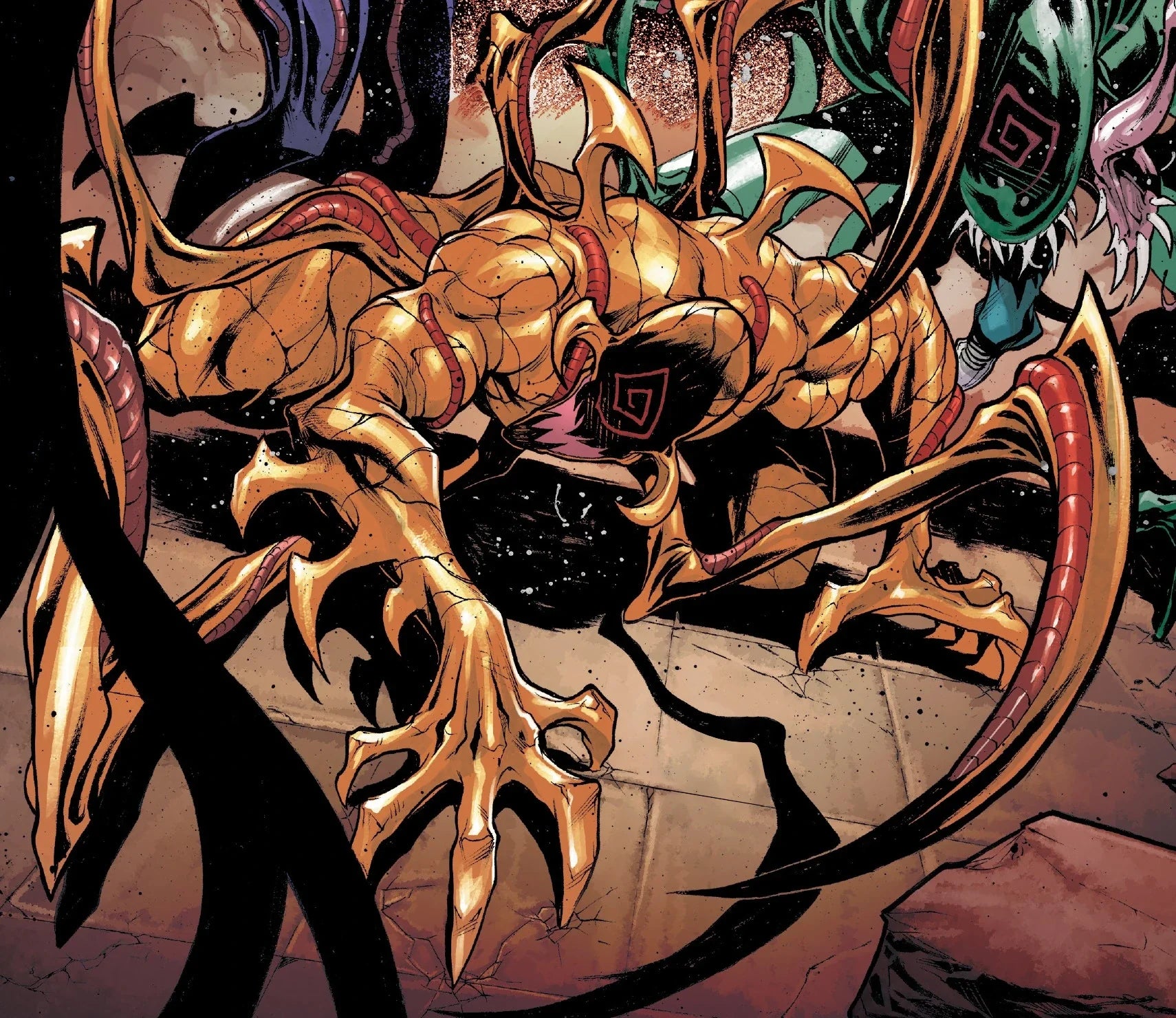
Each of the five was given a distinctive trait, and this one is the easiest to remember: Phage shapes its biomass into blades. Multiple blades at the shoulders, blades along the arms, and a marked preference for anything that cuts. Where Lasher produces whip-like tendrils and Scream a head of living hair, this one produces edges.
The rest is the shared species toolkit: increased strength and speed, a healing factor, camouflage. Our article on the bond with the symbiote goes back over that common ground, and the page devoted to Venom and the symbiotes places each member within the family.
A colour nobody pins down
A telling detail of how little attention it received: its shade changes from issue to issue and from colourist to colourist. Yellow, orange, yellowish brown. The careful wording is 'yellow-orange with black markings' — asserting a single colour means contradicting half the pages it appears on.
Five creatures, one single brief
The five spawn follow a very simple design logic, and understanding it helps you stop mixing them up. Each gets a colour, a weapon and nothing else. Tendrils for Lasher, living hair for Scream, acid for Agony, brute strength for Riot, blades for Phage. None has a written personality at this stage, none has a motivation of its own: they are five variations on one template.
That choice was pragmatic — the story needed five opponents readable in a single panel, in a narrative that had no room to develop them. It had a lasting consequence: three decades later, most readers can recognise their silhouettes without being able to name a single one of their hosts.
It is also what makes them so well suited to being turned into objects. A range of symbiote figures can run through all five by changing the shade and the weapon, where more fully written characters would demand distinct poses. The same principle applies to the stickers and posters devoted to the siblings.
Its own writers got its host wrong
Here is the most telling fact on its record, and it concerns not the character but how it was made. In the origin arc, the creative team names Phage's host sometimes 'Carl', sometimes 'Ramon'. But Ramon Hernandez is Lasher's host. The confusion is in the comic itself, not in the summaries that followed.
Online profiles then copied the error, which today leaves contradictory sources on an elementary point. The correct host is Carl Mach. And watch out for a second first-name trap: another Carl carries the symbiote thirty-one years later, in 2024. Two separate people, not one career.
That kind of editorial wobble is not rare in the series of that era. Our rundown of the sagas' inconsistencies lists others, often turned canon by sheer repetition.
Separation Anxiety: the host dies, the symbiote survives
In late 1994, the five hosts break Eddie Brock out so he can teach them to master their creatures. Donna Diego, Scream's host, murders them one by one and pins the blame on Brock, convinced that every symbiote corrupts its host. Carl Mach dies at her hand.
The crucial point, and the one most summaries flatten: the symbiote itself survives. Diego kills the men, not the creatures. That is precisely what makes what follows possible. Our profile of Scream tells this episode from the point of view of the woman who set it off.
Hybrid: four symbiotes, not five
Recovered by the authorities, the four survivors are held and experimented on. And this is where a nuance almost every article gets backwards comes in: it is not scientists who merge them. The four break their restraints on their own, during the biological scream released by Venom in 1995, and combine of their own accord.
The entity that results is called Hybrid. It counts four symbiotes — Agony, Phage, Riot and Lasher. Scream is not part of it, for the obvious reason that its host had just killed the others. Do not confuse it with Madness, which combines all five strains and appears far later, in 2023, on a different host. Two entities, two line-ups, two eras.
Scott Washington, the host everyone forgets
Hybrid debuts in January 1996 and bonds with Scott Washington, an African-American guard posted at the prison where the symbiotes were being studied. He had let one of them escape after realising that the experiments were causing it pain — which cost him his job.
Back in Brooklyn, he is caught in a shooting: his brother is killed and he is left paralysed. That is when Hybrid bonds with him and gives him back his mobility. The character then turns down an invitation to join a team of young heroes. Our profile of Hybrid follows that path in detail.
A word of honesty about his end: several sources claim Eddie Brock shot him, but none gives a precise reference, and a detailed retrospective of the series of that period does not confirm it. So we are not writing it up as an established fact.
FIGURES & COLLECTION

Spider-Man Noir Symbiote Tobey Maguire Figure
The black suit all five spawn descend from, at the very root of this bloodline.
129.90 €
Discover →Three lives after the merger
Hybrid did not form once but at least three times, and that is the second common error on this subject. After 1996, the entity is recovered by the American government, broken back down into its four original components, and handed out to an anti-Carnage military unit in the early 2010s.
Phage there goes to Lieutenant Rico Axelson, a marksman. The pairing produces the most concrete detail in its whole record: it lets him hit a target with surgical precision at roughly two and a half kilometres. It is the only time the symbiote is used for something other than cutting.
What follows is stranger. In 2014, a clash with Carnage wipes out that unit; the four symbiotes bond with Deadpool's dismembered body and merge again to take revenge. Then, in 2021, they recombine under the control of Knull.
What the secondary spawn bring to the mythology
You might think these five creatures were nothing but 1993 filler. Yet they settled a question the story could not avoid: if one symbiote exists, how many are there? As long as Venom was unique, it stayed an accident. The moment five can be extracted in a laboratory, it becomes a species.
All the later mythology flows from that shift. A species has an origin, a demographic, a hierarchy — and Marvel eventually invented a creator god for it. Our article on Knull tells that story, but none of it would have a foundation without the 1993 extraction.
It is also why the symbiote aisle has broken away from Spider-Man's own. Between the t-shirts carrying the spider logo and the mugs with the gaping jaws, two visual languages now sit side by side on the same shelves — and it is this 1993 family that made the second one possible.
Its one moment of glory: a hunting dog
Phage is the only one of the five to have had its own event issue, in July 2021. And the story takes an unexpected line: the symbiote, which longed for a simple existence, was living bonded to a hunting dog named Mitch.
The image is the truest thing anyone has written about it. After thirty years spent as a bodyguard, a test subject, a merger component and a precision weapon, the creature asked for nothing more than to run in a field. Called back by Carnage, it partly devours the dog's owner before bonding with his dying body.
The issue is written by David Michelinie and drawn by Ron Lim — the two creators behind its first appearance, reunited twenty-eight years later on the character they had left unnamed. It is probably the finest tribute a secondary symbiote has ever received.
And since then?
Its last documented major appearance dates from 2024, in a story where Silver Sable turns her team of mercenaries into a symbiote squad to face an epidemic. Phage there goes to a new host — the second Carl of its history.
The fate of captive symbiotes, a recurring pattern
Phage's history turns on one and the same situation, repeated four times in thirty years: an institution seizes it and decides what it is for. The Life Foundation builds it to serve as a bodyguard. The authorities confiscate it to study it. The army hands it to a marksman. Silver Sable assigns it to a squad. It never chooses.
That is what sets the Life Foundation spawn apart from the major symbiotes. Venom negotiates with Eddie Brock, Carnage dominates Cletus Kasady, Anti-Venom is born of a willing transformation. These ones are assigned. The only moment one of them expresses a desire of its own — to live quietly with a dog — arrives twenty-eight years after its creation, and the story takes it away in the same issue.
That reading lights up the whole family. Our profiles of Agony and Lasher follow the same path of a manipulated object, and the page devoted to the symbiote family lets you compare their journeys with those of the creatures that did get a say.
One exception: the scream of 1995
There is a single episode in which these four act of their own accord, and it is worth underlining: when they break their restraints during Venom's biological scream, nobody gave them the order. They free themselves, then combine. It is the one collective decision of their history, and it produces Hybrid.
What it is not
Two confusions do the rounds, and it is better to cut them off. The first presents it as 'Carnage's twin'. That is a headline the body of the article does not even support: Carnage is born of the Venom symbiote via Cletus Kasady, Phage is born of an industrial extraction. No direct kinship.
The second concerns the films. Phage is not named in any film. Sources contradict one another on whether it even appears in the 2018 film: some see only Riot, others believe they can make out two more spawn. The point is not settled, and presenting it as established would be dishonest. Riot remains the family's one media exception — the only one genuinely adapted and named.
On the merchandise side, this branch has its own aisle of symbiote figures, separate from the Spider-Man figures, and the gaping-jaws imagery turns up on the t-shirts as much as on the posters.
FIGURES & COLLECTION

Spider-Man - Venom 30cm Figure
The large-format Venom, the strain Phage and its four brothers were extracted from.
69.90 €
Discover →The least documented of the five, and why
The claim holds up, provided you argue it. Unlike the hosts of Scream and Agony, Carl Mach has no encyclopaedia entry of his own. His origin arc gets his first name wrong. No adaptation names him. And you have to wait until 2021 for a story to finally give him an intention of his own.
One qualification is needed: it is also the only one of the five to have had an event issue under its own name, something neither Lasher nor Agony managed. Low-profile does not mean absent — it means it took thirty years to find it a role.
To place these characters in relation to one another, the page on the universe of characters gives the overview, and our selection for beginners points to the volume to start this period with. The gift selection covers the safe bets for a reader who already knows the whole family.
A last word on how to read these profiles. The encyclopaedia pages devoted to secondary symbiotes are, today, largely copied from one another, and automated access to the reference databases is frequently blocked — which pushes secondary sites to cite each other without checking. That is exactly how a false date like 1992 survives twenty years. The useful rule, for Phage as for its brothers: every issue, every date and every host name must be confirmed by two independent sources before it is taken as read. We have applied that rule to every claim in this article, and set aside the ones that did not pass — the death of Scott Washington being the clearest example.
The essentials
A spawn extracted from Venom in 1993, not 1992. Blades for a signature. A host named Carl Mach, whom its own writers sometimes called Ramon. A murdered host but a surviving symbiote, which then merges with three of its brothers — four in total, never five — to form Hybrid, on their own initiative. And, after thirty years, an issue in which all it wanted was to be a dog.
To go further, Toxin represents the next generation of the bloodline, and Planet of the Symbiotes tells the story of the event during which Phage and its brothers broke their restraints.

