

14-Day Money-Back Guarantee
0
The short answer
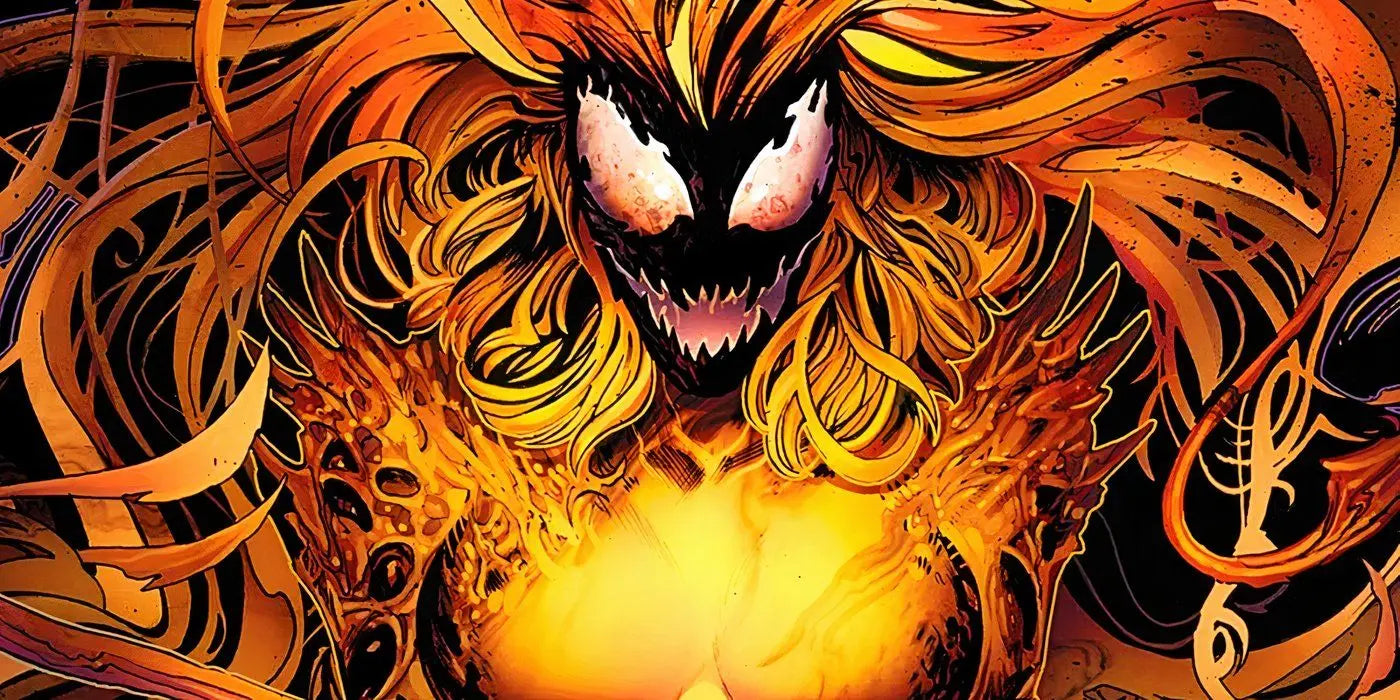
Scream is one of the five symbiotes extracted from Venom by the Life Foundation in 1993. Its signature is unique in the family: a mane of tentacles that it whips and hardens into blades. Its original host, Donna Diego, murders the four other hosts before being arrested. Four women have carried this symbiote in turn, and the name itself does not come from the comics.
There are five symbiotes born of the Life Foundation, and only one of them built its reputation on a purely graphic detail: its hair. Scream is the most recognisable of the five offspring, the one whose silhouette looks like no other symbiote — and its story holds several surprises for anyone who settles for online summaries, starting with the origin of its name.
Born from an extraction, not an encounter
The origin goes back to 1993 and to the mini-series that made Eddie Brock a lead character. The Life Foundation, a survivalist organisation run by Carlton Drake, captures Venom and forcibly extracts five offspring from it. Each one is grafted onto a member of the foundation's security staff. The symbiote later known as Scream appears there for the first time, written by David Michelinie and drawn by Ron Lim.
This birth by extraction changes everything compared with Venom or Carnage. There is no encounter, no choice, no affinity: a laboratory harvests, cultivates and grafts onto staff who volunteered without grasping what they were agreeing to. Our article devoted to this 1993 mini-series covers the background, and the profile of Riot follows another of the five offspring.
The five, and their hosts
Each of the five symbiotes has its own agent. Donna Diego carries the one that will become Scream, Trevor Cole the Riot symbiote, Ramon Hernandez the Lasher symbiote, Carl Mach the Phage symbiote, and Leslie Gesneria the Agony symbiote. These pairings are worth remembering, because the rest of the story rests entirely on the distinction between the symbiote and the person carrying it.
Our profiles of Agony and Lasher cover two other members of this brood, and the one on Hybrid tells what becomes of four of them. On the merchandise side, this whole branch has its own aisle of symbiote figures, separate from the Spider-Man figures.
FIGURES & COLLECTIBLES

Spider-Man and Symbiote Collector Figure
The host-symbiote bond frozen in three dimensions: the founding gesture of this entire family.
99.90 €
Discover →The trap in the name: it does not come from the comics
Here is the point that almost every profile gets wrong. In the 1993 mini-series, none of the five symbiotes is named. They are creatures of different colours worn by anonymous agents. Scream, Riot, Lasher, Phage, Agony: those names do not exist yet.
They appear in the mid-1990s, through the merchandise — a video game in 1995, a figure range in 1996. Sources disagree on which of the two fixed the name first, and it would be dishonest to settle it: what is established is that the name does not come from the original story.
The first appearance of the name in a printed comic dates from 1999, in a promotional booklet handed out by a theme park. And Marvel only officially adopts the alias in 2007, in an encyclopaedic supplement that finally identifies the symbiote as Scream and its host as Donna Diego. Fourteen years after the character was created.
That path says something about the era: a figure named a character the publisher had not thought worth naming. Our surveys of continuity errors list other cases where merchandising came before canon.
The hair, a weapon that belongs to her alone
Every symbiote produces tentacles. Only one turns them into hair. Scream's biomass forms long prehensile strands that she throws out to whip, grab or bind, and that she can harden into blades. It is her offensive signature as much as her visual one, and specialist sources present it as unique to this symbiote in the whole family.
The rest of the arsenal is common to the species: enhanced strength, adhesion, regeneration, and the two historic weaknesses of fire and sonic frequencies. Our article on the relationship with the symbiote revisits that shared foundation, and the page devoted to Venom and the symbiotes places each member within the whole.
A design built to stand out
The choice is no accident. By 1993, symbiotes were already starting to look alike — same build, same maw, same tentacles. Giving one of them bright yellow hair makes it identifiable in a single panel. It also explains its lasting presence in video games and figure ranges, far beyond its actual importance in the stories.
That graphic legibility also explains why the five offspring work so well as objects: with identical silhouettes, colour alone is enough to tell them apart. It is the very principle behind ranges of symbiote figures, where you recognise a character by its shade before reading its name, and the same logic runs through the wall stickers.
Separation Anxiety: the host becomes the monster
The sequel arrives in late 1994, in a four-issue mini-series written by Howard Mackie and drawn by Ron Randall. The five offspring break out Eddie Brock, then separated from his symbiote, so that he can teach them to master theirs. They also kidnap a Daily Bugle journalist.
The twist is brutal: it is Donna Diego who murders the others, using a sonic blade, convinced that every symbiote is evil and corrupts its host. She announces that she intends to kill Brock next, then Carnage. Brock recovers his symbiote, beats her, and she is arrested.
The mistake everyone repeats
You constantly read that 'Scream killed the four other symbiotes'. That is false, and the nuance is decisive: she killed their human hosts. The four symbiotes survive. They are held and studied by the government, then merge into a single entity — Hybrid — bonded to a paralysed guard, in January 1996.
In other words, Donna Diego's act does not destroy her siblings: it forces them to become something bigger. Without that massacre, no Hybrid. Diego herself deserves a closer look: presented as a Life Foundation volunteer living with schizophrenia, a condition that predates her bond with the symbiote, she is one of the rare hosts whose mental state is not caused by the creature.
FIGURES & COLLECTIBLES

Spider-Man Figure - Carnage 30cm
Carnage, the target Donna Diego had promised herself after Brock — and that she will never reach.
69.90 €
Discover →Four hosts, one identity
What sets Scream apart from the other symbiotes is the way it passes on. Where Venom remains overwhelmingly tied to Eddie Brock and Carnage to Cletus Kasady, this symbiote has changed host four times, and always between women.
Donna Diego carries it from 1993 to 2012. In 2019, the revived symbiote uses her corpse as a frame, Diego's consciousness surviving in it only as a residue — an image the story owns as pure horror. Next comes Patricia Robertson, once the host of a Venom clone, killed by Carnage while protecting her successor. Then Andi Benton, whom readers knew as Mania.
Our profile of Mania covers Andi Benton's earlier period, and the one on Carnage sheds light on the recurring enemy of this whole line.
Andi Benton is no longer Scream
Beware of a frequent, and recent, misreading. Andi Benton carried the symbiote from 2019 to 2021 — and she burned it. The symbiote is destroyed, and its remains were used to create another creature. Writing today that 'Andi Benton is Scream' means describing a state of affairs several years out of date. A new host appeared in 2024, a mercenary within a team led by Silver Sable.
An exclusively female line, and what that changes
No other major symbiote shows this trait. Venom passes from Eddie Brock to Mac Gargan and then Flash Thompson, Carnage stays moored to Cletus Kasady, Toxin changes hands with no logic of gender. Scream, for its part, has only ever been carried by women — four in thirty years.
It was probably not an original intention: Donna Diego was one agent among five, chosen for no more reason than her colleagues. But repetition ended up creating an identity. In editorial practice, this became the symbiote that passes from heroine to heroine — which explains why it was given its own series when three of its siblings never rose above walk-on status.
That particular standing shows even in the merchandise catalogue, where the symbiotic creatures have their own aisle alongside the t-shirts and posters devoted to the web-slinger. The page on the characters of the universe places each of these hosts.
The Vault, and what becomes of a confiscated symbiote
One detail of the story deserves a pause, because it explains what follows. After the massacre committed by Donna Diego, the four surviving symbiotes are not destroyed: they are recovered by the authorities and locked inside a prison facility designed for superhumans, where they are studied.
It is an idea that symbiote stories rarely exploit and that deserves better than its treatment: what does a state do with a living creature that has no legal status, no body of its own and no way to communicate? The story's answer is summary — lock it up and watch it — and it produces exactly what you would fear. The four end up merging into a single entity and bonding with a paralysed guard.
This logic of confiscation runs through the whole mythology. You find it in stories where a government agency seizes creatures it does not understand, and it explains the lasting distrust between symbiotes and human institutions. Our profile of Hybrid tells what becomes of that quartet, and the one on Toxin shows another attempt at institutional control, this time by the police.
Scream is not Shriek
The most stubborn confusion is not with another symbiote but with a character who has nothing to do with them. Shriek, real name Frances Barrison, appears in March 1993 — the same year. She is a human with sonic powers linked to the Darkforce, without the slightest connection to the symbiotes, and best known as Carnage's accomplice.
The closeness does not stop at the name. Both characters orbit Carnage, both are women created in the same year, and both have a visual identity built on hair — Shriek's is a bristling black mass, Scream's a cascade of yellow tentacles. A reader who meets one and then the other a few months apart has every reason to mix them up, and search engines keep the misunderstanding alive by offering one for the other.
Two similar names, the same year of creation, the same sonic register in the imagination: everything conspires to blur them. Our profile of Shriek clears up the ambiguity, and our article on Maximum Carnage shows the part she plays in it — an arc where Scream, precisely, does not appear.
A second thing not to confuse: Scream is not named in the 2018 film. Only Venom and Riot are identified there; the other Life Foundation symbiotes merely pass through, without a single name being spoken.
Her own series, and what it says
Scream is the only one of the five offspring to have been given a title of her own. The series follows Andi Benton during her time as host, between 2019 and 2021, and takes an unexpected line: rather than making her one more vigilante, it treats the relationship between host and creature as an uneasy cohabitation, where each pulls in a different direction.
That is where the character becomes interesting. Most symbiote stories ask the question one way round: does the creature corrupt its host? Here it goes the other way — what becomes of a creature bonded to someone who hates it? The answer arrives at the end of the period: Andi Benton burns the symbiote. She does not free herself from it, she destroys it.
A rare ending in the family
Symbiotes almost always come back. Venom has been destroyed, scattered, corrupted, and has returned every time; so has Carnage. That this one is reduced to ashes by its own host, and that its remains are then used to make another creature, makes it an exception. Our page devoted to the symbiote family lists these fates, and the article on Anti-Venom describes the other possible path — the one where the creature transforms instead of disappearing.
One open question remains unsettled by the stories: does the host who appeared in 2024 carry the same symbiote, reconstituted, or a separate creature that has taken over the name? The sources do not establish it, and it is better to say so than to decide in their place.
What to take away from this symbiote
Scream holds a strange place in the family: visually memorable, narratively secondary, and yet present for thirty years. She is the only one of the five offspring to have had her own series, and the only symbiotic creature whose identity passes from host to host rather than staying attached to one name.
She also illustrates an editorial mechanism we forget: a character anonymous in her own origin story, named by a figure, made official fourteen years later, and established enough to carry a title. The overview of the story arcs places each of her appearances, and our selection for beginners says which volume to start this period with.
To carry on with the merchandise, the symbiote branch has its own iconography — the open maw, the tongue, the tentacles — found on the t-shirts, the posters and the tapestries. And if the idea is to give a gift to a reader who already knows the whole brood, the gift selection avoids a duplicate.
FIGURES & COLLECTIBLES

Articulated Spider-Man Figure - Venom Let There Be Carnage
The articulated format, on a small budget, to complete a symbiote brood without spending a month's food shop on it.
20.72 €
Discover →The essentials in five points
An offspring extracted from Venom by the Life Foundation in 1993, created by Michelinie and Ron Lim. A mane of tentacles that belongs to it alone. An original host who murders the hosts of the four others — without killing the symbiotes, which will merge into Hybrid. A name that came from the merchandise, made official by Marvel only in 2007. And four successive hosts, the last of whom destroyed the creature.
For what comes next in this family, Toxin represents the following generation, and Knull the origin Marvel eventually invented for them.

