

14-Day Money-Back Guarantee
0
The short answer
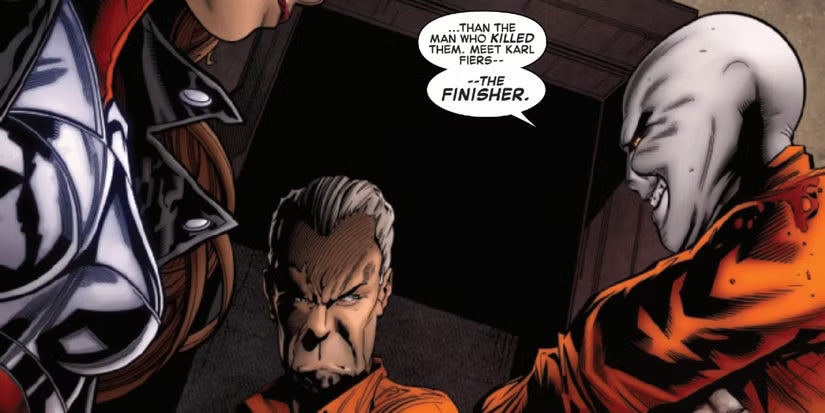
Behind that code name hides Karl Fiers, a professional killer trained in the Cold War school of espionage. He is the one who sabotages the Parkers’ plane, passing a contract killing off as an accident, and who leaves young Peter an orphan. Detailed portrait below.
The shadow behind the founding tragedy: who really is the Finisher?
In the mythology of Peter Parker, one of the most underrated tragedies is not that of Uncle Ben – but the far older, long-hidden death of his parents. Richard and Mary Parker, two agents secretly affiliated with S.H.I.E.L.D., were eliminated by a foreign organisation led by a cold, methodical man, almost invisible in the archives: the Finisher. An almost ironic name, so completely does he embody the full stop placed on a destiny broken before Peter ever had the slightest chance to understand his origins.
Introduced in the early arcs of Amazing Spider-Man, the Finisher, alias Karl Fiers, is the very embodiment of the ghost soldier: a special agent tasked with the missions that are too sensitive, too dirty, too heavy to be handed to a ‘classic’ enemy of the web-slinger. Unlike flamboyant figures such as the Green Goblin or Kraven, the Finisher seeks neither glory nor chaos. He removes. He executes. He leaves reports behind him, not monuments. And it is precisely that clinical coldness that makes his role in Peter’s life so chilling.
The Finisher’s involvement in the death of the Parker parents was long buried under a fog of false files, double agents and deliberately fragmented accounts. But one constant remains: if Peter Parker grew up an orphan, it is partly because of this man. A professional assassin who never faced Spider-Man out of revenge or ambition… but simply because Richard and Mary were on his list.

When Spider-Man later investigates his parents’ past, he discovers that their death was no ordinary plane crash, but an orchestrated elimination. The Finisher then appears as the missing link, as the invisible hand behind a trauma Peter never even suspected. This theme of the past resurfacing sits squarely within the narrative legacy of modern Spider-Man, where every family secret becomes a moral weight to face.
This first chapter sets the scene: a discreet enemy, with no costume, yet whose effect on Peter’s life ran deeper than that of hundreds of supervillains. A man whose presence recalls dark arcs such as Morlun or the Inheritors, where it is not the fights that break Peter, but the revelations.
And of course, that tragic legacy still shapes what fans find today in the Spider-Man figures inspired by his earliest years, or in the retro posters retracing the origins of the orphan from Queens. But the full truth about the Finisher only emerges through his past, his methods… and his direct confrontation with the web-slinger.
A Cold War spectre: understanding the man behind the mission
To grasp the Finisher’s importance, you first have to understand the context of his creation. The Marvel universe of the 1960s and 1970s was steeped in an atmosphere of Cold War, espionage and international paranoia. Masked heroes did not only face monsters or cosmic titans: they also crossed paths with government agents, clandestine operations and secret organisations. It is in that grey zone that the Finisher was born.

Unlike most of Spider-Man’s enemies, he is not the product of a scientific transformation or an accident. He is the result of a brutal military upbringing, methodical training and absolute loyalty to his superiors. His code name, ‘Finisher’, is not a fanciful title: it is a function. He steps in when diplomacy, negotiation and even threats have failed. He closes the files. Without a trace.
This realistic, glacial dimension makes the Finisher a wholly separate antagonist in the web-slinger’s world. Where Shocker or Rhino impose themselves through brute power, the Finisher strikes through administrative efficiency and a total absence of ego. He has no need to deliver a monologue: he simply pulls the trigger and moves on to the next file.
The Parker mission: a ‘routine file’ turned founding tragedy
When Richard and Mary Parker infiltrate an enemy organisation, they know they risk being discovered. But they do not know that the man facing them is someone like the Finisher. To him, Peter’s parents are not charismatic enemies or symbols – they are two names on a list, two spies to be eliminated. Their death is not an epic clash: it is a cold, swift, methodical execution. The plane crash that takes them is not an accident, but a sabotage signed by his own hand.
That detail completely transforms how we read Peter’s past. Unlike multiverse arcs such as the Spider-Verse, where the threats are cosmic, his parents’ death comes from an almost ordinary man. A man whose face could melt into any crowd. And it is precisely that ordinariness that makes his act even more terrifying.

A deliberately dehumanised figure
The Finisher has no grand philosophical motives, no personal vendetta, no founding tragedy. The writers built him as a narrative tool: a mechanical presence, a cog in an international machine where human life counts for very little. It is a total contrast with the web-slinger’s highly personalised antagonists, such as the Green Goblin or Mysterio, who are defined by their tormented psychology.

Facing him, Spider-Man comes up against not a mirror of his own humanity… but a total absence of humanity. That opposition recalls the implacable coldness of certain dark story arcs, such as The Death of Jean DeWolff or Kraven’s Last Hunt, where Peter confronts less an enemy than a trauma made flesh.

A quiet but crucial influence on the adaptations
The Finisher rarely appears in the films or series, yet his influence runs through every modern reinterpretation of the Parker parents. Many versions of the myth introduce elements of espionage, secret missions or terrorist organisations, reusing the narrative structure the Finisher set in motion. That absence of direct representation almost strengthens his aura: he is not a popular character, he is a ghost from the past.
And it is that past Peter is still trying to piece together today, in the major storylines gathered in the pillar pages such as The Story of Peter Parker.
In the next part, we will follow his direct confrontation with Spider-Man, and see how this man without a costume became, in spite of himself, a ‘founding’ enemy of the web-slinger.
Spider-Man facing his parents’ killer: an unexpected confrontation
When Peter Parker finally discovers that his parents did not die in a simple plane crash, but were eliminated by an agent called the Finisher, the shock is immense. This is not a clash like the ones with the Green Goblin or Rhino, where hatred burns on both sides. Here, the antagonist does not even know Peter Parker’s name. To him, Richard and Mary Parker were targets. Their elimination carried no emotional weight at all. That coldness turns the confrontation between Spider-Man and the Finisher into a moment of rare psychological violence.
When Spider-Man hunts him down, he is not looking for revenge – because that is not what drives Peter Parker. He is looking for the truth. And that search leads him straight to an ageing, almost broken man whose career is behind him. The Finisher is no longer the merciless soldier of old: he is a tired veteran agent, eaten away by scars he never speaks of. The contrast recalls Peter’s shock at discovering that some monsters from his past are not titans, but fragile men who committed the irreparable.
A fight that puts the hero’s ideal to the test
The tension between the two does not come from physical power – the Finisher is no superhuman supervillain. It comes from the moral confrontation. For the first time since Ben Parker’s death, Peter finds himself facing the man whose actions shaped his earliest years. And yet, when he can finally stop him, he does not strike. He does not take revenge. He stays faithful to Ben’s maxim: ‘With great power comes great responsibility.’

That moment echoes other scenes of moral restraint, such as when Spider-Man spares Mysterio, or when he desperately tries to save even his worst adversaries, something the MCU films capture perfectly. Peter has always refused to be judge, jury and executioner. And that principle finds even greater force here, because the temptation to avenge his family is immense.
A tragic ending that echoes through the whole of the web-slinger’s mythology
The Finisher ends up dying not at Spider-Man’s hands, but from the consequences of his own life. Wounded in a clash where his technology turns against him, he meets an ironic end: a man who ‘finished’ so many other lives is finally finished off by his own weapons. Before dying, he reveals the details of the Parker mission to Spider-Man, finally giving Peter a form of truth – but not peace.
This scene underlines a theme that runs through the whole Spider-Man universe: the past never offers perfect closure. It simply piles up, layer after layer, shaping the hero’s choices. That pattern connects with modern arcs such as Life Story or The Saddest Moments in Spider-Man’s History, where the web-slinger’s life is marked not by explosive victories, but by lasting wounds.

Impact on modern adaptations
The Finisher almost never appears in the films, but his influence is present in every rewriting of Peter’s past. Marc Webb’s films, for example, lean heavily into the mystery surrounding the Parker parents, and even though the Finisher is never named, his conceptual presence is palpable. His figure serves as a template: the invisible man, the agent in the shadows, the one who opened the first breach in the hero’s life.
That idea also surfaces in some of the merchandise built around Peter’s origins, notably the retro posters or the masks of the early years, which remind us that Spider-Man’s story always begins in loss and resilience.
The final part will conclude by exploring what the Finisher really represents in Spider-Man mythology: a symbol of a past that even superheroes cannot save.
The Finisher: a narrative ghost that defines Spider-Man
When you look at Spider-Man’s career as a whole — his triumphs, his losses, his rebirths — the Finisher stands out as an anomaly. A discreet enemy, almost erased, who never sought the spotlight or faced the web-slinger in a spectacular explosion. And yet his single act altered Peter Parker’s story more deeply than mythic enemies such as Morlun or the Inheritors who threatened the entire multiverse.

Because what the Finisher represents is not the external threat: he is the past made flesh. A past Peter Parker did not choose, could not stop, and only discovered years after the fact. This notion of ‘inherited tragedy’ runs through the whole Spider-Man universe, and feeds pillar pages such as The Story of Peter Parker or The Enemies of Spider-Man, where every antagonist lights up a moral facet of the hero.
The weight of a truth Peter never expected
When Spider-Man learns that the Finisher killed his parents, his reaction is neither rage nor a need for revenge. It is a silent shock — that of realising that his story, already marked by the loss of Ben Parker and the responsibilities that followed, is rooted far deeper than he imagined.
That revelation echoes other moments where Peter uncovers the grey areas of his own life, such as in The Lost Years for Ben Reilly, or in introspective arcs such as Life Story. Spider-Man is not simply a reactive superhero: he carries his past like luggage no power can erase.
And it is precisely because the Finisher is human — profoundly, ordinarily human — that his impact is so immense. He reminds us that even the greatest heroes are shaped by decisions taken by ordinary people, far from the spectacular. A theme that sets Spider-Man apart from many Marvel heroes.
Why the Finisher remains a key character despite his absence
Marvel never tried to exploit the Finisher as a recurring enemy. He has not been brought back to life, transformed, or expanded into sprawling sagas. His strength lies precisely in remaining a fixed piece of the past, an immutable point of origin. Like a silent shadow in the web-slinger’s mythology.
That is also why he rarely appears in merchandise. Nobody sells Finisher figures, yet shops shift endless numbers of pyjamas and Spider-Man blankets that celebrate the hero’s origins. Where the Finisher is a ghost, Spider-Man is the icon.

A discreet character… but essential to the building of the myth
Had there been no Finisher, Peter Parker might have grown up with his parents. He would not have carried the weight of solitude. He might never have spoken the line that defines the entire character: ‘With great power comes great responsibility.’
It is this invisible dimension that gives the Finisher an almost literary power. He never faced Spider-Man at the top of a skyscraper. He never threatened New York. He never bent reality like Mysterio. And yet, without him, the hero we know would simply not exist.
In that sense, the Finisher is one of the rare antagonists to shape Spider-Man without ever sharing the same moment of glory. He is the silent origin. The dark spark. The hero’s first wound.
Conclusion: the Finisher, the invisible pillar of Spider-Man’s destiny
When you trace Spider-Man’s great tragedies — the death of Gwen Stacy, the Spider-Verse saga, the fall of Ben Parker — the loss of the Parker parents often feels distant. Yet it is in fact the first fracture, the first absence, the one that defined Peter Parker before he ever pulled on his mask.
The Finisher therefore embodies an essential idea within the Spider-Man universe: every hero is born of a loss. And sometimes that loss does not come from a titan of crime, but from a man we know almost nothing about.
That is what makes Spider-Man such a profoundly human hero — and what makes the Finisher a character who, despite his tiny role, will remain forever carved into the web-slinger’s mythology.

