
14-Day Money-Back Guarantee
0
The short answer
The story follows Cletus Kasady's escape from the Ravencroft Institute: his scarlet symbiote, which had taken refuge inside his very blood, regenerates, and he then rallies Shriek, Demogoblin, Doppelganger and Carrion to hand Manhattan over to chaos. Origins, characters and legacy are detailed below.
Some story arcs mark a generation of readers not because they are the most refined or the most nuanced, but because they capture the spirit of an era with brutal precision. Maximum Carnage is one of them. Published between July 1993 and November 1993, spread across fourteen issues and five titles of the Spider-Man universe, this arc represents the very peak of what 1990s comics could offer in excess, in violence and — paradoxically — in sheer memorability. When Venom and Spider-Man join forces for the first time against a common enemy whose threat defies all ordinary criminal logic, the Marvel universe plunges into a story that still has not been surpassed for chaotic density and psychological tension.
The 1990s context: the age of excess in Marvel comics
To understand Maximum Carnage, you have to understand the era that produced it. The 1990s were the golden age of extreme comics — a period marked by an explosion in sales, speculation on collector's issues, and a race towards ever greater visual and narrative escalation. Artists such as Todd McFarlane, Jim Lee and Erik Larsen redefined the aesthetic of American comics towards more muscle, more graphic violence, more raw intensity. Hologram and foil covers sold in their millions. Print runs on some issues went beyond a million copies.
In that context, Carnage was the perfect answer to what readers were asking for: a symbiote even more violent than Venom, a host even more unstable than Eddie Brock. Cletus Kasady — a serial killer since childhood, an absolute nihilist, convinced that chaos is the only valid truth — embodies everything the 1990s wanted in a supervillain. No code of honour, no industrial logic, no goal beyond destruction for destruction's sake. Maximum Carnage is designed as the ultimate expression of that philosophy, pushed to the scale of an entire city.
The Ravencroft escape: how Carnage rebuilds his symbiote
The arc opens inside the walls of the Ravencroft Institute, Marvel's equivalent of Arkham Asylum — a high-security psychiatric facility for criminals with supernatural powers, on the outskirts of New York. Cletus Kasady has been locked up there ever since Spider-Man and Venom jointly put an end to his first wave of terror. But in the world of comics, no prison is ever truly permanent.
The mechanics of his release are deliciously horrible: the Carnage symbiote, long thought to have been separated from Kasady, had in fact colonised his own blood. Kasady and the symbiote are literally one at a biological level — the symbiote flows through his veins, lodged inside his red blood cells. That organic fusion explains the scarlet red colour of the Carnage symbiote, unlike the black of Venom, and it makes a complete separation almost impossible without killing the host. Kasady regenerates the symbiote from inside himself, and escapes Ravencroft leaving a trail of bodies behind him.
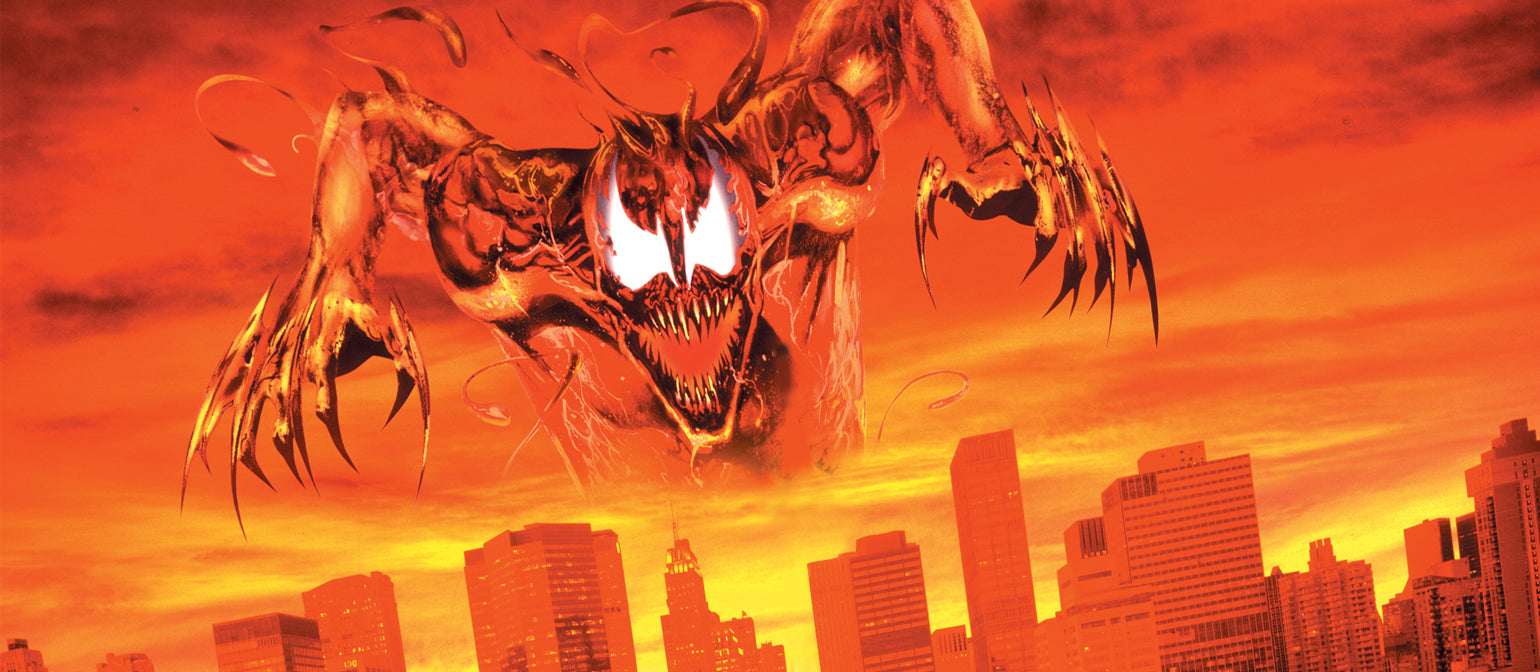
 The iconic cover of Maximum Carnage — 14 issues published between July and November 1993 across five titles of the Spider-Man universe.
Carnage's gang: a family of psychopaths storming New York
What sets Maximum Carnage apart from earlier Carnage arcs is the building of a genuine coalition of chaos. Kasady does not stay alone: he actively recruits allies who share his absolute contempt for social order. This "family" is one of the darkest creations of the 1990s in Marvel comics.
Shriek is the emotional pivot of the group. Frances Barrison — her real name — is a woman imprisoned at Ravencroft whose sonic powers amplify the negative emotions of anyone within her reach. She can literally induce panic, hatred and violence in entire crowds of New York civilians, turning ordinary passers-by into rioters. Her relationship with Carnage is one of the most disturbing in comics: this is not ordinary criminal complicity, it is a kind of twisted pseudo-parental bond. Carnage, who has never known a functional family, builds with Shriek the fantasised equivalent of a family unit — a "mother", monstrous "children", a territory to defend.
Demogoblin is a demonic goblin — a villain created during the Hobgoblin arc, who merged with a demon — and whose violence is aimed selectively at those he sees as sinners. Doppelganger is a mechanical copy of Spider-Man created during the Infinity War crossover, an instinctive, brutal being with no real consciousness. Carrion is a parasitic entity born of corrupted scientific research into viruses, able to disintegrate organic matter on contact. Together, these four allies of Carnage turn the streets of Manhattan into a war zone.

The enemy at the centre of Maximum Carnage
Spider-Man Figure — Carnage 30cm
Cletus Kasady in all his scarlet madness. This 30cm collector's figure captures the essence of the villain who made Maximum Carnage possible — the most absolute threat New York has ever faced in the Spider-Man comics.
69,90 € View the figure
The impossible alliance: Spider-Man and Venom against a common enemy
Peter Parker's decision to join forces with Eddie Brock is one of the most dramatically rich moments in Maximum Carnage. Venom and Spider-Man loathe each other — that hatred runs deep and goes back a long way, fed by the history of the black symbiote that bonded with Peter first, before being rejected and finding refuge with Brock. Peter's Spider-Sense does not react to Venom, which adds a layer of physical anxiety to their collaboration: Peter has to fight alongside a creature he cannot feel coming.
But faced with Carnage and the scale of the carnage he unleashes across New York, pragmatism wins out. Peter contacts Venom — locked up in a high-security prison — and offers him a deal: temporary freedom in exchange for cooperation. Brock accepts, not out of altruism but out of personal hatred for Kasady, whom he sees as a perversion of everything the symbiote stands for. That self-interested motivation sits at the heart of what makes the alliance so unstable and so dramatically fertile.
The coalition gradually widens. Captain America joins Spider-Man with his unshakeable ethics and his absolute refusal of lethal violence. Black Cat brings her street-fighting expertise. Iron Fist and Cloak & Dagger round out the team with their defensive abilities. Firestar — whose microwave-based powers hold the key to the final resolution — and Deathlok also join the coalition. Morbius the Living Vampire, in one of his rare appearances as an ally, completes this mismatched group.
The central moral dilemma: can you answer hatred with hatred?
What makes Maximum Carnage more than a simple action story is the philosophical debate that runs through all fourteen issues between the different members of the coalition. That debate pits two fundamentally incompatible visions of justice and violence against each other.
On one side, Spider-Man and Firestar argue that answering Carnage's chaos with lethal violence would be to prove him right — to prove that chaos is the only response available. Peter Parker does not kill. It is an absolute rule, inherited from the lesson of Uncle Ben, and it defines his heroic identity more deeply than any of his powers. Every time Venom or Deathlok suggests finishing Kasady off for good, Peter opposes it — even when that prolongs the threat.
On the other side, Venom is brutally clear: Carnage has to die. There is no possible rehabilitation for a being whose entire existence is geared towards gratuitous destruction. Leaving Kasady alive after Maximum Carnage means guaranteeing a next time. Deathlok, whose programming includes utilitarian calculations about reducing harm, reaches the same conclusion by a different route. That tension between Peter's idealism and the pragmatism of his allies is the emotional backbone of the arc — and it never really resolves. Peter wins the argument tactically, but the story will prove him wrong operationally: Carnage will come back, again and again.

The ally Spider-Man hates
Spider-Man Figure — Eddie Brock Transformation
Eddie Brock mid-fusion with the black symbiote — the exact moment Venom becomes Peter Parker's impossible ally. This premium 119,90 € figure captures the man-monster duality at the heart of Maximum Carnage.
119,90 € View the figure
The resolution and Firestar's victory
The ending of Maximum Carnage is both tactically satisfying and morally frustrating — which makes it perfectly consistent with its themes. It is Firestar who finds the solution: her microwave-based powers heat the Carnage symbiote to a level that temporarily breaks the fusion between Kasady and the scarlet symbiote. Without the symbiote's protection and power, Kasady becomes an ordinary human being again — still dangerous, but on a human scale.
Peter Parker chooses not to kill Kasady in that vulnerable state. It is a decision Venom will contest — furious at seeing his personal enemy recaptured rather than eliminated — and one that foreshadows exactly the future relapses of Carnage. Kasady is locked up at Ravencroft again. The symbiote regenerates. And the cycle starts over. Maximum Carnage ends on an ethical ambiguity that later writers would exploit at length: did Spider-Man win, or simply postpone the inevitable?
The human cost of the arc is considerable. New York is traumatised. Hundreds of civilians have been injured or killed, driven to violence by Shriek's powers. The police are overwhelmed. Whole neighbourhoods of Manhattan bear the marks of Carnage's gang passing through. That scale of destruction — rarely shown so directly in mainstream Spider-Man comics — is one of the reasons Maximum Carnage struck readers of the time with such particular intensity.
The video game adaptation: the cult red cartridge of 1994
1990s pop culture is passionately attached to Maximum Carnage through its video game adaptation. Spider-Man and Venom: Maximum Carnage, developed by Software Creations and published by Acclaim Entertainment in 1994, was released simultaneously on the Super Nintendo and the Mega Drive. Its immediately recognisable feature is its blood-red cartridge — a bold marketing decision that turned the game into a collector's item before anyone had even played it.
The game faithfully follows the structure of the arc: the player alternately controls Spider-Man and Venom across fourteen levels matching the fourteen issues of the crossover. The soundtrack — provided by Green Jelly and Sponge — is a period piece in its own right, saturated heavy metal that fits the brutal aesthetic of the source material perfectly. Spider-Man and Venom: Maximum Carnage remains to this day one of the few 1990s superhero games to have kept a high nostalgia rating — original cartridges in good condition sell on the retro-gaming market for serious sums.
A direct sequel, Separation Anxiety, came out in 1995 on the same platforms, this time centred on the forced separation of the Venom symbiote. But it is Maximum Carnage that remains the reference point for this period — more violent, more direct, more memorable in its execution.
The legacy of Maximum Carnage: Absolute Carnage and King in Black
Thirty years after publication, Maximum Carnage still shapes the way the Marvel universe handles Carnage and the symbiotes. This arc set narrative precedents that became conventions of the genre: Carnage as a city-scale threat requiring a coalition of heroes, the ethical debate about lethal violence in the face of nihilistic threats, and Venom as an anti-hero whose interests occasionally align with Spider-Man's without the two characters ever truly becoming allies.
Absolute Carnage (2019), written by Donny Cates, explicitly revisits the structure of Maximum Carnage: Kasady set free, a coalition of heroes, a debate about neutralising him for good. But Cates injects into that homage the mythology of Knull — the god of the symbiotes — which gives a cosmic dimension to what had until then been an essentially local threat. King in Black (2020-2021) pushes that logic all the way: what Maximum Carnage began as a neighbourhood arc becomes a planetary threat.
The 1990s animated series worked elements of Maximum Carnage into several episodes, adapting the arc to the constraints of television censorship — without the graphic violence, but keeping the coalition structure and the philosophical dilemma. Those adaptations introduced the arc to a generation of fans who had no access to the original comics, cementing its reputation as a founding moment in symbiote mythology.

The symbiote era on your wall
Spider-Man Alien Costume Saga Comics Poster
The alien costume saga that started it all — the black symbiote before Venom, before Carnage, before Maximum Carnage. This vintage collector's poster pays tribute to the era that made the symbiote universe what it is.
22,90 € View the poster
Why Maximum Carnage is still essential thirty years on
It would be easy — and intellectually honest — to point out the weaknesses of Maximum Carnage. The arc is repetitive over its length, replaying the same confrontations against different backdrops. Some characters in the coalition are underused. The psychological treatment of Shriek, the most interesting character on the opposing side, stays superficial. And the artwork of the period, with its impossible muscles and distorted perspectives, has aged badly for a contemporary eye.
But those flaws are inseparable from what makes the arc valuable. Maximum Carnage is a document of its time — the most intense expression of a precise moment in the history of American comics. It captures the excess of the 1990s with an authenticity that more calculated modern tributes lack. And above all, it laid narrative foundations — the psychology of Carnage, the Spider-Man/Venom dynamic, the urban scale of the symbiote threat — that fed the best Carnage arcs of the following twenty years.
For fans of the symbiote universe who have not yet read Maximum Carnage, working through the fourteen original issues — available as a collected edition — remains a foundational experience. Not for its narrative refinement, but for its raw energy and its unapologetic ambition. This is the comic that proved the Spider-Man universe could carry a darkness nobody had dared explore until then — and that opened the way to everything that followed, from Anti-Venom to Knull.
To go further into the world of the symbiotes: discover the full story of Carnage, the villain born out of Maximum Carnage, and explore Planet of the Symbiotes, the other great symbiote arc of the 1990s that perfectly rounds out a reading of Maximum Carnage.

