
14-Day Money-Back Guarantee
0
The short answer
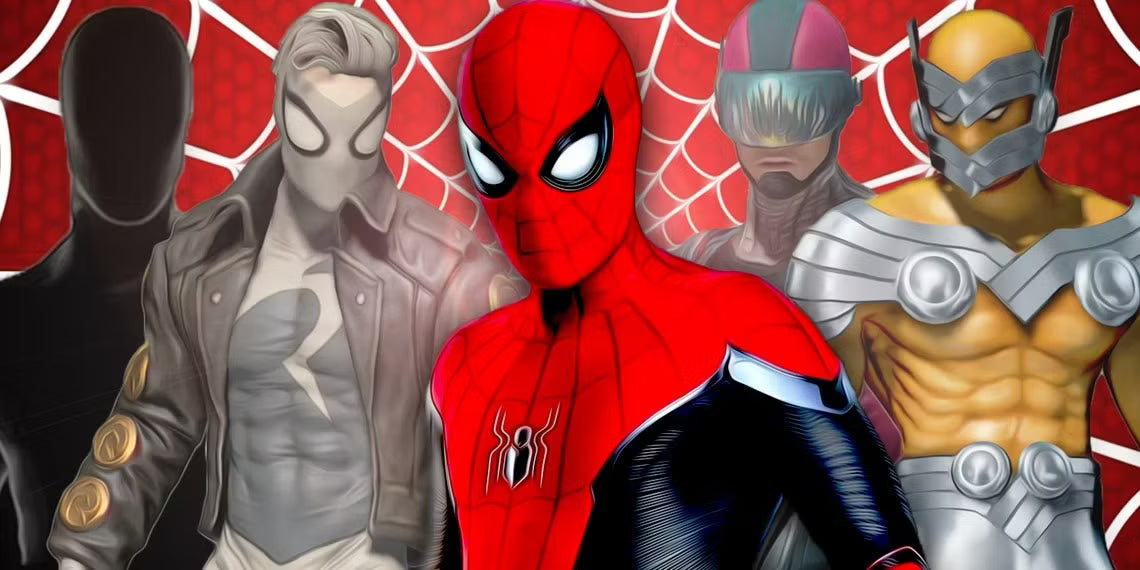
Stripped of the right to wear his red-and-blue suit in the late 1990s, Spider-Man splits into four brand-new alter egos: Hornet, Prodigy, Ricochet and Dusk. Each one embodies a side of himself Peter had never let himself explore. We break down all four below.
When people talk about Identity Crisis in the Marvel universe, plenty of them think straight away of the DC arc of the same name. Marvel has its own story built around the question of the secret identity, though, and it is the pages of Peter Parker: Spider-Man #90 to #95 that laid the foundations, back in 1998. The central idea is as simple as it is dizzying: what happens when a hero, wrongly accused, can no longer wear his own costume without risking arrest? The answer Howard Mackie and John Romita Jr. went for looked like nothing that had been tried before: Peter Parker shatters his identity into four, becomes four distinct characters, and explores in parallel four sides of himself he had never allowed to coexist.
This arc is often overshadowed by higher-profile sagas such as Back in Black, The Other or the Clone Saga. It left a lasting mark on Spider-Man's mythology all the same, because it asks a question most stories dodge: who is Peter really when he is no longer allowed to be himself? To place Identity Crisis within the hero's wider story, the best starting point is still the Clone Saga, which still divides fans, because both arcs share one obsession: the splitting of the self.
The background: why Peter Parker had to give up his costume
The trigger for Identity Crisis is not a cosmic attack or a new supervillain, but a murder charge. Peter Parker is suspected of killing a police officer, and the manhunt zeroes in on the red-and-blue suit. As long as that accusation hangs over him, the hero cannot stay active under his usual name. But Peter cannot stop helping people either, because what defines him is not a costume — it is a reflex to step in.
That tension echoes major arcs such as Spider-Man No More, where Peter hangs up the costume or Back in Black, where he abandons his morals after Aunt May's death. But Identity Crisis goes further: instead of simply walking away, Peter accepts the constraint, then works around it with a creative gesture. He invents new characters.
The editorial context matters too. In the late 1990s, Marvel was looking to rekindle interest in the web-slinger's stories after a decade marked by fan fatigue. To gauge the mood, a detour through One More Day, the story that changed everything — later, admittedly — sheds light on the ambition of that period: putting Peter back on the drawing board without discarding him altogether.
The four identities: Hornet, Prodigy, Ricochet, Dusk
The heart of the arc is the creation of the four alter egos. Each one matches a trait of Peter's personality he had never had the chance to push to its limit. For an overview of all these identities, a detour through Ricochet, Hornet and Prodigy, Peter Parker's alternative identities gives you the full picture.
Hornet, the electric vigilante
Hornet is the most tactical identity. Yellow-and-black costume, electric gauntlets, visored helmet. Where Peter usually favours acrobatic fluidity, Hornet favours the direct strike. That stance is a reminder of the temptation always present in the hero to slide into pure violence — the same temptation raised in the question of whether Peter has ever killed an enemy.
Prodigy, the shining hero
Prodigy is the exact opposite of Hornet: the classic hero, brilliant, almost a caricature. Cape, colourful costume, reassuring presence. Through him, Peter explores what he might have been had he been a hero with no guilt, no debt, none of the weight of Uncle Ben's death. It is a touching interlude. It shows a Peter who, for the length of an arc, lets himself embody the triumphant version he usually rules out. To understand the logic behind that chronic restraint, a detour through how hard Peter finds it to balance his private life and heroism is illuminating.
Ricochet, the undercover agent
Ricochet is the cleverest of the four. Green costume, orange goggles, small-time hoodlum attitude. This identity lets Peter infiltrate the New York underworld without raising suspicion. It is also the one that most resembles a noir comics character, halfway between hero and thug. The arcs where Peter plays with moral boundaries — as in The Clone Conspiracy, where Spider-Man faces the ethics of resurrection — show just how much that flirtation with ambiguity is a constant for the character.
Dusk, the living shadow
Dusk is probably the most interesting of the four identities. An entirely black costume, a cloak, a hood, an almost spectral silhouette. Dusk moves in silence and uses shadow as terrain. This identity echoes Peter's famous black suit directly, and his tormented relationship with the symbiote — a subject dug into in depth in Spider-Man and the symbiote, a dark and legendary relationship.
The hidden meaning of the arc: fragmentation as therapy
Taken literally, Identity Crisis is a narrative workaround for a plotting problem: Peter cannot be active in his usual costume. Read more deeply, though, the arc is saying something else. It says a hero is never reducible to a single mask, and that a freedom regained — even an imposed one — can produce a self-exploration no routine would ever have allowed.
This logic of fragmentation runs through the whole of Spider-Man's mythology. It already shows up in Peter Parker's dual identity, a hero torn between ordinary life and responsibility, and it resurfaces regularly in the arcs where Peter doubts his calling. Identity Crisis takes that logic and pushes it to the extreme: instead of two faces, Peter explores four, side by side, without ever dropping any of them until the resolution.
That structure inevitably recalls the wider question of the Spider-Totems and the multiverse. For anyone who wants to read further, the Spider-Verse explained simply and the origins of Madame Web offer a fascinating theoretical frame: what if each of Peter's identities in Identity Crisis were not a fiction, but a possible emanation of a Spider-Man from the multiverse?
Why Identity Crisis is a one-of-a-kind psychological arc
Plenty of Marvel arcs move their heroes forward through action. Identity Crisis moves Peter forward by taking away his frame. That is a major difference. When you strip a hero of his costume, his name and his moral licence, you do not destroy him — you force him to discover what survives underneath. And what survives in Peter is precisely the engine underlying his whole existence: the inability to leave anyone in danger.
That discovery brings Identity Crisis close to more recent stories such as Spider-Man Brand New Day, the great reset and The Other, where Spider-Man dies and is reborn. All three explore a variation on the same theme: to rediscover who you are, you have to accept losing everything, even temporarily. What sets Identity Crisis apart is that it does not break Peter — it multiplies him.
The arc also questions the way the other heroes of the Marvel ecosystem see the web-slinger. To understand how his allies and his enemies view him under different identities, it is worth rereading Eddie Brock and Peter Parker, two sides of the same tragedy — a piece that sheds light on how hard Peter finds it to exist outside Venom's gaze. Identity Crisis, in that context, is a rare interlude where Peter can finally act without the obsessive filter of his traditional enemies.
The legacy of Identity Crisis in Spider-Man's mythology
What is left, twenty-five years on, of this seemingly minor arc? Quite a lot, in fact. First, Identity Crisis legitimised the idea that a hero can explore several identities without betraying his own. That principle runs through many alternative arcs today, such as Superior Spider-Man, where Doctor Octopus becomes Peter Parker or Spider-MJ, what if Mary Jane had been bitten instead of Peter.
Next, the arc inspired a whole line of stories where Peter steps outside his usual frame. It feeds directly into Jackpot, the heroine linked to Spider-Man in recent arcs, Spider-Girl, Peter Parker's daughter in an alternative future and Spider-Island, where the whole of New York becomes Spider-Man. Without Identity Crisis, those narrative explorations would have been harder to introduce.
Finally, the arc rehabilitated a type of hero everyone thought obsolete: the cunning vigilante, able to play several roles at once. That dimension came back in force with characters like Kaine, Peter Parker's tragic clone finally rehabilitated and Ben Reilly, Spider-Man's clone. All of them descend, in their own way, from the precedent Identity Crisis set.

The mask of the fresh start
Spider-Man Brand New Day Mask
Brand New Day resets Peter's identity, just as Identity Crisis had fragmented it ten years earlier. This mask captures the moment the web-slinger starts over — with a lightness and a speed he had lost.
36,90 €
See the Brand New Day mask →How to read Identity Crisis today
For anyone discovering this arc in 2026, two pieces of advice. First, read it while keeping Spider-Man's overall chronology in mind. A comparative reading of arcs such as Kraven's Last Hunt places Identity Crisis within the sequence of pivotal stories. That matters, because the arc sits between key moments: just after the public revelation of his identity, and just before the great Brand New Day revolution. Without that continuity, you miss half the point.
Second, do not forget that the four identities of Identity Crisis did not die with the arc. They seeped into the rest of the mythology. When you read, today, Chasm, the broken clone turned enemy, or The Lost Years, the forgotten clone finally told, you find that same Marvel obsession with fragmented identity, of which Identity Crisis is one of the founding points.

The identity you choose every morning
Oversized Black Spider-Man T-Shirt - Symbiote
The classic red suit or the black suit of the psychological arcs: a t-shirt to wear the side of Spider-Man that looks most like you.
29,90 €39,90 €
See this t-shirt →Identity Crisis and the question of the costume
One last angle is worth the detour: the costume as a psychological extension. Hornet, Prodigy, Ricochet and Dusk are not just narrative fictions; they are costume choices that say a great deal about Peter's relationship with fabric. Where the red-and-blue suit is an immediate cultural inheritance, the four new costumes are personal inventions. Peter designs them, sews them, adjusts them. That craft side is rarely highlighted — and yet it sits at the heart of the arc.
In the same vein, the arc echoes other stories where the costume changes the man. The complete story of the black symbiote and its tragic bond with Spider-Man is the ultimate example: the black suit is not an accessory, it is a living being. Identity Crisis takes the same question — what does a costume change? — and works it through four variations. That may be why the arc still fascinates: it asks a simple question, but explores seven different answers side by side.

The mask, the cornerstone of every identity
Premium Electronic Full Iron Man Helmet - from Spider-Man Homecoming
Hornet has his visor, Dusk his hood, Prodigy his glowing mask. Spider-Man's official mask remains the basis of any credible take.
299,90 €349,90 €
See this mask →In the end, Identity Crisis is an arc to recommend to any fan who wants to understand Spider-Man's psychological depth. More introspective than the Clone Saga, less commercial than Brand New Day, it holds a place of its own in the mythology: that of a story where the hero searches for himself, multiplies himself, and comes out more complete — without ever having stopped being himself.

