
14-Day Money-Back Guarantee
0
The short answer
Uncle Ben's maxim about power and responsibility is still the most quoted line of all, but the web-slinger's repertoire goes far beyond it: inner monologues born in Stan Lee's yellow thought bubbles, Tobey Maguire's vulnerable confessions, Alfred Molina's speech about intelligence. We break down each line below.
Some heroes are defined by their powers. Others by their enemies. Spider-Man, though, is defined by his words. No character in the history of comics and superhero cinema has produced as many lines that transcended fiction to become universal mantras. From words whispered in a Queens bedroom to quips thrown out mid-fight, every incarnation of Peter Parker has given the world lines that resonate far beyond comic panels and darkened cinemas. These are lines that fans tattoo on their skin, quote in their wedding speeches and repeat to their children at night like secular prayers.
And that is no accident. If Spider-Man's lines land so deeply, it is because they are not about superpowers. They are about responsibility, loss, perseverance, guilt and redemption - the most human themes there are, carried by a hero who, beneath his mask, remains an ordinary man facing extraordinary choices.
Before the films: the founding words of the comics
It all starts, of course, with the most famous line in comics history - the one from Uncle Ben about power and responsibility, whose origin and philosophical reach we explored in depth in a dedicated article. But reducing Spider-Man to that single maxim would mean ignoring the incredible richness of his verbal repertoire. Peter Parker did not deliver just one great line in sixty years of existence. He delivered dozens, and some marked readers just as deeply as his uncle's mantra.

Stan Lee, in his early writing years, gave Spider-Man a voice that nobody else had in the comics of the time. Where Superman spoke with the solemnity of a general and Batman with the coldness of a detective, Peter Parker spoke like a real teenager - sarcastic, anxious, sometimes over the top, always sincere. Stan Lee's captions in the opening pages of Amazing Spider-Man asked questions nobody dared ask in superhero comics: am I doing this for the right reasons? Am I a hero, or just a bloke who is afraid of not being one? Those inner doubts, put into words with unprecedented honesty, invented the introspective superhero as we know it today.
And then there is that tradition unique to Spider-Man: the monologue under the mask. Peter thinks out loud mid-fight, comments on his own performance like a spectator of his own life, mocks himself when he misses a web-shot. That inner voice, which would become the character's trademark across every adaptation, was born in the yellow thought bubbles of the original comics. That is where the real Peter shows himself - not in the quips he throws at villains, but in the lines he mutters when nobody is listening.
The Raimi trilogy: when Tobey Maguire gave Peter Parker a voice
The Sam Raimi trilogy (2002-2007) produced some of the most memorable lines in superhero cinema, and many of them do not come from Spider-Man himself. The strength of these films lies in dialogue of an almost naive sincerity, carried by a cast that took the material seriously. When Willem Dafoe's Green Goblin issues his ultimatum to Spider-Man on the Queensboro Bridge - asking him to choose between saving Mary Jane and saving a tram full of children - the scene works because the dialogue does not cheat. It poses the moral question with brutal clarity, without irony, without a wink.

Tobey Maguire, in his portrayal of Peter Parker, chose to play vulnerability rather than bravado. His most striking lines are not heroic quips. They are admissions of weakness delivered with disarming honesty. Peter telling Mary Jane on her doorstep in the rain that he has always loved her. Peter explaining to Aunt May why he did not stop the burglar who killed Ben. Peter giving up his love to protect the people around him. Those moments, carried by simple words and real emotion, defined what being Spider-Man means for a whole generation of viewers who were between ten and twenty years old in the early 2000s.
And then there is Doctor Octopus in Spider-Man 2. Alfred Molina, in one of the best villain roles ever written for a superhero film, delivers a line that resonates with particular force once you know Peter's arc: 'Intelligence is not a privilege, it's a gift. And you use it for the good of mankind.' That line, addressed to Peter Parker the student, is both a compliment and a warning. It echoes Uncle Ben's message while reframing it in the language of science and ethics. And it takes on a tragic dimension when you realise that Octavius himself will betray that principle, letting his ambition consume him.
Lines that cross the generations deserve to be celebrated beyond the screen. The premium resin Spider-Man figure captures that timeless essence of the hero - the same quiet determination Tobey Maguire carried into every scene, the same humanity that gives Peter Parker's words their weight. The kind of piece you give someone while telling them exactly why Spider-Man matters so much.
Discover the Premium Resin Spider-Man Figure
Andrew Garfield and pain put into words
The Amazing Spider-Man films by Marc Webb (2012-2014) were commercially disappointing compared with the Raimi trilogy, but they produced some of the most emotionally devastating lines in the whole franchise. Andrew Garfield brought Peter Parker a nervous, almost feverish energy that made every word he spoke more urgent, more fragile, more likely to break under the weight of emotion. His Peter Parker speaks fast because he thinks fast, and the words come out before he has time to filter them - which produces moments of raw truth the script may not even have planned.
The promise made to a dying Captain Stacy - to stay away from Gwen to protect her - is one of the cruellest pivotal lines a superhero film has ever imposed on its hero. Peter makes that promise knowing he will not be able to keep it, and the audience knows it too. The whole tragedy of Amazing Spider-Man 2 is contained in that paradox: a man who promises to protect someone by staying away from her, but who cannot live without her. And when Gwen dies - when the promise turns out not to have been enough, when the distance did not save her - Andrew Garfield's silence says more than any dialogue could. Sometimes the most iconic Spider-Man lines are the ones that are never spoken.
Then came No Way Home, years later, and that extraordinary scene where Andrew Garfield catches MJ as she falls. The tears running down his face tell the whole story without a word. But it is the small line murmured afterwards - confirming that he is all right, that he saved her this time - that had entire cinemas sobbing across the world. In two seconds, Andrew Garfield rewrote the ending of his Spider-Man, proving that sometimes the simplest words are the most powerful when they carry the weight of twenty years of history.
Tom Holland and the era of openly owned vulnerability
The Tom Holland Spider-Man introduced something radically new into the character's catalogue of iconic lines: humour as a transparent defence mechanism. When Holland's Peter Parker cracks jokes mid-fight, nobody in the audience believes he is relaxed. The quips are a shield, a teenage reflex hiding terror behind irony - and that dynamic produced lines that work as comedy and as tragedy at the same time.

The most devastating line in the MCU Spider-Man is not a quip. It is a cry for help. In Infinity War, when Peter Parker starts to dissolve in Tony Stark's arms and whispers that he does not want to go, the whole world collapsed with him. That scene, largely improvised by Tom Holland according to the crew, redefined what an emotional moment could be in a 300-million-dollar blockbuster. Five words - 'I don't wanna go' - spoken by a terrified teenager who understands that he is about to die, clinging to the only adult he trusts. It has become one of the most quoted, most parodied and most wept-over moments in the entire MCU.

And then there is No Way Home, which produced a line of immense symbolic power. When Peter asks Doctor Strange to erase his memory from the minds of everyone he loves, and Strange asks whether he is sure, Peter's answer is heartbreakingly simple. He knows what he is losing. He knows that nobody will remember him. And he does it anyway, because it is the right choice. That scene is the culmination of the character's entire philosophy since 1962: sacrifice that is voluntary, silent, unrewarded, unacknowledged. The greatest heroic act in the whole MCU is an act nobody will remember - except the viewer.
Fight-scene lines: when Spider-Man's humour hides the pain
Spider-Man is the only superhero whose humour in combat is a character trait documented in the comics as a conscious psychological strategy. Peter Parker jokes during fights to unsettle his opponents, yes, but above all to manage his own fear. The fictional psychologists of the Marvel universe have noted it: Spider-Man's quips are a coping mechanism, a way of turning terror into something manageable. And the best writers - Dan Slott, Brian Michael Bendis, J.M. DeMatteis - have used that dynamic to build scenes where Spider-Man's joke falls flat, where silence replaces the punchline, and where the reader understands that Peter no longer has the strength to pretend everything is fine.
In the films, this dimension has been especially well used in the confrontations with villains who refuse to play along. The Green Goblin played by Willem Dafoe never laughs at Spider-Man's jokes - he turns them against him, making every attempt at humour a reminder of how grave the situation is. The Doctor Octopus ignores the quips with the contempt of a teacher facing an unruly pupil. And Michael Keaton's Vulture, in that terrifying car scene in Homecoming, kills every urge to joke in Peter with a single look. Those moments where Spider-Man's humour hits the wall of reality are often more memorable than the lines themselves.
Every Spider-Man fan has a favourite line - the one that resonates a little louder than the others, the one you repeat to yourself when things get hard. Carrying that passion around every day is exactly what you get from the Spider-Man T-shirts that put the hero's symbol across your chest. No need for words when the logo speaks for you - and the people who get the reference are exactly the people you want to share a smile with.
See the Spider-Man T-shirtsThe comic book lines that defined the character for good
Long before the films, the comics forged Spider-Man's verbal identity across decades of dialogue written by Marvel's greatest writers. Every era added its own contribution to the repertoire, and some comic lines are so deeply rooted in Spider-Man culture that they still shape today's adaptations.
One of the most famous comes from Amazing Spider-Man #33, the climax of the 'If This Be My Destiny' arc. Peter Parker is trapped under tonnes of rubble, the water is rising, and the last drops of the serum that can save Aunt May are out of reach. For three pages - three full comic pages, an eternity in the medium - Peter talks to himself, calls up the memory of Ben and May, and finds the strength to lift the impossible. That inner monologue, drawn by Steve Ditko with a claustrophobic intensity that remains unmatched, is regarded by comic book historians as one of the founding moments of the modern superhero genre. It is the scene that proved a superhero could be defined not by his strength, but by his refusal to give up.

In J. Michael Straczynski's run in the early 2000s, Peter Parker delivers a line that has been picked up and quoted in countless articles, theses and lectures on superhero psychology. In essence, Peter explains that anyone can wear the mask - that Spider-Man is not an individual but an idea, a refusal to look away when someone needs help. That philosophy, which foreshadows the message of Into the Spider-Verse fifteen years later, is what gives Spider-Man his universal reach. Peter Parker is not Spider-Man because he was bitten by a spider. He is Spider-Man because he refuses to ignore other people's suffering - and that quality is something anyone can develop.
The animated Spider-Verse: a new generation of iconic lines
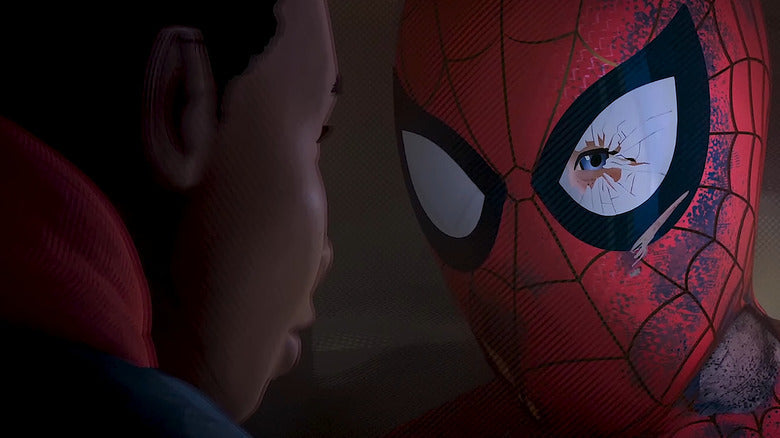
Spider-Man: Into the Spider-Verse (2018) and its sequel Across the Spider-Verse (2023) made a major contribution to the lexicon of iconic Spider-Man lines, largely thanks to Miles Morales. The first film contains a narrative moment that became instantly iconic: the 'leap of faith' - the plunge Miles takes by letting himself fall from the roof of a building, eyes closed, trusting his powers for the first time. The line that goes with that moment - the idea that becoming Spider-Man is not a question of ability but of trust - transcended the film to become a motivational mantra used by millions of people who have no idea where it comes from.
What is remarkable about the Spider-Verse approach is the way it democratises the Spider-Man message. The film does not say that only Peter Parker can be a hero. It says that everyone has a 'leap of faith' moment in their life - a moment when they have to jump without a net, without a guarantee, trusting who they are. That philosophy, expressed through the most creative animation ever made for a superhero film, reached an audience that did not necessarily see itself in the white, middle-class, New York Peter Parker of previous iterations. Miles Morales, an Afro-Latino teenager from Brooklyn, proved that Spider-Man's words resonate in every language, every culture, every neighbourhood.
The sequel, Across the Spider-Verse, added a layer of complexity by introducing the concept of the 'canon event' - the idea that certain tragic events are unavoidable in the life of every Spider-Man. That notion sparked passionate debate far beyond the Spider-Man community, touching on philosophical questions about determinism, free will and everyone's capacity to rewrite their own destiny. Miles's refusal to accept the 'canon event' - his conviction that nobody has to lose the people they love just because it is 'supposed' to happen - is perhaps the most radically optimistic line in the character's whole history.

Why Spider-Man's words move us more than those of any other hero
There is a structural reason why Spider-Man's lines resonate with an intensity that neither Superman, nor Batman, nor the Avengers can match. Superman is a god pretending to be a man. Batman is a billionaire playing vigilante. Thor is literally a Norse god. When these characters talk about sacrifice, pain or responsibility, there is always a distance between their reality and the viewer's. They can afford to be heroic - they have the means, the powers, the technology to absorb the consequences.
Spider-Man, by contrast, is an ordinary man with overdue bills, a shabby flat, relationship trouble and a boss who hates him. When Peter Parker talks about responsibility, he knows exactly what it costs - rent unpaid because he missed a shift at the paper to stop a robbery, a relationship broken because he cannot explain his absences, one more night spent on a freezing rooftop instead of sleeping. Spider-Man's words land because they come from a place of everyday truth that every viewer recognises in their own life.
That is also the reason why Spider-Man's lines cross the generations without ageing. Iron Man's lines are tied to a period - Robert Downey Jr.'s tech-bro sarcasm works in a 2010s context, but it could feel dated in twenty years. Spider-Man's lines, by contrast, are timeless because they speak to the fundamental human condition: what do you do when you have the power to help and it costs you everything? That question has no expiry date. It will be as relevant in a hundred years as it was in 1962, when Stan Lee and Steve Ditko first put on paper the idea that a teenager from Queens could be the most important hero in the world - not despite how ordinary he was, but because of it.
The fans who wear the Spider-Man symbol on their bag, their phone case or their bracelet do not do it just because they like a fictional character. They do it because Spider-Man said something to them - a line, a word, a silence - that changed the way they see the world. And that is Peter Parker's most lasting victory: not the villains beaten, not the cities saved, but the lives touched by seven words written more than sixty years ago in a twelve-cent magazine.

