
14-Day Money-Back Guarantee
0
The short answer
Born in 2008 in the 'New Ways to Die' arc, this character owes his existence to Martin Li, alias Mister Negative, whose energy cures Eddie Brock's cancer and turns the symbiote residue lodged in his marrow inside out. Healing by touch, immunity to fire and ultrasound, but a symbiote that wears itself out from healing: we break it all down below.
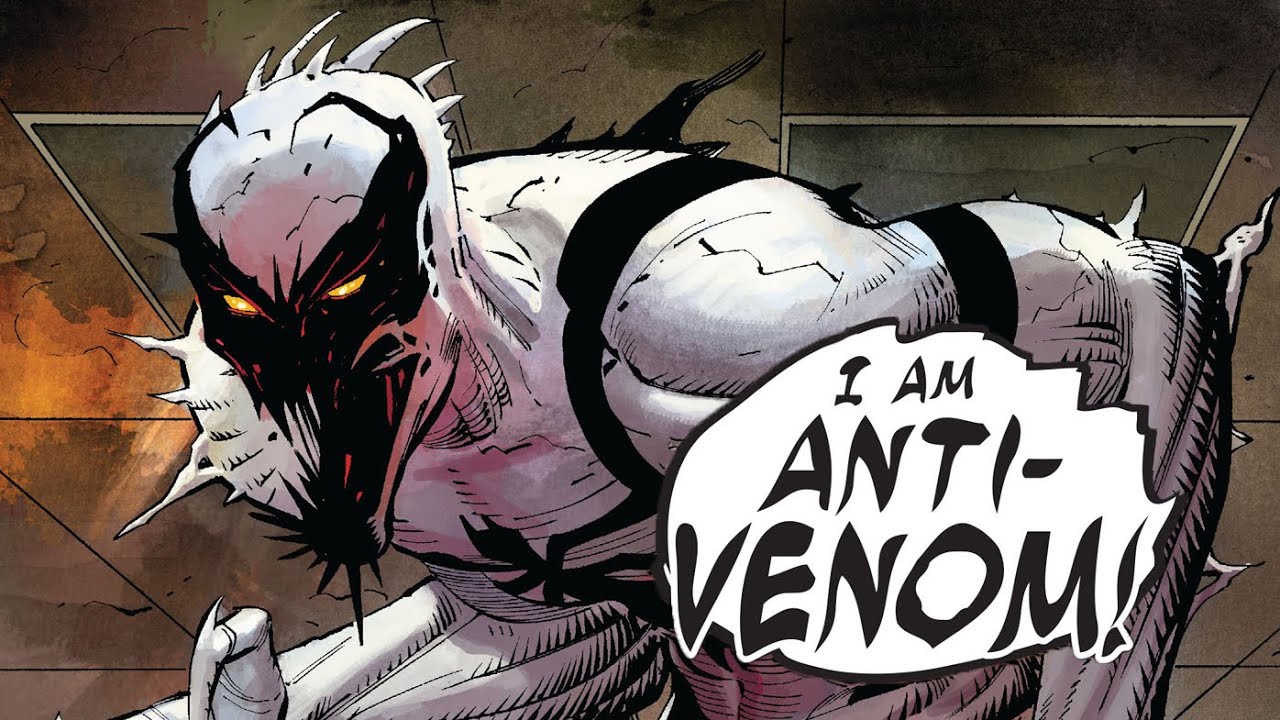
There is a creature in the Marvel universe whose white skin is anything but innocent: it is the memory of a darkness turned against itself. Anti-Venom is not a new symbiote fallen from the sky, nor is he a shining hero who appeared by chance at the edge of the Spider-Verse. He is what Eddie Brock's black costume becomes when a mystical force, able to purify flesh the way you drive out an infection, turns the venom against itself. Where most symbiotes amplify the darkest part of their host, this one does the opposite: it heals, it wipes out toxins, it shuts down other symbiotes on contact alone. It is, in Spider-Man's history, one of the most astonishing inversions ever published, and probably the most powerful lesson in redemption Marvel has ever printed on the skin of a former antagonist.
Before going into the detail of that mutation, you need to remember who Eddie Brock was at that precise moment. A broken journalist, eaten up by hatred, whose original trajectory is told in depth in our article on Eddie Brock and Peter Parker, two faces of the same tragedy. It is with that man — a dead man walking, ravaged by cancer, abandoned by the symbiote he worshipped — that the redemption begins. The symbiote we are talking about here has its oldest origin in the founding story of Venom, the complete history of the black symbiote and its tragic bond with Spider-Man. Anti-Venom is, quite literally, the next page of that book.
Anti-Venom's origin: when Mister Negative purifies the black symbiote
The founding storyline is called 'New Ways to Die', written by Dan Slott and published in Amazing Spider-Man in 2008. At that point, Eddie Brock has just been separated from the black symbiote, which has bonded with Mac Gargan, the former Scorpion, in an era readers know as Brand New Day. Deprived of the parasite that had kept him alive for years, Brock discovers that his body is harbouring terminal cancer. He has only a few weeks left to live. It is in that absolute despair that an unexpected man saves the journalist: Martin Li, a New York philanthropist, alias Mister Negative, whose hands give off an energy able to purify corrupted souls as well as sick bodies.
When Martin Li lays his palms on Eddie Brock's chest in the soup kitchen he runs in Hell's Kitchen, two miracles happen at once. First, the cancer disappears, dissolved by the light of the Inner Light. But there is a second effect, invisible to the human eye: the few stem cells of the black symbiote still present in Brock's marrow — microscopic residue left by years of cohabitation — are turned inside out. Inverted. Mutated into their exact opposite. Where the black symbiote fed on adrenaline hormones and amplified rage, the new symbiote, white as freshly pressed linen, will feed on antitoxins and amplify healing. Brock does not know it yet, but he now carries inside him a creature whose very nature is the chemical opposite of what had possessed him.
Anti-Venom wakes up in pain, in a filthy basement, when the first confrontation with his former host — Mac Gargan, the official Venom of the Thunderbolts at that time — triggers the lightning emergence of the white costume. The fight that follows, handled with legendary graphic efficiency by John Romita Jr., stages an unforgettable moment: Anti-Venom literally breaks down Gargan's black symbiotic flesh on contact alone. The venom heals by wounding the poison. It is the mathematical inversion of a dynamic twenty years old. That turning point, which belongs to one of the great narrative shifts documented in our complete guide to Spider-Man's story arcs, could only happen in the Brand New Day era, in a Marvel where roles can be swapped, where a former iconic Spider-Man enemy could become, if not a friend, then at least an ally of circumstance.
The white symbiote's unique powers: healing, anti-toxin, anti-radiation
To understand what Anti-Venom makes possible, you first have to understand what he refuses. The white symbiote does not feed like the others. It rejects adrenaline, testosterone, the stress hormones that make up the usual menu of a classic black symbiote such as the one described in our feature on Spider-Man and the symbiote, a dark and legendary relationship. Instead, it synchronises with its host's antibodies and amplifies their production. Brock stops ageing at a normal rate. Wounds close in a matter of seconds. The toxins in his blood are identified, isolated and neutralised as if a microscopic pharmaceutical laboratory were running at full tilt under his skin.
The most spectacular power, though, remains healing by touch. Anti-Venom can lay his white-gloved hands on a sick person's skin and purge their body of any foreign substance: cancer, drugs, poison, radiation. That ability becomes central in the Amazing Spider-Man Family Business arc, where Brock, now seeking redemption, uses his gifts to clear the streets of New York of synthetic heroin trafficking. The most memorable scene shows him crossing a Manhattan neighbourhood, touching a dozen addicts one after another, like a chemical Christ handing out the antidote. The symbolism is deliberate, owned by the writers, and is an integral part of the political reading of Brand New Day.
But it is the effect on other symbiotes that truly defines Anti-Venom within the Marvel ecosystem. On contact with the white costume, any black symbiote — Venom, Carnage, Toxin, Scream, Lasher — goes into convulsions, loses its molecular cohesion and disintegrates into filaments and then ash. That automatically turns Brock into a living anti-symbiote weapon, something that will escape neither the government, nor the army, nor Knull, the god of the symbiotes, who will very quickly see Anti-Venom as a cosmic heresy to be wiped out.
There is a limit to this immune omnipotence: the healing antibodies are not inexhaustible. Every patient healed, every toxin neutralised eats into the white symbiote's reserve, which weakens the more it heals — to the point where it can be overwhelmed by another symbiote once it has spent too much. That wear and tear will go as far as total sacrifice: Eddie Brock will let his symbiote burn itself out to turn its antibodies into a mass cure, and will find himself stripped of his powers for years.
CULT PIECE — Anti-Venom Mask

Spider-Man Mask — Anti-Venom
199,90 €
The official Anti-Venom mask — white skin, twisted grin, the stare of an inverted symbiote. The rare piece for fans who want to embody Eddie Brock's redemption rather than his original darkness. Screen-quality finish, ideal for convention cosplay.
Discover →Brand New Day and Anti-Venom's first appearance in New Ways to Die
The 'New Ways to Die' saga runs across six issues of Amazing Spider-Man, from #568 to #573, published between August and November 2008. Dan Slott orchestrates a massive reintroduction of the web-slinger's rogues' gallery, in the wake of the controversial One More Day that had put Peter Parker back into single life. Norman Osborn, once again director of the Thunderbolts, lands in New York at the head of a team of patriotic antiheroes including Bullseye, Songbird, Radioactive Man and the new Venom played by Mac Gargan. Their official aim: to arrest Spider-Man, by then declared a public enemy by the administration in place. Unofficially: to settle old scores.
It is in this climate of manhunt for the web-slinger that Anti-Venom appears for the first time, coming out of Mister Negative's back alleys like a white answer to the political black of the era. Brock, brought back to life by Martin Li, slowly grasps what he has become. He steps in to defend Spider-Man — his historic enemy — against Mac Gargan, which creates one of the most interesting narrative dynamics of the run: Peter Parker and Eddie Brock side by side, forced into an alliance, sharing a goal without ever ceasing to hate each other personally. That tension runs through the whole arc, and peaks in a legendary exchange where Anti-Venom thanks Spider-Man for separating him from the black symbiote, because it is precisely that separation that made his resurrection possible.
The editorial reach of Brand New Day is vast, and some of its direct offshoots are documented in detail on our page devoted to every version of Spider-Man and the Spider-Verse. Anti-Venom is not a Spider-Man variant, but he belongs to the same narrative school: a character defined by his relationship with the costume, with identity, with transformation. As Eddie Brock himself put it in New Ways to Die #4: 'I'm not Venom any more. I'll never be Peter Parker. I'm what's left when you take the hate out of an angry man.'
An antihero facing Spider-Man: the rivalry turned inside out
The whole narrative appeal of Anti-Venom lies in the permanent imbalance he brings to his relationship with Peter Parker. For years, Eddie Brock embodied the black enemy: stronger, more violent, driven by a personal hatred that made every fight more intimate than the rest. Seeing him again with white skin and healing powers changes nothing about the hatred itself — it is still there, intact, burning. What changes is what Brock does with it. The rivalry does not disappear: it turns against shared enemies. That does not make Anti-Venom an ally, but a companion of circumstance, which, in Marvel grammar, is infinitely more complex and dramatically richer.
That ambiguous status is explored in a dozen or so mini-series that follow New Ways to Die. Amazing Spider-Man Family #1 shows Anti-Venom tracking a drug dealer in Brooklyn and running into Spider-Man, who was investigating the same case; the pair end up co-operating, without ever shaking hands. Amazing Spider-Man Presents: Anti-Venom #1-3 develops that solitary stance of an evangelical-Christian antihero — Brock becomes openly religious after his resurrection, sees his new nature as a divine gift and sets off on a personal quest for redemption that runs through the destruction of New York's dealers. That religious dimension, sometimes criticised by readers as heavy-handed, is nevertheless what sets Anti-Venom apart from every other symbiotic antihero.
Spider-Man, for his part, wavers between mistrust and forced recognition. Peter Parker does not like Brock's methods — healing an addict by putting him through a white overdose is, medically speaking, a form of violence — but he cannot deny the results. That tension is documented more fully in our complete profile of Peter Parker, which is a reminder of how constantly the web-slinger's morals are tested by the grey figures around him. Anti-Venom is probably the greyest of them all.
SOURCE MATERIAL — Black symbiote

Venom Premium Bust Statue Figure
89,90 €
To understand Anti-Venom's whiteness, you first have to look straight at the darkness he came out of. This premium bust statue freezes the original symbiote at its peak: fangs out, tongue unfurled, living black flesh. The collector's piece that closes the narrative loop between Eddie Brock's fall and his redemption.
Discover →Anti-Venom against the other symbiotes: an antibody facing Carnage and Knull
Anti-Venom's status as an anti-symbiote weapon places him, almost mechanically, at the centre of the major events involving the Klyntar race. The first striking confrontation is the one against Cletus Kasady, Spider-Man's most unstable enemy. Carnage and Anti-Venom embody the two extremes of the symbiotic spectrum: one is poison in its purest state, the other the antidote. When they clash in Amazing Spider-Man Presents Anti-Venom #2, the mere contact of the white costume with Kasady's red filaments triggers a disintegration reaction the writers describe as 'acid poured on living sugar'. Carnage comes out of it shrunken, drained, almost killed — he will only be pieced back together several arcs later, after exposure to cosmic energy.

But the real test for Anti-Venom comes with Absolute Carnage, the 2019 event written by Donny Cates, which sees Cletus Kasady try to wake the dark god Knull by collecting the codices of every former symbiotic host. Brock returns to the front line in that saga, where Anti-Venom becomes one of the rare creatures able to protect the hosts targeted by Kasady. The sequence in which Eddie crosses St Patrick's Cathedral in immaculate white, tearing apart the carnage-ridden tentacles with his bare hands, has become iconic. It symbolically inverts the darkness of the old Eddie Brock — now an almost Christ-like figure fighting the symbiotic antichrist.
King in Black, the direct sequel to Absolute Carnage published in 2020-2021, pushes that logic to its extreme. Knull, the cosmic creator of the symbiotes, invades Earth at the head of an army of symbiotic dragons. Anti-Venom becomes a strategic resource: his blood, distilled, can be used to vaccinate dozens of heroes against black symbiotic infection. Eddie Brock literally drains himself of his own substance to save humanity. That sacrificial mechanic is one of the reasons Anti-Venom has become, in modern comics pop culture, a figure as respected as the other great characters of the Spider-Man universe. To get a better grasp of the symbiotic ecosystem as a whole, you can turn to our feature on Planet of the Symbiotes, which sheds light on the nature of the Klyntar before Knull's arrival.
Anti-Venom's modern return: Absolute Carnage and King in Black
For several years after Brand New Day, Anti-Venom was seen as a closed parenthesis. Eddie Brock had, at one point, sacrificed his white symbiote to neutralise an epidemic of Spider-Slayers — an episode too often forgotten by recent readers — and had become an ordinary human again, ageing slowly, with no powers. That near-disappearance would last until the end of the 2010s, when Donny Cates set about restoring the symbiotic myth to its former glory with his run on Venom Vol. 4. That is when Anti-Venom reappears, in new circumstances: Brock, contaminated a second time by a residual fragment of inverted symbiote, becomes the white costume again on the eve of Absolute Carnage.
That resurrection is not identical to the first. The new Anti-Venom is more powerful, more stable, but also more tragic: Brock understands that he is now a tool in the great symbiotic war, a reluctant soldier in a cosmic conflict beyond him. Cates and his co-writer Ram V write an introspective, almost melancholy Eddie, who doubts the value of his redemption. That nuance was missing from the original 2008 Anti-Venom, who was more binary, more enthusiastic. It adds a depth that brings the character closer to figures such as Daredevil or Moon Knight, both caught up in personal spiritual battles.
The King in Black event, wrapped up in 2021, marks Anti-Venom's modern peak. Brock briefly becomes King of the Symbiotes after killing Knull, takes the name Venom King, and unfurls a new hybrid form blending the original black with the anti-symbiotic white. It is a complex transitional period, followed by the character's cosmic retirement, which temporarily hands the Venom role to his son Dylan Brock. For readers who want to explore the full ramifications of that era, the feature on the alternative versions of Venom across the multiverse provides essential insight. Eddie Brock's journey to Anti-Venom and then Venom King is one of the longest redemption arcs ever published in Marvel canon.
Other related events are worth a look to grasp Anti-Venom's place in the universe: Maximum Carnage, one of the most violent crossovers in the Spider-Man universe, which lays the groundwork for the Venom-Carnage conflict that Absolute Carnage would pick up again; or the story of Shriek, Carnage's deranged accomplice, whose sonic signature scrambles symbiotes and complicates Anti-Venom's task across several crossover arcs. Not forgetting Vermin, the monstrous enemy who mirrors Spider-Man's darkness, another example of a transformed figure whose path throws Brock's into relief.
Anti-Venom in the multiverse and in video games: Spider-Man PS4 and beyond
Anti-Venom's arrival in mainstream pop culture did not happen through the comics alone. Marvel's Spider-Man 2, released in 2023 on PS5, stages a central symbiotic arc in which Peter Parker wears the black costume before getting rid of it, and where Harry Osborn becomes Venom. While Anti-Venom does not appear directly in the main campaign, he is strongly hinted at by the game's ending, and fans are waiting for him to turn up in the DLC or the sequel. For a complete map of the Spider-Man video games, the feature devoted to the Spider-Man video games encyclopaedia details every symbiotic appearance by the web-slinger, generation by generation.
Marvel's Spider-Man from 2018, the first instalment of the Insomniac trilogy, also contains foreshadowing anti-symbiotic elements. The character of Martin Li / Mister Negative plays a central role there as the main antagonist, and although no Anti-Venom formally appears, the black-and-white energy that defines Negative's powers is a direct nod to Dan Slott's run. That narrative continuity, intended by the studio, shows how important Anti-Venom is as a milestone in the web-slinger's modern mythology. To place those games in the character's overall chronology, the overview of the Spider-Man films in order, versions, costumes and universes helps you understand how the different media feed off one another.
On the comics multiverse side, several Anti-Venom variants exist on alternative Earths. On Earth-1610 (the Ultimate Universe before the convergence), a darker version of Eddie Brock develops an inverted form of the symbiote. On Earth-1048 (the world of the PS5 games), Anti-Venom is canonised in the timeline. On Earth-65, Spider-Gwen's universe, a fragment of Anti-Venom appears briefly in a spin-off mini-series. Those multiversal appearances are not exhaustive, but they show just how far the concept — an inverted symbiote that heals — has spread well beyond Earth-616.
Spider-Man's extended universe in its live-action formats also deserves a detour. The film Spider-Man Noir with Nicolas Cage, due in 2026, does not include Anti-Venom but explores the same thematic territory: a haunted Peter Parker, a dark costume, a moral redemption. The aesthetic kinship between Spider-Man Noir and Anti-Venom has not escaped fans, who happily bring the two together as figures of luminous shadow.
DAILY UNIFORM — Venom T-Shirt

Spider-Man T-Shirt — Venom
34,90 €
The t-shirt that pays tribute to the black symbiote Anti-Venom is the white mutation of. An iconic design for fans who want to wear both faces of symbiote mythology every day. Comfortable cut, soft cotton, ready to switch into hero mode.
Discover →Why Anti-Venom embodies Marvel's most powerful redemption
If you had to sum up what sets Anti-Venom apart from Marvel's other antiheroes, it would probably be the exact mechanics of his redemption. Eddie Brock is not forgiven. He is not rehabilitated by a plot twist or a political amnesty. He is not even transformed psychologically — he remains, fundamentally, an angry, wounded man eaten up by resentment. The only thing that changes is his biology. The symbiote living inside him has become, by chemical accident, the mathematical opposite of the one that had possessed him. And that physical inversion forces Brock to use his body as an instrument of healing rather than destruction.
That mechanic is fascinating because it inverts the usual logic of fictional redemption. In most stories, the sinner has a change of heart, and his actions follow. For Anti-Venom, it is the other way round: the actions change first — he heals, he purifies, he saves — and the heart follows slowly, by osmosis, by habit. Brock becomes better because he is forced to act better, not because he decided to. That narrative inversion is one of Dan Slott's subtlest writing inventions, and one of the reasons Anti-Venom still fascinates readers fifteen years after his creation.
There is also an almost theological dimension to this figure of the sinner whose flesh has been turned inside out. The Christian references are owned by the writers: Brock becomes a practising believer after his resurrection, sees Mister Negative as a divine instrument, and several sequences are composed like Renaissance paintings — Anti-Venom crossing Hell's Kitchen like a symbiotic Saint Christopher. That symbolic charge lifts the character above the simple tattooed antihero he could have remained. To explore the mystical dimension of the Spider-Man universe more widely, the feature devoted to the Web of Life and Destiny and the Spider-Totems offers a complementary reading of the invisible forces running through the myth.
In that respect, Anti-Venom joins a wider line of Marvel characters transformed against their will — Spider-Man himself, bitten by a radioactive spider, or Spider-Man Noir, the 1930s detective, marked by the shadows of the Great Depression — all those heroes who do not choose to become what they are, but who choose what they do with it. Brock is perhaps the one who best expresses that dilemma, because he carries on his skin the white scar of what he once was in black.
Anti-Venom in merchandise and the extended Marvel universe
The merchandise ecosystem around Anti-Venom is more low-key than Venom's, but it exists, and it grows year after year. Hot Toys and Hasbro Marvel Legends figures have produced several versions of the character since 2010, with special editions during Absolute Carnage in 2019 and King in Black in 2021. On the collectibles side, the shop's Spider-Man figures bring together the most iconic pieces of the symbiotic gallery, and the Spider-Man masks now include Anti-Venom editions prized by cosplayers.
On the clothing side, the white symbiote-patterned costume has inspired plenty of spin-off pieces: Spider-Man t-shirts for men with inverted designs, complete Spider-Man cosplays in the Anti-Venom version for conventions, and even a few LEGO Spider-Man bricks depicting Eddie Brock in his white form. For fans who want the full picture, our ultimate guide to Spider-Man merchandise details the must-have pieces, from the beginner collector to the seasoned connoisseur.
Finally, there is Anti-Venom's place in general popular culture. Fifteen years after his debut in New Ways to Die, the character is now taken as a given in the Spider-Man myth. He features in most of the specialist media's 'top symbiotes' rankings, artists draw him regularly at conventions, and his design — white skin, inverted symbiote maw, the stare of a ravaged ascetic — is instantly recognised by every modern Marvel reader. He belongs to that rare category of characters who are not exactly heroes, not quite villains, and who precisely through their ambiguity embody something more valuable: a human face of transformation.
Eddie Brock was full of hate. He fell ill. He very nearly died. And he came out of it white — not pure, never pure, but white all the same. That nuance matters. It is what makes Anti-Venom one of the most moving figures in the Spider-Man ecosystem, and one of those Marvel comics have not finished exploring.

