
14-Day Money-Back Guarantee
0
The short answer
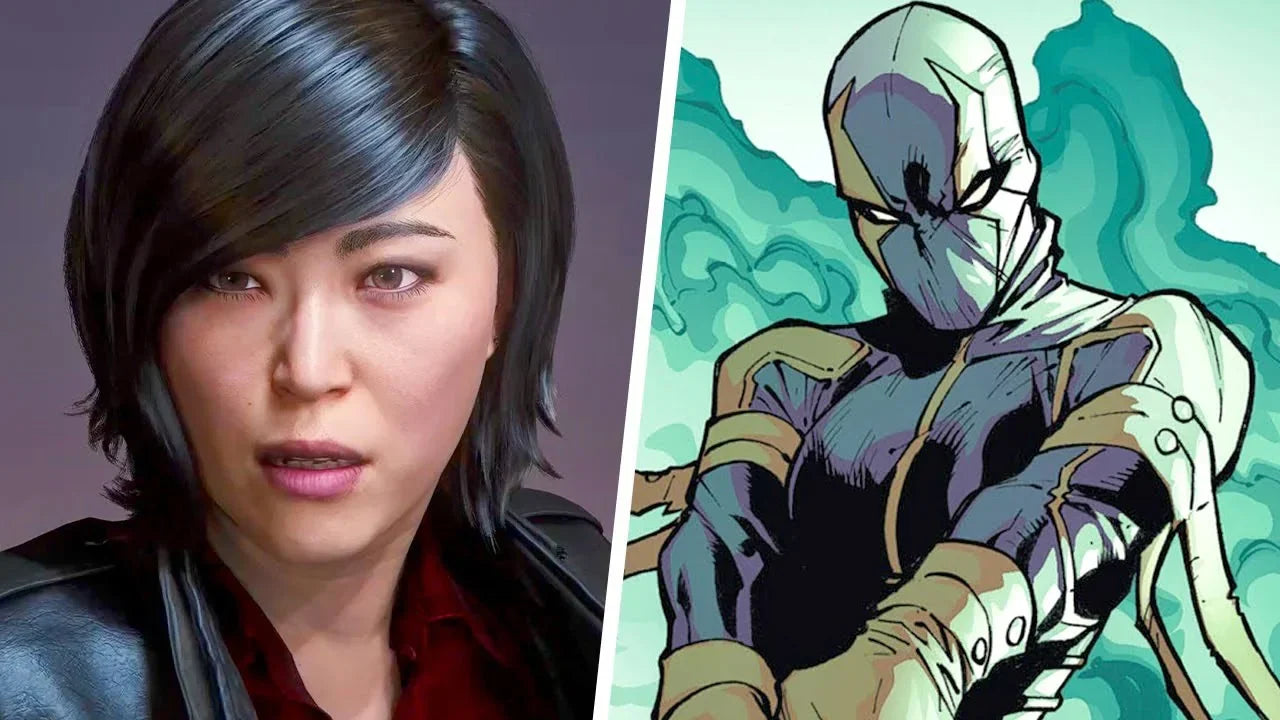
Wraith is the alias taken on by Yuri Watanabe, a New York police officer who gives up her badge to permanently stop criminals who keep being put back on the streets. Her journey highlights a major ideological disagreement with the web-slinger, rather than a simple rivalry. We retrace that turning point step by step below.
When justice is no longer enough
In the world of Spider-Man, the villains are not always born of crime or madness. Some are the product of a broken system, of a justice that is too slow, too lenient, or simply powerless. Yuri Watanabe, later known as Wraith, embodies that dangerous border between law and revenge.
A former NYPD captain, Yuri is neither a career criminal nor a masked psychopath. She is a woman of the law, trained to protect, investigate and arrest. But after years of facing New York's worst monsters — monsters often released, acquitted or never punished at all — something breaks. Where Spider-Man still believes in moral responsibility, Yuri ends up losing faith in the system.

Her shift is neither spectacular nor instant. It is slow, painful, deeply human. And that is exactly what makes Wraith so fascinating. She is not Spider-Man's opposite: she is what he could become if he stopped believing that justice can still work.
Yuri Watanabe: a police officer facing the failure of the system
Before becoming Wraith, Yuri Watanabe is a respected figure within the NYPD. She works closely with Spider-Man, especially on cases tied to organised crime and the city's recurring super-villains. She believes in the law, in procedure, in the idea that even the worst criminals deserve a trial.
But New York is no ordinary city. Between the mobs, the madmen who escape from Ravencroft, and the iconic enemies detailed on the pillar page Spider-Man's enemies, the police are constantly overwhelmed.
Every quashed arrest, every criminal released, every forgotten victim widens the fracture inside Yuri a little more. Where Spider-Man agrees to protect even those he fights, Yuri starts to think that some people no longer deserve to be saved… but stopped for good.
This ideological conflict between Spider-Man and Yuri is one of the most powerful in the Marvel universe, because it does not rest on good against evil, but on two opposing visions of justice. A tension comparable to the one explored in darker arcs such as Back in Black, where Peter himself flirts with his own limits.
In the next part, we will see how Yuri Watanabe gradually gives up her badge to become Wraith, and why that choice places her in a grey area even Spider-Man struggles to accept.
The birth of Wraith: when the law gives way to revenge
The shift from Yuri Watanabe to Wraith does not happen in a flash of madness, but through a slow process of disillusionment. Unlike many of Spider-Man's antagonists, she does not reject justice straight away. She tests it, again and again, until its limits become impossible to ignore.

The criminals she arrests keep coming back to the streets of New York. Some benefit from procedural flaws, others slip through the cracks of the judicial system before striking again. That repetition turns frustration into anger, then anger into conviction: the law alone no longer protects the innocent.
It is in this context that Yuri gradually gives up her badge. She does not give up her role as a protector, only her method. Where Spider-Man goes on believing that every life can be saved — a core philosophy explored in the story of Peter Parker — Wraith makes a radical choice: permanently removing those that justice lets slip away.
A vigilante with no illusions
Under the Wraith identity, Yuri seeks neither recognition nor heroic symbolism. She works in the shadows, with no flamboyant costume and no moral speeches. Her approach is surgical, methodical, almost cold. She is not there to inspire, but to put an end to a threat.
That stance brings her closer to the more ambiguous figures of the Marvel universe than to classic superheroes.
Her very existence raises a fundamental question: can we still call it justice when revenge becomes the only effective solution? It is a question that runs through the whole Spider-Man mythology, particularly in dark stories such as The Death of Jean DeWolff, where the line between law and violence blurs dangerously.


Spider-Man facing his most unsettling reflection
When Spider-Man realises what Yuri has become, he is not facing a classic enemy. He is facing a former ally, a woman who once shared his vision of good, but who chose another path. That confrontation is one of the most uncomfortable for Peter, because Wraith often acts where he fails.
She permanently neutralises criminals drawn from the same pool as those described in Spider-Man's enemies, where Peter merely arrests them… only to watch them come back.
Through Wraith, Spider-Man is confronted with an alternative version of himself: a Spider-Man who had stopped believing in moral responsibility in order to embrace summary justice. And it is precisely that mirror that makes their opposition so powerful.
In the next part, we will look in depth at the relationship between Spider-Man and Wraith, and why this ideological conflict is one of the richest and most complex in the whole mythology of the web-slinger.
Spider-Man vs Wraith: heroic morality against summary justice
The conflict between Spider-Man and Wraith does not rest on a classic rivalry. There is no shining hero on one side and a monster hungry for chaos on the other. There are two protectors of New York, each convinced they are defending the innocent… but with irreconcilable philosophies.
Spider-Man is the hero who refuses to give up the idea that the human being behind the crime can still be saved. It is a conviction forged by the founding trauma of his life, the murder of Ben Parker, told and analysed in the story of Uncle Ben's death. Peter was not created by revenge, but by guilt: he fights so as never to repeat his mistake, to stay on the right side.

Wraith no longer has that faith. She has seen too many investigations fail, too many arrests turn into revolving doors, too many victims forgotten. Where Spider-Man tries to hold the moral line whatever the cost, Yuri considers that line to have become a luxury… and that the reality of New York demands something else.

The city as catalyst: New York does not forgive
In the Spider-Man universe, New York is a character in its own right: a magnificent city, but a harsh one, saturated with crime, trauma and cycles of violence. When Spider-Man stops an enemy, he hands him over to the justice system. But that system is regularly overwhelmed, and some criminals reappear again and again, sometimes even more dangerous than before.
This reality becomes especially clear as soon as you look at Spider-Man's rogues' gallery: figures such as Carnage, Shocker, or even threats tied to institutions such as Ravencroft are a reminder that bars and walls are not always enough.

Wraith embodies precisely that rupture: when the law can no longer contain evil, she chooses to snuff it out. And that is what makes Spider-Man so deeply uncomfortable: because deep down he knows the system is imperfect… but he refuses to let that imperfection justify an execution.
Why Wraith is his most dangerous opponent… morally
Spider-Man knows how to fight monsters. He knows how to improvise against scientific threats, symbiotes and costumed criminals. But Wraith is not a physical puzzle: she is a moral threat. She forces him to ask whether his own code is a strength… or a weakness.
This question already runs through dark arcs such as Back in Black, where Peter comes dangerously close to a logic of punishment. But unlike Wraith, Spider-Man always holds back at the edge. Wraith has crossed the line.
That is why she becomes an obsession for Spider-Man: he is not just fighting a vigilante, he is fighting the idea that killing might be more effective.
A conflict that also feeds the wider culture
This kind of moral tension also explains why fans love stories in which Spider-Man faces 'mirror' figures. Wraith belongs to that tradition: she is not a cosmic threat, but a character who pushes Spider-Man to define himself. And it is often this sort of confrontation that stays with readers the longest… and that keeps inspiring the imagination around the web-slinger.
It is also what fuels the passion of collectors: you do not collect Spider-Man only for his fights, but for what he stands for. Hence the constant appeal of pieces that carry that symbolism, such as Spider-Man figures, posters that capture his darkest moments, or Spider-Man masks that embody the heroic identity Wraith gave up for the shadows.
In the final part, we will see what Wraith represents in Spider-Man mythology, why her existence is essential to understanding Peter's psychology, and how this character fits into a wider logic: that of a world where justice and revenge keep blurring into one another.
Wraith in Spider-Man mythology: a narrative necessity
Wraith is not just a secondary character added to complicate a plot. She is a direct answer to the evolution of Spider-Man's world. As New York becomes more violent, more cynical, more unstable, the story needed a character able to embody what Spider-Man refuses to become.
Yuri Watanabe represents the extreme limit of security-first logic: the point where the end justifies the means. Where Peter Parker goes on believing that saving a life, even a criminal one, is a founding act — a conviction analysed on the main pillar page about Peter Parker — Wraith considers that some lives no longer deserve to be spared.
This opposition is not there to prove either of them right. It exists to remind us that Spider-Man is a deeply moral hero in a world that is not always moral. Without Wraith, that morality would stay abstract. Thanks to her, it becomes direct confrontation.
Why Wraith is essential to Spider-Man's evolution
Every great Spider-Man era is marked by a character who calls his foundations into question: the Green Goblin through loss, Doctor Octopus through identity, Venom through power… Wraith attacks the very heart of his philosophy.
She asks a question Peter has always run from: what if the justice he defends were not enough? A question already sketched out in dark stories such as Kraven's Last Hunt or Back in Black, but never embodied so directly.
Wraith is not a passing temptation: she is the materialisation of what Spider-Man could become if he stopped believing, even for a moment, in his moral responsibility.
A character built for modern storytelling
In an increasingly mature universe, where readers expect nuanced stories, Wraith is an enormous narrative asset. She speaks to adult fans, to those who grew up with Spider-Man and who now understand that the real world does not always run on ideal principles.

That is precisely why her return, in one form or another, is regularly called for by readers. She fits perfectly into an era in which the boundaries between heroes, anti-heroes and vigilantes are blurring — a shift you can also see in the Spider-Verse, where each version of Spider-Man embodies a different vision of responsibility.

Wraith's legacy in Spider-Man culture
Even without being everywhere, Wraith has left a lasting mark on fans' imaginations. She is one of those characters who make you want to reread Spider-Man differently, with a more critical, more adult eye. It is often figures like these that feed the passion of readers and collectors the most.
That fascination shows up in the wider culture too: Spider-Man may stay at the centre, but it is his moral conflicts that make him timeless. That is what explains the constant appeal of pieces that carry that symbolism, such as Spider-Man figures, blankets or Spider-Man costumes, which embody far more than a hero: an idea, a choice, a moral line.
Conclusion: Wraith, the price paid when the law fails
Wraith is neither a heroine nor a true antagonist. She is the symptom of an imperfect world. She exists because the law fails, because justice is slow, and because some wounds never heal.
Facing her, Spider-Man has no glorious victory. All he can do is keep believing, again and again, that responsibility is worth more than revenge. And it is exactly that silent opposition that makes their relationship so powerful.
As long as New York remains a broken city, as long as the line between justice and violence stays blurred, Wraith will have an essential place in the Spider-Man universe — a constant reminder of what the hero refuses to become.

