

14-Day Money-Back Guarantee
0
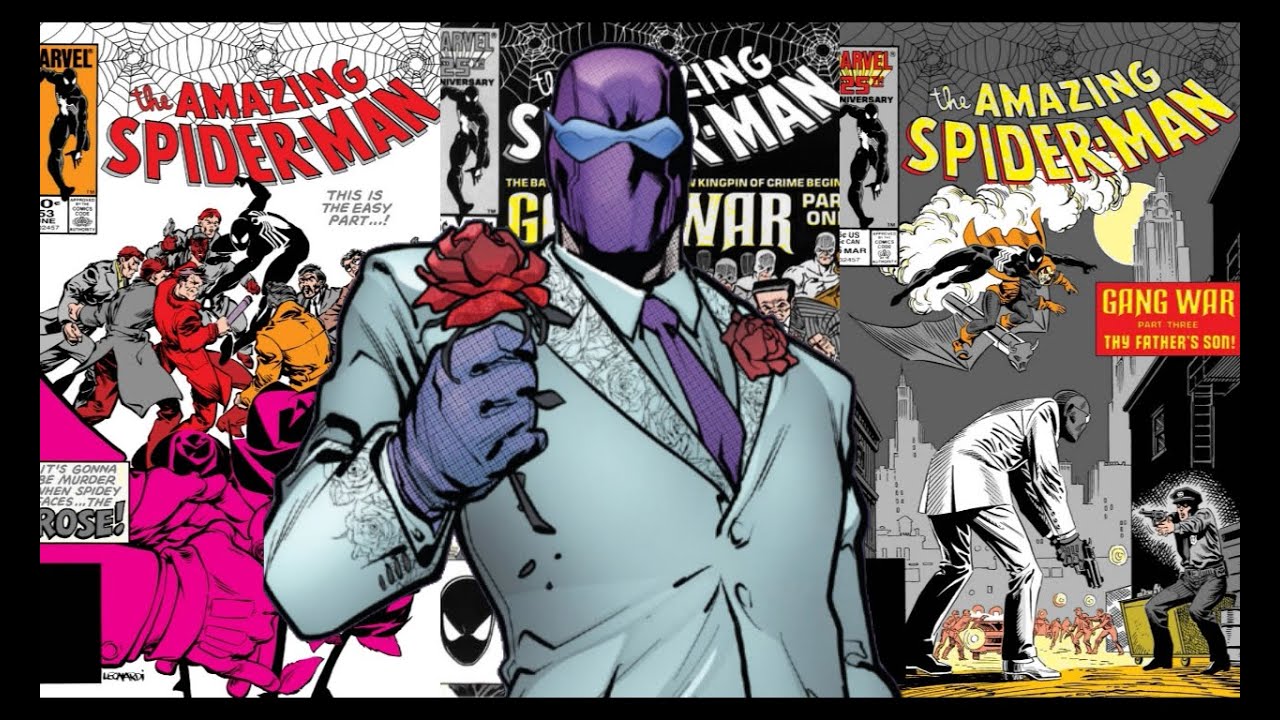
The short answer
The Rose is none other than Richard Fisk, who builds his own mob network instead of taking over his father's empire. His strength lies in discretion: coordinating gangs from a distance, staying untraceable, outlasting the bosses everyone can see. We break that trajectory down below.
An heir in the shadows of New York's criminal underworld
In the world of Spider-Man, some enemies dominate through brute force, others through intelligence or manipulation. The Rose belongs firmly to the second category. A character who spent a long time in the shadows, he embodies a subtler, more insidious threat: that of a criminal inheritance.
Behind the white mask and the elegant silhouette hides Richard Fisk, the son of the fearsome Kingpin. Where Wilson Fisk rules through terror, The Rose prefers anonymity, strategy and the quiet manipulation of New York's criminal networks.

This father / son duality is essential to understanding the character. The Rose is not simply a gangster: he is a direct reaction to the crushing shadow of Kingpin. He refuses to be a mere heir, seeking to build his own empire far from his father's brutal methods.
This theme of criminal inheritance and lineage echoes other dark stories in the Marvel universe, notably those explored in our full analysis of Kingpin or in the stories where the line between justice and crime turns blurry.
A radically different criminal style
Unlike his father, The Rose does not impose his rule through direct violence. He acts as an invisible conductor, linking gangs, traffickers and middlemen without ever stepping into the foreground. That approach makes him a particularly hard opponent for Spider-Man to reach.
Where Peter Parker can physically take on enemies such as Rhino or Venom, The Rose embodies a systemic threat, rooted in the very structure of organised crime. It is an approach that recalls the more political, urban Spider-Man arcs, where the hero comes up against enemies he simply cannot punch.
This more 'realistic', mob-flavoured dimension also explains why The Rose fascinates readers: he represents a silent evil, the kind that survives even when the big bosses fall.
A discreet enemy... but a lasting one
The Rose is not the sort of villain who chases glory or recognition. His goal is simple: control, endure, prosper in the shadows. That philosophy of crime makes him especially dangerous in the long run, because he adapts, disappears, then comes back in another form.

That criminal longevity explains why his name keeps coming up in discussions of the iconic enemies of Spider-Man, despite a far smaller media presence than his father's.
And while The Rose remains less familiar to the general public, he is a firm favourite with fans drawn to mob intrigue, power games and the 'clever' enemies of the web-slinger — a profile that also shows up in the more grown-up merchandise, such as certain Spider-Man figurines inspired by New York's criminal underworld.
In the next section, we look at how Richard Fisk became The Rose, and how his relationship with his father shaped one of the most complex antagonists in the Spider-Man universe.
Richard Fisk: born under the weight of a criminal empire
Before he was The Rose, there was Richard Fisk — a child born in the crushing shadow of Kingpin. Growing up as Wilson Fisk's son means living in a world where power, fear and control are core values. But where his father embodies raw domination, Richard develops a more introspective, more distant... and deeply conflicted personality very early on.
Richard does not want to be Kingpin. He wants to exist outside of him. That silent opposition sits at the heart of his development. He rejects his father's showy violence and looks for another path, convinced that crime can be governed differently: with intelligence, structure and invisibility.
This generational fracture is essential to Spider-Man mythology. It reminds us that evil is not always passed on by imitation, but sometimes by reaction. Where Wilson Fisk crushes everything in his path, Richard learns to slip into the cracks of the system.
The birth of The Rose: a mask in order to exist
It is this desire for a clean break that pushes Richard to take on the identity of The Rose. The white mask is not a simple disguise: it is a symbol. It stands for neutrality, the erasure of ego, the idea that power should not be embodied but diffuse.

Unlike the flamboyant supervillains of the Spider-Man universe, The Rose never seeks recognition. He works backstage, manipulates the gangs and reshuffles the cards of New York's organised crime without ever appearing as the central figure.
That approach makes him all the more dangerous. Spider-Man can neutralise a visible enemy, but how do you fight a structure? The Rose understands long before many others that real power lies in organisation, not in direct confrontation.
A father / son conflict that cannot be resolved
The relationship between Richard Fisk and Kingpin is one of the most tragic in the Spider-Man universe. Wilson Fisk does not see a worthy heir in his son, but a weakness. Richard, for his part, sees in his father an archaic force incapable of evolving.
That opposition inevitably leads to confrontation. Where other villains' sons embrace their inheritance, Richard tries to surpass it — even if it means going to war, indirectly, with his own father. It is a dynamic rarely explored with such subtlety in Marvel comics.
This family conflict reinforces the human dimension of the character. The Rose is not driven by hatred of Spider-Man, but by a search for identity. Spider-Man is just one obstacle among many in his attempt to build a different kind of empire.
A key figure in New York's urban crime
By operating in the shadows, The Rose quickly becomes a central piece of organised crime. He connects mafias, street gangs and clandestine networks while remaining impossible to pin down. That approach echoes the most urban, realistic Spider-Man stories, where New York is a living entity rotting from within.
It is exactly this dark, mob-tinged atmosphere that many fans are after, not least through more 'grown-up' merchandise such as certain Spider-Man posters or figurines staging the web-slinger's criminal underworld.
In the next section, we analyse The Rose's role against Spider-Man, and why this kind of intellectual enemy represents a far more lasting threat than purely physical villains.

The Rose versus Spider-Man: fighting an enemy with no face
For Spider-Man, facing The Rose is a deeply disorienting experience. Unlike opponents such as Doctor Octopus or Green Goblin, there is no head-on fight, no spectacular scheme, no cathartic showdown. The Rose is never where you expect him to be.

Spider-Man finds himself up against an enemy who is not trying to beat him physically, but to wear him down mentally. Every arrest feels pointless, every victory temporary, because the criminal organisation keeps running, intact, like a self-sustaining organism.
An intellectual antagonist, not a classic supervillain
The Rose belongs to a rare category in the Spider-Man universe: enemies who are structural. Where the web-slinger can neutralise an individual, he struggles to destroy a system. That tension recalls certain urban storylines from New York's darkest arcs, close to the atmosphere explored in the enemies of Spider-Man.
The Rose is not after glory, nor spectacular domination. He is after stability. He operates like a CEO of crime, anticipating the moves of the police, of Spider-Man, and even of his own father. That cold, calculated approach makes him a long-term threat, far harder to stamp out.
An inverted mirror of Peter Parker
Narratively, The Rose works as an inverted mirror of Peter Parker. Both live in the shadow of an overwhelming figure: Peter under the weight of the responsibility left by Ben Parker, Richard under that of Kingpin. But where Peter chooses altruism, Richard chooses control.
That duality deepens the symbolic reach of their clashes. Spider-Man fights to protect the innocent, while The Rose restructures crime to make it 'bearable'. Two opposing visions of the same broken world.
This ideological opposition sits at the heart of the web-slinger's most mature stories, the ones that go beyond a simple physical fight to question the very idea of justice — a theme also explored in the story of Peter Parker.
Why The Rose so often escapes justice
One of the most frustrating — and most realistic — aspects of the character is his ability to remain legally untouchable. The Rose delegates, manipulates, disappears. He never leaves direct evidence, only consequences.
That makes him closer to a mob strategist than to a traditional supervillain, which explains why he is rarely put front and centre in mainstream adaptations. Yet it is precisely this realism that makes him so fascinating for adult readers.
This kind of enemy also feeds the appetite for more narrative, darker merchandise, such as certain Spider-Man lamps or posters showing New York by night, sunk into its grey areas.
In the next and final section, we look at why The Rose remains an underrated but essential figure, and how he could play a key role in a more mature evolution of the Spider-Man universe.
The Rose: a criminal legacy more dangerous than Kingpin?
While The Rose remains less familiar to the general public than his father, his importance in Spider-Man mythology is nonetheless crucial. Where Kingpin represents visible tyranny, fear worn openly and head-on domination, Richard Fisk embodies a far more worrying evolution of organised crime: invisible power.

The Rose proves that crime does not need a face to exist. It can survive the fall of its emblematic figures, reassemble, mutate, adapt. In that sense, he may well be one of the most realistic antagonists Spider-Man has ever faced.
Why The Rose is an underrated villain
In a universe crowded with gods, symbiotes and multiversal threats, The Rose looks almost unremarkable. No powers. No spectacular costume. No apocalyptic plan. And yet that is exactly where his strength lies.
He works in the blind spots of the story. Right where Spider-Man is most vulnerable: in the grey areas of justice, where arresting one man is not enough to dismantle a system. That logic is a reminder that the web-slinger's fight is not limited to the rooftops of New York, but is also played out in the very foundations of the city.

A perfect antagonist for a more mature Spider-Man
As the Spider-Man universe moves towards more adult, darker stories, The Rose looks like an ideal antagonist. It is no longer about saving the world, but about understanding why the world keeps producing monsters.
In an era where stories interrogate systemic corruption, collective responsibility and toxic legacies, Richard Fisk finds his place naturally. He would fit perfectly into a narrative close to what is already explored in the great enemies of Spider-Man, but with a more political and psychological approach.
Why his absence from the screen makes sense (for now)
The Rose is not a 'cinema-friendly' character in the classic sense. He sets off no explosions, poses no direct threat to the city, and never seeks the spectacular showdown. His danger is slow, diffuse, almost invisible.
But that is also what would make him an exceptional antagonist in a series or a film centred on the consequences of crime, Spider-Man's moral fatigue, and the complexity of the world he protects. Ideal ground for taking the web-slinger beyond the simple masked hero.
Conclusion: an enemy who does not need to win in order to triumph
The Rose is not trying to defeat Spider-Man. He is trying to prove to him that even if he wins every fight, evil can survive. And that idea may be one of the most unsettling in the whole Marvel universe.
By refusing to be Kingpin, Richard Fisk became something even more insidious: the symbol of a crime that adapts. An enemy with no face, no ego, but deeply rooted in the reality of New York.
That is why The Rose deserves a place of his own in the web-slinger's gallery of antagonists. Not as a mere criminal heir, but as one of the cruellest reminders that Spider-Man cannot fix everything... even with the best intentions.

