

14-Day Money-Back Guarantee
0
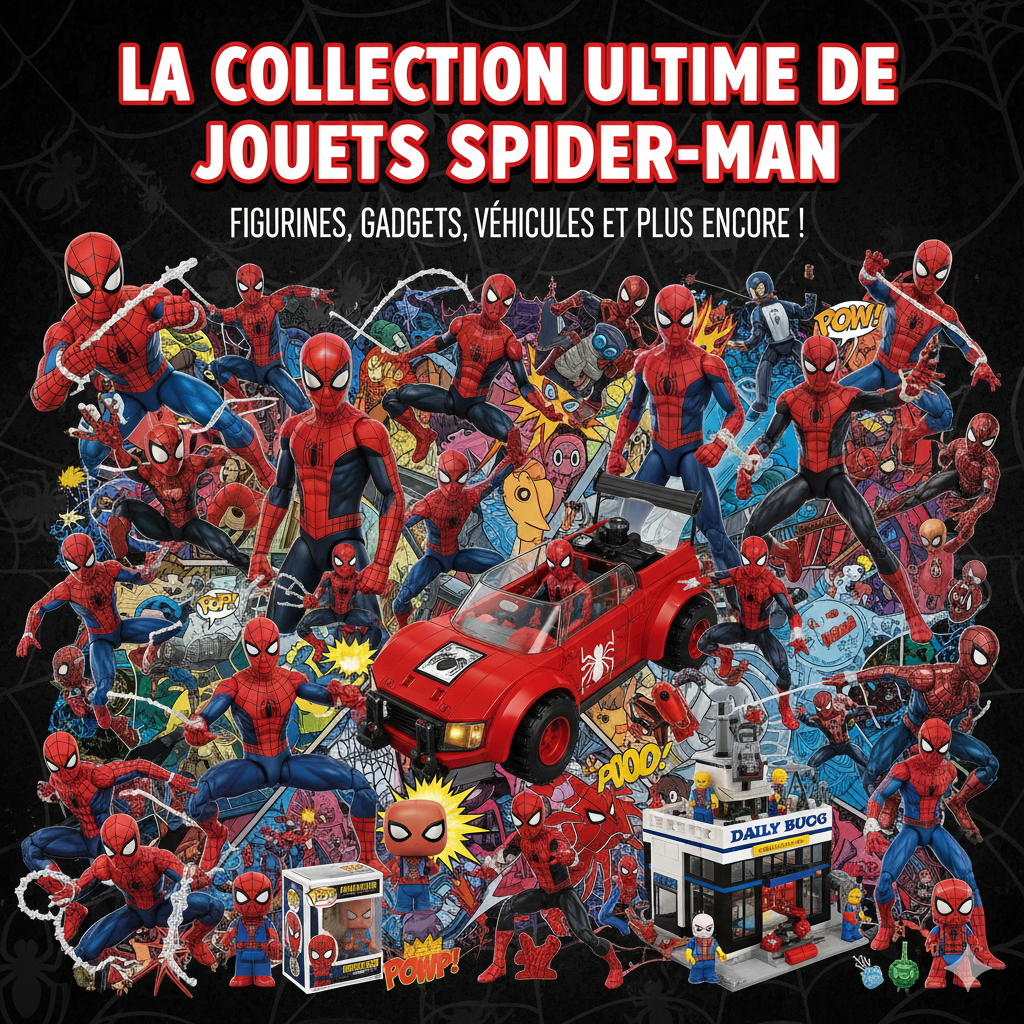
The essentials before you choose
Three markers guide the purchase: the age range you have in mind, the type of play you are after (sensory handling, narrative role-play or technical construction) and how robust the object is. Every stage, from toddlers to the oldest children, calls for very different toys. We run through the criteria below.
Contents
Why choose a Spider-Man toy suited to the child's age?Spider-Man toys for toddlers (2 to 4 years)Spider-Man toys for children aged 5 to 7: imagination and first storylinesSpider-Man toys for 8 to 10 year olds: missions, technology and constructionSpider-Man toys for 11 to 13 and over: collecting, symbols and lasting passion
Why choose a Spider-Man toy suited to the child's age?
In the teeming world of Marvel merchandise, Spider-Man holds a place of his own. Present from the earliest age through cartoons, toys, films and figures, he often stays with children for several years. But not every Spider-Man toy suits every age.
A badly chosen toy quickly becomes frustrating, or simply never gets used. A toy matched to the child's age, on the other hand, fires the imagination, develops motor skills and strengthens the bond with the hero's world. This guide was therefore designed as a genuine reference point for parents, drawing on how a child develops and on the different facets of the web-slinger's universe, set out in detail on our pillar page devoted to Spider-Man merchandise.
From sensory toys to complex LEGO builds, by way of figures and interactive accessories, each age range corresponds to a different way of living Spider-Man. Let's explore them one by one.
Imagination
A toy matched to the child's age fires the imagination.
Motor skills
It develops the child's motor skills.
Attachment
It strengthens the bond with the hero's world, where a badly chosen toy only frustrates.
Spider-Man toys for toddlers (2 to 4 years)
Between 2 and 4, a child discovers the world through touch, movement and repetition. At this age, Spider-Man is above all a reassuring visual figure, taken from the animated series made for the youngest viewers. Toys therefore need to be simple, sturdy and safe.
Sensory or stress-relief toys are a perfect fit. For example, a pop-up Spider-Man stress toy lets the child handle it, squeeze it and repeat simple gestures while making the hero's world their own.
Gentle interactive toys, such as a Spider-Man bouncy ball, are also ideal for developing hand-eye coordination and encouraging movement without needless complexity.
At this age, stick to standalone toys with no complex storyline. Spider-Man becomes a familiar presence, a playmate more than a narrative character. It is the first step before fully entering the web-slinger's adventures, told in more detail in the story of Peter Parker.
To find every toy suited to this age range, you can go straight to our collection devoted to Spider-Man toys, designed to accompany children from their very first discoveries.
Stress-relief toys
A pop-up is handled, squeezed and repeats simple gestures.
Bouncy ball
It develops hand-eye coordination and encourages movement.
Standalone toys
With no complex storyline, Spider-Man becomes a familiar playmate.
Spider-Man toys for children aged 5 to 7: imagination and first storylines
Between 5 and 7, a child steps fully into symbolic play. Spider-Man is no longer just a recognisable character: he becomes a hero to embody, to speak for, to move around, to place in imaginary situations. This is the age when the first rescue, chase and fight scenarios take shape.
This is where articulated figures come into their own as a perfect way in. A Spider-Man toy figure lets the child recreate favourite scenes from the films or cartoons while developing their own storytelling. To enrich the experience, some variants such as the Spider-Man figure in the Infinity War suit introduce the first notions of the multiverse and of alternative versions of the hero.
At this age, play also extends into space and movement. Mobile toys, such as a Spider-Man toy with a motorbike, let children stage real chases and anchor Spider-Man in a dynamic urban world, faithful to the one explored in the Spider-Man films.


Interactive toys also start to play a key role. A Spider-Man walkie-talkie turns play into a shared adventure: the child communicates, organises missions, coordinates actions. Solitary play gives way to cooperative play, ideal for developing communication and a shared imagination.
This is also often the age when a child discovers the first villains. A Venom figure introduces the idea of rivalry, moral choices and confrontation while staying accessible and fun. These first clashes lay the groundwork for the great rivalries of the Spider-Man universe, explained in more detail on our pillar page devoted to Spider-Man's enemies.
For this age range, the aim is not complexity but freedom to create. Spider-Man becomes a tool for expression, a hero the child adapts to their own world while staying connected to the rich, coherent universe of the web-slinger.
Articulated figures
Recreate favourite scenes from the films or cartoons and develop your own storytelling.
Mobile toys
A Spider-Man motorbike lets children stage real chases.
Walkie-talkie
Play becomes a shared, cooperative adventure.
Venom figure
It introduces rivalry, moral choices and confrontation.
Spider-Man toys for 8 to 10 year olds: missions, technology and construction
Between 8 and 10, a child shifts up a gear. Play becomes more structured, more 'logical', sometimes even strategic. Spider-Man is no longer just a hero you run along the sofa: he is a universe you organise, you stage, and above all one you make evolve with more technical toys.
This is the perfect age to introduce objects that look like 'real hero kit': technology, accessories, vehicles. A Spider-Man helicopter toy or a remote-controlled Spider-Man drone tips the child into a 'mission' mindset: reconnaissance, rescue, intervention. Free play gives way to a built adventure, close to the mood of the modern adaptations where Spider-Man sometimes has to deal with threats bigger than himself.
This step up in play is also a natural gateway to the great stories of the multiverse and of responsibility, two central themes in the story of Peter Parker and in the multiversal events gathered on the Spider-Verse page.

The LEGO moment: building Spider-Man's world
From the age of 8, many children latch on to another kind of pleasure: building. You no longer just play 'with' Spider-Man: you make his sets, his places, his world. And on that ground, LEGO is almost a rite of passage.
The LEGO Spider-Man – Daily Bugle is exactly the kind of set that turns simple play into a complete experience. The Daily Bugle is a cornerstone of the mythology: the place where Peter Parker faces J. Jonah Jameson, where Spider-Man's image is torn down or rebuilt, where rumours become weapons. If you want to put that location back in context, your article on The Daily Bugle makes a perfect narrative bridge.

In the same vein, the LEGO Spider-Man Mask works differently: it does not tell a scene, it celebrates a symbol. It is the kind of build that strengthens attachment to the character and his iconography, as you also explain in your content on the importance of the suit and of identity.
Why this age range 'unlocks' the transactional
It is often between 8 and 10 that purchases become more intentional: the child states a preference ('I want that version', 'I want Venom', 'I want a gadget that flies'). It is also the moment when families move towards more structured gift buying, which makes collections such as LEGO Spider-Man and Spider-Man Toys particularly strong on conversion.
And above all, this age range loves to collect: figures, accessories, builds. It is no longer 'a toy', it is 'a universe'. Exactly the point where Spider-Man becomes a licence you live with every day, beyond the films and the comics.
Helicopter or drone
They tip the child into a mission mindset: reconnaissance, rescue, intervention.
LEGO Daily Bugle
A set that turns simple play into a complete experience.
LEGO Mask
A build that celebrates a symbol rather than a scene.
Spider-Man toys for 11 to 13 and over: collecting, symbols and lasting passion
From 11–13 onwards, the relationship with Spider-Man changes again. Pure play gradually gives way to collecting, to emotional attachment and to the universe as a whole. Spider-Man is no longer only an action hero: he becomes a symbol, a figure to identify with, sometimes a lasting passion that outlives childhood.
At this age, figures take on particular importance. A Spider-Man Venom figure or a Spider-Man Infinity War suit figure no longer serve only for play: they embody a precise story arc, a version of the hero, a defining era of his life. To go further into this diversity of versions, our Spider-Verse pillar page gives perfect context.

This age range is also the one that starts to appreciate the nuances: Peter Parker's moral dilemmas, his failures, his sacrifices. Themes we already develop in The story of Peter Parker, and which explain why Spider-Man remains, for many, the most human hero in Marvel.
When a toy becomes an object of identity
Among pre-teens and teenagers, some objects go well beyond the idea of a toy. A LEGO set on display, a figure on a desk, even a decorative object becomes a marker of identity. You display Spider-Man because he stands for values: responsibility, courage, resilience.

This is also the age when worlds cross over: films, video games, comics. Children who grew up with Into the Spider-Verse or Across the Spider-Verse develop a deeper, more mature attachment and look for objects that extend that experience into daily life. Hence the growing interest in complete collections such as Spider-Man figures or LEGO products with strong symbolic value.
Spider-Man gift ideas by age: how never to get it wrong
If you are looking for a genuinely relevant Spider-Man gift idea, age remains the best starting point:
3–5 years
simple toys, balls, sturdy figures → reassuring and fun.
6–7 years
articulated figures, motorbikes, walkie-talkies → narrative play.
8–10 years
drones, helicopters, LEGO → missions and building.
11 and over
collector figures, iconic LEGO sets → collecting and identity.
This age logic is exactly the one you apply in your Spider-Man Toys and Spider-Man Gift Ideas selections, which makes your shop especially coherent and reassuring for parents and relatives alike.
Conclusion: supporting the child… and the fan, at every age
Choosing a Spider-Man toy according to a child's age is not only a question of safety or complexity. It is a way of supporting an evolution: from play to passion, then to lasting attachment to a universe.
Spider-Man has that unique ability to grow up with his audience. And thanks to a well-considered selection – from the first toy to the iconic figure – it is possible to keep that passion alive at every stage. That is precisely what makes Spider-Man one of the most powerful licences in the world… and what makes every Spider-Man gift so memorable.

